
A successful corporate training workshop requires clear objectives, the right venue, structured content, skilled facilitation, and measurable outcomes. Businesses achieve higher engagement and knowledge retention when training aligns with team growth goals and uses professional training environments designed for learning efficiency.
What are the key objectives of a corporate training workshop?
Corporate training workshops aim to improve employee performance, close skill gaps, and support business growth through structured learning outcomes. Effective workshops define measurable objectives, such as increasing productivity by 15%, improving compliance accuracy, or strengthening leadership capabilities within defined timelines.
Clear objectives anchor every decision in the planning process. Teams perform better when training goals align with business metrics such as revenue growth, operational efficiency, or customer satisfaction scores.
Define objectives using measurable indicators. For example, set targets like reducing onboarding time from 14 days to 10 days or improving customer response accuracy by 20%. These benchmarks allow businesses to validate training impact.
Segment objectives by team function. Sales teams focus on conversion optimisation, while HR teams improve compliance accuracy. This alignment ensures training remains relevant and actionable. When objectives are documented and communicated before the workshop, participants engage with clarity and purpose.
How do you identify training needs for a growing team?
Training needs are identified by analysing performance data, conducting skill gap assessments, and aligning workforce capabilities with business expansion plans. Organisations that use structured evaluation methods achieve up to 24% higher training effectiveness compared to teams relying on informal feedback.
Start with performance metrics. Review KPIs such as sales conversion rates, error rates, or project delivery timelines. These figures highlight operational weaknesses. Conduct structured assessments. Use three evaluation methods: employee surveys, manager evaluations, and skills testing. Each method provides a different layer of insight.
Analyse growth requirements. If a company expands into new markets, teams require training in compliance frameworks, communication standards, and operational processes specific to those regions. Map current capabilities against future needs. This gap analysis defines precise training topics instead of broad, ineffective sessions.
Why does choosing the right training environment matter?
The training environment directly impacts knowledge retention, engagement levels, and participant focus. Research shows that professional training spaces increase retention rates by up to 30% compared to informal office settings due to fewer distractions and optimised learning infrastructure.
Physical space shapes learning behaviour. Poor lighting, noise, and cramped seating reduce concentration and engagement. Professional venues provide structured layouts designed for learning. These include ergonomic seating, advanced presentation systems, and controlled acoustics.
Technology integration improves delivery. Features such as high-resolution displays, fast internet connectivity, and collaborative tools support interactive training methods. Businesses that use dedicated training rooms experience better outcomes because the environment signals purpose and professionalism. You can explore Comparing In-House Training vs External Professional Training Room Rental Solutions Today.
What elements make a corporate training workshop effective?
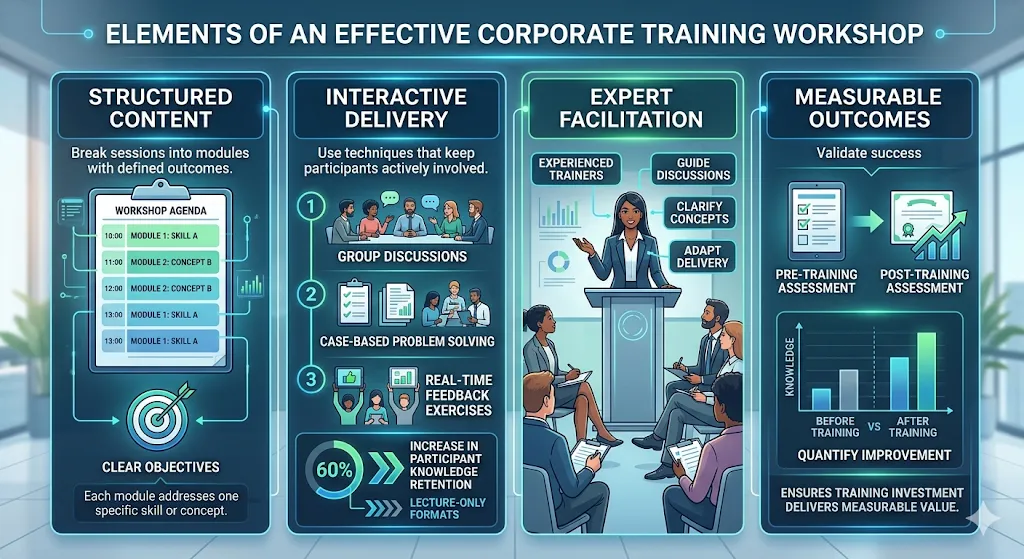
An effective corporate training workshop combines structured content, interactive delivery, expert facilitation, and measurable outcomes. Workshops that integrate these four components consistently deliver higher engagement, with studies showing a 60% increase in participant knowledge retention compared to lecture-only formats.
Content structure determines clarity. Break sessions into modules with defined outcomes. Each module addresses one specific skill or concept. Interactive delivery drives engagement. Use three techniques: group discussions, case-based problem solving, and real-time feedback exercises. These methods keep participants actively involved.
Facilitators influence learning outcomes. Experienced trainers guide discussions, clarify concepts, and adapt delivery based on participant responses. Measurement validates success. Use pre-training and post-training assessments to quantify improvement. This approach ensures training investment delivers measurable value.
How should you structure the workshop agenda?
A structured workshop agenda ensures time efficiency, maintains participant engagement, and aligns learning outcomes with business goals. Effective agendas divide sessions into focused segments, typically 45–90 minutes, with scheduled breaks to optimise attention and retention levels.
Start with a clear timeline. Allocate time slots for each session, including introductions, core training modules, and review sessions. Balance theory and practice. Alternate between instructional segments and practical exercises. This structure reinforces learning through application.
Include scheduled breaks. Research indicates that attention spans decline after 90 minutes. Breaks reset focus and improve retention. End with evaluation. Dedicate time for feedback and assessments. This step captures insights and validates training effectiveness.
When comparing delivery formats, businesses often evaluate internal options versus external solutions. This comparison is explored in detail here: comparing in-house training vs external professional training room rental solutions today.
What role does facilitation play in training success?
Facilitation determines how effectively content is delivered and understood. Skilled facilitators improve engagement, adapt to participant needs, and ensure learning objectives are achieved, resulting in up to 35% higher knowledge retention compared to unstructured delivery methods.
Facilitators guide the learning process. They translate complex ideas into clear, actionable insights. Adaptability is critical. When participants struggle with a concept, facilitators adjust explanations or introduce examples that clarify understanding.
Engagement techniques maintain attention. Facilitators use questioning, group interaction, and feedback loops to keep sessions dynamic. Professional facilitators also manage time effectively. They ensure each segment stays aligned with the agenda while maintaining flexibility.
How do you measure the success of a corporate training workshop?
Training success is measured using performance metrics, participant feedback, and behavioural changes observed after the workshop. Organisations that implement structured evaluation frameworks report 25% higher return on training investment compared to those without measurement systems.
Use quantitative metrics. Compare pre-training and post-training performance data such as productivity rates or error reductions. Collect structured feedback. Use surveys with rating scales and open-ended questions to capture participant insights.
Track behavioural changes. Observe how employees apply new skills in real work scenarios over a defined period. Evaluate long-term impact. Measure outcomes after 30, 60, and 90 days to assess sustained improvement. This multi-layered evaluation approach ensures that training delivers measurable business value.
Explore our Training Rooms guides,
Why Your Small Business Needs a Professional Space for Staff Development Sessions
Understanding the Impact of Classroom Design on Effective Adult Learning and Retention
When should businesses use external training rooms instead of in-house spaces?
Businesses use external training rooms when they require professional environments, scalable capacity, and advanced facilities that internal offices lack. External venues improve focus, reduce workplace distractions, and support structured learning, making them ideal for high-impact corporate training sessions.
Office environments often introduce interruptions. Daily operations, meetings, and noise disrupt training flow. External venues provide controlled environments. Participants focus solely on learning without workplace distractions.
Scalability matters for growing teams. External spaces accommodate varying group sizes without compromising comfort or functionality. Advanced infrastructure supports better delivery. Features such as integrated AV systems and collaborative tools enhance training quality.
For organisations planning immediate sessions, booking a professional venue simplifies logistics. You can review options and order your training room booking online today for professional staff training sessions.
Planning a successful corporate training workshop requires structured objectives, accurate needs analysis, effective facilitation, and a professional environment. Each element contributes directly to measurable improvements in employee performance and business outcomes.
From My Company provides purpose-built training rooms designed to support focused learning, advanced delivery methods, and scalable team development. Businesses that invest in structured planning and professional environments consistently achieve stronger training outcomes and long-term workforce growth.
Frequently Asked Questions
What are training rooms used for in corporate settings?
Training rooms are designed for structured learning activities such as employee onboarding, compliance sessions, and skill development workshops. From My Company provides training rooms equipped with presentation tools and layouts that support focused, distraction-free corporate training.
What features should a professional training room include?
A professional training room includes ergonomic seating, high-quality AV equipment, fast internet connectivity, and flexible layouts for group activities. Training rooms offered by From My Company are configured to support interactive sessions and efficient knowledge delivery.
How do training rooms improve employee learning outcomes?
Training rooms improve learning outcomes by providing a controlled environment that reduces distractions and supports engagement. Studies show structured spaces increase retention rates, and From My Company training rooms are designed to enhance focus and participation.
When should a business rent external training rooms instead of using office space?
Businesses rent external training rooms when internal spaces lack capacity, privacy, or technical infrastructure. From My Company’s training rooms offer scalable solutions that accommodate growing teams and specialised training requirements.
How do you choose the right training room for your team size?
The right training room depends on participant numbers, session format, and equipment needs. From My Company provides training rooms in multiple configurations, allowing businesses to match room size and layout with their specific training objectives.