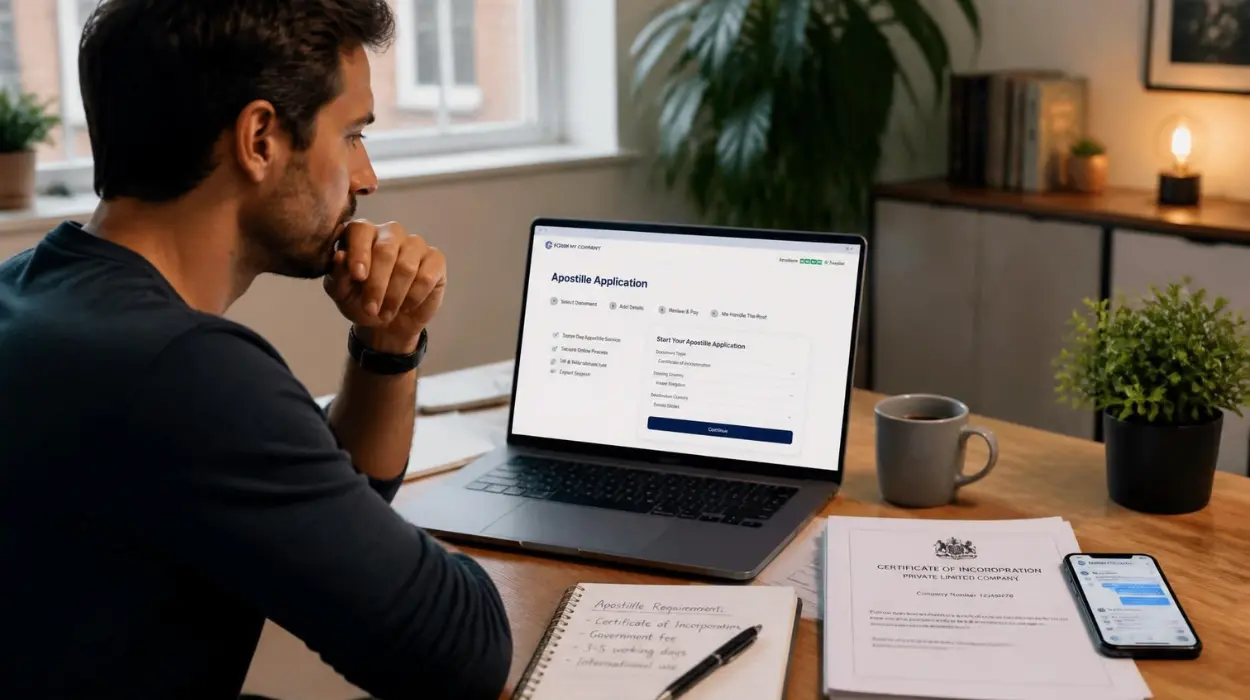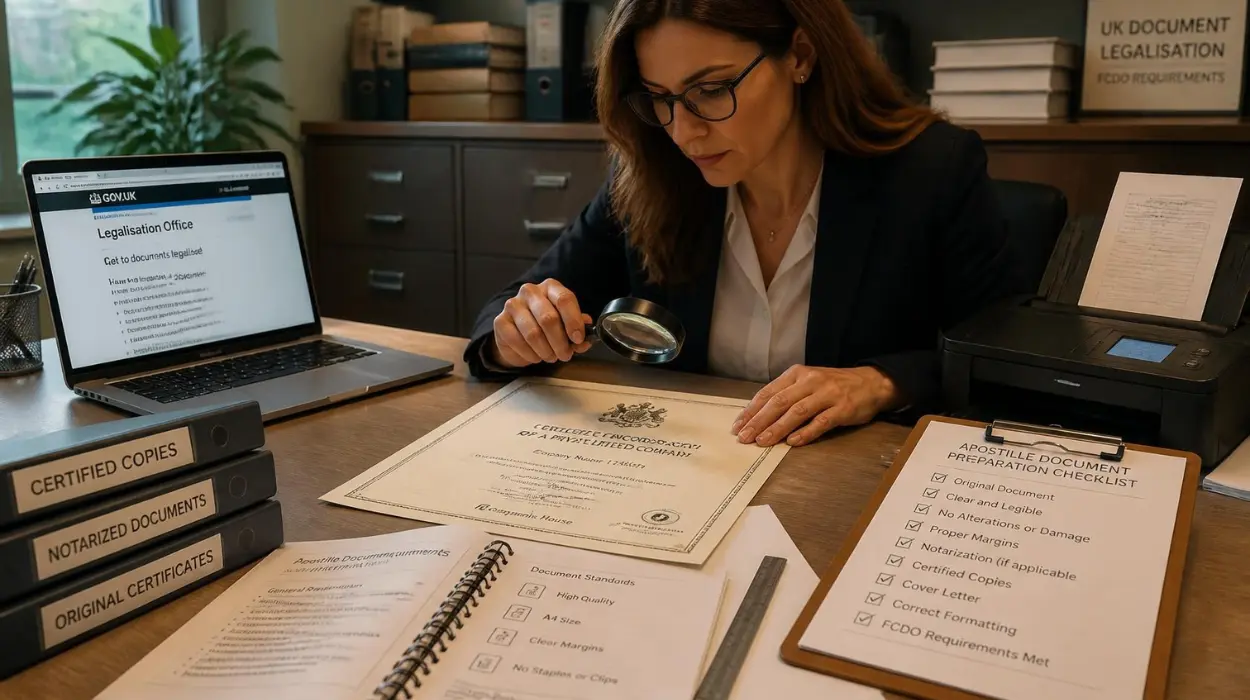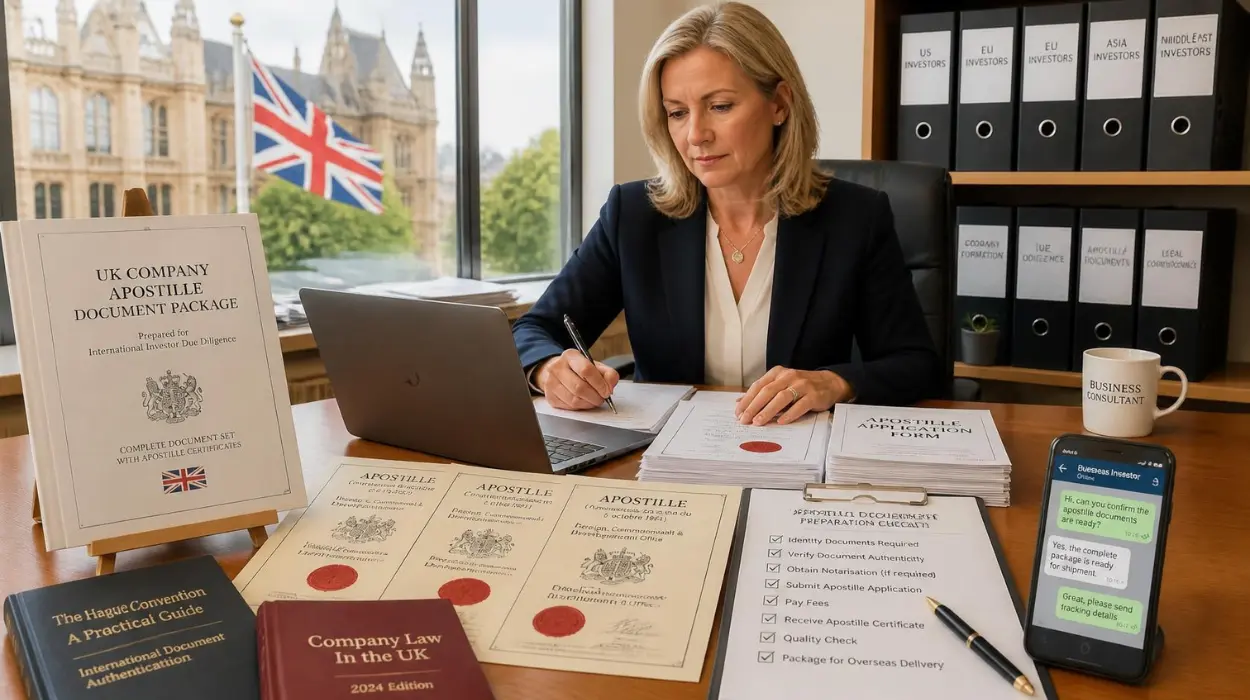
Providing apostilled documents that satisfy overseas investors requires official authentication under the 1961 Hague Convention, validating company incorporation certificates, memoranda of association, and director resolutions through the UK Foreign, Commonwealth & Development Office so foreign entities recognize their legal validity.
How Do Overseas Investors Verify UK Company Documents?
Overseas investors verify UK company documents by inspecting stamps, digital authentication codes, and official signatures issued by the Foreign, Commonwealth & Development Office through the international apostille certification process.
Foreign financiers evaluate corporate paperwork before transferring capital across international borders. They examine certificates of incorporation, registers of directors, and annual accounts to confirm corporate existence. When documents originate in the United Kingdom, foreign entities require formal confirmation that signatures and seals match official government records.
The verification workflow involves presenting physical or electronic certificates to competent UK authorities. These bodies inspect registrar stamps and cross-reference them with Companies House databases. Once authorities confirm authenticity, they attach a standardized square certificate known as an apostille. This certificate removes the need for consular legalization across participating member states.
Investors demand this step because domestic company registries lack jurisdiction over foreign legal entities. Fraudulent business registrations cost international markets billions annually. Official validation provides absolute legal certainty. Financial stakeholders rely on authenticated records to mitigate compliance risks and protect cross-border investments.
What Types of Company Documents Must Be Apostilled?
Companies must apostillate foundational constitutional documents, including certificates of incorporation, memorandum of association, articles of association, and official board resolutions authorizing international share issuances.
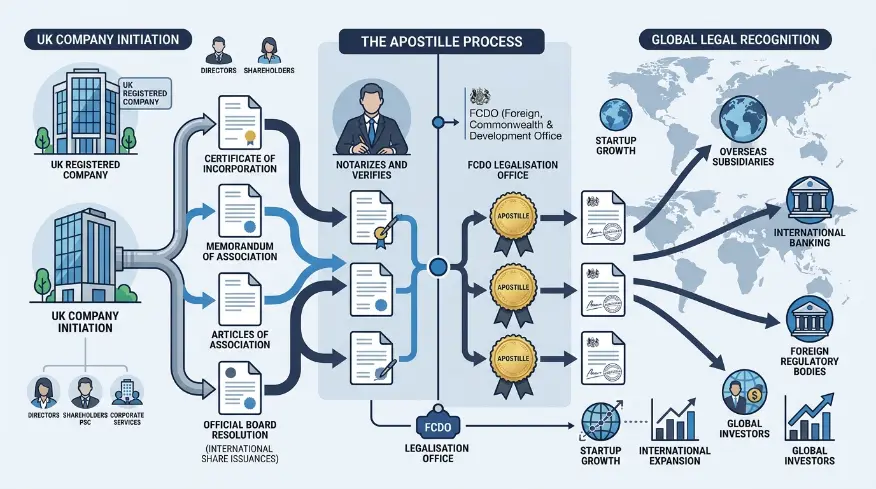
Corporate structuring requires specific documentation to establish legal ownership and operational authority. Investors scrutinize foundational paperwork before releasing funds into corporate bank accounts. Each document serves a distinct purpose during international due diligence reviews.
Key corporate documents require precise authentication steps:
| Document Type | Purpose in Investment | Verification Requirement |
| Certificate of Incorporation | Proves legal existence of the UK corporate entity | Official registrar signature and seal |
| Memorandum & Articles of Association | Outlines internal governance and share structures | Notarization followed by FCDO apostille |
| Board Resolutions | Authorizes share allotments and executive powers | Certified by a practicing UK notary public |
| Registers of Directors & PSCs | Identifies ultimate beneficial owners and controllers | Current Companies House filing extraction |
Foreign stakeholders examine these structured records to assess corporate governance standards. Missing or unverified paperwork delays funding rounds by weeks. Executing proper authentication protocols protects transactions against regulatory challenges in target markets.
Why Do International Lenders Require Apostilled Paperwork?
International lenders require apostilled paperwork because foreign legal systems mandate verified proof of corporate identity, authorized signatories, and financial standing before enforcing cross-border commercial agreements.
Global financing agreements involve complex multi-jurisdictional compliance frameworks. When a UK registered business secures capital from overseas venture funds or institutional lenders, legal teams review every corporate filing. Foreign courts will not enforce loan agreements or equity purchases backed by unverified foreign paperwork.
Local regulatory bodies enforce strict anti-money laundering legislation across global financial centers. Compliance officers must trace capital investments to legitimate corporate structures. Apostilled documents satisfy statutory know-your-customer mandates by establishing verifiable chains of custody.
Commercial disputes require clear jurisdictional authority. If a contract breaches terms, international courts rely on apostilled corporate resolutions to determine liability. Providing verified documents eliminates judicial resistance, accelerating legal recourse during cross-border commercial disagreements.
How Can Businesses Prepare Documents for Fast Apostille Processing?
Businesses prepare documents for fast apostille processing by obtaining certified copies from Companies House, engaging practicing UK notaries, and submitting applications directly to the Foreign, Commonwealth & Development Office.
Speed matters during active funding rounds. Delays in paperwork processing jeopardize venture capital agreements and international expansion timelines. Companies streamline validation workflows by following strict procedural steps before submission.
Essential preparation actions include:
Order certified historical company extracts directly from the Companies House portal
Engage a registered UK notary public to witness director signatures on resolutions
Submit paper or electronic document batches through authorized government channels
Select standard or premium processing speeds based on investment deadlines
Failing to verify document formatting before submission causes immediate rejection by government examiners. Business administrators must confirm that all registrar stamps remain legible. Utilizing professional apostilled documents management platforms eliminates administrative errors and reduces turnaround times.
What Common Mistakes Delay International Document Verification?
Common mistakes delay international document verification because submitters rely on uncertified photocopies, miss notary witnessing steps, or submit damaged certificates that fail government inspection standards.
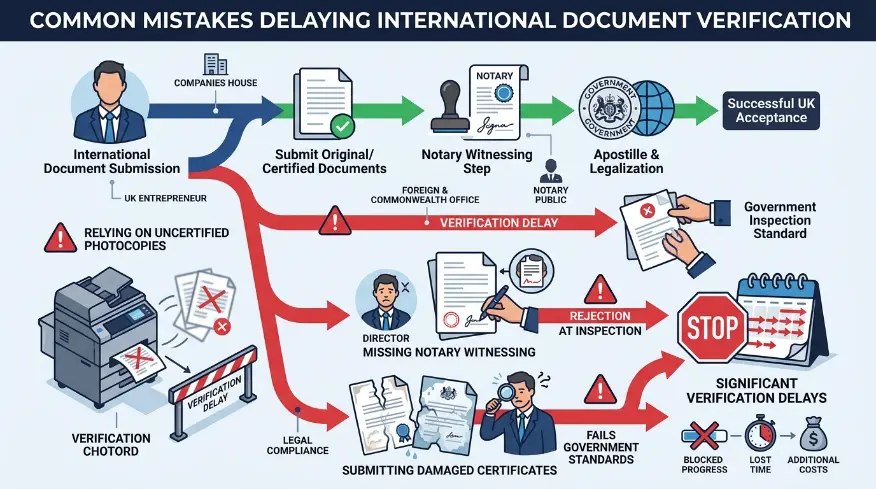
Administrative oversights frequently halt international expansion projects. Government agencies reject submissions instantly when paperwork lacks required official signatures or seal impressions. Understanding these pitfalls protects corporate timelines.
Submitting uncertified registry printouts creates immediate compliance blocks. Foreign investors reject homemade document copies immediately. Every page submitted for international use requires official government or notary validation.
Document degradation also causes rejection. Faded stamps, torn certificates, or illegible registrar watermarks fail electronic and manual scanning checks. Business owners must request fresh certified duplicates from official UK registries before initiating the apostille process. Utilizing insights from Why Do Overseas Investors Ask for Apostilled Company Documents? helps founders anticipate compliance hurdles before closing funding rounds.
How Do Professional Services Streamline Investor Compliance?
Professional services streamline investor compliance by managing end-to-end document notarization, coordinating government apostille submissions, and delivering verified corporate files directly to international stakeholders.
Navigating multi-step verification processes consumes valuable executive time during critical growth phases. Specialized corporate service providers manage administrative burdens, ensuring total compliance with international legal standards. Form My Company coordinates every verification stage, from initial registry retrieval to final overseas delivery.
Executing complex cross-border transactions requires absolute precision. Form My Company assists entrepreneurs through structured frameworks, ensuring every constitutional filing meets global investor demands. Exploring Want to Order Investor-Ready Apostilled Documents From Form My Company? provides immediate access to professional document authentication solutions tailored for global expansion.
Explore our Apostilled Documents guide,
How to Choose a Well-Connected Conference Venue?
How to schedule back-to-back interviews across multiple rooms?
Frequently Asked Questions
How long does it take to get an apostilled document for a UK company?
Standard apostille processing through the UK Foreign, Commonwealth & Development Office typically takes between 3 to 5 working days once documents are received. Form My Company accelerates this workflow by handling notary certification and government submissions concurrently to minimize international funding delays.
Do overseas investors require original certificates or certified copies for apostilles?
Overseas investors and regulatory authorities strictly require certified copies or original extracts issued directly by Companies House rather than standard photocopies. Form My Company obtains official registry duplicates and authenticates them to satisfy international due diligence standards.
Can digital documents be apostilled for foreign business transactions?
Electronic documents can receive an e-Apostille if they bear a valid UK government or public official digital signature recognized by the Foreign, Commonwealth & Development Office. Form My Company reviews digital files to ensure compatibility with international electronic verification systems before submission.
What is the difference between notarization and apostille certification?
Notarization involves a practicing notary public witnessing and validating corporate signatures, whereas an apostille is a government-issued certificate validating the notary or registrar seal under the Hague Convention. Form My Company coordinates both sequential steps to ensure total legal compliance for cross-border investments.
Why do foreign banks ask for apostilled UK company incorporation documents?
Learn how to provide apostilled UK company documents that satisfy overseas investors, streamline compliance, and accelerate global funding rounds.