
What if the company you first spot in an ownership chain isn’t the one you should record? Knowing How to Record a Relevant Legal Entity on Your PSC Register starts with checking which entity meets the rules, not simply copying the nearest corporate name. Recording the wrong entity can leave your company’s control information incomplete.
It’s understandable to feel unsure. An entity must meet a significant-control condition and be both relevant and registrable before it can be entered as an RLE. If a chain includes several entities, the registrable RLE is generally the first qualifying one. Since 18 November 2025, companies no longer keep a separate local PSC register. They report PSC information directly to Companies House.
This guide sets out a practical process: assess the control conditions, trace the ownership chain, identify the entity to record and verify the required particulars. You’ll also learn what to report to Companies House and when, including the 14-day deadline for reporting a confirmed change. Use these steps to keep your company’s PSC information accurate and organised.
Key Takeaways
- How to Record a Relevant Legal Entity on Your PSC Register starts with checking both significant control and whether the entity is relevant and registrable.
- Trace the ownership chain to identify the first qualifying RLE, rather than assuming every corporate shareholder should be recorded.
- Check the required particulars carefully, including the entity’s name, address, legal form, governing law and registration details.
- Since 18 November 2025, PSC information is reported directly to Companies House rather than kept in a separate local PSC register.
- Report confirmed changes to Companies House within 14 days, and keep supporting details and dates organised.
Before recording an RLE, identify what your PSC register needs to show
Use a clear sequence: identify a potentially registrable relevant legal entity (RLE), assess whether it qualifies, gather the required particulars and report the information to Companies House. Don’t copy a corporate shareholder’s details into your company records before checking its status and position. The PSC information must show who has significant control and the basis for that control, so establish whether the entity meets the relevant tests first.
Since 18 November 2025, companies have not had to maintain a separate local PSC register. They file PSC information directly with Companies House, which holds the central record. “PSC register” remains a common term for this information and its administration. For a practical overview, consult the PSC register guidance.
What makes a company’s PSC register relevant to an RLE?
The PSC record identifies people or qualifying legal entities that have significant control over a company. This guide focuses on corporate entities in an ownership or control structure, rather than the wider process of identifying every possible PSC. A corporate body isn’t automatically registrable just because it owns shares or appears in the ownership chain. Check its status and position before deciding what to report.
Keep the RLE definition separate from the recording decision
An RLE is a legal entity that would meet a PSC condition if it were an individual, and that is subject to its own disclosure requirements. A registrable RLE also qualifies to be entered for this particular company, including by being the first qualifying RLE in the ownership chain. Being an RLE does not, by itself, mean the entity should be recorded.
Before preparing an entry, work through these questions:
- Is there significant control? Assess whether the entity meets at least one statutory condition.
- Is it relevant? Check whether it is subject to a qualifying disclosure or transparency regime.
- Is it registrable here? Trace the chain to identify whether it is the first RLE that meets the requirements.
This avoids a common mistake: treating every corporate shareholder as the correct entry, even when another entity in the chain is registrable. Separate the decision from the data-entry task. First document why the entity qualifies and is registrable for your company. Then gather its particulars and report them to Companies House.
Apply the statutory definitions, terminology and filing requirements when assessing the entity. These determine whether it belongs on the record and what information must be submitted. Next, test the control conditions and trace the ownership chain. Don’t rely on an entity’s name or its position as a direct shareholder alone.
Check the RLE conditions and ownership chain before entering an entity
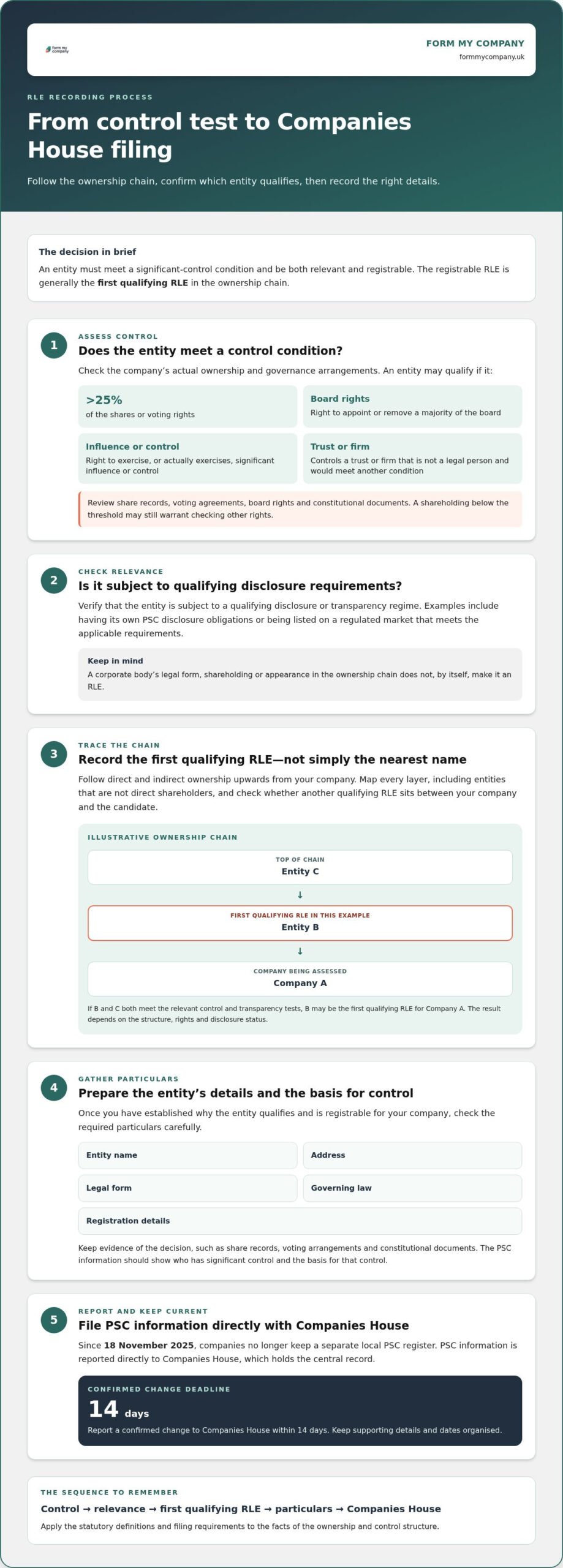
Use a three-step decision path before recording a corporate body: assess whether it meets a control condition, check whether it is a relevant entity, then trace the chain to identify which entity is registrable for your company. Keep a note of the evidence you relied on, such as share records, voting arrangements and constitutional documents. Your decision should reflect how control works in practice, not just the labels in a shareholder list.
1. Assess control. Check whether the entity holds more than 25% of the shares or voting rights, has the right to appoint or remove a majority of the board, or has the right to exercise or actually exercises significant influence or control over the company. Also consider whether it controls a trust or firm that is not a legal person and would meet one of the other conditions.
2. Check transparency status. Establish whether the entity is subject to a qualifying disclosure regime, such as having its own PSC disclosure obligations or being listed on a regulated market that meets the applicable requirements. A corporate body’s legal form alone doesn’t make it an RLE.
3. Trace the chain. Follow direct and indirect ownership upwards from your company. Identify whether another qualifying RLE sits between your company and the candidate. RLE status alone doesn’t determine whether the entity is registrable.
Does the entity meet a control condition?
Compare the entity’s rights with the company’s actual ownership and governance arrangements. A shareholding below the threshold may still make it important to check other rights, such as board appointment powers or significant influence. Review voting agreements and other arrangements alongside share records. Apply the statutory wording and thresholds to the facts, rather than relying on a general description of the entity’s role.
Is it a relevant entity that should be recorded here?
Next, verify that the candidate is subject to the kind of transparency requirements recognised by the PSC rules. Then map every ownership layer, including entities that don’t appear as direct shareholders. The registrable entity is generally the first qualifying RLE in the chain, not necessarily the ultimate parent or the company immediately above yours.
For example, imagine Company A is owned by Entity B, which is in turn owned by Entity C. If B and C both meet the relevant control and transparency tests, B may be the first qualifying RLE in the chain for Company A. This is an illustration, not a conclusion for every structure. If B doesn’t qualify, or the rights and disclosure status differ, the result may change. Check each entity in sequence and record why you selected the one you did.
For How to Record a Relevant Legal Entity on Your PSC Register, classification comes before data entry. Apply the statutory tests, recognised transparency regimes and filing rules to the facts of your company’s structure. If you’re organising wider PSC administration, the PSC Register service can help keep company records in order.
Record the RLE’s particulars accurately in the PSC register
Once you’ve identified the registrable RLE, prepare its entry from reliable records, not memory or an old filing. Since 18 November 2025, companies have reported PSC information directly to Companies House instead of maintaining a separate local PSC register. The particulars below cover the information to gather. Compare them with current Companies House guidance and statutory rules before filing, especially if the entity’s legal form or registration arrangements are unusual.
Which RLE details belong in the entry?
Gather each prescribed particular and check how it applies to the entity. Use its formal legal name, not a trading name, and describe its legal form and governing law precisely. Include the register on which it appears and its registration number where applicable. Record the date it became a registrable RLE and the nature of its control, identifying the condition or conditions it meets.
- Entity name: the RLE’s correct legal name.
- Office address: its registered office or, where relevant, principal office address.
- Legal form and governing law: the entity type and the law under which it is governed.
- Registration details: the register on which it appears and its registration number, where required.
- Registrable date: the date it became registrable in relation to your company.
- Nature of control: the applicable significant-control condition or conditions.
Don’t assume that every entity has a registration number in the same format. Confirm the required register reference and identifier for the entity under the current rules. If a field appears not to apply, check the prescribed approach rather than omitting it without explanation.
Check the entry against reliable company records
Verify the entity’s name, address and registration details against authoritative corporate records. Compare the stated control condition with your company’s share records, voting arrangements, board appointment rights and other relevant governance documents. Keep the evidence together so the entry can be checked against it later.
Before submitting, make sure the entity name, office address, legal form, governing law, register reference, registration number, registrable date and stated control condition match the supporting records and current requirements.
If information is missing or inconsistent, don’t guess or copy a detail from an outdated document. Establish what is accurate, note what remains unresolved and follow the applicable statutory and Companies House process for obtaining or reporting the information. The company’s PSC information should accurately reflect its position, including any prescribed status that applies while information is being confirmed.
Use this final check before entering or submitting the particulars:
- Confirm the entity’s current legal name and address.
- Check its legal form, governing law and applicable registration details.
- Make sure the registrable date and control condition are supported by records.
- Compare every field with the current Companies House requirements.
Accurate particulars make ongoing PSC administration easier to manage. For practical support with keeping PSC information organised, see the PSC Register service. Knowing How to Record a Relevant Legal Entity on Your PSC Register means getting both the classification and each reported detail right, then keeping the supporting information available for future updates.
Report the RLE to Companies House and keep the record current
Once you’ve confirmed the RLE’s status and particulars, separate your internal compliance notes from the official filing. Since 18 November 2025, companies have not been required to keep a separate local PSC register. PSC information is filed directly with Companies House, which maintains the central record. Keep an internal audit trail of your decision and evidence, but remember that it does not replace submitting the required information.
What should happen after the register entry is prepared?
Follow a clear sequence: confirm the facts, submit the relevant information to Companies House, then retain evidence of what was sent and when. Use the current Companies House filing service and follow its instructions for the applicable RLE update. The form or online route can depend on the filing task, so use the current process rather than an old form or saved procedure.
Companies must report a confirmed change to a PSC or RLE within 14 days. Note when the change was confirmed so you can track the reporting deadline. Save the submission confirmation, a copy of the information provided and any follow-up correspondence with your supporting records. If Companies House requests clarification or a filing needs correction, record who will act and by when.
Identity verification is a related but separate compliance task. Since 18 November 2025, PSCs and relevant officers of RLEs must have their identity verified. New PSCs added on or after that date must verify within 14 days of being added; existing PSCs have a transition period ending on 18 November 2026. Check the current requirements for the people involved and the applicable process for director or PSC identity verification.
What changes should trigger a review?
Don’t wait for an annual filing to notice a change that may affect PSC information. Review the record when the RLE’s ownership or voting rights change, its control rights are amended, its legal details change, or its transparency status is affected. Changes elsewhere in the ownership chain can also alter which entity is registrable, even if your company’s direct shareholder stays the same.
When a change comes to light, establish what happened and when the company confirmed it. Reassess the control condition, the entity’s relevant status and its position in the chain. The change may require an update or mean a different entity should be reported. Check the current rules for notices, corrections and timing before taking action, particularly where facts are disputed or incomplete.
A simple tracking log can help organise the process. Record the change identified, the date it was confirmed, the decision made, the evidence reviewed, the date submitted to Companies House and any follow-up needed. This makes How to Record a Relevant Legal Entity on Your PSC Register an ongoing compliance task, not just a one-off entry. Assign responsibility for checking updates and filing promptly, in line with your wider company records.
Avoid common RLE recording errors and choose your next step
Shortcuts can lead to the wrong entity being reported or important particulars being missed. Don’t assume every corporate shareholder is registrable. Don’t stop tracing ownership at the first company in the chain, and don’t copy details from an old filing without checking they’re still correct. The right entry depends on the entity’s status and relationship to your company.
Use a final quality-control checklist
Before submitting or updating PSC information, review the decision from start to finish. Confirm that the selected entity is the registrable RLE for this company, then compare each particular with current source records and statutory requirements. Keep a clear audit trail so someone else can understand what was decided, which evidence supported it and what action followed.
- Classification: Have you assessed the relevant control and transparency tests, then traced the ownership chain to select the correct entity?
- Particulars: Do the entity name, office address, legal form, governing law, registration details, registrable date and stated control condition match reliable records?
- Evidence: Have you kept the documents and notes supporting the classification and reported details?
- Reporting: Have you submitted the required information to Companies House using the current process?
- Dates: Have you recorded when the change was confirmed, when it was reported and when the information should next be reviewed?
Since 18 November 2025, companies report PSC information directly to Companies House rather than maintaining a separate local PSC register. Keep internal decision notes and supporting evidence organised, but don’t mistake them for the required Companies House submission. For wider recordkeeping, Form My Company’s PSC Register information is a relevant administrative resource.
Know when to get specialist help
Once the classification is clear, complete the checks, submit the required information and diarise dates for follow-up. For help keeping company administration organised, explore company administration support. A careful final review makes How to Record a Relevant Legal Entity on Your PSC Register manageable: verify the decision, check the details and keep a reliable record of what you did.
Make PSC accuracy part of your company routine
Understanding How to Record a Relevant Legal Entity on Your PSC Register gives you a clear process, but complex structures may call for advice tailored to your company’s circumstances. For day-to-day administration, Form My Company provides company formation and administrative services, including a dedicated PSC Register service to help keep company records organised.
For support with company administration, contact Form My Company.
Frequently Asked Questions
Can a company or other corporate body be recorded on a PSC register?
Yes. A company or other legal entity can be reported as an RLE if it meets the applicable control, relevance and registrability tests. Unlike an individual PSC entry, an RLE entry identifies the qualifying entity and its basis for control. Incorporation or share ownership alone isn’t enough. Check the statutory criteria and any rules or transitional arrangements in force in 2026.
What information must I record about a relevant legal entity?
Required particulars may include the entity’s legal name, registered or principal office, legal form, governing law, registration details, the date it became registrable and the nature of its control. Verify the current requirements before preparing a submission. Compare each field with reliable company records, such as official entity details and ownership documents, rather than relying on an old or incomplete template.
How do I decide which entity in an ownership chain to enter?
When must a company notify Companies House about an RLE?
For a confirmed change to a PSC or RLE, the company must update Companies House within 14 days of confirming the change. Use the current Companies House filing route and follow its instructions for the specific update, including any applicable transitional requirements. Keep the confirmation date and submission evidence together so you can show how the deadline was calculated and follow up if the filing needs attention.
What should I do if I cannot confirm an RLE’s details?
Does an RLE entry need to be updated when ownership changes?
It may. Assess whether the change affects the entity’s control, registrable status or any particulars already reported. A corporate change doesn’t automatically alter the PSC information. Since 18 November 2025, companies report PSC information directly to Companies House rather than keeping a separate local PSC register. Retain evidence of the change and follow the current correction process and reporting deadline before submitting an update.