
Choosing the right company type is just as important as getting the paperwork right. To register a limited company in the UK, prepare a company name, registered office address, director and shareholder details, and a SIC code. Companies House requires at least one natural-person director aged 16 or over, and the company needs articles of association.
The process of registering a limited company can feel like a tangle of forms and unfamiliar terms, especially when you’re deciding who owns the shares and how the company will be run. Start by comparing a private company with a public limited company: the right structure depends on how you plan to own, fund and grow the business.
This guide explains which details and documents to prepare, how shares and company types work, and the registration steps and costs to expect. You’ll also learn how to avoid common application problems and what happens after incorporation, so you can plan your next steps with confidence.
Key Takeaways
- A limited company can be set up by one person, and a private company can have one share. Decide how shares and voting rights should be divided before applying.
- Prepare the company name, registered office address, director and shareholder details, and SIC code before starting the application.
- Choose a physical UK registered office address, not a PO Box, and consider how using a home address affects privacy.
- Companies House requires a shareholder holding more than 25% of the shares to register as a Person with Significant Control.
- Compare private and public company structures against your plans for ownership and growth before choosing which type to form.
How many shares does a company need?
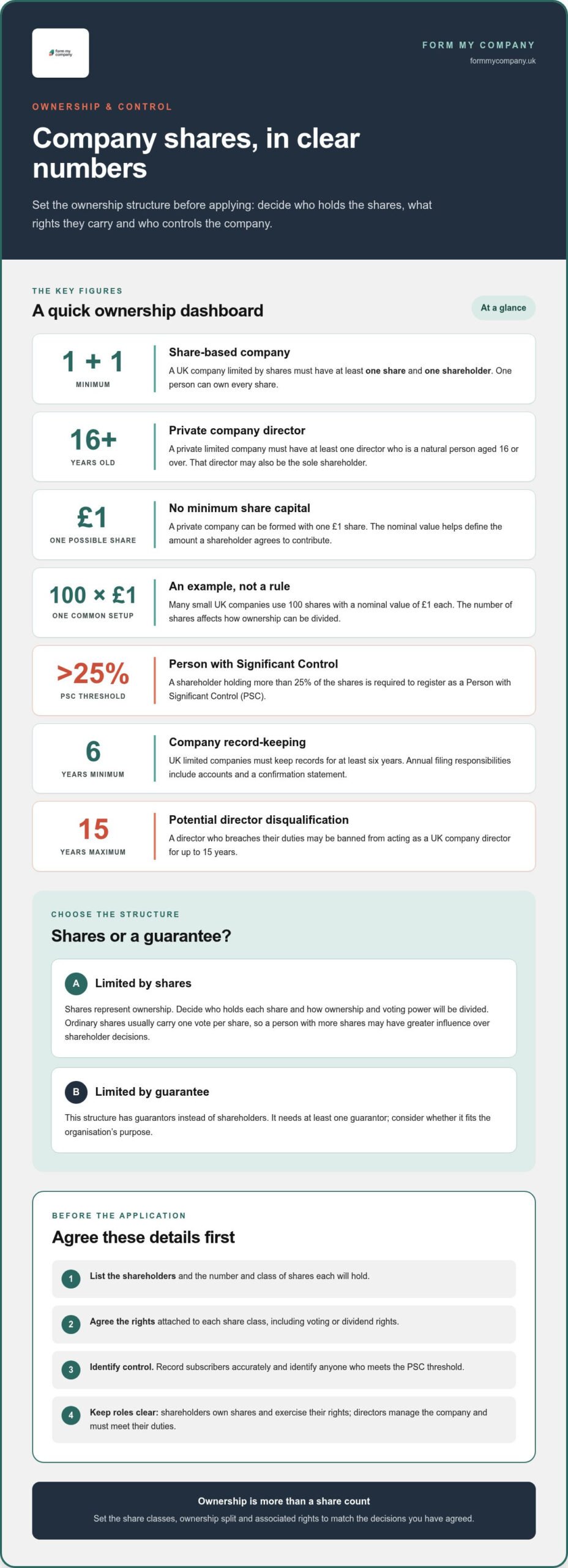
A UK company limited by shares must have at least one share and one shareholder. A company limited by guarantee instead needs at least one guarantor. Depending on the structure, one person can set up either type alone.
The main disadvantages are ongoing filing and record-keeping duties, plus the risk of personal consequences if a director breaches their duties. A director who breaches those duties may be banned from acting as a UK company director for up to 15 years.
- Choose the company structure and appoint directors. A private limited company must have at least one director who is a natural person aged 16 or over, according to Companies House. That director may also be the sole shareholder. A company limited by shares suits owners who want shares to represent their ownership. A company limited by guarantee has guarantors instead of shareholders, so consider whether that structure fits the organisation’s purpose.
- Decide who will own each share. List each shareholder and the number and class of shares they will hold. One person can own every share; with several shareholders, agree how ownership and voting power will be divided before applying. Ordinary shares usually carry one vote per share, so a person holding more shares may have greater influence over shareholder decisions.
- Set the share amount and rights. A private company can be formed with one £1 share, and there is no minimum share capital requirement. Many small UK companies use 100 shares with a nominal value of £1 each. Treat that as one possible arrangement, not a required template. The number of shares affects how ownership can be divided, while each share’s nominal value helps define the amount a shareholder agrees to contribute.
- Prepare the statement of capital and prescribed particulars. The statement of capital records the company’s shares and share capital. Include the share classes and the prescribed particulars describing the rights attached to each class, such as voting or dividend rights. The company’s memorandum and articles of association set out how it will be run. Make sure the proposed rights match the ownership decisions you have agreed, rather than relying on share numbers alone.
- Enter each subscriber and identify significant control. A subscriber is an initial shareholder named on the incorporation application. Each subscriber must have its own legal personality, and the company cannot subscribe to itself. Record the subscribers accurately, then identify who controls the company. According to Companies House, a shareholder holding more than 25% of the shares is required to register as a Person with Significant Control. Use the PSC register service where you need support with that record.
- Understand the responsibilities before submitting. Shareholders own shares and exercise the rights attached to them; directors manage the company and must meet their director duties. Keep the company’s records organised, since UK limited companies must keep records for at least six years. After incorporation, the company also has annual filing responsibilities, including accounts and a confirmation statement.
What do I need to register a limited company?
Use “Limited” or “LTD” at the end of the name; companies registered in Wales may use “Cyfyngedig” or “Cyf”. Choose a physical UK registered office address, not a PO Box. Corporation Tax and VAT obligations after registration depend on the company’s circumstances.
Choose a unique company name
Choose a company name that reflects the business and distinguishes it from existing registered names. Avoid names that are identical or too similar to another company’s name, as they can confuse customers, suppliers and shareholders. Check spelling, punctuation and word order, then use the same version throughout the application and company documents. If the name includes a sensitive word or expression, you’ll need to provide supporting documentation with the incorporation application.
Check company name availability
Search the Companies House register for the exact name and close variations before preparing the application. Check differences in spacing, punctuation and commonly substituted words, not just exact matches. A name that appears available must still meet registration rules, so a minor spelling change may not be enough to distinguish it. Once you choose a suitable name, use it consistently in the memorandum and articles of association and the incorporation details.
Review name and registered office rules
Make sure the name ending matches the company’s registration jurisdiction. Most UK limited companies use “Limited” or “LTD”, while a company registered in Wales may use “Cyfyngedig” or “Cyf”. The registered office must be a physical UK address, not a PO Box. Companies House publishes home addresses used as a registered office or a director’s service address on its website.
Before submitting the formation application, gather the required company and personal details. Use this preparation list:
- Record the company name, physical registered office address and SIC code describing its activities.
- Prepare the full names and details of the directors and shareholders, plus the memorandum and articles of association.
- Identify people with significant control. According to Companies House, a shareholder holding more than 25% of the shares must register as a Person with Significant Control.
Plan the tax administration alongside incorporation. Company registration usually sets the business up for Corporation Tax, unless it is dormant. After receiving its 10-digit Unique Taxpayer Reference, the company needs to add Corporation Tax services to its business tax account. HMRC requires VAT registration when taxable turnover exceeds £90,000 over the last 12 months, or when the business knows it will exceed that threshold within the next 30 days.
Incorporation costs and registered office addresses
Budget for the formation package, the address you use and any optional support. Your address choice also affects privacy, because Companies House publishes certain home addresses.
Review incorporation costs
Compare the formation options before submitting your application. Include the Companies House filing fee in your budget, and account separately for any other support you choose. A formation package price and the Companies House fee are separate costs.
The total depends on the route, company structure and any additional support you choose. A quote request is needed for a service price, with the cost shaped by the support and options selected. Check which items are included before you commit, especially if you need printed documents or an address service.
Choose registered and director service addresses
Choose a physical UK address for the registered office; a PO Box cannot be used. Directors also cannot use a PO Box as their address. Companies House publishes home addresses used as a registered office or a director’s service address on its website.
Separate the registered office from the director’s service address when planning privacy. The registered office is the company’s official address, whilst a director’s service address is used for correspondence with that director. If keeping a home address off the public register matters, consider a suitable registered office address service.
- Prepare the company’s other contact and activity details. The application requires an official address and a SIC code that describes the company’s activities. Choose the code that best matches its main activities and enter it consistently. Keep a working email address available for company administration and filing messages. An email contact does not replace the physical registered office.
For a company limited by shares, the registered office is a formal company detail, even if directors work elsewhere day to day. Before submitting, check the address spelling and format. A mismatch can make post harder to route, especially if the business uses separate trading and registered addresses.
- Make a final address and cost check. Confirm the registered office is a physical address in the appropriate UK jurisdiction and can receive official post. Make sure director addresses are not PO Boxes. Then review the formation package, the Companies House filing fee and any optional address support as separate budget items. This gives you a clearer picture of the costs before setting up the company.
Companies House registration process
Prepare the application details and incorporation documents before choosing your filing route. Online applications are usually registered within 24 hours; postal applications take longer.
Check the registration requirements
Confirm the company has the required officers and ownership details. According to Companies House, a UK limited company must have at least one director who is a natural person aged 16 or over. A shareholder holding more than 25% of the shares must register as a Person with Significant Control, according to Companies House.
Gather the company name, registered office address, director and shareholder details, and SIC code. Prepare the memorandum and articles of association. If there is more than one director, each director must have a personal code to register the company. Enter full names, not initials, and spell nationalities correctly in the application.
Choose a registration method
You can apply directly online through Companies House or use a formation agent. With direct filing, you complete and submit the application yourself. A formation agent can submit it for you and help organise the required details and documents.
Both routes require accurate information and the company’s incorporation documents. An online application takes around 10 minutes to complete, but allow time to gather details for every director and shareholder. Check the agent’s package terms separately from the Companies House filing fee, so you understand which services and charges relate to each.
Submit the Companies House registration
Enter the company details carefully and review the full application before submitting it. Include the memorandum of association and the information required for the statement of capital or guarantee. The memorandum submitted with an incorporation document must contain a printed name, signature and date.
Check that each subscriber is a person or body with its own legal personality; a company cannot subscribe to itself. Keep the company name, SIC code, registered office and officer details consistent across the application. Once Companies House approves the filing, the certificate of incorporation confirms that the company legally exists and gives its company number and formation date.
Review incorporation fees and registration time
Budget for the formation package and Companies House fee separately. Check the package terms so you know what the service includes and which costs are additional.
Companies House usually registers an online application within 24 hours. Postal applications take 8 to 10 days, so factor that longer processing period into your plans. The online and postal routes both require complete information; incorrect or missing details can disrupt processing. After approval, use the certificate of incorporation as proof that the company has been formed.
Private versus public limited companies
Choose the structure around ownership and growth, not just the company name. More than 95% of new businesses registering with Companies House choose a private limited company.
- Match the structure to your funding plans. A private limited company can be a practical fit when a small group will own and run the business. A public limited company may suit a venture planning broader investment and a public-company structure. Write down how you expect ownership to develop, then check that your chosen form supports those plans.
- Consider who will hold ownership rights. For a private company, identify the people or organisations expected to own shares and make decisions. For example, two founders might divide ownership according to their agreed contributions and responsibilities. For a public company, consider how a broader shareholder base could affect decision-making, communication and the company’s governance documents.
- Compare the administrative commitment. Both are limited companies, but their documents and governance arrangements should reflect the chosen structure. Review the memorandum and articles of association before incorporation. They explain how the company will be run and the rights attached to shares. Choose terms that fit the intended ownership rather than copying arrangements designed for another company.
- Check the practical requirements before deciding. Companies House registration requires accurate company and officer details, and a public limited company has its own formation route. Consider whether your directors are ready to manage the company’s responsibilities and maintain its records. Plans to change ownership or funding can also affect which structure makes sense at the outset.
- Use a clear decision test. If a small, known group will own the business, compare the private company option first. If your plans involve a public-company structure, assess the PLC route before preparing incorporation documents. Don’t choose a PLC simply because it sounds larger. Base the decision on your funding strategy, governance needs and intended shareholders.
For a private company with closely held ownership, focus on the share rights and governance documents that fit its founders. If a public-company structure better matches your plans, explore company formation options before preparing the application.
Form My Company: Digital Package
Form My Company supports founders through company formation, from choosing a structure to submitting the application. If you’ve prepared your company details and want help with registration, the Digital Package is one option to consider.
Compare the Digital & Print Package if you want printed documents, or the Entrepreneurs Choice Package if you’re considering other formation options. If you plan to form a partnership rather than a limited company, Form My Company also offers Limited Liability Partnership (LLP) Formation.
Choose the option that fits your company structure and document preferences. To discuss the next step, contact Form My Company or visit formmycompany.uk.
Turn your formation decision into a clear next step
Registering a limited company gives your business a formal starting point, but your plans will continue to develop after incorporation. Decide what support you need during formation and which documents you want to receive. Choosing a package that fits your needs can make the next administrative steps easier to manage.
Form My Company offers a Digital Package, a Digital & Print Package and an Entrepreneurs Choice Package. Compare what each includes with your formation and document needs. Choose the option that suits how you want to organise your company’s setup, rather than simply selecting the one with the most features.
Ready to move from planning to forming your business? Contact Form My Company to discuss your next step. You’ve already done the work of understanding the main choices. Now take the next step with a plan that feels right for your business.
Frequently Asked Questions
Is it possible to form a dormant company?
Yes, you can incorporate a company before it begins trading. Dormant status relates to its activity, not whether it legally exists. Decide whether the company will start trading straight away or remain inactive, then keep its records and filing obligations organised. If its activity changes later, update its tax arrangements accordingly. Dormant status does not remove the need to understand which Companies House filings apply.
What is Company Formation?
Company formation creates a legally registered business entity. In the UK, incorporation through Companies House gives the company its own legal identity, separate from its owners. For example, a founder may form a limited company to conduct business through that entity rather than as a sole trader. Formation also establishes the company’s governing documents and records its initial officers and ownership.
What type of company should I choose?
Choose a structure that reflects who will own the organisation and how it will operate. A private company limited by shares can suit a trading business whose owners hold shares. A company limited by guarantee may suit an organisation without shareholders. Consider a public limited company only if its structure fits your funding and governance plans. Compare ownership, decision-making and ongoing administration before choosing a type.
What’s in this guide?
This guide helps you move from an idea to a prepared formation application. Use it to understand the decisions involved, identify details that need agreement between founders, and plan for registration costs and post-formation administration. If you’re discussing the business with co-founders, work through the relevant choices together and record your decisions before filing. This helps keep the application details consistent.
How do I register a limited company with Companies House in the UK?
Prepare the company information and incorporation documents, then submit an application to Companies House online or by post. You can also use a formation agent to submit it for you. Review every field before filing, especially names, addresses and ownership details, as errors may delay the application. Once Companies House approves it, keep the certificate of incorporation with the company records and use the company number in future official correspondence.
What information and documents are needed to register a UK limited company?
Prepare the proposed name, registered office, SIC code, director and shareholder details, and articles of association. The incorporation application also records the initial subscribers and share information. Check that each person’s full legal name and nationality are accurate. If the company name contains a sensitive word or expression, provide supporting documentation. Keep a copy of the application and incorporation documents with the company records.
How much does it cost to register a limited company in the UK?
The total depends on the registration method and any formation support or document options you choose. Separate the Companies House filing fee from a formation agent’s service charge, and check whether the quoted package includes the filing fee. For a formation package, the price depends on the case and is given after a quote request; cost factors include filing support and selected document options. Avoid comparing totals until you know what each includes.
How many directors and shareholders does a UK limited company need?
A UK private limited company needs at least one director and, if limited by shares, at least one shareholder. Companies House requires a director who is a natural person aged 16 or over. One person can hold both roles, so a sole founder can establish the company alone. A company limited by guarantee has guarantors instead of shareholders. Decide who will hold each role and understand their distinct responsibilities before applying.