
Limited company formation starts with choosing a company name, registered office address and SIC code, then providing details about the people involved. A UK private limited company needs at least one director and one shareholder, and one person can hold both roles. You’ll also need to decide how to divide ownership and understand what limited liability means in practice.
The paperwork can feel like the hardest part, especially when you’re deciding who should own and run the business. This guide explains the information you’ll need, how the company’s structure works and where the limits of personal liability lie.
Use these steps to prepare your application, choose a suitable structure and understand what happens after registration, so you can move forward with a clearer plan.
Key Takeaways
- Prepare the company name, registered office address, SIC code and details of the people involved before submitting your application.
- Decide who will act as director and shareholder, and how ownership will be divided.
- Identify anyone who must be registered as a Person with Significant Control, including shareholders holding more than 25% of the company’s shares, according to Companies House.
- Understand how a limited company is legally separate from its owners and what limited liability means for personal finances.
- Compare the available formation options to choose a route that suits the structure and support your business needs.
What do I need to register a limited company?
Prepare your company details and information about the people involved before applying to Companies House. The UK process can be completed online, but registration is only the first step in running a company.
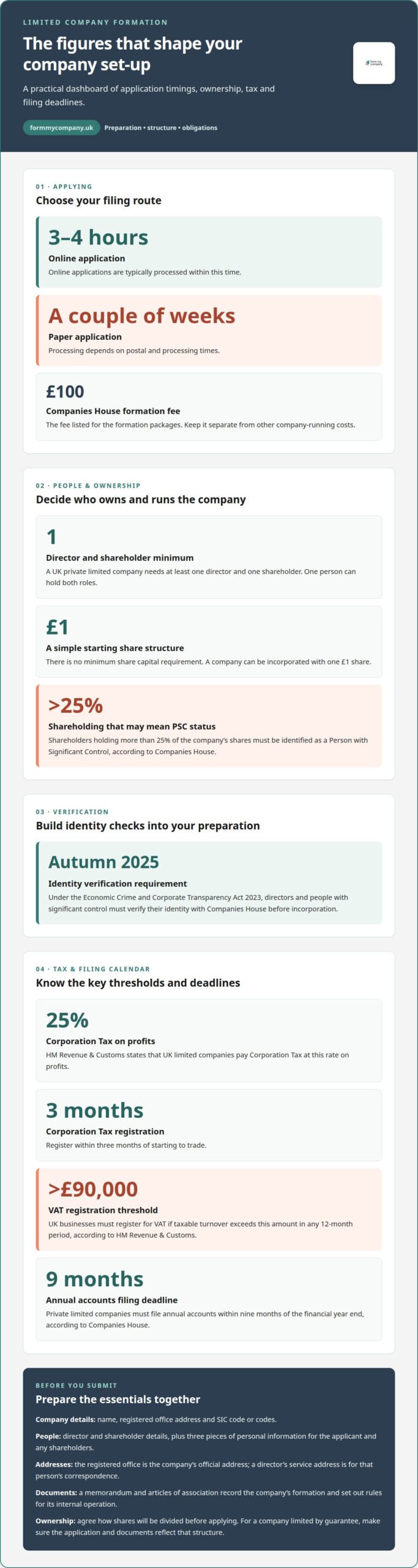
- Choose how to apply. Submit an online application through Companies House or use a paper application. Online applications are typically processed within 3 to 4 hours. Paper applications can take a couple of weeks, depending on postal and processing times. Allow time to prepare accurate information before submitting either method. The Companies House fee listed for the formation packages is £100, according to Companies House. Keep this filing fee separate from any other costs associated with running a company.
- Complete identity verification. Identity verification is required for all new company formations under the Economic Crime and Corporate Transparency Act 2023. From autumn 2025, directors and people with significant control must complete identity verification checks with Companies House. Directors and PSCs must verify their identity before incorporation. Build this into your preparation, so the people named in the application can complete the required checks before the company is registered.
- Decide the share structure. A UK private limited company has no minimum share capital requirement. It can be incorporated with one £1 share, giving a sole owner a simple starting structure. If several people will own the company, decide how shares will be divided before applying. Share ownership affects each person’s stake in the business and may determine who must be recorded as a person with significant control.
- Plan for tax and trading. HM Revenue & Customs states that UK limited companies pay Corporation Tax at a rate of 25% on profits. Register for Corporation Tax within 3 months of starting to trade. UK businesses must register for VAT if their taxable turnover exceeds £90,000 in any 12-month period, according to HM Revenue & Customs. A company can remain dormant instead of trading immediately, but plan its tax obligations around when trading begins.
- Record filing deadlines. Private limited companies must file annual accounts within 9 months of the financial year end, according to Companies House. Keep the company’s accounting records organised from the outset, even if it starts trading later. A business bank account can help separate company transactions from personal spending, making it easier to track income and costs. Note the financial year end and prepare accounts in time for the filing deadline.
Company name, registered office and application information
Before submitting your application, prepare the company’s name, address and registration details. Keep the information consistent so Companies House receives a clear application.
Choose a company name
Choose a name that reflects the business, then check it against existing company names and trademarks. UK rules restrict using a name that conflicts with an existing trademark. Avoid investing in branding before checking, as a conflict could mean changing the name. Use the same spelling throughout your application and supporting documents.
Prepare application information
Gather the company name, registered office address, director and shareholder details, and SIC code. The application also requires three pieces of personal information for the applicant and any shareholders. Decide who will provide each detail, then check names and addresses carefully before submitting. Select the SIC code or codes that best describe the company’s activities.
- Choose the registered office address. Every UK limited company must have a registered office, and it can be the owner’s home address. Consider whether you want the company’s official address to be your home or a separate business address. Keep the registered office address accurate and make sure company correspondence can be received there. A separate business address service may suit founders who prefer not to use their home address.
- Separate address roles. A registered office is the company’s official address, while a director’s service address is used for that person’s correspondence. A director can use a service address instead of their home address. Decide which address belongs to the company and which belongs to each director, then enter them in the correct fields. This helps prevent company and personal contact details from being mixed up.
- Prepare the company documents. The Companies Act 2006 requires a memorandum and articles of association. These documents record the company’s formation and set out rules for its internal operation. Read them alongside the proposed ownership arrangements, so the paperwork matches how the company will be run. Keep the approved documents with the company’s statutory records after registration.
- Organise records for practical use. Store the application details, registered office information and constitutional documents together. These provide a consistent reference for company administration and when sharing details with a bank. If the company is limited by guarantee, make sure the application and documents reflect that structure rather than a share-based company. Accurate records also make later updates easier to manage.
What is Company Formation?
Incorporation registers a company as a separate legal entity with Companies House. Follow these steps to submit the application, understand the costs and organise the resulting documents.
Complete the online incorporation application
Submit the application online once the company details and identity checks are ready. The process can be completed in 15 minutes, but allow time to review every entry before sending it. Check that the details match your chosen structure and ownership arrangements. An error in the company name, director information or share details can delay the application or require correction.
Check incorporation timescales
Plan around Companies House processing, not just the time needed to complete the form. Companies House typically incorporates a UK company within 3 to 6 working hours after submission. Treat that as a processing timescale, not the time needed to prepare documents or verify identities. Set your trading plans after registration, rather than assuming the company exists as soon as you submit.
- Separate the filing fee from package pricing. Companies House charges a filing fee for incorporation, while a formation package may cover additional work or documents. Compare what each option includes, such as application preparation and printed paperwork, before deciding what suits your needs. The price depends on the case and is given after a quote request; relevant factors include the company structure, application requirements and services selected.
Receive incorporation documents
After approval, download and store the certificate of incorporation and the company’s constitutional documents. The certificate records the company’s registered name and incorporation, while the memorandum and articles set out key formation details and internal rules. Check that the certificate matches the approved application. Keep these documents accessible to the owners and directors for company administration.
- Organise records for the next stage. File the incorporation documents alongside the application details and make them accessible to the company director. These records help demonstrate that the company is registered and explain how it is governed. Organise accounts and company records from the start, so directors can manage their responsibilities and respond to future filing requirements.
Directors, shareholders and company secretaries
Directors manage the company and remain responsible for its records, accounts and performance. Shareholders own shares and have a stake in the company, while a company secretary is optional for a UK private limited company.
Identify directors, shareholders and secretaries
Decide who will direct the company and who will own its shares. One person can hold both roles, but keep their responsibilities distinct: directors manage company affairs, while shareholders hold ownership rights. A UK private limited company does not have to appoint a company secretary. If you appoint one, record the role clearly and keep the company’s officer information up to date.
Meet director, shareholder and PSC requirements
List every shareholder and the shares each person will hold, then identify anyone with significant control. According to Companies House, shareholders holding more than 25% of a UK company’s shares must also register as a Person with Significant Control. Record the basis of each person’s control accurately. This helps the company registration information reflect who owns or controls the business.
Understand director duties and responsibilities
- Plan ongoing filings. Keep a calendar for company accounts, tax returns and Companies House filings. A company’s confirmation statement is due 12 months after incorporation, with 14 days to file it, according to Companies House. Use the company’s incorporation date to schedule this filing, then review the company information before submitting. Directors remain responsible for ensuring the company meets its filing obligations.
- Keep ownership and company records aligned. Update internal records when shares or control arrangements change. For example, if a shareholder’s holding moves above the 25% threshold, review the PSC information and make the required registration. Keep evidence of decisions and changes with the company’s records. Clear records help directors explain ownership, respond to filing requirements and maintain accurate information for the company.
Limited company structure and limited liability
A UK limited company is legally separate from the people who own it. This can separate company finances from owners’ personal finances, but it also brings ongoing responsibilities for records, accounts and filings.
The main advantage is limited liability: owners’ responsibility for business debts is generally limited to the value of their financial investment. The trade-off is company administration and compliance, and limited liability does not remove directors’ legal responsibilities.
Form My Company: Digital Package
Form My Company can help turn your prepared company details into a registration application through its Digital Package. It’s a practical next step if you want a digital route for setting up a UK limited company. If you’d prefer printed formation documents, compare the Digital & Print Package. The Entrepreneurs Choice Package is another option to consider when choosing how to proceed.
Choose a package based on your preferred document format and the company structure you plan to register. If your plans call for a partnership rather than a limited company, Form My Company also offers Limited Liability Partnership (LLP) Formation. Select the route that fits your business, then use the information you’ve prepared to move towards registration.
Visit formmycompany.uk to explore the available formation options.
Take the next step with confidence
Your next step is to turn your decisions into an application that reflects how you intend to own and run the business. Before proceeding, agree the ownership arrangement with any co-founders and consider how you’ll manage company administration after registration. A clear plan can make the move from limited company formation to trading more straightforward.
Form My Company offers a Digital Package, a Digital & Print Package and an Entrepreneurs Choice Package. Compare the options against how you want your formation documents prepared, then choose the one that fits your plans.
If you’re ready to take that step, contact Form My Company today to explore your formation options. You’ve already done the groundwork. Move forward with a structure that supports the business you’re building.
Frequently Asked Questions
How many shares does a company need?
A UK private limited company can be incorporated with one £1 share, so a single-share structure is possible. You can issue more shares to divide ownership between founders. For example, 100 shares can make it easier to allocate different proportions. Choose a number that reflects the owners’ agreed stakes and consider whether the company may need to adjust ownership later.
Is it possible to form a dormant company?
Yes. You can register a company before it begins trading, and it can remain dormant until you’re ready to start business activity. This may suit a founder preparing a venture or reserving a company name for a planned launch. Keep the incorporation date distinct from the date trading begins, and maintain the records and filings required of the company.
What type of company should I choose?
Choose a structure based on how the business will be owned and run. A private limited company has shareholders and shares. A company limited by guarantee has guarantors instead, while an LLP may suit partners operating together. A PLC is another option. During limited company formation, consider who will own the business, how decisions will be made and whether shares or guarantees better fit its purpose.
Can I delay my company’s official start date after it is formed?
No. You can’t choose a future incorporation date when registering a company. Companies House registration establishes the company, so incorporation takes place on registration. You can delay trading after formation, though, and the company may remain dormant in the meantime. Keep the official incorporation date separate from the date the business begins trading or receives income.
How many shares do I need to issue?
Issue enough shares to reflect the ownership split you’ve agreed. For example, two founders seeking equal ownership could each hold 50 of 100 shares. Another total may suit a different division. Decide the proportions before registering, then make sure the application and company records show the same allocation. The number of shares is a way to express ownership, not a measure of business value.
Is it mandatory to use the model articles of association?
No. A company must have articles of association, but it can use model articles or adopt tailored articles. The articles set out rules for the company’s internal operation, so consider how the owners want decisions and share transfers handled. Review the document before incorporation, particularly if the company has several shareholders with different roles or expectations.
Is there a minimum share capital required?
No. A UK private limited company has no minimum share capital requirement. It can be incorporated with one £1 share, though the share arrangement should reflect the ownership plan. Share capital is separate from the money the business needs to operate. Plan funding independently, and ensure the shares issued match what the founders have agreed.
What is a limited company in the UK and how does it differ from a sole trader?
A limited company is a legal entity separate from its owners; a sole trader runs a business personally. That distinction affects ownership of business assets and responsibility for debts. In a limited company, owners’ responsibility for business debts is limited to the value of their financial investment. Consider how you want to structure ownership, administration and personal financial exposure before choosing.