
Registering a limited company for an existing business in the UK starts with choosing a company name and preparing the registered office address, director and shareholder details, information about people with significant control, and a SIC code for the business activity. When setting up a limited company, consider who will take on its management and ownership roles; these roles may be held by the same person. You’ll also need to plan how the existing business will operate through the new company, which is legally separate from its owners.
The process involves more than completing a form. You’re creating a new legal structure and deciding how it will fit with a business that already exists, so planning the steps in the right order matters.
This guide covers the details to prepare, how to register with Companies House, and what to consider for Corporation Tax with HMRC. It also explains how to choose a name and structure, select a SIC code, and plan the practical transition to the new company.
Key Takeaways
- Map out how ownership will be divided and identify anyone who may need to be recorded as a person with significant control.
- Choose a company name and structure that fit how the existing business will operate, then select a SIC code that describes its activities.
- Prepare the incorporation details and documents before submitting the application to Companies House.
- Set up the company’s tax arrangements with HMRC and note that, according to HM Revenue & Customs, a UK limited company must file its Corporation Tax return within 12 months of the end of its accounting period.
- Review VAT obligations as the business grows: according to HM Revenue & Customs, registration is required when taxable turnover exceeds £90,000.
What do I need to register a limited company?
To register a limited company for an existing UK business, prepare its director, shareholder, ownership and address details before applying. Identify people with significant control, then plan how the new company will take over the existing business’s activities.
Choose directors and shareholders
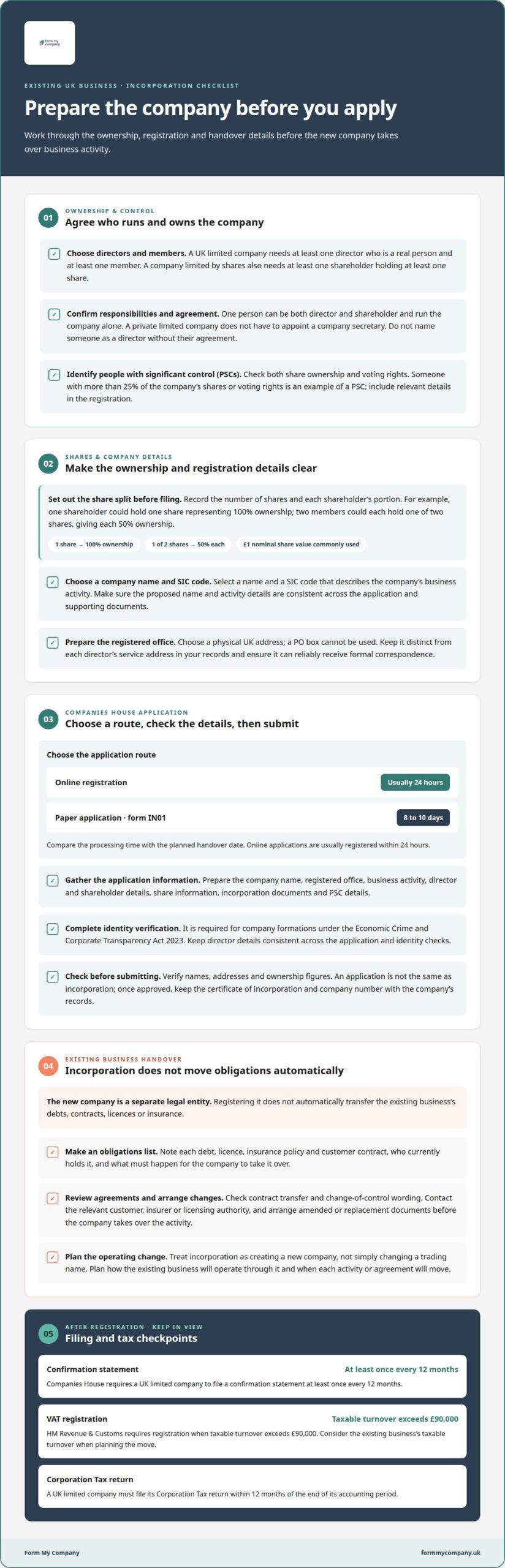
Decide who will direct the company and who will own its shares. A UK limited company needs at least one director who is a real person and at least one member. A company limited by shares also needs at least one shareholder holding at least one share. One person can fill both roles and run the company alone.
Before appointing anyone, agree their responsibilities and check that their details are accurate. A private limited company needs a director, but it does not have to appoint a company secretary. Do not name someone as a director without their agreement to take on the role.
Identify members and PSCs
List each member and record how much of the company each will own. A person with more than 25% of a company’s shares or voting rights is an example of a person with significant control, or PSC. Identify anyone who meets that threshold and include the relevant information in the registration.
Check both share ownership and voting rights, as they can reveal different control arrangements. If the existing business has several owners, agree who will hold shares in the new company before applying. The Companies House registration also requires details of people with significant control.
Decide share ownership and structure
Set out the number of shares and each shareholder’s portion before filing. For example, one shareholder could hold one share representing 100% ownership. Two members could each hold one of two shares, giving each 50% ownership. A nominal share value of £1 is commonly used for shares in a UK limited company.
Choose a structure that reflects the owners’ agreed share split instead of automatically copying the old business arrangements. Record who will hold each share and check that the figures match the intended ownership. This makes the company’s ownership clear from the outset.
- Prepare the registered office address. Choose a physical UK address for the company’s registered office; a PO box cannot be used. Keep this separate from each director’s service address in your records, and decide where formal company post should go. Make sure the address can reliably receive correspondence.
- Plan the next filing and tax steps. According to Companies House, a UK limited company must file a confirmation statement at least once every 12 months. According to HM Revenue & Customs, UK limited companies must register for VAT when taxable turnover exceeds £90,000. Consider the existing business’s taxable turnover when planning its move into the company.
Registering with Companies House
Register the company with Companies House before it starts trading. Incorporation creates a separate legal entity, but it does not automatically transfer the existing business’s debts, contracts, licences or insurance to the company.
Choose a registration route
Choose online registration or submit a paper application using form IN01. Online registration usually takes 24 hours, while paper processing takes 8 to 10 days. Compare the route and processing time with your planned handover date.
Use consistent company details across the application and supporting documents. If you’re moving from sole trader status to a company, treat incorporation as creating a new legal entity, not simply changing a trading name. The company is legally separate from its owner, but existing obligations still need a transition plan.
Complete and submit the application
Enter the proposed company name, registered office, business activity, director and shareholder details, and share information. Include the required incorporation documents and identify people with significant control. Before submitting, check names, addresses and ownership details carefully: errors can delay registration or leave Companies House records incorrect.
Complete identity verification for the people covered by the application. Identity verification is required for company formations under the Economic Crime and Corporate Transparency Act 2023. Keep each company director’s details consistent across the application and identity checks. After submission, Companies House usually registers an online application within 24 hours.
Once the application is approved, keep the certificate of incorporation and company number with the company’s records. Use them when setting up business accounts, preparing invoices and arranging the transfer of operations. Submitting an application does not mean the company has been incorporated.
Consider existing business obligations
List every existing debt, licence, insurance policy and customer contract before moving business activity. Registration does not transfer these obligations from a sole trader or another business structure to the new company. Record who currently holds each agreement and what needs to happen for the company to take it over.
Review each contract’s transfer and change-of-control wording, then contact the relevant customer, insurer or licensing authority about the steps required. Arrange amended or replacement documents before the company takes over the activity. For example, a contract may name the sole trader, while the new company needs to become the contracting party.
Keep a transition record showing each agreement, the responsible party and the action needed to complete the change. This helps avoid trading under an old insurance policy or licence, or invoicing through an entity different from the one named in a contract. Complete the transfer plan alongside incorporation rather than assuming the Companies House filing handles it.
Choosing a company name and business structure
Yes. You can move an existing sole trader business or partnership into a limited company by transferring its operations and agreed assets. Incorporation creates a separate legal entity, so plan the transition of the business name, contracts, employees, stock and goodwill.
List what will move, identify its current owner and record how each item will be handled. This gives you a practical transfer plan instead of leaving you to assume registration moves everything automatically.
- Choose a company name and registered office. Select a company name that suits the business you’re moving and use it consistently in your transfer plan. Check that it is suitable for your intended company structure before submitting the application. Choose the registered office at the same time, so official company correspondence has a clear destination.
If the trading name and proposed company name differ, keep them distinct in your records. For example, list both names on transition documents and specify which one will appear on future customer paperwork.
- Select a private or public limited company. A private limited company is a separate legal entity, and its shares cannot be traded publicly. A public limited company can offer shares for public trading and wider investor ownership. Choose the structure that fits the business’s funding plans and ownership arrangements, rather than opting for a public company without a practical need.
For an organisation built around an association or shared purpose, consider whether a company limited by guarantee suits its aims. This structure has guarantors rather than shareholders. Match the structure to how the organisation will be governed and funded.
- Set the accounting reference date. Companies House sets the company’s accounting reference date unless it is changed. Consider it alongside the existing business’s record-keeping cycle and planned transfer date. A clear accounting period helps you keep the new company’s records separate from the sole trader’s or partnership’s books.
Record which transactions belong to each business, particularly if the transfer takes place part-way through a trading period. Keep invoices, stock records and income entries attributed to the correct entity.
- Plan the transfer item by item. Prepare an inventory of assets, contracts, employees, stock and goodwill. For each item, record its current owner, intended destination and the action needed to complete the transfer. For example, list stock separately from equipment and record customer agreements individually instead of assuming they all transfer together.
Use the inventory to organise transfer documents and timing. Keep the old business’s records separate from the limited company’s, and update customer and supplier details as the company takes over. This makes the change easier to manage and creates a clear record of what moved.
Setting up a Corporation Tax account with HMRC
Moving an existing business into a company can raise capital gains tax, VAT and stamp duty considerations. The tax treatment depends on the assets or rights transferred, how the transfer is structured and what consideration applies. Record each item and its transfer terms separately.
- Establish the company’s Corporation Tax position. Online company registration usually sets the company up for Corporation Tax at the same time, unless it is dormant. Keep the company’s registration details and Unique Taxpayer Reference together when HMRC issues it. The reference is a 10-digit number used to identify the company for tax matters.
A limited company pays Corporation Tax on its profits. If it starts trading after incorporation, tell HMRC it is active within three months of starting to trade. Record the actual trading start date rather than assuming it is the same as the incorporation date. This helps organise the company’s first accounting period and tax records.
- Separate the new company’s records. Keep a clear record of the company’s income, costs, assets and transfer dates, separate from the sole trader’s or partnership’s records, even if the same people manage both. For example, identify which entity issued each invoice and paid each expense during the transition.
Use the company’s accounting period to organise its accounts and tax information. HM Revenue & Customs says a UK limited company must file its Corporation Tax return within 12 months of the end of its accounting period. The Corporation Tax payment is due within nine months and one day of that period’s end, according to HM Revenue & Customs.
- Plan VAT registration for the new entity. Incorporation creates a separate company, so review which business is making taxable supplies and whose turnover is relevant. Consider the transfer date, the company’s activity and its invoices when setting up VAT records. Keep the company’s VAT documents separate from those of the previous business.
Corporation Tax registration does not cover every business tax. A company may also need VAT or PAYE registration, depending on its activities and whether it employs staff. Record the decision and effective dates for each applicable tax, and use the company’s details consistently in its accounting records.
- Review tax consequences of transferred assets. List the assets, stock, contracts and goodwill moving into the company, and document their ownership, transfer date and agreed value. These details help establish the facts relevant to capital gains tax, VAT and stamp duty. Keep supporting transfer documents with the company’s accounts, separate from the former business’s records.
Identify any assets or rights that remain with the previous owner. A clear inventory helps the company distinguish what it owns from what it uses under an arrangement. Directors remain responsible for keeping company and accounting records that support the company’s tax filings.
SIC codes and incorporation documents
Prepare the activity code and formation documents before submitting the incorporation application. These details describe the new legal entity and establish its official company record.
Choose SIC codes
Select at least one five-digit SIC code to describe the company’s business activity. Check that the code matches the work the new company will actually carry out, rather than choosing one solely because it matched the old business name. If the business has several activities, identify the code or codes that best represent them.
Use the company’s planned trading activity as your guide. For example, distinguish the main service from any separate additional activity, then check that the selected code accurately describes each relevant line of work.
Prepare incorporation documents
Prepare the memorandum and articles of association as part of the formation documents. The memorandum records the subscribers’ intention to form the company, whilst the articles set out rules for its internal management. These documents are a legal requirement under the Companies Act 2006.
Review the company details against the documents before filing. Check that subscriber and ownership information matches the application and that the articles suit how the company will make decisions. Keep the final versions with the company’s official records.
- Check consistency across the application. Compare the proposed company name, registered office, director details, share information and SIC code. Each entry should refer to the same legal entity. If the existing business uses a trading name, distinguish it clearly from the company’s registered name in your records.
Correct any inconsistencies before submission. For example, make sure the company name in the incorporation documents matches the name entered in the Companies House application.
- File the completed formation details. Submit the incorporation documents with the company application. They work together: the application provides the registration information, while the memorandum and articles record key formation and governance details.
Keep a copy of the submitted information and note which version of each document you filed. This gives the directors a clear reference when organising company records and preparing to trade through the new entity.
- Store the documents issued after incorporation. Companies House issues a certificate of incorporation confirming that the company legally exists. The certificate states the company number and formation date, so file it with the memorandum, articles and submitted application.
Use the company number to identify the entity in future company records. Keep the incorporation documents accessible to the directors alongside the company’s accounting and ownership records, separate from paperwork belonging to the previous business.
Form My Company: Digital Package
Form My Company offers the Digital Package for business owners ready to form a limited company. It provides a practical next step once you’ve worked out the company’s structure, ownership and transfer plan.
Choose the Digital Package for a digital formation option, or compare it with the Digital & Print Package and Entrepreneurs Choice Package. If you’ve decided that a partnership structure is more suitable, Form My Company also offers Limited Liability Partnership (LLP) Formation. Choose the route that matches the legal structure you intend to establish.
Prepare your company details and formation information before proceeding. This helps keep the incorporation process aligned with the decisions you’ve made for the existing business.
Visit formmycompany.uk to explore the formation options or contact Form My Company to get started.
Plan the handover with confidence
Incorporation gives your business a new legal identity. Next, make the change clear in day-to-day operations: set a handover point, then align invoices, payment details, customer communications and supplier records with the company that will continue trading.
If you’re registering a limited company for an existing business in the UK, treat the transition as a planned change, not just a Companies House filing. Record what moves, when it moves and which entity is responsible. This provides a practical reference as the new company takes over and helps keep old and new business details separate.
Form My Company can help you move forward with company formation. Bring your chosen structure and registration details together, then decide what support you need for the next stage. For a clear next step, contact Form My Company to discuss your company formation.
With registration and the handover planned, you can focus on building the company around the business you’ve already created.
Frequently Asked Questions
What are your ongoing obligations?
Keep annual accounts and statutory records in order, even if the company has little activity. A dormant limited company can file dormant accounts with Companies House and is not required to file a tax return with HMRC. If the company trades, keep records that distinguish its transactions from the former business’s. Set reminders for filing dates so administrative tasks don’t get lost among day-to-day work.
What is company formation?
Company formation establishes a company as a registered legal entity. A company can also be formed and kept dormant before trading begins. For an existing business, this lets you prepare the company structure before planning when the new entity will start operating. Keep the intended trading start date distinct from the incorporation date.
What mistakes should you avoid?
Include company identification details on formal business documents. A UK company must show its company registration number and registered office address on business letters, order forms and its website. It must also display its name at its registered office and other places where it conducts business, except when operating from home. Update document templates and website details as part of the changeover.
What should you do after incorporation?
If the company is VAT registered, include its VAT registration number on invoices, stationery and its website. Review each template separately: updating invoices alone could leave older stationery or online pages inconsistent. Keep a record of what you have changed, and make the company’s details consistent across the channels customers use to contact or pay the business.
What type of company should you choose?
Start with the people and funding the business expects to involve. A share-based company may suit owners who want defined shareholdings, while a public limited company may be relevant if public investment is part of the plan. For a membership organisation, consider whether a company limited by guarantee fits its purpose. Record the intended ownership and governance before choosing a structure.
What information and documents are needed to register a UK limited company with Companies House?
Prepare the applicant’s and shareholders’ personal information alongside the company’s formation details. A UK online limited-company application requires three pieces of personal information for the applicant and any shareholders. Gather those details before filing and keep them consistent across the people named in the application. Have the company’s proposed activity and ownership arrangements ready too, so you can complete the relevant fields accurately.
How much does it cost to register a limited company in the UK, including Companies House fees?
Budget for the Companies House filing fee and any formation package or additional service you choose. The total depends on the registration route and the support or documents included. When comparing options, separate the statutory filing fee from the formation provider’s charge. This makes clear what each amount covers and avoids confusing optional package features with the government fee.
What are the current UK Companies House rules and identity verification requirements for company directors and people with significant control?
Each director and relevant person with significant control should complete the required identity verification and retain their Companies House personal code. A company with more than one director must have each director’s personal code before registration. Keep the codes securely available for the filings that require them, and ensure the company’s records connect each code to the correct individual.