
What if the only thing standing between your business and the global stage wasn’t a visa or a flight, but a single digital application? In 2026, the British market is more accessible than ever, yet the barrier to entry has shifted from physical presence to administrative precision. Learning how to register a UK company as a non-resident requires more than just filling out a form. It demands a clear strategy to navigate mandatory identity verification and strict new address requirements that have redefined the incorporation process.
You likely already know that the UK offers one of the most prestigious corporate environments in the world, but the fear of failing an anti-money laundering check or being rejected by a bank can feel like a massive hurdle. This guide will demystify the entire process, ensuring you meet every 2026 regulation whilst securing the professional British image your venture deserves. We will walk you through the essential steps of securing a legal physical address, verifying your identity as an international director, and opening the doors to UK banking and payment gateways from anywhere in the world.
Key Takeaways
- Confirm that UK law permits 100% foreign ownership and directorship, allowing you to launch a British business without ever needing to live in the country.
- Discover the step-by-step process of how to register a UK company as a non-resident whilst meeting the 2026 requirements for physical addresses and mandatory identity verification.
- Identify the most effective business structure for your global goals, whether you require a Private Limited Company for international trade or an LLP for professional services.
- Learn how to leverage virtual office services to establish a prestigious UK presence and navigate the hurdles of opening a British business bank account from abroad.
- Understand the essential compliance duties for international directors to ensure your company stays in good standing with Companies House and HMRC.
Can a Non-Resident Legally Register a UK Company?
The short answer is a definitive yes. British law is remarkably open to international investment, allowing for 100% foreign ownership and directorship of Limited Companies. Understanding how to register a UK company as a non-resident begins with the legal framework. There are no nationality or residency restrictions within the UK Companies Act 2006, which serves as the primary legislation for all business formations. Essentially, a non-resident UK company is a standard UK legal entity owned by overseas individuals, enjoying the same rights and prestige as any firm based anywhere in Britain.
In 2026, the regulatory environment focuses on maintaining high standards of corporate transparency whilst prioritising ease of access. While the UK remains a low-barrier market, the government has introduced mandatory identity verification for all directors and Persons with Significant Control (PSCs). This digital-first approach ensures that knowing how to register a UK company as a non-resident is a straightforward process, provided you have the correct documentation ready for electronic submission. Companies House now processes most digital applications within 24 hours, reflecting the UK’s commitment to being a global digital leader.
The Difference Between a Branch and a New Subsidiary
When expanding into the UK, you must choose between registering a branch or incorporating a new subsidiary. A branch is technically a ‘UK establishment’ of your existing overseas firm. It doesn’t have a separate legal identity, meaning your parent company is fully liable for its debts and legal obligations. Most entrepreneurs prefer incorporating a new Limited Company for several reasons:
- Liability Protection: Your personal and overseas business assets are shielded from UK business risks.
- Tax Efficiency: A subsidiary is taxed as a UK entity, which often simplifies accounting and allows for specific UK tax reliefs.
- Market Credibility: British clients often prefer dealing with a local ‘Ltd’ company rather than an overseas branch.
Visa and Residency Myths Debunked
Many entrepreneurs mistakenly believe they need a UK visa to start a company. This is a myth. You can own 100% of the shares and act as the sole director without ever visiting the UK. Ownership is a legal right, not an immigration permission. However, you must distinguish between ‘running a company’ and ‘working in Britain’. If you intend to relocate to the UK to manage the business, you’ll require an appropriate visa. For remote owners, the only requirement is ensuring your company remains compliant with UK filing duties. It’s also worth noting that the ‘Right to Work’ code requirement only applies to staff physically based in the UK, not to overseas directors managing their firm remotely.
Core Requirements for Overseas Founders in 2026
Establishing a presence in Britain involves more than just a digital signature. To understand how to register a UK company as a non-resident, you must first secure the legal infrastructure required by Companies House. Since the full implementation of the Economic Crime and Corporate Transparency Act (ECCTA), the process has become more rigorous. Every new formation requires a physical presence and verified stakeholders. A UK address acts as a legal ‘anchor’ for official government correspondence, ensuring that HMRC and Companies House can always reach a representative of the business.
You’ll need to provide specific details for all directors, shareholders, and Persons with Significant Control (PSCs). This includes full names, dates of birth, and residential addresses. Whilst these details are recorded, they don’t all have to be visible to the public if you use a professional service. If you are looking to Register an overseas company with Companies House, you must also appoint an Authorised Corporate Service Provider (ACSP). These entities act as the bridge between you and the regulator, ensuring all data is accurate and verified.
Mandatory Identity Verification (ECCTA 2023/2026)
The 2026 landscape requires every officer to undergo a formal Identity Verification Service. This isn’t just a suggestion; it’s a statutory requirement. You’ll need to provide a valid passport, proof of your residential address, and complete a digital biometric check. This often involves a ‘liveness’ test using a smartphone camera to confirm your identity. Failing to verify your identity within the required timeframe can lead to the rejection of your application or, for existing companies, significant fines and criminal proceedings against the directors.
The Registered Office Address Service
A physical Registered Office Address is non-negotiable. As of March 2024, Companies House no longer accepts P.O. Box numbers. The address must be a physical location where someone can receive and acknowledge mail on behalf of the company. For non-residents, using a professional service is the most practical solution. It protects your international home address from being published on the public register, which is a major privacy concern for global founders. Official mail from HMRC is scanned and forwarded to you digitally, allowing you to manage your UK obligations from any time zone. For those seeking a complete solution, our Virtual Office Services provide the necessary legal footprint whilst maintaining your corporate privacy.
Choosing the Right Structure for International Trade
Selecting the right legal vehicle is a strategic choice that defines your brand’s authority. In 2026, the majority of overseas founders opt for a Private Limited Company (Ltd) because it offers a clear separation between personal assets and business liabilities. This structure is universally recognised by British suppliers and high-street banks, providing an instant layer of professional credibility. If you are researching a complete guide to setting up a UK company, you’ll find that your choice of structure is just as vital as your business plan.
While the Ltd is the standard, professional service providers like consultants or architects often consider a Limited Liability Partnership (LLP). For those looking at more ambitious horizons, a Public Limited Company (PLC) is available, though it requires a minimum of £50,000 in nominal share capital. Each structure sends a specific signal to the market. An Ltd suggests a scalable, modern business, whilst an LLP signals a partnership of experts. Choosing correctly impacts how you’ll manage how to register a UK company as a non-resident and how easily you can scale your operations later.
The Private Limited Company Advantage
The Ltd structure is the most straightforward route for international entrepreneurs. It requires only one director and one shareholder, who can be the same person. This simplicity makes it ideal for solo founders who want to move quickly. Beyond the ease of setup, an Ltd company is a distinct legal person. This means the company pays its own Corporation Tax, and you only pay tax on the income you take out. This separation is a significant advantage for international founders who want to reinvest profits back into their UK operations without complicating their personal tax status in their home country.
LLPs for Non-Resident Partners
If you’re launching a venture with at least one other partner, an LLP offers unique flexibility. Unlike a standard company, an LLP is ‘tax transparent’. This means the partnership itself doesn’t pay Corporation Tax. Instead, profits flow directly to the partners, who are then responsible for tax in their own jurisdictions. This can be highly efficient for non-resident teams. However, you must appoint at least two ‘Designated Members’ who take on extra administrative duties. It’s a robust choice for firms where profit-sharing needs to be flexible rather than strictly tied to shareholdings. You can explore our formation packages to see which structure fits your 2026 business goals.
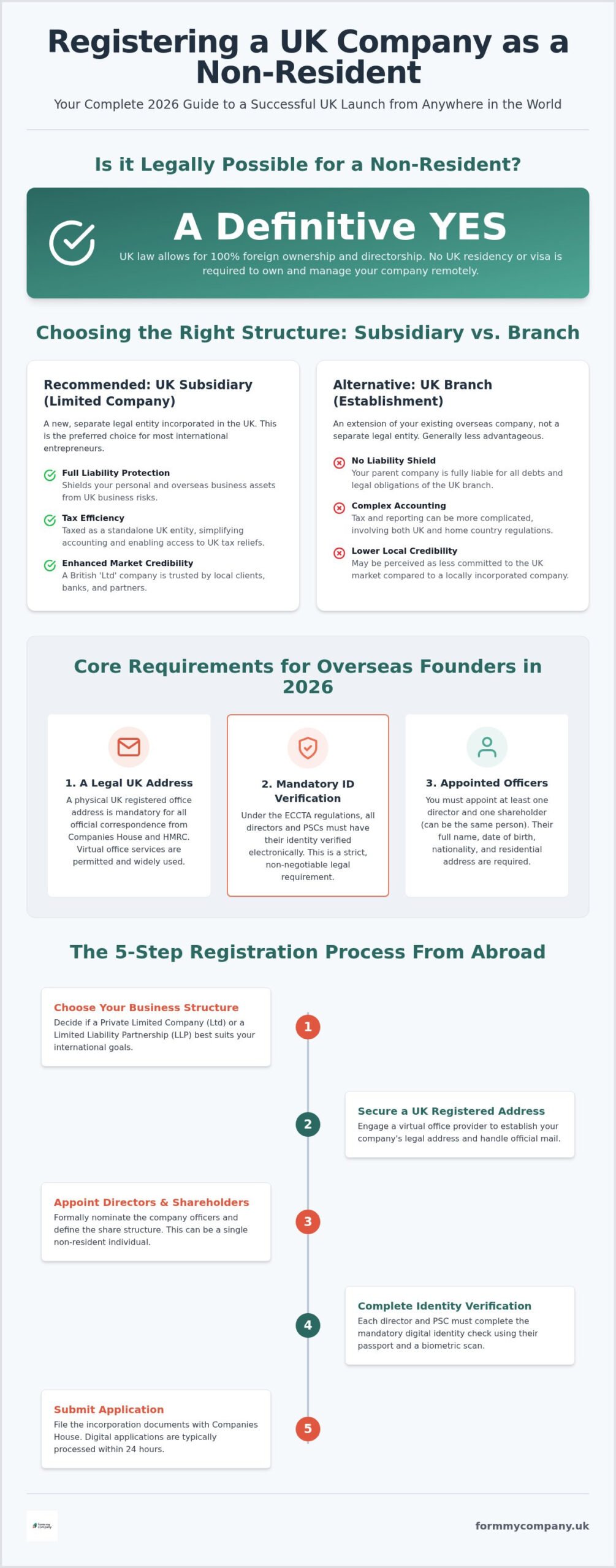
Step-by-Step Registration Process from Abroad
Once you’ve decided on your business structure, the actual incorporation process is remarkably swift. To start, you must choose a unique name that isn’t already registered or too similar to an existing brand. Use a UK company name checker to ensure your preferred title is available. You’ll then need to appoint your directors and shareholders. Since 2025, every officer must have their Identity Verification completed before the application is submitted. This digital-first approach is exactly how to register a UK company as a non-resident without the delays of traditional paper filings.
You’ll also need to prepare your constitutional documents: the Memorandum and Articles of Association. Most founders use ‘model articles’, which are a standard set of rules governing how the company is run. Submitting these through a digital formation agent is the most efficient route. Whilst paper applications can take over a week, digital submissions are typically processed within 24 hours. Upon approval, you’ll receive a digital Certificate of Incorporation and a professional Company Pack containing your share certificates and registers. If you’re ready to secure your British business presence, explore our comprehensive formation packages to get started today.
Selecting SIC Codes and Share Capital
During the application, you must select at least one Standard Industrial Classification (SIC) code. These five-digit numbers tell the government exactly what your business does, whether it’s software development or retail. You’ll also need to define your share capital. For most new companies, it’s common to start with a nominal amount, such as 100 shares valued at £1 each. This keeps the initial setup costs low whilst clearly defining the ownership split amongst international founders. It’s a simple step, but getting it right ensures your corporate structure is solid from day one.
Recording Persons with Significant Control (PSC)
Transparency is a cornerstone of the British corporate system. You are legally required to maintain a PSC Register, which identifies anyone who owns or controls more than 25% of the company. In a non-resident setup, this is usually the founder or the parent company. This register must be kept up to date and filed with Companies House annually via your confirmation statement. It’s a vital part of understanding how to register a UK company as a non-resident, as failing to disclose this information can lead to your company being struck off the register. Accuracy here builds trust with UK banks and future investors.
Managing Your UK Business Remotely in 2026
After you’ve mastered the steps of how to register a UK company as a non-resident, your focus shifts to long-term operational success. The British corporate ecosystem is designed for digital efficiency, allowing you to manage every aspect of your firm from any time zone with total confidence. Utilising a Virtual Office is a strategic move here. It provides a prestigious national presence that builds trust with British clients whilst ensuring all your statutory mail is handled professionally. Beyond the image, you must also monitor your turnover. If your UK taxable sales exceed £90,000, registering for VAT becomes mandatory, a process that our VAT Registration Service can facilitate seamlessly.
Banking and Payment Gateways
Securing a business account is often the most challenging step for overseas founders. Traditional high-street banks can take 4-6 weeks to process applications and frequently require at least one UK resident director. In contrast, digital-first business accounts like Wise or Revolut Business are built for the modern entrepreneur, often approving non-resident applications in 1-3 business days. Having your UK company registration number is a prerequisite for accessing UK-based payment gateways like Stripe or PayPal. If your company has been active for some time, banks may request a Certificate of Good Standing to verify that your firm is fully compliant with all filing requirements before they approve your facility.
Ongoing Compliance and Filings
Maintaining a UK company requires strict adherence to annual deadlines. You are legally required to file a Confirmation Statement every year to ensure the information held by Companies House is accurate. Even if your company is not currently trading, you must still file annual accounts and notify HMRC of your Corporation Tax status. Missing these statutory dates can result in significant fines or your company being struck off the register entirely. To avoid these risks, many international owners rely on a Company Secretarial Service. This professional support ensures all your registers are maintained and every filing is submitted on time, allowing you to focus on growing your business without the stress of administrative oversight.
Launch Your British Business Today
Establishing a corporate footprint in the United Kingdom has never been more accessible for global entrepreneurs. By securing a physical registered office and completing the mandatory 2026 identity checks, you position your brand for international growth. You now understand the strategic importance of choosing the right structure and the necessity of maintaining a transparent PSC register. Mastering how to register a UK company as a non-resident is simply a matter of following the correct administrative path whilst leveraging digital-first banking and compliance tools.
As an authorised Companies House agent, we provide specialist support for international directors to ensure every filing meets the highest regulatory standards. You can maintain complete privacy with our registered office services, keeping your international home address off the public record. Success in the British market starts with a compliant foundation and a professional image. Explore our non-resident company formation packages and take the first step towards your global expansion. Your journey into the UK market is just one digital application away.
Frequently Asked Questions
Do I need to visit the UK to register a company as a non-resident?
No, you don’t need to visit the UK at any stage of the incorporation process. Everything is handled digitally through an authorised agent. You can manage the entire application from your home country, provided you have a stable internet connection and the necessary digital identity documents. This remote access is a core part of how to register a UK company as a non-resident, allowing you to establish a British presence without the expense of international travel.
Can a non-resident be the sole director and shareholder of a UK company?
Yes, a single individual can hold both roles, regardless of their nationality or where they live. UK law is highly flexible, allowing for 100% foreign ownership and control. You don’t need to appoint a local UK director or shareholder to satisfy Companies House requirements. This makes the Private Limited Company (Ltd) structure an excellent choice for solo entrepreneurs who want full autonomy over their British business operations from abroad.
What is the mandatory UK address requirement for overseas founders?
Every UK company must have a physical Registered Office Address located within the UK. This address is used by Companies House and HMRC for official government correspondence. Since March 2024, PO Box addresses are no longer permitted. Non-residents typically use a professional Registered Office Address Service to meet this legal obligation. This ensures your company remains compliant whilst protecting your international residential address from appearing on the public register.
How do I verify my identity for Companies House if I live abroad?
Identity verification is now a mandatory requirement for all directors and Persons with Significant Control (PSCs). This digital identity check is a fundamental step in how to register a UK company as a non-resident under the 2026 transparency laws. You’ll use a digital process that involves scanning your passport and performing a biometric check. This data is securely transmitted to Companies House through an Authorised Corporate Service Provider (ACSP), ensuring a fast and secure verification.
Is it difficult to open a UK business bank account as a non-resident?
Traditional high-street banks can be challenging for non-residents because they often require a UK-based director. However, digital-first business accounts like Wise or Revolut Business are specifically designed for global entrepreneurs. These platforms often approve applications within a few working days once they’ve verified your UK company registration number. Using these modern banking solutions is the most efficient way to access UK payment gateways and manage your corporate finances remotely.
Do I need to pay UK tax if I run my company from another country?
Yes, your UK company will be subject to UK Corporation Tax on any profits it generates. You’ll need to register with HMRC for Corporation Tax within three months of starting to trade. Even if you manage the business from another country, the company itself is a UK tax resident. It’s also vital to consider the tax laws in your home country to avoid double taxation, though the UK has treaties with many nations to prevent this.
What is an ACSP and why do I need one in 2026?
An Authorised Corporate Service Provider (ACSP) is a firm, like a formation agent, that is registered with a UK anti-money laundering supervisor. In 2026, you need an ACSP to facilitate the mandatory identity verification for all directors and PSCs. They act as a trusted intermediary, ensuring that the data provided to Companies House is accurate and verified. Working with an ACSP streamlines the registration process and ensures your company meets all current transparency regulations.
Can I register a UK company without a UK visa?
Yes, you don’t need a UK visa to own or direct a British company. Company registration is a matter of corporate law, not immigration law. You can legally hold shares and manage your firm from anywhere in the world. However, owning a company doesn’t grant you the right to live or work in the UK. If you plan to relocate to Britain to run the business, you’ll need to apply for an appropriate visa separately.