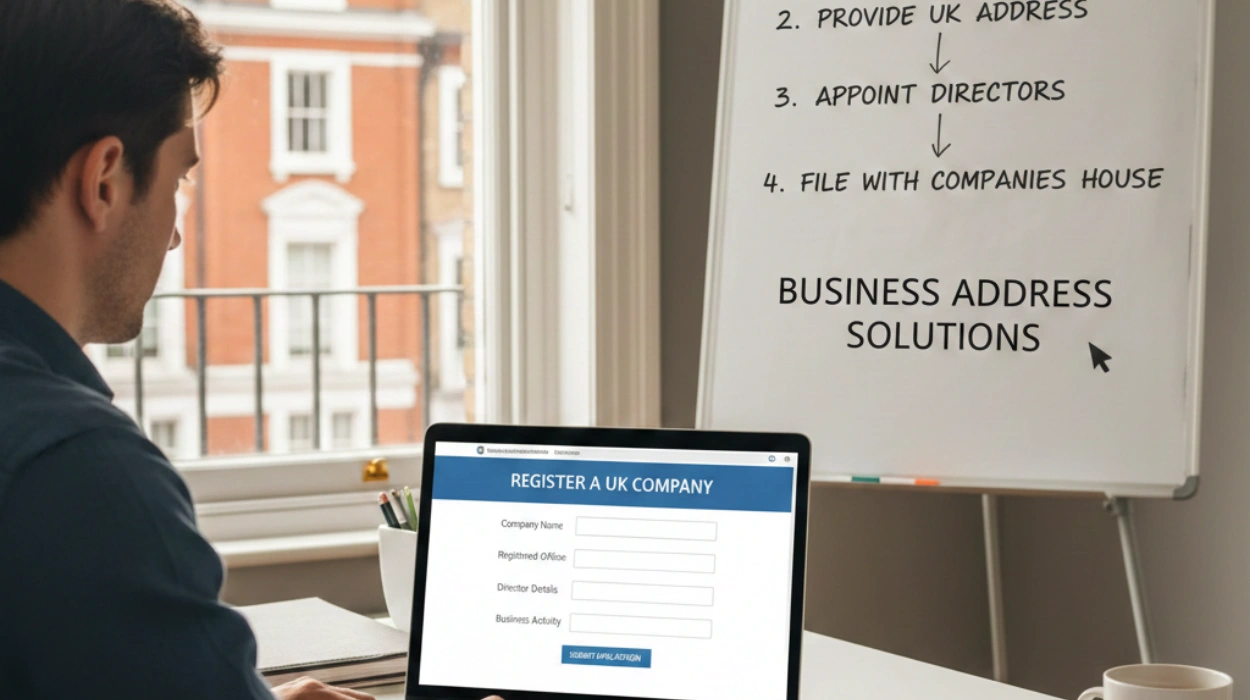
Registering a company in the UK requires a valid registered office address—a physical UK location where official documents can be received and acknowledged. This address must comply with Companies House rules, including being in the same jurisdiction as your incorporation and no longer a PO Box since March 2024. Form My Company simplifies this by offering compliant business addresses alongside full company formation services.
Setting up a limited company in the UK opens doors to credibility, tax efficiency, and growth opportunities for entrepreneurs, startups, and established traders alike. Central to this process is selecting and providing a suitable business address, specifically the registered office address, which serves as the official hub for legal correspondence from Companies House, HMRC, and other authorities. Under the Companies Act 2006, as amended by the Economic Crime and Corporate Transparency Act 2023, every UK-incorporated company must maintain an “appropriate” registered office address at all times—a physical UK premises capable of receiving and acknowledging statutory mail.
This requirement isn’t just bureaucratic; it underpins transparency and accountability in UK business structures. For directors and shareholders, the registered office appears publicly on the Companies House register, making privacy a key concern for many home-based or remote operations. Virtual offices and professional address services have surged in popularity, offering prestigious London or regional addresses without the overheads of physical leases. However, non-compliance risks severe penalties, including forced address changes to Companies House defaults or even strike-off proceedings. In this guide, we’ll delve into every aspect of company registration with a business address, drawing on official GOV.UK guidance and recent regulatory shifts to equip you with practical, actionable insights for seamless incorporation. Whether you’re a sole director forming a private limited company (Ltd) or scaling with multiple shareholders, understanding these rules ensures your venture starts on solid legal ground.
Step-by-Step Guide to Company Registration with a Business Address
The company formation process via Companies House is straightforward but demands precision, especially around the registered office address. Begin by deciding your company structure—most opt for a private company limited by shares—then gather essentials: a unique name (checked via the Companies House webCHeck service), at least one director and shareholder (who can be the same person), a SIC code for your industry, and crucially, your registered office address.
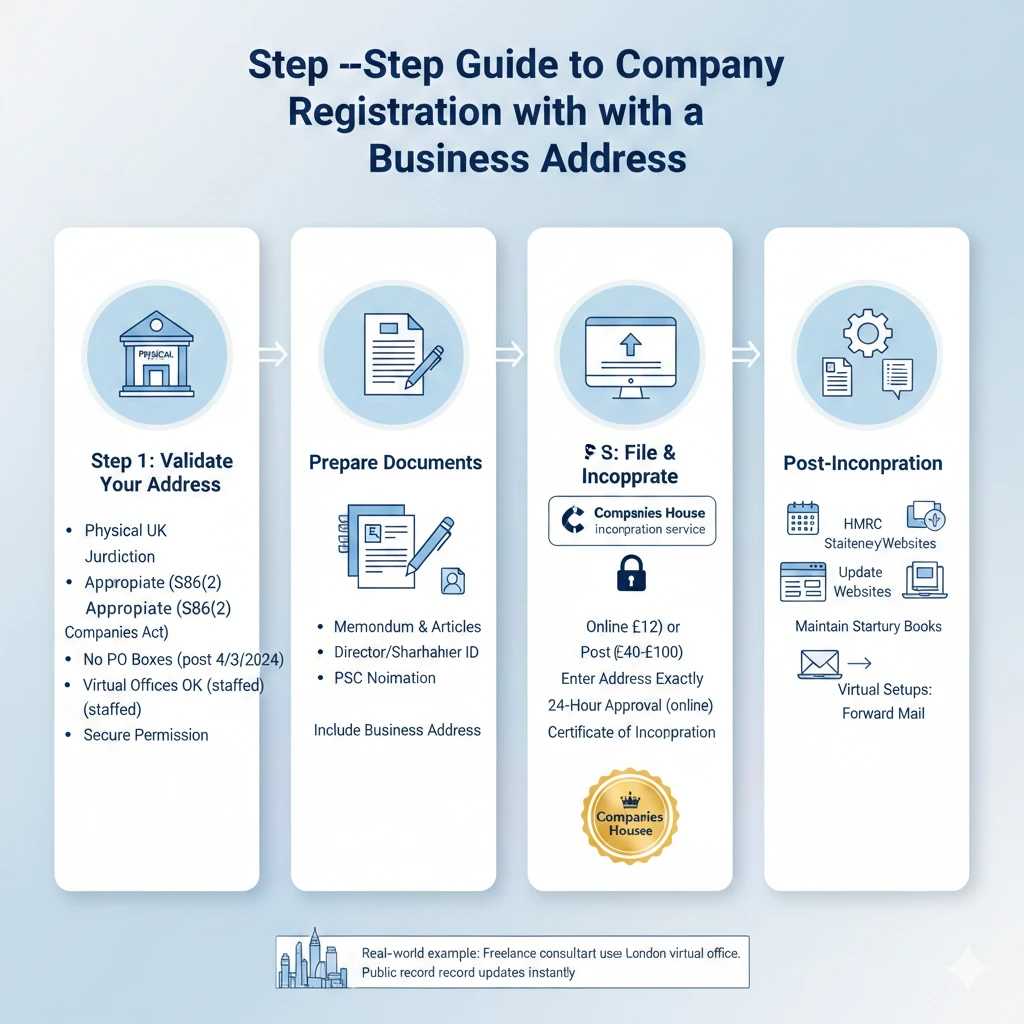
Step 1: Validate your address. It must be physical, in the correct UK jurisdiction (e.g., England/Wales for most incorporations), and “appropriate” per Section 86(2) of the Companies Act 2006—meaning documents delivered by hand or post reach someone acting for the company, with delivery acknowledgment possible. PO Boxes are banned post-4 March 2024; virtual offices qualify if staffed and compliant. Secure permission if using a third-party address like an accountant’s.
Step 2: Prepare documents. Draft your memorandum and articles of association (model articles suffice for standard Ltds), appoint directors/shareholders with ID verification, and nominate a person with significant control (PSC). Include your business address here—no trading address is needed at formation, but it’s useful for VAT/PAYE later.
Step 3: File online via Companies House (web incorporation service, £12 fee) or post (£40-£100). Enter the address exactly; mismatches lead to rejection. Approval takes 24 hours online, yielding your certificate of incorporation.
Step 4: Post-incorporation, notify HMRC for Corporation Tax, update the address on all stationery/websites, and maintain statutory books. For virtual setups, forward mail promptly to avoid missing deadlines like annual confirmations. Real-world example: A freelance consultant registers an Ltd using a London virtual office, gaining prestige while working remotely—Companies House updates the public record instantly. This process integrates seamlessly with compliance needs like VAT registration if turnover exceeds £90,000.
Benefits and Potential Risks of Using a Business Address
Opting for a dedicated business address during registration yields multifaceted advantages. Primarily, it enhances professionalism: a City of London postcode signals stability to clients, banks, and investors, far surpassing a residential one. Privacy protection is paramount—over 4 million UK companies shield home addresses via third-party services, preventing public exposure on Companies House searches. Cost savings shine through virtual offices (£20-£100/month), bundling mail handling, scanning, and forwarding without lease commitments.
For international founders, a UK business address facilitates banking (e.g., easier Barclays/Metro Bank opens) and e-commerce platforms like Amazon, proving local presence. Compliance benefits include reliable receipt of HMRC notices for PAYE/VAT, reducing late-filing fines (£100+). Scalability suits solopreneurs to SMEs, supporting director service addresses separately if needed.
Risks, however, loom large without diligence. Using an invalid address triggers Companies House intervention: a 14-day rectification notice or immediate switch to a default (e.g., Cardiff PO Box 4385 for England/Wales), suspending duties like displaying company details and risking uncollected mail. Persistent non-compliance invites strike-off, dissolving the company. Directors face personal offences, fines up to £5,000, or disqualification. Privacy risks arise if addresses leak via data breaches, while banks reject virtual-only setups lacking proof of operations. Example: A startup ignored “appropriate” rules, faced defaulting, and incurred £1,500 remediation costs—avoidable with vetted providers. Balancing these, professional services mitigate 90% of pitfalls.
Legal and Compliance Considerations
UK law mandates strict adherence for registered office addresses, governed by Companies House and the Companies Act. Key: physicality, jurisdiction-matching, and appropriateness—no PO Boxes, overseas, or unstaffed sites. GOV.UK specifies delivery must alert company agents with acknowledgment; virtual offices comply if providers sign for mail.
Post-ECCT Act (2024), Companies House proactively enforces via digital checks, defaulting addresses without notice and initiating 28-day cures or strike-offs. Directors must update changes within 14 days via AD01 form (£8 online), notifying HMRC automatically. Public disclosure on registers demands caution—service addresses protect PSCs too.
Compliance extends to related obligations: display the address on websites/letters, enable public inspections (if applicable), and link to VAT/PAYE registrations. Non-residential addresses aid GDPR by separating home data. For LLPs/partnerships, 2026 rules align addresses similarly. Penalties: company fines £1,000+, officer liability. Auditors verify annually. Example: Welsh companies must use Wales-based addresses, or face rejection—jurisdiction silos prevent crossovers. Integrating with KYC/AML, addresses support economic crime prevention. Always consult solicitors for bespoke structures like companies limited by guarantee.
Common Mistakes to Avoid
A frequent pitfall is selecting invalid addresses—PO Boxes or non-physical sites lead to instant rejections, delaying launches by weeks. Entrepreneurs overlook jurisdiction: a Scottish company can’t use a London address, per GOV.UK rules, risking dissolution.
Failing permission: Using an accountant’s address without consent exposes to disputes; always document approval. Neglecting updates post-move—14-day AD01 lapses trigger fines. Privacy errors: Listing home addresses invites spam/physical risks; 70% now pivot to virtuals.
Overlooking mail management: Unforwarded HMRC letters miss CT600 deadlines (£100+ penalties). Bank mismatches: Virtual addresses need trading proof for accounts. Ignoring 2024 rules: Legacy PO Box users face defaults. Example: A director used a relative’s unstaffed home, missing a winding-up petition—company struck off, personal bankruptcy followed. Verify providers’ compliance certifications and trial mail tests pre-registration.

Practical Tips and Best Practices
Choose reputable virtual providers like Form My Company for AML-verified London addresses, ensuring scanning/forwarding. Test: Send tracked post pre-incorporation. Diversify: Use separate service addresses for directors (£50/year privacy).
Bundle with formation: Same-day incorporation includes address setup. For e-commerce, pair with VAT (£90k threshold)—HMRC accepts virtuals. Banks prefer: Provide lease proofs/utilities. Annual reviews: Audit address efficacy during confirmations. Tech tip: Automate AD01 via Companies House WebFiling. Scale smart: Upgrade to serviced offices as you grow. Best practice: Retain 7-year mail records for audits. Example: Tech startup used Manchester virtual address, secured NatWest account Day 1, scaled to 50 staff seamlessly. Partner with compliance experts for PAYE onboarding.
Frequently Asked Questions
Can I use a virtual office as my registered office address?
Yes, provided it meets Companies Act criteria: physical UK location, staffed for mail, with acknowledgment. Providers handle statutory post, forwarding digitally—ideal for remote teams. Avoid cheap unverified ones; vetted services prevent defaults.
What happens if my address is deemed inappropriate?
Companies House issues a 14-day notice or defaults it (e.g., Cardiff PO Box). Cure within 28 days via AD01 with evidence; failure risks strike-off. Costs: £8 filing + potential fines.
Do I need a separate trading address for my business?
No, registered office suffices initially, but specify trading addresses on websites/letters. Virtuals work for mail; physical sites aid VAT/PAYE inspections.
How do I change my registered office address after formation?
File AD01 online (£8, 24-hour approval), authorise via board resolution. Update stationery/HMRC auto-syncs.
Is a home address allowed as registered office?
Yes, if appropriate (staffed, permissioned), but public exposure risks privacy. Switch to professional for protection.
Mastering company registration with a business address ensures compliant, professional UK operations from Day 1. From validating physical premises to navigating ECCT changes, precision averts costly pitfalls while unlocking growth.
If you’re ready to register your company with confidence, Form My Company provides fast, fully online company formation with expert compliance support, including verified business addresses, VAT & PAYE setup, and virtual office solutions. Get started today and let our specialists handle the paperwork while you focus on growing your business.