
To set up and maintain a statutory company register in the UK, purchase an official register, record initial director, shareholder, and PSC details, store it at your registered office or SAIL address, and update records within 14 days of any legal company changes.
Setting up a statutory company register is a legal obligation for every UK company incorporated under the Companies Act 2006. The register acts as the official legal record of your business ownership, management, and governance. While many business owners confuse statutory registers with Companies House filings, the physical or electronic statutory register kept by the company serves as the ultimate legal proof of record.
What Is Included in a Statutory Company Register?
A statutory company register contains six mandatory registers: Register of Directors, Register of Directors’ Residential Addresses, Register of Secretaries, Register of Members, Register of People with Significant Control (PSC), and Register of Charges.
UK company law mandates specific records inside every official register. Maintaining these sections ensures complete compliance during legal audits or share transfers.
Key Statutory Registers and Requirements
| Register Type | Required Details | Legal Update Deadline |
| Register of Directors | Full name, service address, country of residence, nationality, business occupation, date of birth. | Within 14 days of change |
| Register of Directors’ Addresses | Usual residential address of each director (kept confidential from public inspection). | Within 14 days of change |
| Register of Secretaries | Full name and service address (optional position for private limited companies). | Within 14 days of change |
| Register of Members | Names, addresses, share classes, number of shares held, and date registered as a member. | Effective date of allotment/transfer |
| Register of PSCs | Name, date of birth, nationality, service address, and specific nature of control over the company. | Within 14 days of change |
| Register of Charges | Details of company mortgages, charges, and secured loans (for charges created before April 2013). | Retained historically |
How Do You Set Up a Statutory Company Register After Incorporation?
You set up a statutory register by obtaining an official hard-copy register or compliant electronic software, then inputting initial incorporation data from your Companies House Form IN01 immediately after your company formation completes.
The initial setup requires accurate transfer of information from your incorporation documents. Errors made during setup complicate future share issuances or banking applications.
Steps to Initialize Your Statutory Records
Obtain professional statutory register materials
Purchase a durable loose-leaf statutory register or dedicated digital compliance system. Using casual notebooks or unformatted text files fails compliance audits. Business owners who want a complete physical filing solution can review the Company Pack to receive pre-formatted statutory registers and company seals.
Populate subscriber share details
Record the initial shareholders (subscribers) who took shares during formation. Enter the exact number of shares, share class, nominal value, and amount paid per share.
Log officer and PSC information
Enter complete personal details for all appointed directors and designated People with Significant Control. Verify that service addresses match incorporation records precisely.
Issue official share certificates
Generate and issue share certificates to every founding member within two months of incorporation. Cross-reference certificate numbers with the Register of Members.
Where Must You Keep Your Statutory Company Register?
You must keep your statutory company register at your company’s registered office address or at a Single Alternative Inspection Location (SAIL) registered officially with Companies House.
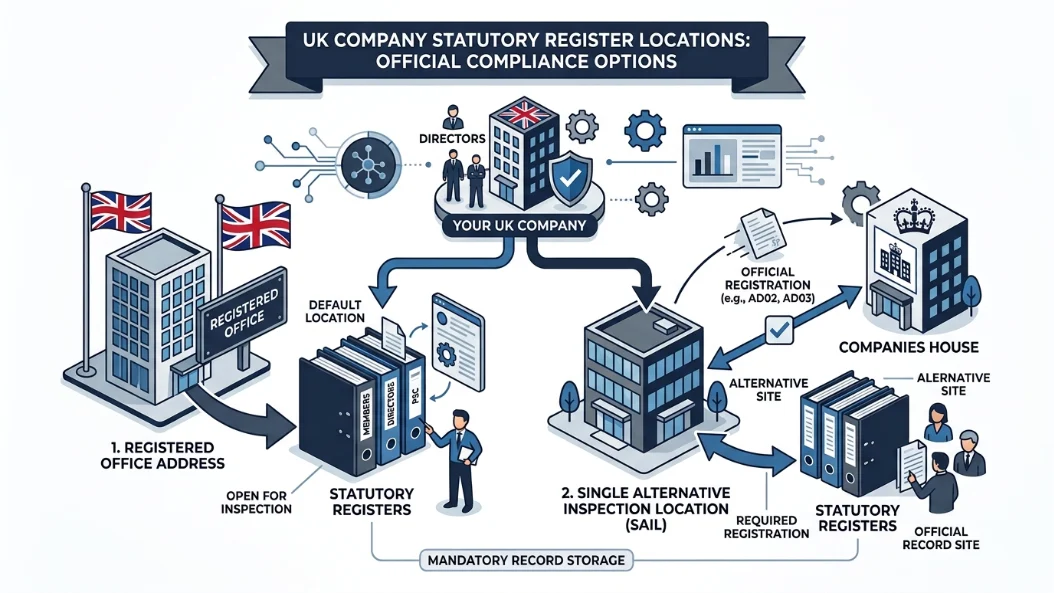
Companies House must know the physical location of your statutory registers at all times. This allows shareholders and the public to exercise their statutory inspection rights.
Single Alternative Inspection Location (SAIL) Rules
If you choose not to keep statutory registers at your registered office, submit Form AD01 to notify Companies House of your SAIL address. Additionally, submit Form AD02 to specify which individual registers move to the SAIL address.
Inspection rules require companies to make registers available for public inspection for two hours daily during standard business hours. Refusing lawful inspection requests results in financial penalties for the company and officers.
How Do You Maintain and Update Your Statutory Register?
You maintain your statutory register by logging every corporate change, share transfer, officer appointment, or address update into the appropriate register section within the legally prescribed statutory timeframe.
Maintaining company records requires ongoing oversight. Updates to statutory registers take legal precedence over Companies House filings; legal ownership transfers when entered into the Register of Members, not when filed online.
Quick Guide for Updating Corporate Changes
| Event / Corporate Action | Statutory Register Action Required | Companies House Form Required |
| New Share Transfer | Update Register of Members upon receiving valid stock transfer form. | Annual Confirmation Statement |
| Director Appointment | Log full details in Register of Directors and Address Register. | Form AP01 |
| Director Resignation | Record date of resignation in Register of Directors. | Form TM01 |
| PSC Detail Change | Log changes in PSC Register within 14 days. | Form PSC04 |
| Share Allotment | Record new shares and member entries in Register of Members. | Form SH01 |
What Are the Penalties for Failing to Maintain Statutory Registers?
Failing to maintain statutory company registers constitutes a criminal offence under UK law, subjecting the company and its directors to fines up to £5,000 plus daily default fines.
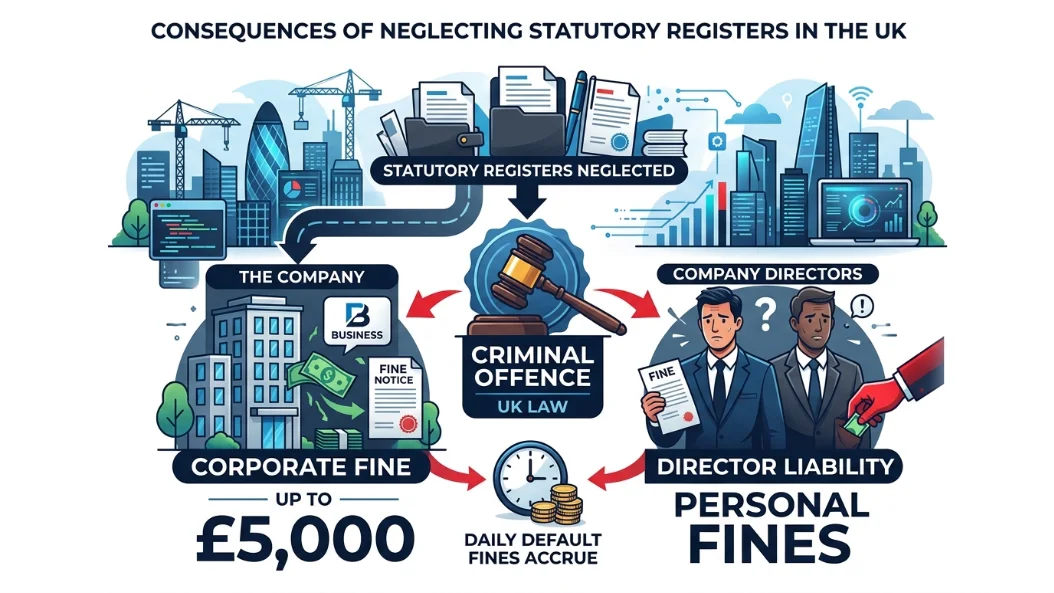
Companies House and UK courts enforce strict compliance rules regarding corporate record-keeping. Neglecting statutory registers exposes directors to personal legal liabilities.
Consequences of Non-Compliance
Criminal fines and officer liability
Courts impose fines on every officer of the company who defaults on statutory duty. Continued non-compliance incurs daily fines until registers update fully.
Disrupted corporate transactions
Investors and lenders demand complete statutory records during due diligence. Incomplete registers delay sales, block investments, and void loan agreements.
Disputes over share ownership
Courts treat the Register of Members as legal proof of share ownership. Missing entries trigger costly legal disputes between founding shareholders.
For foundational guidance on statutory compliance obligations, read our detailed guide: What Is a Statutory Company Register and Is It Mandatory?
How Can Professional Services Simplify Statutory Register Management?
Professional services streamline statutory register management by supplying pre-bound physical books, automated software templates, and continuous administrative support to ensure complete compliance with the Companies Act 2006.
Managing statutory books internally requires continuous tracking of filing deadlines and legal formats. Professional corporate support eliminates compliance oversights for busy directors.
Form My Company provides comprehensive statutory register solutions designed specifically for UK business structures. To secure a fully compliant, physical statutory register package tailored to your enterprise, you can Order a Statutory Company Register From Form My Company to maintain accurate legal records effortlessly.
Explore our Company Pack guide,
How to Calculate the ROI of Professional Interview Rooms
Hourly vs Daily Interview Room Hire: Which Costs Less?
Frequently Asked Questions
What is included in the Form My Company Company Pack?
The Form My Company Company Pack provides all essential post-incorporation materials required for statutory compliance under UK company law. It includes a hard-copy statutory company register, printed share certificates, customized company seal, and bound copies of the Articles of Association. This complete compliance kit ensures new businesses can legally record ownership and maintain official administrative records from day one.
Is a physical statutory register required for a UK limited company?
Yes, under the Companies Act 2006, every UK private limited company must maintain an official statutory register at its registered office or Single Alternative Inspection Location (SAIL). A physical register, such as the one provided in the Form My Company Company Pack, serves as the ultimate legal proof of member ownership, director appointments, and Persons with Significant Control (PSC) details.
How soon after incorporation should share certificates be issued?
UK company law mandates that share certificates must be generated and issued to company shareholders within two months of incorporation or share allotment. The Form My Company Company Pack includes official share certificate templates designed to match the legal details entered into your Register of Members. Promptly issuing these certificates prevents legal disputes regarding equity distribution among founding members.
What is the purpose of a legal company seal in the UK?
While not strictly mandatory for every transaction, a company seal is used to execute formal legal documents, deeds, share certificates, and international contracts with maximum authenticity. Utilizing a company seal from the Form My Company Company Pack adds an extra layer of corporate governance and authority, which is often requested by overseas banks, institutional investors, and legal entities.
Where must statutory company records be kept for public inspection?
Statutory company books must be stored at the company’s registered office address or a designated Single Alternative Inspection Location (SAIL) registered with Companies House. The Form My Company Company Pack organizes all mandatory registers—including those for directors, members, and PSCs—into a single durable binder, making it straightforward to satisfy legal inspection requests from authorities or the public.