
A statutory company register is an official set of records detailing a UK limited company’s legal and administrative structure. Under the Companies Act 2006, maintaining these records is strictly mandatory for all registered private and public companies from the date of incorporation.
What Is a Statutory Company Register?
A statutory company register is a legal ledger containing mandatory details about a company’s directors, shareholders, secretaries, and people with significant control. UK business law requires every registered entity to maintain these records accurately at its registered office address or SAIL location.
Every UK limited company must maintain official records to remain legally compliant. The legal framework defined under the Companies Act 2006 obliges directors to record accurate corporate details. These registers record ownership, administrative management, and controlling stakes within the legal entity. They serve as public evidence of who owns and controls the business. Standard statutory registers consist of specific sub-registers:
Record director details including names, service addresses, and appointments
Register shareholders and track exact share allotments and transfers
Log people with significant control possessing over 25% voting rights
Detail company secretaries, registered charges, and official debentures
Failure to maintain these corporate ledgers constitutes a criminal offence under UK company law. Directors face personal liability and financial fines if records remain incomplete or inaccurate. The statutory registers differ from standard filing submissions sent directly to Companies House. While filings update the public database, statutory books remain the primary legal proof of corporate ownership. Courts rely on statutory registers during legal disputes to confirm shareholder rights. Keeping these documents accurate protects corporate credibility and maintains complete transparency across all operations.
Which Records Are Included in Statutory Registers?
Statutory registers include seven distinct legal records covering directors, director residential addresses, company secretaries, shareholders, people with significant control, mortgages or charges, and share allotments. Each sub-register captures specific legal data required under current UK corporate governance standards.
UK company law requires specific sub-registers to capture comprehensive details about corporate governance. Each sub-register handles distinct administrative data. The main sub-registers include:
Register of Directors: Records full names, service addresses, legal nationalities, occupations, and appointment dates.
Register of Directors’ Usual Residential Addresses: Keeps residential addresses private from public inspection records.
Register of Secretaries: Captures details of appointed corporate or individual company secretaries.
Register of Members: Tracks shareholder names, contact addresses, share classes, and exact acquisition dates.
Register of People with Significant Control: Logs individuals holding over 25% of shares or voting rights.
Register of Mortgages and Charges: Details secured loans, legal encumbrances, and company debts.
Register of Allotments: Documents share issuance dates, nominal values, and payment statuses.
Each entry must reflect current company structures accurately. When updates occur within the business, officers must update the books immediately. Outdated records violate statutory compliance standards and risk corporate penalisation. Maintaining organized sub-registers simplifies statutory annual reporting duties. Professional corporate software or physical legal binders securely preserve these mandatory entries.
Is Maintaining a Statutory Register Mandatory for UK Companies?
Yes, maintaining a statutory register is mandatory for every UK limited company under Section 113 of the Companies Act 2006. Failure to maintain these ledgers constitutes a criminal offence, exposing company officers to statutory fines up to £1,000 plus daily default penalties.
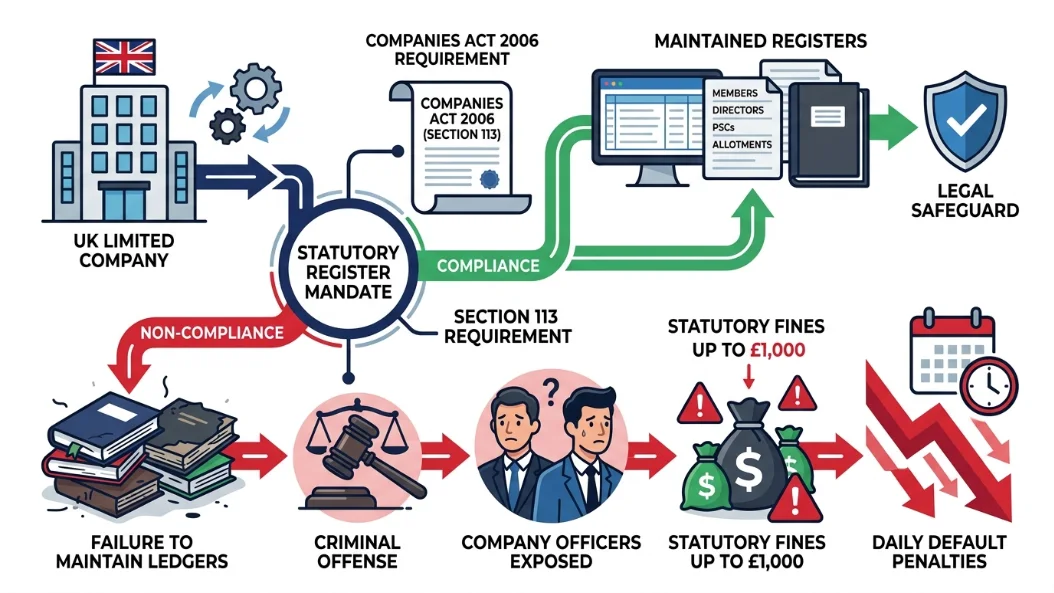
The legal requirement applies immediately upon official business formation. Every limited company, whether trading or dormant, must keep updated records. Companies House requirements enforce complete compliance across all registered entities. Section 113 mandates that legal ownership transfers take effect only after entry into the Register of Members. Share certificates alone do not grant formal shareholder status without entry into official statutory books.
Company directors bear direct personal responsibility for statutory record management. When law enforcement or tax authorities inspect corporate structures, they request statutory ledgers. Statutory compliance officers assess whether entries match public filings accurately. Defaulting on these duties leads to severe legal penalties. Fine structures include an initial penalty up to £1,000, followed by continuous daily fines for ongoing non-compliance. Persistent failure to maintain records damages corporate standing and risks court-ordered company dissolution.
Where Must Statutory Books Be Kept and Inspected?
Statutory books must be kept at the company’s registered office address or an designated Single Alternative Inspection Location within the same UK jurisdiction. Companies can also elect to hold specific register data directly on the central Companies House public register.
UK corporate regulation governs physical and digital storage locations for statutory books. Companies must notify Companies House regarding the location of their statutory books using formal filing forms. Public inspection rules allow legitimate third parties to inspect statutory records. Four inspection parameters govern access:
Inspect records during standard business hours upon providing advance legal notice
Access registers at the official registered office address registered with Companies House
View records at a designated Single Alternative Inspection Location registered via Form AD02
Review central public registers if the company elects central filing under statutory provisions
When third parties request formal inspection, companies must comply within statutory deadlines. Refusing lawful inspection requests leads to court orders and financial penalties. Digital statutory registers meet legal requirements if they remain accessible and printable upon request. Using secure digital management tools streamlines record maintenance while ensuring compliance during formal audits.
How Do Statutory Registers Impact Business Operations and Sales?
Statutory registers impact business sales by serving as the ultimate legal proof of share ownership and corporate authority during due diligence. Inaccurate registers delay commercial investments, invalidate share transfers, and disrupt company sales transactions.
Commercial solicitors scrutinize statutory registers during corporate acquisitions, bank financing applications, and investment funding rounds. Investors verify share capital structures using the Register of Members before transferring capital. When corporate records show discrepancies, deals stall indefinitely. Missing entries cast doubt on who legally owns the business, creating friction during contract negotiations.
Proper record management streamlines due diligence procedures significantly. Corporate buyers require complete statutory histories going back to initial business formation. To ensure long-term legal compliance, business owners often evaluate professional statutory solutions to prevent administrative gaps. If corporate records display errors, share transfers become legally void. Updating historical records retrospectively requires complex court applications or formal board rectifications. Clean, up-to-date registers instill confidence in lenders, investors, and potential corporate buyers.
What Is the Difference Between Companies House Filings and Statutory Registers?
Companies House filings are public administrative notifications submitted to the central registrar, whereas statutory registers are the primary internal legal documents that establish ownership. Public filings report corporate changes, but the statutory register legally enacts those changes.
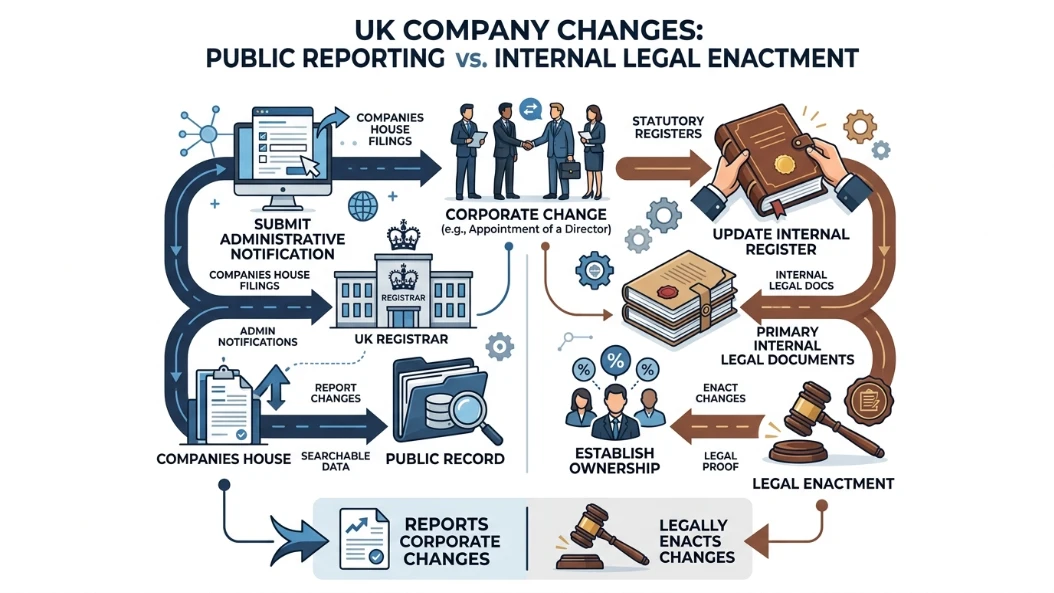
Many business owners confuse public submissions with internal statutory books. Companies House acts as a public repository for corporate notifications. However, submitting a form to Companies House does not fulfill internal statutory requirements on its own. Key distinctions define these two regulatory mechanisms:
Primary Evidence: Statutory registers serve as legal proof of legal ownership in court proceedings.
Legal Timing: Share ownership transfers legally when recorded in internal registers, not upon public filing.
Location: Statutory registers remain at registered office addresses, while public filings exist on online registries.
Scope: Internal registers hold confidential details, including private director residential addresses, exempt from public web databases.
Filing annual confirmation statements or director appointments updates the public database. However, directors must simultaneously update internal statutory books to satisfy legal duties. Relying solely on Companies House filings creates severe compliance failures. Both systems must mirror each other accurately to maintain legal integrity across all corporate operations.
How Can Companies Maintain Compliant Statutory Registers Efficiently?
Companies maintain compliant statutory registers efficiently by implementing automated governance software, executing immediate updates after corporate changes, and conducting routine annual compliance audits. Professional company secretarial services simplify legal bookkeeping and ensure full accuracy.
Maintaining compliance requires systematic administrative habits. Business structures change regularly through share allotments, director resignations, or address updates. When structural adjustments occur, secretarial administrators must record them immediately. To establish robust legal structures from day one, businesses rely on a comprehensive company pack to receive compliant statutory books, official share certificates, and required corporate ledgers.
Managing records manually via basic spreadsheets often leads to formatting errors and missing data. Digital governance platforms automate entry processes, reducing human error. Outsourcing secretarial management to trained professionals guarantees adherence to evolving UK legislation. Regular compliance audits identify discrepancies between internal records and public registers before problems arise. Proactive record management mitigates legal risks, protects director reputations, and maintains corporate transparency.
Organized record-keeping lays a solid foundation for long-term commercial success. When management prioritizes corporate compliance, business operations run smoothly without regulatory interruptions. To master proper record setup, follow our complete guide on how to set up and maintain your statutory company register for step-by-step secretarial instructions. Furthermore, when preparing for corporate growth, explore our advanced strategic framework on how to set up and maintain your statutory company register to keep your business fully audit-ready.
Form My Company delivers full corporate governance management for growing enterprises across the UK. With expert compliance tools, Form My Company simplifies administrative tasks so business owners can focus on commercial expansion.
Explore our Company Pack guide,
Identity Verification: Why Proof of ID Matters for UK PSCs
Confirmation Statements: Avoiding the Common Pitfalls for UK Directors
Frequently Asked Questions
What is included in a complete legal company pack for a UK limited company?
A standard legal Company Pack provides foundational governance documents, including the official certificate of incorporation, articles of association, and share certificates. It also contains fully formatted statutory registers to track directors, members, and people with significant control (PSC). Form My Company supplies these compliant digital and printed corporate records to ensure new businesses meet all legal requirements under the UK Companies Act 2006.
Why does a newly incorporated company need a statutory company pack?
A statutory company pack establishes legal proof of corporate ownership and structure required by banks, investors, and HMRC during due diligence. Without organized statutory registers and official share certificates, informal share transfers remain legally invalid regardless of public filings. Utilizing the Company Pack from Form My Company ensures all internal registers and governance documents are legally binding and audit-ready from day one.
Are physical corporate registers mandatory, or are digital versions allowed?
Under UK company law, statutory company registers can be maintained in either physical binder form or secure digital formats, provided they are accessible for inspection. Both formats must contain up-to-date details regarding company officers, shareholder allotments, and voting rights. Form My Company offers the Company Pack in flexible digital and physical formats to help business owners fulfill continuous record-keeping obligations efficiently.
How does a company pack assist with business bank account opening and due diligence?
Financial institutions and commercial solicitors require verified corporate formation documents and statutory registers to satisfy Anti-Money Laundering (AML) checks. The official documentation in a Company Pack confirms the identity of directors, ultimate beneficial owners, and issued share capital. Form My Company structures these corporate files to align with banking standards, accelerating account approval and investment processes.
How often should statutory registers in a company pack be updated?
Statutory registers must be updated immediately whenever structural changes occur, such as director appointments, share transfers, or address changes. Updating central records annually through confirmation statements does not replace the legal obligation to maintain real-time internal books. The Company Pack service from Form My Company includes standardized register templates that simplify ongoing secretarial updates and maintain continuous statutory compliance.