
UK companies must distribute the Articles of Association to shareholders through physical delivery, email attachment, or secure portal access under Section 32 of the Companies Act 2006. Delivery requires official tracking, digital confirmation, or statutory written acknowledgment to guarantee legal compliance.
Why Must UK Companies Share Articles of Association With Shareholders?
Section 32 of the Companies Act 2006 obligates UK registered companies to provide a current copy of the Articles of Association to any shareholder upon official request within seven days. Non-compliance results in statutory financial penalties and potential regulatory enforcement.
The Articles of Association serve as the legal constitution for a private limited company in the United Kingdom. This foundational document establishes legal governance rules, shareholder rights, director powers, and share transfer procedures. Private limited companies operate under clear statutory obligations to maintain total corporate transparency with equity holders. Shareholders rely on this document to evaluate voting rights, dividend entitlements, and pre-emption rights during share issuances.
Corporate compliance requires corporate officers to maintain accurate records of constitutional distributions. When a shareholder submits a written request, the company must dispatch the document within seven calendar days. Statutory regulations mandate that every registered member receives an exact copy of the constitutional framework operating at the time of request. Failure to deliver constitutional documents within the prescribed statutory timeframe triggers financial fines under UK company law. Managing corporate distributions effectively reduces legal exposure during shareholder disputes or governance audits.
When shareholders review their rights, questions often arise regarding co-founder documentation. Company secretaries and legal administrators should understand Do Co-Founders Each Need a Copy of the Articles of Association? to ensure early-stage compliance across all founding members. Directors must uphold transparent communication channels from company formation through every subsequent growth phase.
What Are the Approved Delivery Methods for Distributing Constitutional Documents?
Companies distribute Articles of Association legally using recorded postal delivery, direct email transmission with read receipts, or secure shareholder portals. Each method requires documented audit trails to prove statutory compliance under standard corporate governance frameworks.
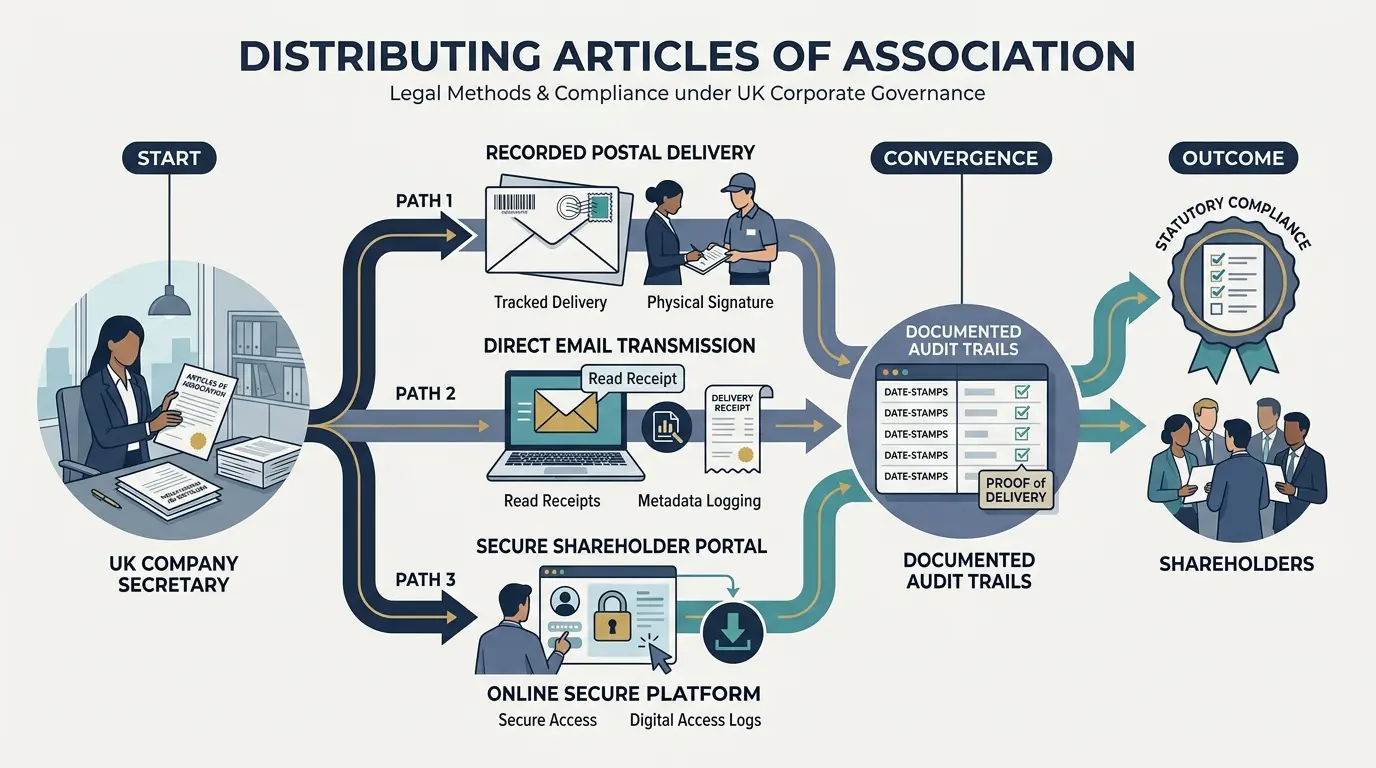
Digital transmission represents the most efficient distribution method for modern business operations. Company secretaries send PDF documents via encrypted email channels to verified shareholder addresses. Email delivery protocols require legal administrators to request delivery confirmations and read receipts. Digital audit logs capture exact timestamps, IP addresses, and recipient details to confirm successful transmission. Electronic distribution minimizes administrative expenses while ensuring instant delivery across global shareholder bases.
Physical distribution remains a valid statutory option for corporate compliance officers. Companies dispatch printed bound copies via royal mail tracked services or certified couriers. Physical delivery mechanisms demand sign-off upon receipt to establish an unassailable evidentiary paper trail. Registrars archive postal tracking numbers alongside official shareholder correspondence files. Corporate governance standards dictate that both physical and digital methods must guarantee document security and complete text legibility.
Secure shareholder portals provide centralized repositories for corporate documentation. Businesses upload constitutional files to restricted cloud environments requiring multi-factor authentication. Shareholder access logs record every document download, view, and print event automatically. Portals eliminate version control errors by hosting a single active master document online. Corporate entity management systems rely on these secure repositories to maintain continuous compliance readiness.
How Do You Ensure Version Control When Updating Shareholders?
Version control requires adding clear revision dates, updating the Companies House registry within 15 days, and issuing special resolution notices alongside revised constitutional documents. These steps prevent shareholder confusion and maintain statutory accuracy.
Constitutional amendments require approval through a special resolution passed by 75% of shareholder voting rights. When shareholders pass a special resolution, the company must file the updated Articles of Association at Companies House within 15 calendar days. Corporate filing delays breach statutory requirements and create discrepancies between internal registers and public records. Company secretaries update the master document header with precise amendment dates and resolution references before issuing copies.
Maintaining strict version control prevents shareholders from relying on obsolete corporate regulations. Version tracking standards require three documentation elements: clear header dates, resolution reference numbers, and precise clause revision logs. Administrative staff must archive legacy versions in designated secure folders marked as historical records. Shareholders must receive written notification highlighting specific clause modifications whenever constitutional updates occur.
Document management systems prevent conflicting governance rules from circulating among equity holders. Officers archive previous constitutional iterations in secure digital vaults to preserve historical corporate records. Every distributed file must match the registered document held on the public Companies House register exactly. Mismatches between internal shareholder copies and public filings jeopardize board decisions and corporate transactions.
What Documentation Records Must Companies Maintain for Audit Compliance?
Companies maintain complete distribution logs containing shareholder names, transmission dates, delivery methods, tracked receipt confirmations, and exact document version numbers. These records provide verifiable proof of compliance during independent corporate audits.
Audit compliance demands robust record-keeping protocols for all corporate distributions. Governance teams log every shareholder request in a dedicated corporate compliance register immediately upon receipt. Registrars record five primary metadata points: shareholder full name, delivery address, dispatch timestamp, transmission channel, and active version number. Detailed documentation logs satisfy statutory auditor requirements during annual governance reviews.
Digital record archives protect companies against potential shareholder litigation or compliance claims. Cloud platforms backup distribution receipts, signed acknowledgments, and electronic delivery confirmations automatically. Legal frameworks require companies to retain these compliance records for ten years minimum. Accessible documentation allows corporate officers to verify historical distribution compliance during investor due diligence or regulatory checks.
Professional corporate services simplify legal record maintenance and administrative tracking significantly. Businesses utilize specialized services to order supplementary company documents to maintain organized corporate registers without increasing internal overhead. External corporate support guarantees that physical and digital record archives adhere strictly to UK regulatory standards.
How Can Businesses Manage Large-Scale Shareholder Distributions Efficiently?
Businesses manage large-scale distributions efficiently by deploying automated compliance platforms, utilizing bulk digital messaging tools, and outsourcing physical document binding and dispatch to specialized corporate service providers.
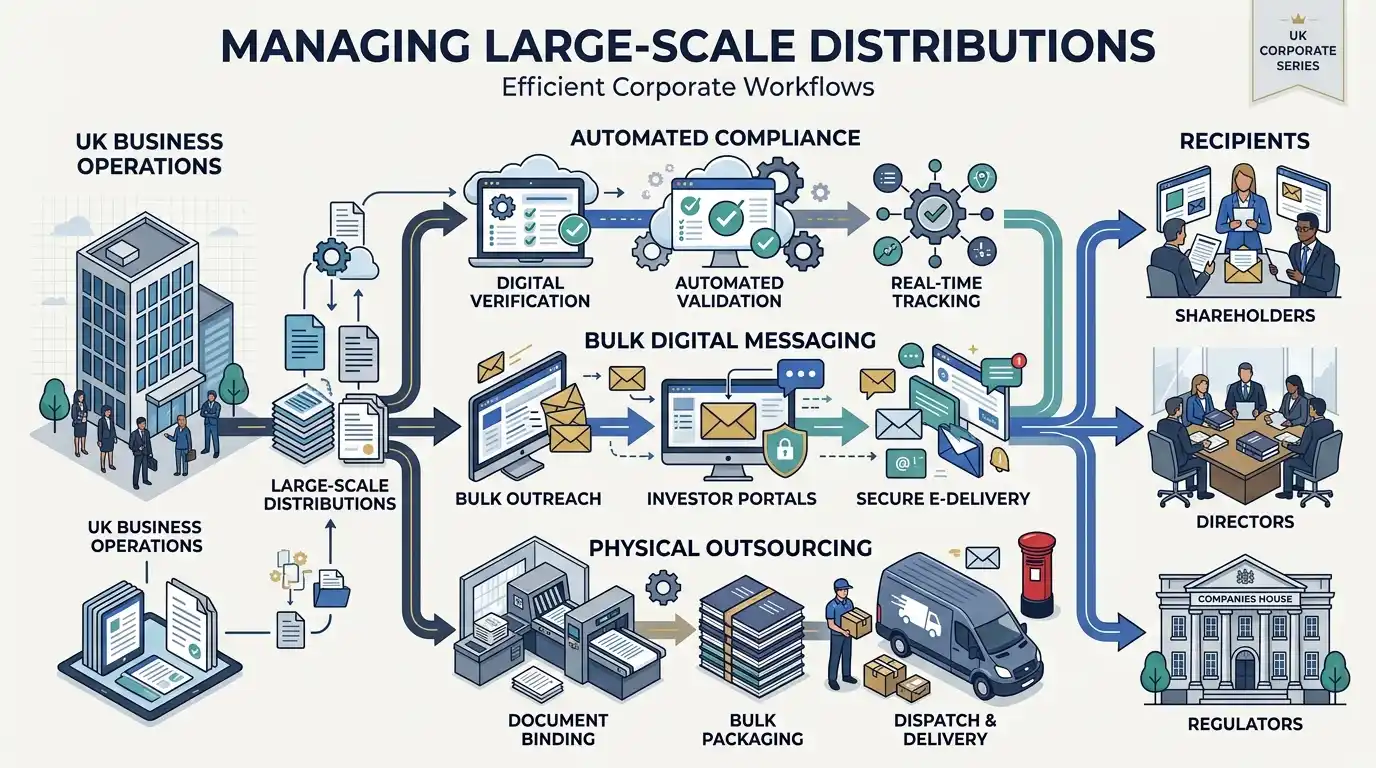
Companies with expanding share registers face complex document distribution challenges during corporate restructuring or annual general meetings. Automated shareholder management software integrates direct messaging channels with corporate database records. Automated workflows generate personalized delivery emails with tracked download links sent simultaneously to hundreds of registered members. Digital distribution platforms reduce administrative processing timelines from weeks to minutes.
Physical distribution for large shareholder bases requires specialized document production and fulfillment processes. Printed materials must conform to professional corporate presentation standards to ensure readability and durability. When preparing physical compliance packets, companies often choose to Get Extra Bound Articles for Every Director From Form My Company to maintain executive presentation standards alongside shareholder mailings. External fulfillment services handle printing, thermal binding, personalizing, and tracked mailing efficiently.
Outsourcing corporate document fulfillment eliminates operational bottlenecks for internal legal teams. Professional service providers guarantee strict quality control checks, complete page accuracy, and precise tracking integration. Corporate secretarial teams save valuable operational hours while maintaining total statutory compliance. Enterprise risk management models favor automated, outsourced fulfillment structures for high-volume corporate communication requirements.
How to Handle Shareholder Disputes Regarding Document Access?
Companies resolve document access disputes by presenting tracked delivery confirmations, verifying registered contact details, and reissuing authenticated copies within twenty-four hours via secure tracked channels.
Shareholder disputes regarding constitutional access require immediate, structured intervention by corporate officers. When a shareholder claims non-receipt, company secretaries inspect the central compliance distribution log immediately. Officers verify the dispatch timestamp, destination email or postal address, and delivery tracking confirmation. Clear documentary evidence establishes that the company fulfilled its statutory duties under Section 32 of the Companies Act 2006.
Address discrepancies represent a primary root cause of delivery failures in corporate governance. Shareholders must notify the company of contact detail updates under standard constitutional rules. If a shareholder fails to update their registered address, initial dispatch to the old address satisfies legal distribution attempts. Corporate teams update registers instantly upon receiving corrected details and reissue the constitutional files immediately.
When legal ambiguity arises, company secretaries issue a fresh, certified copy via tracked courier or encrypted email. Certification requires a formal statement signed by a director confirming the document matches the active Companies House filing. Rapid resolution protocols protect company reputation and prevent escalations to regulatory oversight bodies. Clear communication maintains positive investor relations across the entire corporate structure.
Explore More Supplementary Company Documents Guide,
How to Update Your Articles and File Them With Companies House
How to Store Bound Articles Alongside Your Statutory Registers
Frequently Asked Questions
What are supplementary company documents in the UK?
Supplementary company documents are official legal and administrative records that complement a business’s primary formation certificate and constitution. These include extra bound copies of the Articles of Association, official share certificates, statutory registers, and board resolutions required for corporate governance. Services from Form My Company enable businesses to order certified Supplementary Company Documents to satisfy bank compliance, investor due diligence, and statutory record-keeping standards.
Why do businesses need extra printed copies of corporate documents?
Banks, mortgage lenders, institutional investors, and foreign government bodies frequently demand physical, certified copies of corporate records during compliance reviews and account openings. Having physical Supplementary Company Documents produced by Form My Company ensures business owners can present professionally bound, up-to-date constitutional records without delaying commercial transactions or regulatory approvals.
How do I order additional share certificates or bound Articles of Association?
Business owners can request official constitutional duplicates and official registers directly through corporate secretarial providers. Form My Company offers streamlined access to Supplementary Company Documents, allowing company directors to specify required quantities, binding formats, and delivery preferences online. The processed documentation is printed, verified against official filings, and dispatched via tracked courier services.
Are supplementary company documents legally binding?
Yes, supplementary corporate files are legally valid when they match the current active register maintained at Companies House and contain authorized officer signatures. Certified Supplementary Company Documents provided by Form My Company reflect the registered legal framework of the business, ensuring complete statutory validity for corporate governance and legal proceedings.
When should a company update its statutory registers and supplementary records?
Statutory registers and constitutional documentation must be updated immediately following any corporate changes, such as share transfers, director appointments, or constitutional amendments passed via special resolutions. Utilizing Form My Company to maintain updated Supplementary Company Documents ensures full compliance with the Companies Act 2006 and prevents discrepancies during annual corporate audits.