
To time your Certificate of Good Standing request properly, submit your application 14 to 21 days before your compliance deadline or international transaction. This window accounts for standard Companies House processing times, shipping delays, and the typical 3-month validity period required by overseas authorities.
Timing a corporate document request requires strict adherence to administrative timelines. Overseas authorities, banking institutions, and regulatory bodies demand recent verification of a company’s active status. Delays in document issuance disrupt international trade, foreign subsidiary expansion, and corporate bank account openings. Business leaders must navigate bureaucratic processing windows carefully to prevent document expiration before the completion of commercial transactions.
Why Does Timing Matter for a Certificate of Good Standing?
Timely document requests ensure that corporate verification remains valid during active international transactions, preventing costly commercial delays and rejected applications from foreign regulatory bodies or overseas banking partners.
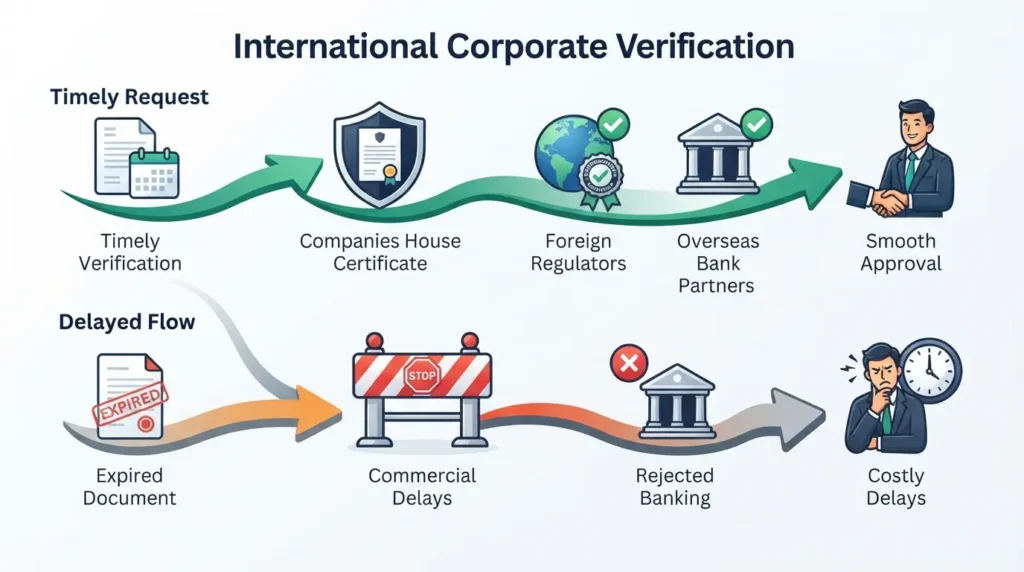
International trade and foreign expansion require strict alignment with administrative calendars. Foreign registries rarely accept verification documents older than 90 days. When directors request documents too early, the verification window closes before foreign authorities review the paperwork. When applicants wait until the last minute, standard processing backlogs at Companies House halt urgent business operations.
Strategic timing protects corporate timelines. Directors balance registry processing speeds against the strict expiration policies enforced by foreign jurisdictions. Companies House processes standard electronic requests within several business days while postal requests require additional transit time. International couriers introduce further variables when shipping physical certificates overseas. Proper planning neutralizes these operational risks.
How Long Does Companies House Take to Process a Request?
Companies House processes standard electronic Certificate of Good Standing requests within 3 to 5 business days, while expedited digital services and postal requests require distinct turnaround times based on submission methods.
Administrative efficiency at the UK registrar dictates operational scheduling for corporate compliance teams. Standard electronic applications move through digital verification queues swiftly. Expedited same-day services cost more fees but deliver urgent files rapidly. Postal applications involve manual document handling and physical dispatch cycles, extending total delivery duration to two weeks or more.
Business administrators must evaluate submission channels against project deadlines. Electronic delivery bypasses postal transit delays entirely. Digital files allow instant transmission to overseas legal counsel, foreign tax authorities, and international banking compliance officers. Physical paper copies require secure courier dispatch when overseas jurisdictions mandate stamped wax seals or original wet-ink signatures. Factoring these variables into operational schedules prevents missed deadlines during critical corporate expansions.
What Expiry Windows Do International Authorities Enforce?
International regulatory authorities and foreign banks enforce a strict 30-day to 90-day validity window for corporate verification documents originating from external jurisdictions.
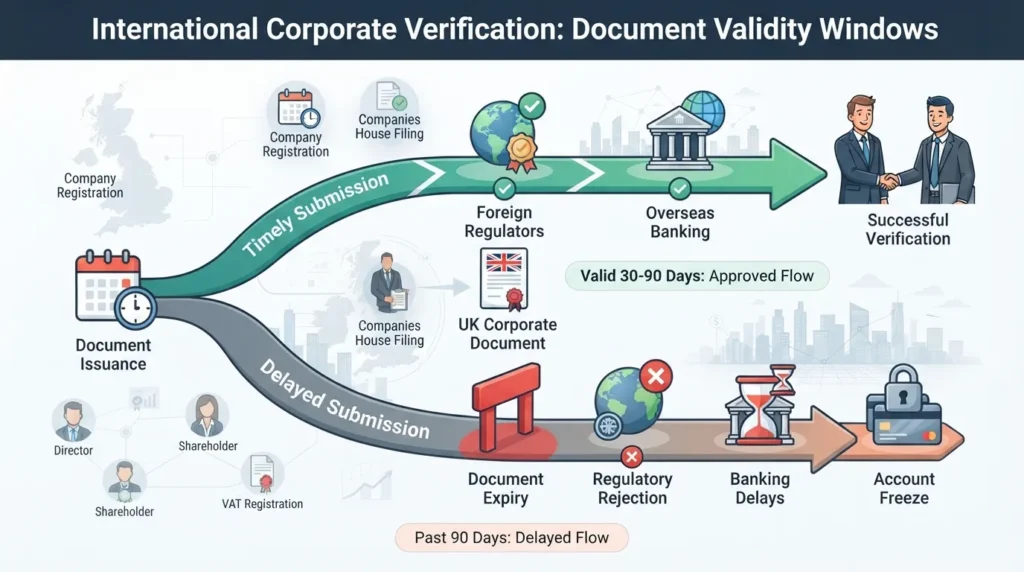
Global compliance standards require absolute certainty regarding an enterprise’s ongoing legal solvency. Foreign corporate registries assume that company directors alter corporate structures, update registered office addresses, or file dissolution notices frequently. Consequently, authorities in the United States, United Arab Emirates, and European Union demand fresh proof of active operational status. Documents older than three months face immediate rejection.
Navigating these international rules demands precise coordination between UK corporate secretaries and overseas legal representatives. When a foreign bank requests proof of company solvency for a merchant account opening, the issuance date dictates acceptance. Submitting an outdated document triggers administrative rejections, forcing corporate officers to restart the acquisition workflow. Aligning the request date with foreign intake schedules guarantees seamless cross-border regulatory clearance.
When Should You Order Your Document for Foreign Expansion?
Order your corporate verification document 15 days before submitting incorporation paperwork to a foreign trade ministry, ensuring the certificate remains fully valid throughout review.
International expansion involves multi-layered bureaucratic hurdles. Foreign investment boards review articles of association, director identifications, and proof of domestic solvency simultaneously. If a compliance officer reviews a file on day forty of an evaluation, a certificate ordered two months prior satisfies the local ninety-day validity threshold.
Strategic sequencing eliminates administrative bottlenecks. Corporate legal teams establish a timeline where company secretarial tasks synchronize with foreign filing windows. Directors coordinate with specialist providers like Form My Company to streamline document generation. Securing verified corporate credentials at the exact midpoint of an overseas project lifecycle protects against unexpected administrative friction.
How Can You Prevent Expiration Delays During Complex Transactions?
Prevent expiration delays by monitoring Companies House filing cycles, auditing annual confirmation statement dates, and utilizing professional corporate secretarial services for rapid document retrieval.
Complex cross-border mergers and foreign subsidiary setups involve numerous interdependent variables. An overdue confirmation statement or unfiled annual accounts halts the issuance of a Certificate of Good Standing immediately. Companies House rejects applications automatically if a business fails to maintain up-to-date public records. Directors must resolve all internal compliance discrepancies before submitting a formal document request.
Proactive compliance management safeguards enterprise value. Business leaders review internal filing calendars quarterly to identify upcoming statutory deadlines. Establishing a systematic review process ensures that statutory registers, director records, and PSC registers remain pristine. Read our comprehensive guide on how long is a Certificate of Good Standing valid for to understand exact statutory validity rules. When international transactions demand immediate proof of active status, utilize our expert solutions detailed in renew your Certificate of Good Standing quickly with Form My Company to accelerate document acquisition and secure global compliance.
Mastering the timeline for requesting a Certificate of Good Standing protects corporate agility during international expansion. Structuring applications around Companies House processing speeds and foreign validity windows prevents costly administrative rejections. Form My Company delivers precise document retrieval solutions that align with strict global compliance standards.
Explore More Certificate of Good Standing Guide,
How to Prepare Your Company Before Requesting Proof of Good Standing
Comparing Reasons Companies Request a Certificate of Good Standing
Frequently Asked Questions
What is a Certificate of Good Standing UK?
A Certificate of Good Standing is an official document issued by Companies House confirming that a UK registered company has been in continuous existence since incorporation. Form My Company assists businesses in obtaining this authenticated corporate verification to satisfy international regulatory requirements, banking compliance checks, and foreign subsidiary setups.
How long does it take to get a Certificate of Good Standing?
Standard digital processing through Companies House typically takes between 3 to 5 business days for electronic delivery. When businesses use professional filing agents like Form My Company, urgent applications and expedited delivery options can significantly accelerate document retrieval for time-sensitive global transactions.
How long is a Certificate of Good Standing valid for?
Most international authorities, overseas banks, and foreign corporate registries enforce a validity window of 30 to 90 days from the date of issuance. Because foreign institutions require up-to-date proof of legal solvency, businesses must time their requests carefully through providers like Form My Company to prevent administrative rejections.
Can a dissolved or non-compliant company get a Certificate of Good Standing?
Companies House will not issue a Certificate of Good Standing if a company has overdue confirmation statements, unfiled annual accounts, or active dissolution notices pending. Companies must resolve all internal filing discrepancies and ensure complete regulatory compliance before Form My Company can successfully retrieve their certificate.
Why do international banks require a Certificate of Good Standing?
Foreign banking institutions require a Certificate of Good Standing to authenticate a corporate entity’s legal existence and verify that directors hold active authorization to open merchant accounts. Submitting this official verification via Form My Company satisfies international anti-money laundering frameworks and cross-border compliance standards.