

Inside IR35 means a contractor is treated as an employee for tax purposes for a particular engagement, even when providing services through their own limited company or personal service company. The off-payroll working rules determine whether Income Tax and National Insurance must be deducted from payments for that engagement. The same contractor can be inside IR35 on one contract and outside IR35 on another.
The distinction matters because an inside IR35 determination changes how the income from an engagement is taxed and who is responsible for operating PAYE. It can also affect the financial advantages of working through a limited company.
This guide explains what inside IR35 means, how it differs from outside IR35, which employment-status factors matter, who makes the determination and what contractors should check before accepting an engagement.
What Is Inside IR35 in Plain English?
Inside IR35 describes an engagement where the working relationship is considered employment for tax purposes if the contractor were providing the services directly to the client rather than through an intermediary.
The rules are designed to prevent individuals from avoiding employment taxes by providing services through a personal service company when the underlying working relationship resembles employment.
For example, a consultant may operate through a limited company but work under arrangements where the client controls their activities, expects them to provide the services personally and treats them much like an employee. These circumstances may indicate that the engagement falls inside IR35.
An inside IR35 determination does not automatically make the contractor an employee under employment law. It concerns the tax treatment of the engagement and does not, by itself, provide employment rights such as statutory holiday pay, sick pay or redundancy protection.
The rules are commonly called IR35 or the off-payroll working rules. The applicable legislation and responsibility for determining status depend on the engagement and the type and size of the client.
Inside vs Outside IR35: Key Differences
The main difference between inside and outside IR35 is whether the engagement is treated as employment for tax purposes. Inside IR35 generally requires PAYE-style deductions under the applicable rules, while outside IR35 means the engagement is not treated as deemed employment under those rules.
| Comparison | Inside IR35 | Outside IR35 |
|---|---|---|
| Tax status | Deemed employment for tax purposes | Not deemed employment for tax purposes under IR35 |
| Income tax | PAYE deductions generally apply where the off-payroll rules apply | The intermediary accounts for income and company taxes under normal rules |
| National Insurance | Employee NIC deductions and employer NIC liability apply under the relevant rules | Normal company payroll and personal tax rules apply |
| Salary and dividends | Salary-and-dividend flexibility does not apply in the same way to income treated as deemed employment | The contractor may use salary and dividends where legally and financially appropriate |
| Status assessment | Determined under the applicable IR35 rules | Determined under the applicable IR35 rules |
| Employment rights | Does not automatically provide employment rights | Does not automatically establish employment rights either |
| Contract assessment | The actual contractual terms and working practices indicate deemed employment | The overall working relationship indicates genuine independence for tax purposes |
A contractor should not assume that operating through a limited company automatically means every contract is outside IR35. The status depends on the specific engagement and the reality of the working relationship.
For a broader explanation of the legislation and its effect on contractors and businesses, read our guide to what IR35 is and how it affects contractors.
What Are the Main Status Tests for Inside IR35?
There is no single question or isolated test that determines IR35 status. Employment status is assessed by considering the complete contractual relationship, the practical working arrangements and relevant case-law principles.
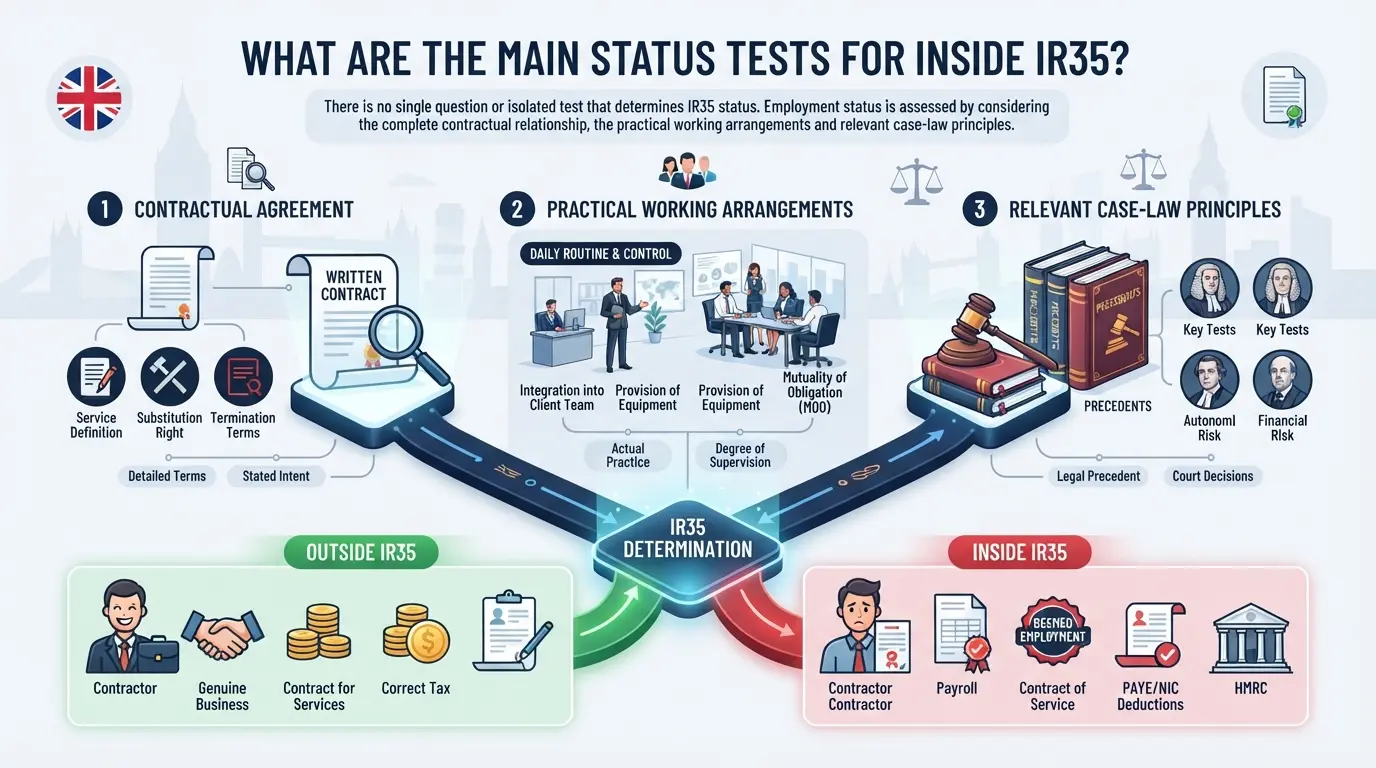
Three important factors commonly considered are control, personal service and mutuality of obligation.
1. Control
Control concerns how much authority the client has over the contractor’s work. This includes whether the client decides how tasks are completed, sets working hours, determines the place of work and supervises the contractor’s day-to-day activities.
A high level of client control may indicate an employment relationship, particularly where the contractor has little practical independence over how the services are delivered.
By contrast, genuine control over the method and organisation of the work can support an outside IR35 position. However, the nature of the assignment must be considered because some projects require clients to specify outcomes, deadlines or security procedures without necessarily creating an employment relationship.
2. Substitution and Personal Service
Personal service concerns whether the contractor must personally carry out the work or has a genuine right to provide a suitably qualified substitute.
A genuine and workable right of substitution can support an outside IR35 assessment. It suggests that the client is purchasing a service rather than requiring the personal labour of a particular individual.
However, the wording of a contract is not enough by itself. The right must be genuine and consistent with the actual working arrangements. A substitution clause that cannot realistically be used, or that requires unrestricted client approval, may carry limited weight.
3. Mutuality of Obligation
Mutuality of obligation considers the commitments between the client and contractor.
The assessment may consider whether the client is required to provide ongoing work and whether the contractor is expected to accept it. An ongoing obligation to provide and accept work can support an employment relationship.
A defined project with specific deliverables and no continuing obligation beyond the agreed assignment may support an outside IR35 position.
The duration of a contract alone does not determine status. A long engagement can still be outside IR35, while a shorter engagement can fall inside the rules.
Other Relevant Employment-Status Factors
Control, substitution and mutuality of obligation are important, but they are not the only considerations. Other factors may include:
- Financial risk: Whether the contractor bears genuine financial responsibility for correcting defective work or managing project costs.
- Equipment: Whether the contractor supplies significant equipment or relies on the client’s resources.
- Integration: Whether the contractor is integrated into the client’s organisation in a way that resembles an employee.
- Business independence: Whether the contractor operates independently, markets services to other clients and manages their own business activities.
- Contractual obligations: Whether the written agreement reflects the actual relationship and working practices.
HMRC considers the overall circumstances rather than relying on a single contractual clause or label.
Who Decides Whether a Contract Is Inside IR35?
Responsibility for determining IR35 status depends mainly on the client’s sector and size.
For public sector clients and medium or large-sized private and voluntary sector clients, the client is generally responsible for determining the contractor’s employment status for tax purposes under the off-payroll working rules.
For small private sector clients, the contractor’s intermediary, usually their personal service company, remains responsible for assessing status under the original IR35 rules.
Medium and Large Private Sector Clients
Where the off-payroll working rules apply, the client must take reasonable care when making its determination. It must communicate the outcome through a Status Determination Statement, commonly called an SDS.
The statement should explain whether the engagement is inside or outside the off-payroll working rules and provide the reasons for the decision. It must be passed to the worker and the relevant organisation in the contractual chain.
The fee-payer is generally responsible for operating PAYE and accounting for employee National Insurance contributions where the engagement is determined to be inside the rules. Employer National Insurance contributions and the Apprenticeship Levy, where applicable, are also dealt with by the responsible deemed employer.
Small Private Sector Clients
Where the client qualifies as small under the relevant rules, the off-payroll working rules introduced for medium and large clients do not apply.
The contractor’s intermediary remains responsible for determining whether the engagement falls inside IR35 under Chapter 8 of the Income Tax (Earnings and Pensions) Act 2003.
This means the contractor cannot assume that working for a small client automatically makes the contract outside IR35. The underlying employment-status assessment is still necessary.
Overseas Clients and Company-Size Changes
Special rules apply where a client is wholly overseas and has no UK connection. In these circumstances, the client-side off-payroll working rules may not apply, and the contractor’s intermediary may remain responsible for the status assessment under the original rules.
Company-size thresholds also changed. From 6 April 2025, the relevant Companies Act financial thresholds increased to £15 million turnover and £7.5 million balance sheet total, while the employee threshold remained at 50. The timing of the effect on IR35 classification depends on the relevant financial years and the applicable two-year test. Therefore, it is not correct to assume that every previously medium-sized client became small on 6 April 2026.
Contractors should ask clients to confirm their size where responsibility for the determination is unclear.
What Are the Tax Consequences of Being Inside IR35?
An inside IR35 determination changes how income from the relevant engagement is treated for tax purposes. Where the off-payroll working rules apply, the deemed employer or fee-payer generally deducts Income Tax and employee National Insurance contributions before paying the remaining amount.
The responsible party must also account for employer National Insurance contributions and the Apprenticeship Levy where applicable.
PAYE and National Insurance Deductions
For an engagement inside the off-payroll working rules, PAYE-style deductions apply to the deemed employment payment. The contractor therefore receives a payment after the relevant tax and employee National Insurance deductions.
The precise calculation depends on the contractual arrangements, the fee-payer’s responsibilities and the applicable tax rules.
Contractors should review the payment breakdown carefully so they understand which deductions have been made and which party is responsible for the associated liabilities.
Reduced Salary and Dividend Flexibility
One financial consequence of being inside IR35 is that the income from the engagement cannot be treated as ordinary company trading income for extraction through the usual salary-and-dividend approach in the same way as an outside IR35 engagement.
A contractor may still operate a limited company and undertake other work, but the tax treatment of each engagement must be considered separately.
Where a contractor has outside IR35 income, the company may continue to account for that income under the normal corporation tax and payroll rules. Any salary or dividend payments must be supported by the company’s circumstances and the relevant legal requirements.
Outside IR35 and Company Income
For an outside IR35 engagement, the intermediary generally accounts for the income under normal company tax rules. A limited company may pay Corporation Tax on its taxable profits and, where appropriate, pay its director a salary or distribute dividends from available profits.
Dividend payments are subject to personal tax rules and the applicable dividend allowance and rates. For the 2026/27 tax year, the dividend tax rates above the £500 allowance are 10.75% for the basic rate, 35.75% for the higher rate and 39.35% for the additional rate.
The most suitable way to extract company profits depends on the contractor’s total income, company profits, other earnings and personal circumstances. An accountant should review the figures before recommending a salary and dividend arrangement.
Contractors who want to understand the practical options can read our guide on how to pay yourself from a contractor limited company.
How Can Contractors Assess Their Own IR35 Position?
A contractor can review the main features of an engagement before accepting a contract or starting work. This initial review helps identify potential concerns, but it is not a substitute for a professional status assessment.
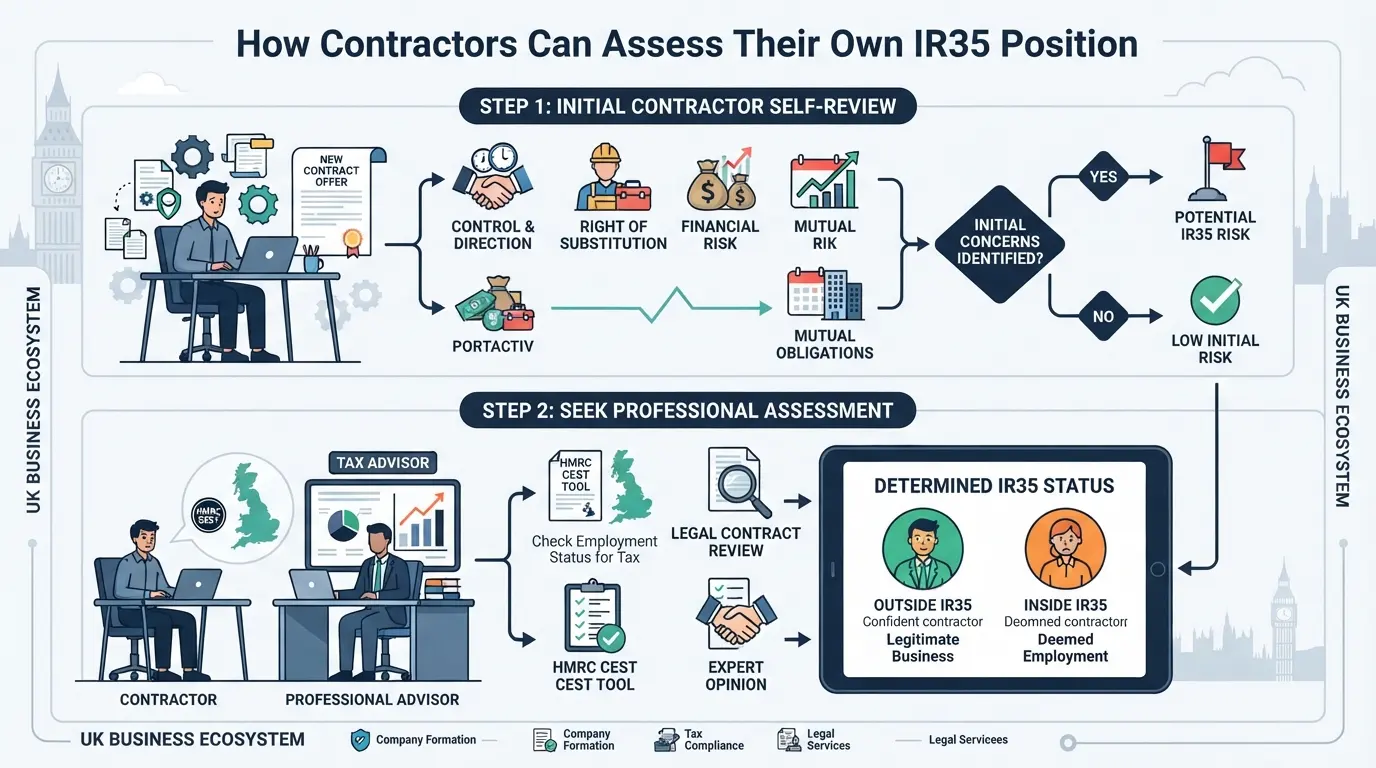
Use the following checklist to organise the information.
Inside or Outside IR35 Contract Checklist
| Question to review | What to consider |
|---|---|
| Who controls the work? | Does the client control the method, working hours and day-to-day delivery? |
| Is personal service required? | Must you personally perform the work, or is there a genuine substitution arrangement? |
| Is there an ongoing obligation? | Must the client provide continuing work, and are you expected to accept it? |
| Do you carry financial risk? | Are you responsible for correcting defective work or managing costs? |
| Who supplies equipment? | Do you provide significant tools and equipment required for the assignment? |
| Are you integrated into the client organisation? | Do you operate as part of the client’s staff structure or as an independent service provider? |
| Can you work for other clients? | Are you genuinely free to provide services to other businesses? |
| Does the contract reflect actual working practices? | Do the written terms match how the engagement operates in practice? |
| Who is responsible for the determination? | Is the client small, medium or large, and which IR35 rules apply? |
| Has a status statement been provided? | Where required, have you received an SDS explaining the determination and its reasons? |
The answers should be considered together. A contractor should not classify an engagement as outside IR35 simply because one or two factors appear favourable.
Review the Contract and Working Practices
A contract should accurately describe the services, responsibilities, payment arrangements and working relationship. However, the actual working practices must also reflect those terms.
If the client changes the contractor’s responsibilities, introduces closer supervision or changes the delivery arrangements, the original status assessment may no longer reflect the engagement.
Contractors and clients should review the determination when there is a material change to the contract or working arrangements.
Use HMRC’s Employment Status Guidance
HMRC provides the Check Employment Status for Tax tool, known as CEST, to help assess employment status for tax purposes.
The tool can support a status review, but users must provide accurate information about the contract and working practices. Where the circumstances are complex or the result does not provide a clear answer, professional advice may be necessary.
Why Does the Difference Between Inside and Outside IR35 Matter?
The distinction affects contractor income, company administration, client responsibilities and the financial suitability of operating through a limited company.
For an outside IR35 engagement, a contractor generally has greater flexibility over how the company manages its income and pays the director. For an inside IR35 engagement, the applicable tax deductions reduce that flexibility for the relevant income.
The distinction can also influence whether a contractor accepts an assignment, negotiates a different rate or considers working through an umbrella company.
However, contractors should not make a decision based only on estimated take-home pay. They should consider the full contract terms, tax treatment, business expenses, accountancy costs and the security of the working arrangement.
Those comparing business structures can also explore our guides to UK limited companies versus sole traders and limited company versus sole trader tax considerations in 2026. These guides cover wider business-structure and tax considerations rather than replacing an IR35 status assessment.
How Form My Company Supports Contractors
Form My Company helps entrepreneurs and contractors establish UK limited companies and organise the administrative foundations needed to operate a business.
For contractors planning to work through a personal service company, company formation is an important first step. A properly established company provides the legal structure through which business activities, contracts and company administration can be managed.
Form My Company supports the company formation process and provides assistance with relevant setup requirements, including registered office arrangements and identity verification support.
IR35 status assessments and ongoing tax planning require specialist advice from a qualified contractor accountant or IR35 adviser. Form My Company does not replace that specialist assessment. Contractors should obtain advice on their specific engagements before relying on an inside or outside IR35 determination.
Frequently Asked Questions
What does inside IR35 mean?
Inside IR35 means a contractor is treated as an employee for tax purposes for a particular engagement, even when providing services through a limited company or another intermediary. Where the off-payroll working rules apply, PAYE and National Insurance deductions are generally made by the responsible fee-payer or deemed employer.
What is the difference between inside and outside IR35?
Inside IR35 means the engagement is treated as employment for tax purposes under the applicable rules. Outside IR35 means the engagement is not treated as deemed employment under those rules, allowing the intermediary to account for the income under normal tax arrangements.
What are the three main IR35 status factors?
Three important factors are control, personal service and mutuality of obligation. They help establish whether the contractor is operating independently or working in a relationship resembling employment. Other factors, including financial risk, equipment and integration, must also be considered.
Who decides whether a contractor is inside IR35?
Public sector and medium or large private sector clients are generally responsible for determining status under the off-payroll working rules. For qualifying small private sector clients, the contractor’s intermediary remains responsible for the assessment under the original IR35 rules.
Does being inside IR35 mean I am an employee?
No. An inside IR35 determination concerns tax treatment and does not automatically give the contractor employment rights. The contractor may still operate through a limited company, but the income from the relevant engagement is treated as deemed employment income for tax purposes.
Can I be inside IR35 on one contract and outside IR35 on another?
Yes. IR35 status is assessed for each engagement rather than assigned permanently to an individual. A contractor can have one engagement inside IR35 and another outside IR35, depending on the specific contractual terms and working practices.
Does an outside IR35 contract mean I pay no tax?
No. Outside IR35 does not mean tax-free income. The contractor’s intermediary must account for applicable Corporation Tax, payroll obligations and other company taxes. The individual may also pay personal tax on salary and dividends received.
Can a small company still have inside IR35 contractors?
Yes. A small private sector client does not have to operate the reformed client-side off-payroll rules in the same way as a medium or large client. However, the contractor’s intermediary must still assess whether the engagement falls inside IR35 under the original rules.
Can I use an umbrella company for an inside IR35 contract?
Yes. An agency or client may arrange for a contractor to work through an umbrella company. The contractor becomes an employee of the umbrella company, which operates payroll and makes the required deductions. The contractual and payment arrangements should be reviewed before accepting the assignment.
Make Informed Decisions About Your IR35 Status
Understanding inside IR35 is essential for contractors who provide services through a limited company or personal service company. The determination affects how income is taxed, who is responsible for deductions and how the contractor manages the financial arrangements for each engagement.
Contractors should review the contract, actual working practices and client responsibilities before accepting an assignment. They should also obtain specialist advice where the status is uncertain or the working relationship changes.
Form My Company supports contractors with UK company formation and the administrative foundations of running a limited company. Explore the available company formation support and seek qualified tax advice to manage your contracting arrangements with confidence.