

A non-profit can have a formal company structure without shareholders. For a non-profit, setting up a limited by guarantee company means its members act as guarantors, promising an agreed amount if the company cannot pay its debts; that amount can be as low as £1. The company needs at least one director and one guarantor, although the same person can hold both roles.
Choosing this structure is only the first step. You’ll also need governing documents that reflect the organisation’s aims, a registered office address and ongoing Companies House filings. If the company is intended to operate as a charity, charitable status is separate from incorporation and may involve additional requirements.
This guide explains how the structure works, who makes decisions and carries responsibilities, and what the memorandum and articles of association should cover. It also outlines the accounts and confirmation statements the company must file, so you can understand the commitments before proceeding.
Key Takeaways
- Understand how members’ guarantees limit their liability and how this structure differs from a company with shares.
- Learn who can act as a director or guarantor, and how one person may hold both roles.
- See how the articles of association can set out the organisation’s aims and direct what happens to its assets if it closes.
- Know which annual documents the company must file and why keeping its records up to date matters.
- Find out how Form My Company’s Limited by Guarantee Package can support the formation process.
What is a limited by guarantee company?
A company limited by guarantee is an incorporated structure with members rather than shareholders. For a non-profit, setting up a limited by guarantee company can provide a formal organisation without share ownership. Members promise an agreed contribution if the company cannot pay its debts.
Membership and member guarantees
Membership means belonging to the company and agreeing to its guarantee, rather than owning shares. Each member’s liability is generally limited to the amount they have promised, which the company chooses. That amount can be as low as £1. The guarantee is not a share of the company’s value. This distinction helps founders separate membership and decision-making from personal ownership, and clarify who can participate in the organisation.
Liability and separate legal personality
Separate legal personality means the company exists as a legal entity distinct from its members. It can take on responsibilities in its own name, while a member’s financial exposure is generally limited to their agreed guarantee. The company remains responsible for its own debts. Limited liability does not remove the need to manage the organisation responsibly, meet filing obligations or ensure directors oversee its activities.
The Companies Act 2006 framework governs UK companies limited by guarantee, according to The National Archives. A registered company needs a registered office address within the UK and must register with Companies House. Its name generally ends in “Limited” or “Ltd”, unless a statutory exemption applies. It can also provide up to four SIC codes describing its business activities.
Unlike a company limited by shares, this structure has no share capital or shareholders. Instead, members act as guarantors. Their guarantees support the company’s limited liability structure, while its objectives guide its work. For example, a community organisation could use membership rules to define who participates in decisions while directing its activities towards its stated non-profit purpose.
A company limited by guarantee does not automatically become a charity. In England and Wales, it must register with the Charity Commission to gain charitable status; Scotland and Northern Ireland have their own charity regulators. Its objects must be charitable in law and meet the public benefit test under charity law.
Before setting up a limited by guarantee company for a non-profit, align the membership model, guarantee and stated objectives. Common mistakes include assuming incorporation alone grants charitable status, overlooking the usual “Limited” or “Ltd” name ending, and confusing a guarantee with share ownership. Unclear membership rules can also complicate decision-making, so ensure the governing documents reflect how the organisation intends to operate.
Directors, guarantors and People with Significant Control
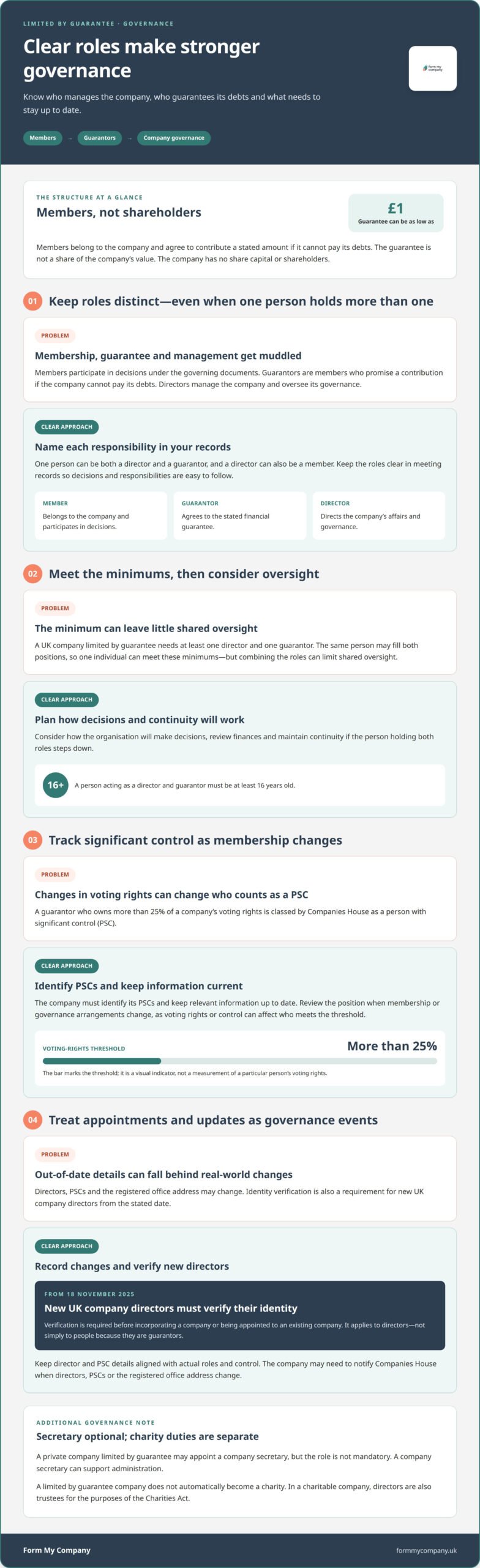
Directors manage the company, while guarantors are members who promise a contribution if it cannot pay its debts. Some people hold both roles, but each role has distinct responsibilities.
Director and company secretary eligibility
A director is responsible for helping direct the company’s affairs, while a company secretary can support its administration. A person acting as a director and guarantor must be at least 16 years old, according to Companies House. A private company limited by guarantee may appoint a company secretary, but the role isn’t mandatory. Consider who can contribute the time, judgement and oversight the organisation needs.
Roles of members, guarantors and directors
Members belong to the company and participate in decisions under its governing documents; guarantors are members who agree to a financial guarantee. Directors lead the company’s management and are responsible for its governance. One person can be both a director and guarantor, and a director can also be a member. Keep the roles clear in meeting records so decisions and responsibilities are easy to follow.
Minimum directors and guarantors
A UK company limited by guarantee needs at least one director and one guarantor. The same person may fill both positions, so a small organisation can meet these minimums with one individual. However, combining both roles in one person can limit shared oversight. Consider how the organisation will make decisions, review finances and maintain continuity if that person steps down.
Companies House classes a guarantor who owns more than 25% of a company’s voting rights as a person with significant control (PSC). The company must identify its PSCs and keep relevant information current. A change in voting rights or control can affect who meets the threshold, so review the position when membership or governance arrangements change.
From 18 November 2025, new UK company directors must verify their identity before incorporating a company or being appointed to an existing company. This requirement applies to directors, not simply to people because they are guarantors. Build identity verification into the appointment process, and keep the company’s director and PSC details aligned with actual roles and control.
Directors oversee the company’s activities and should understand its objectives, governing documents and financial position. In a charitable company, directors are also trustees for the purposes of the Charities Act. Governance decisions must therefore account for both company responsibilities and the charity’s purposes. Clear minutes, defined responsibilities and careful financial oversight help directors demonstrate how decisions support the organisation’s work.
The company may need to notify Companies House when directors, PSCs or the registered office address change. Treat appointments and departures as governance events, not just internal updates. Record who made each decision and when; accurate records help the company maintain a consistent account of its leadership and control.
Memorandum and articles of association
The memorandum and articles establish the company’s starting point and internal rules. For a non-profit, their wording should support its purpose and explain how it will be governed.
Choosing bespoke or model articles with help from a formation provider
Model articles offer a standard starting point, while bespoke articles can reflect an organisation’s specific aims and governance needs. This choice matters because members and directors use the articles to understand how decisions are made.
A formation provider can help align the proposed company name, registered office address and objects with the intended structure. It can also identify where standard wording may not reflect the organisation’s membership arrangements or non-profit aims, and prepare the relevant formation details for filing.
For example, an organisation with several member groups may need clear provisions explaining how each group participates in decisions. Review the proposed articles against the organisation’s actual plans rather than treating them as administrative wording alone.
Company purpose and objects
The company’s purpose describes what it exists to achieve, while its objects set out the activities it is organised to pursue. Clear objects help members and directors understand the boundaries of the company’s work.
For a charity, the objects must be charitable in law and meet the public benefit test. Careful drafting matters: broad or unclear language may not accurately describe the organisation’s intended charitable work. For instance, an organisation supporting local education should ensure its stated objects reflect that purpose.
Connect the objects to the organisation’s planned activities and governing arrangements. A formation provider can help present the company’s name, registered office details and stated objects consistently in the incorporation information.
Asset locks in the articles
An asset lock is a provision in the articles that directs what happens to remaining funds or assets if the company dissolves. It can help keep the organisation’s resources dedicated to non-profit purposes.
The articles may direct remaining assets to another registered non-profit or charitable body on dissolution. This gives members a defined way to deal with assets rather than leaving the outcome unclear. The wording should identify an appropriate recipient by its status and purpose.
Guarantors do not usually receive profits from a company limited by guarantee. Funds are generally retained within the company or used for other purposes, with profits reinvested towards its objectives. The articles should explain how those objectives guide the use of funds and what happens to assets if the organisation closes.
Before filing, compare the memorandum and articles with the organisation’s practical plans: who can join, how decisions are made and how resources support its objects. Consistent documents help members and directors apply the same rules as the organisation develops.
Annual accounts and confirmation statements
After incorporation, a company limited by guarantee has ongoing filing, accounting and tax responsibilities. Keep these duties in view alongside its governing arrangements.
Annual accounts and returns
Every year, the company must deliver annual accounts and a confirmation statement to Companies House. These separate filings help keep its financial and registered information current.
Accounts report the company’s financial position for the relevant accounting period. The confirmation statement confirms key company details, including its registered office and people with significant control. Treat these as separate filings: submitting one does not replace the other.
In England and Wales, a charitable company must also submit annual returns and accounts to the Charity Commission. It therefore has reporting responsibilities to both Companies House and its charity regulator. Keep records organised so the figures and details in each submission are consistent.
A useful routine is to record income and spending as they occur, then reconcile those records before preparing accounts. For example, record a grant separately from membership income so the organisation can explain how funds support its activities. Clear records also help directors review finances and prepare accurate filings.
A company may need support with filing its confirmation statement. A formation provider can help with this administrative task through a confirmation statement filing service, helping keep the company’s Companies House information up to date.
Ongoing filing, tax and governance duties
Ongoing duties include annual Companies House filings, tax responsibilities to HMRC and recording the company’s governance decisions. Managing them together helps directors maintain a reliable view of the organisation’s finances and compliance.
Profits made by a UK company limited by guarantee are subject to Corporation Tax. The company may need to submit a corporation tax return to HMRC. It must notify HMRC of its operational tax status within three months of starting active operations.
Track when the organisation starts active operations, as this starts the three-month notification period. Keep financial records showing income, costs and how funds are used. These records support tax reporting and give directors information for oversight.
Banking arrangements also affect how clearly the company can manage its finances. A business bank account can keep company transactions separate from personal spending, making it easier to track grants, donations or membership payments. Plan for account administration as part of the company’s financial controls, and retain supporting transaction records.
Governance continues between annual filings. Directors should review financial information, record significant decisions and ensure submitted details reflect the company’s current position. If directors, people with significant control or the registered office address change, the company may need to notify Companies House. Update internal records as changes happen so the next confirmation statement and accounts can be prepared using accurate information.
Differences between guarantee and share companies
The main difference is how each company is structured. A company limited by guarantee has no share capital or shareholders; its members act as guarantors instead. A company limited by shares has shareholders and share capital, so the structures organise membership and financial participation differently.
In a guarantee company, members agree to contribute a specified amount if the company cannot pay its debts. Their membership does not represent ownership through shares. In a share company, shares represent a person’s interest in the company. This distinction helps a non-profit decide whether it needs a member-based structure or one based on share ownership.
Consider a community group whose members want to shape the organisation’s decisions without holding shares. A guarantee structure can link membership to participation and the agreed guarantee. By contrast, a business that needs share capital or intends to involve shareholders may find a share-based structure better suited to its plans. The right choice depends on how the organisation intends to govern itself and fund its work.
These differences affect governance as well as funding. Members of a guarantee company participate under its articles of association, while shareholders in a share company hold shares. The company’s documents set out how decisions are made. For example, a membership organisation can define voting arrangements for its members without allocating shares to them.
- Guarantee structure: members act as guarantors, with no shares or shareholders.
- Share structure: shareholders hold shares, and the company has share capital.
- Practical choice: match the structure to the organisation’s membership, decision-making and funding plans.
Both structures require formal company records and filings with Companies House. Consider their accounts and reporting requirements as part of ongoing administration, not just a one-off formation task. The company name and public records identify the legal entity, but do not determine whether it has members or shareholders. A clear decision at the start helps keep its governing documents and operating model consistent.
For a non-profit, the guarantee model can suit an organisation that wants members rather than shareholders and does not plan to issue shares. It does not, by itself, make the company a charity or define how funds must be used. The organisation’s objects and articles address its purpose and governance, while the company structure determines whether participation is based on membership or shares.
If a member-based structure fits your organisation, explore company formation options for setting up a company limited by guarantee.
Form My Company: Limited by Guarantee Package
Form My Company’s Limited by Guarantee Package is a practical next step if you’ve chosen this structure and want support with incorporation. It helps you move your formation forward, while your organisation’s objects, membership arrangements and governing documents remain important decisions.
If you’re comparing formation options, Form My Company also offers the Digital Package, Digital & Print Package and Entrepreneurs Choice Package. Consider which option suits the way you want to complete your company formation.
When you’re ready to proceed, contact Form My Company to discuss setting up your limited by guarantee company.
Move your organisation from planning to formation
As you plan to set up a limited by guarantee company for a non-profit, focus on how its structure will work in practice. Consider who will guide decisions, how members will stay involved and how the organisation’s purpose will shape its priorities as it develops. These choices help turn an initial plan into a structure people can understand and support.
Before proceeding, bring the people involved together around a shared understanding of the organisation’s aims and the responsibilities of running it. Clear communication at this stage can help establish sound working relationships and consistent governance as activities grow.
Formation support can help put the incorporation process in motion while you focus on the organisation’s plans. Form My Company offers different formation packages to suit different preferences. Choose the next step that fits your plans, then contact Form My Company for help.
Your non-profit can now move forward with purpose and a clearer path to getting established.
Frequently Asked Questions
Can guarantors take a share of the profits?
Generally, no. Guarantors don’t receive a share of profits simply because they’re members. A company limited by guarantee has no share capital, so it doesn’t distribute profits as shareholder dividends. Instead, money is kept within the company or used towards its objectives. For a non-profit, the articles should explain how funds support its aims and what happens to remaining assets if the company dissolves.
How long will it take?
Electronic incorporation typically takes between 24 and 48 hours. A postal application can take up to 14 days, depending on processing timescales. These are incorporation timelines, not the time needed to agree the organisation’s name, membership and governing documents. Allow time to prepare a complete application and coordinate the people involved, especially if decisions about the company’s objects or articles remain open.
Is the information about guarantors and directors publicly available?
Yes. Key details filed with Companies House form part of the company record, including information about directors and People with Significant Control. This means proposed office-holders should understand what information will be submitted before incorporation. A guarantor who holds more than 25% of voting rights is classed as a person with significant control. Treat company filings as information visible beyond private membership records.
What Are the Key Requirements Before Company Incorporation?
Before applying, decide on a company name, its objectives, membership arrangements and governing documents. The company needs a registered office address in the UK, at least one director and one guarantor. Prepare the required incorporation information, including the Statement of Compliance. Check that the details consistently describe the same organisation, so its proposed purpose, governance and registered particulars align in the application.
What Happens After Companies House Approves the Registration?
After approval, the company is incorporated and receives its official incorporation documents. Form My Company states that these include a digital Certificate of Incorporation and the Memorandum and Articles of Association. The company can then operate in its registered name while keeping its records organised. Next, establish financial processes and track the annual filings and tax responsibilities linked to its activity.
What are the key benefits?
For organisations setting up a limited by guarantee company for a non-profit, the structure can provide member participation without shareholders holding shares. It also creates a separate legal entity for the organisation’s activities. For example, a membership group can set governance rules for participation and decisions while keeping the company’s objectives central. The structure is most useful when its member-led model matches how the organisation plans to operate.
What is a company limited by guarantee in the UK, and how does it work for a non-profit?
It’s an incorporated company whose members promise an agreed contribution if it cannot pay its debts. For a non-profit, setting up a limited by guarantee company can provide a formal structure for organising activities and involving members without issuing shares. The company’s governing documents set out how it operates. Incorporation alone doesn’t make it a charity, so charitable status requires separate registration with the relevant regulator.
What are the advantages and disadvantages of a company limited by guarantee for a UK non-profit?
Its advantages include a member-based structure without shareholders and members’ liability being limited to their agreed guarantees. The trade-off is ongoing administration: the company must maintain its records and make required filings, while profits remain subject to Corporation Tax. It also isn’t automatically a charity. Weigh these commitments against the organisation’s plans for membership, governance and charitable status before choosing this structure.