Nominee Director Agreement UK
If you’ve come across the idea of a nominee director agreement in the UK, you may be wondering what one actually is, what it covers, and whether it protects you if you’re the beneficial owner using a nominee. The short answer is that a nominee director agreement is a private contract between the nominee and the beneficial owner, but under UK law it doesn’t do many of the things people often assume it does. And in 2026, under the Economic Crime and Corporate Transparency Act (ECCTA), even fewer of them. At Form My Company, we help founders form UK companies transparently and compliantly, and in this guide we explain what a nominee director agreement really is, what it can and can’t do, and what most non-residents should use instead.
What Is a Nominee Director Agreement?
A nominee director agreement is a private written contract between two parties:
- The nominee director. The person publicly named as a director on the Companies House register.
- The beneficial owner (or appointing party). The person for whom the nominee is acting, who is behind the scenes.
The purpose of the agreement is to set out the terms of the nominee relationship between them, such as what the nominee will and won’t do, how they’ll be paid, and what the beneficial owner’s expectations are.
The critical point up front is that a nominee director agreement is a contract between the two of them. It’s not filed with Companies House, it’s not visible to anyone else, and it has no effect at all on how UK law treats the nominee director or the beneficial owner. Both remain fully subject to the Companies Act 2006, the ECCTA, and every other statutory obligation.
What a Nominee Director Agreement Typically Covers
A well-drafted nominee director agreement usually includes:
- Confirmation of the nominee arrangement. Clear statement that the nominee is acting on behalf of the beneficial owner.
- Duties and limits of the nominee’s role. Sometimes agreements try to restrict the nominee to acting only on the beneficial owner’s instructions (though as we’ll explain, this creates real problems under UK law).
- Fees and expenses. How and when the nominee is paid, and who covers costs.
- Indemnity clauses. Promises by the beneficial owner to reimburse the nominee for costs, losses, or liabilities.
- Confidentiality. Provisions about not disclosing the arrangement.
- Termination. How and when the arrangement ends, and what happens on termination.
- Return of documents. Requirements to hand back company records and resign as director on request.
- Undated resignation letter. Sometimes the nominee signs an undated resignation to be used by the beneficial owner if needed.
These agreements can look formal and detailed. But their private nature is exactly the problem. UK company law doesn’t recognise them for the purposes it matters most.
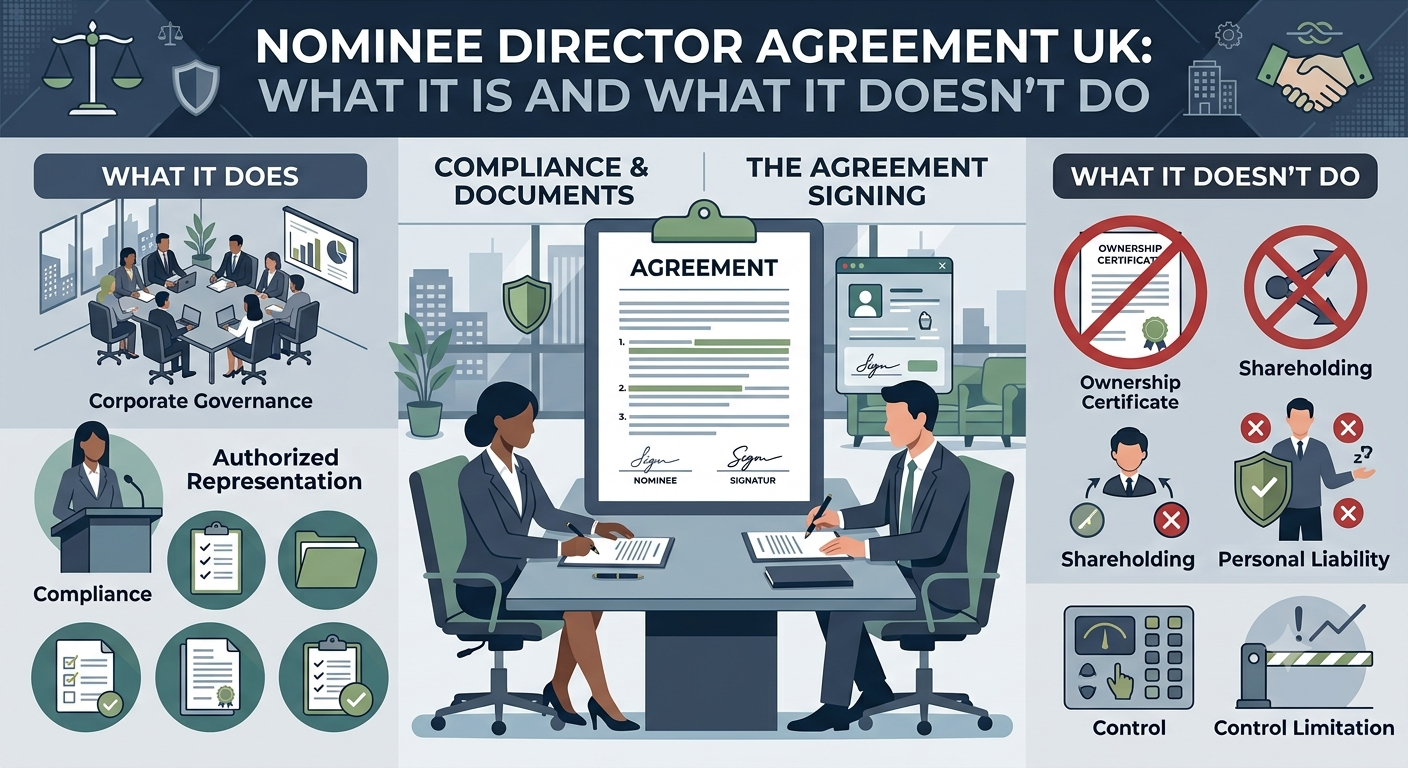
What a Nominee Director Agreement Doesn’t Do
This is the crucial part, and it’s where many founders (and honestly, many older articles online) get things badly wrong.
- It doesn’t reduce the nominee’s legal duties. No matter what the agreement says about the nominee “only acting on instructions,” UK law treats the nominee as a full director. They owe duties to the company under the Companies Act 2006, and they can be held personally liable for breaches. A private indemnity from the beneficial owner doesn’t override statutory duties owed to third parties like HMRC, creditors, or the courts.
- It doesn’t hide the beneficial owner. Under the ECCTA and PSC transparency rules, anyone with 25% or more of shares or voting rights, or who otherwise exercises significant control, must be publicly declared as a Person with Significant Control. A nominee agreement doesn’t change this obligation. Attempting to structure things so the beneficial owner escapes PSC disclosure is a criminal offence.
- It doesn’t protect the beneficial owner from shadow director status. If the beneficial owner is instructing the nominee behind the scenes (which is often the whole point of the agreement), they may be classified as a shadow director under UK law. That brings the same duties, liabilities, and identity verification requirement as any named director. The agreement itself can actually be evidence of shadow director status.
- It doesn’t exempt anyone from identity verification. Under the ECCTA, both the nominee director and PSCs must complete identity verification with Companies House. Agreements don’t override this.
- It doesn’t fully protect the nominee. Indemnity clauses can help with disputes between the two parties, but they don’t protect the nominee against statutory penalties, disqualification, or criminal sanctions for breaches of their duties. Those apply personally to the nominee regardless of what the beneficial owner has agreed to cover.
In short, a nominee director agreement is a private document that regulates a private relationship. It has no bearing on the extensive public obligations both parties owe under UK company law.

The Legal Realities Both Parties Must Understand
If you’re considering a nominee arrangement, both sides need to be clear-eyed about the position UK law puts you in.
- For the nominee director. You are legally the company’s director. You owe duties to the company, its members, and its creditors under the Companies Act 2006. You must exercise independent judgement. You must not act on instructions that harm the company’s interests, even if the beneficial owner instructs you to. You can be personally sued, fined, disqualified, or (in serious cases) prosecuted, regardless of any private indemnity.
- For the beneficial owner. You must be publicly declared as a PSC if you meet the ownership or control test. You must complete identity verification. If you direct the company through the nominee, you may legally be a shadow director with the full range of director duties and liabilities. Companies House now has enhanced powers to look through nominee arrangements and challenge those that appear designed to obscure ownership.
Neither position is what the marketing around nominee director services often implies. This is exactly why we generally recommend a different route entirely.
Why the ECCTA Has Made Agreements Less Useful
Before the ECCTA, some nominee director agreements sat in a grey area where PSC enforcement was patchy and identity verification was voluntary. That’s over.
Under current UK rules:
- Mandatory identity verification. Both nominee director and PSC must be verified. Their names and details are held by Companies House with confirmed identity.
- Active PSC enforcement. Companies House actively challenges companies with incomplete or unclear PSC disclosure.
- Shadow director extension. Verification and duties extend to shadow directors, closing the practical loophole nominee arrangements used to depend on.
- Failure to prevent fraud offence. Corporate service providers and other regulated parties have statutory duties around identifying and preventing misuse of nominee structures.
The result is that even a well-drafted nominee director agreement now sits in a more scrutinised, less private, and less useful position than it did five years ago. For legitimate founders, the case for using one has weakened significantly.
When (If Ever) a Legitimate Nominee Arrangement Might Fit
To be fair to the concept, nominee director arrangements remain legal in the UK and can still fit specific commercial situations, provided they’re set up transparently. Examples include:
- Certain trust structures. Where a professional trustee acts as director on behalf of trust beneficiaries who are properly disclosed.
- Professional executor or administrator roles. In estate administration.
- Institutional arrangements. Where a corporate services firm provides a director for a specific, transparent commercial purpose with full disclosure.
In each case, the arrangement works because it’s fully transparent, verified, and disclosed. The privacy of the beneficial owner isn’t the point. If it were, the arrangement wouldn’t work in 2026.
For general non-resident founders looking to run their own UK company, none of these fit, and there’s no legitimate need for a nominee agreement.
What Most Non-Residents Should Use Instead
The vast majority of founders who research nominee director agreements are actually looking for one of three things, none of which require an agreement or a nominee at all:
- Keeping your home address off the public register. Use a professional UK director’s service address, which puts a UK correspondence address on the register instead of your overseas home address.
- A professional UK business presence. Use a UK registered office address for your company. Combined with a service address, this gives your company a genuine, credible UK footprint.
- Full compliance without complications. Form your company directly as your own director and shareholder, complete your ECCTA identity verification through an Authorised Corporate Service Provider (ACSP), and file everything transparently.
This is exactly what Form My Company’s Non-Residents package provides. You end up with a fully compliant UK company that’s genuinely yours, your privacy is protected in the ways UK law legitimately allows, and there’s no nominee agreement, no shadow director exposure, and no ongoing dependency on a third party.
How Form My Company Helps
We help founders form UK companies transparently and compliantly, without needing nominee director agreements. As an ACSP, we handle:
- Fast UK company formation with you as the actual named director
- Compliant UK registered office address in Bolton BL1
- UK director’s service address to keep your home address off the public register
- Identity verification (IDV) support for directors and PSCs under the ECCTA
- Ongoing compliance help including confirmation statements
- Banking partner introductions for non-resident-friendly providers
If you have a specific commercial situation that genuinely calls for a legitimate, transparent nominee-style arrangement (such as a trust structure), we’d always recommend speaking with a qualified UK solicitor to make sure any agreement is properly drafted and the structure is compliant with the ECCTA and PSC rules.
Understand the Reality Before You Commit
A nominee director agreement is a private contract that does far less than its marketing often suggests. It doesn’t reduce the nominee’s legal duties, it doesn’t hide the beneficial owner under the ECCTA, and it doesn’t exempt anyone from identity verification. For legitimate non-resident founders, forming a UK company directly with the right supporting services delivers everything the arrangement was supposed to provide, with none of the legal exposure. With Form My Company, forming and running a UK company transparently is quick and fully supported. Get started today.
Frequently Asked Questions
What is a nominee director agreement in the UK?
It’s a private contract between a nominee director (publicly named on the Companies House register) and a beneficial owner (behind the scenes), setting out the terms of their relationship. It’s not filed publicly and has no effect on the statutory duties either party owes under UK law.
Does a nominee director agreement protect the beneficial owner from disclosure?
No. UK law requires anyone owning or controlling 25% or more of a company to be publicly declared as a Person with Significant Control. A nominee agreement doesn’t override this, and trying to use one to hide the beneficial owner can be a criminal offence.
Does the agreement reduce the nominee director’s legal duties?
No. The nominee is legally a full director and owes all duties under the Companies Act 2006. Private agreements can’t override statutory obligations owed to the company, HMRC, creditors, and the courts.
Do nominee director agreements cover identity verification?
No. Under the ECCTA, both the nominee director and PSCs must complete identity verification with Companies House. Agreements don’t create exemptions from this requirement.
Are nominee director agreements still legal in the UK?
Yes, they remain legal, but only where the underlying arrangement is transparent. Both the nominee and the beneficial owner must be identified, verified, and (where PSC criteria are met) publicly disclosed. Arrangements designed to obscure ownership are no longer viable.
What should non-resident founders use instead of a nominee director agreement?
For most non-residents, a direct company formation with a UK director’s service address and registered office delivers the privacy and professionalism they actually want, without any nominee arrangement. Our Non-Residents package covers everything needed.
When might a legitimate nominee arrangement still be appropriate?
Specific commercial situations like certain trust structures, professional executor roles, or institutional corporate services arrangements can still legitimately use a nominee, provided the structure is fully transparent, PSC-disclosed, and ECCTA-compliant. In these cases, we always recommend involving a qualified UK solicitor.