
You order a fresh, in-date Certificate of Good Standing directly through the Form My Company portal by submitting your UK company registration number and paying the official dispatch fee. This authentic document validates active status and director credentials for international regulatory bodies.
Why Do International Authorities Require an In-Date Certificate of Good Standing?
Global financial regulators require a freshly issued certificate to confirm a UK company remains fully compliant and legally active on the public register. When foreign banks review corporate structures, they demand up-to-date documentation to mitigate financial crime risks. Three verification factors drive this demand: active company status, current director registration, and verified filing history. Overseas authorities reject historical documents older than three months because corporate compliance changes rapidly.
International expansion projects stall immediately when verification documents show outdated dates of issuance. Overseas banking partners, foreign tax offices, and cross-border regulatory agencies require absolute proof of active trading status. Business leaders navigating foreign jurisdictions must secure formal validation directly from the registrar.
When overseas entities evaluate corporate structures, they examine official paperwork to confirm that no administrative dissolution actions are pending. If annual confirmation statements or statutory accounts are overdue, the registrar flags the entity as non-compliant. Foreign institutions use these certificates to protect their domestic markets from fraudulent corporate entities.
Compliance officers in international banks cross-reference document issue dates against strict internal policies. If a certificate lacks recent authentication stamps, compliance teams halt corporate account opening procedures. Therefore, procuring a current document prevents costly delays during international corporate expansion.
What Information Do You Need Before Submitting Your Request?
You need your official UK company registration number, exact registered company name, and payment authorization details. Preparing these essential details ensures rapid processing through digital filing gateways. Three core data points streamline the application: the eight-digit registration number, exact corporate spelling, and designated delivery recipient details.
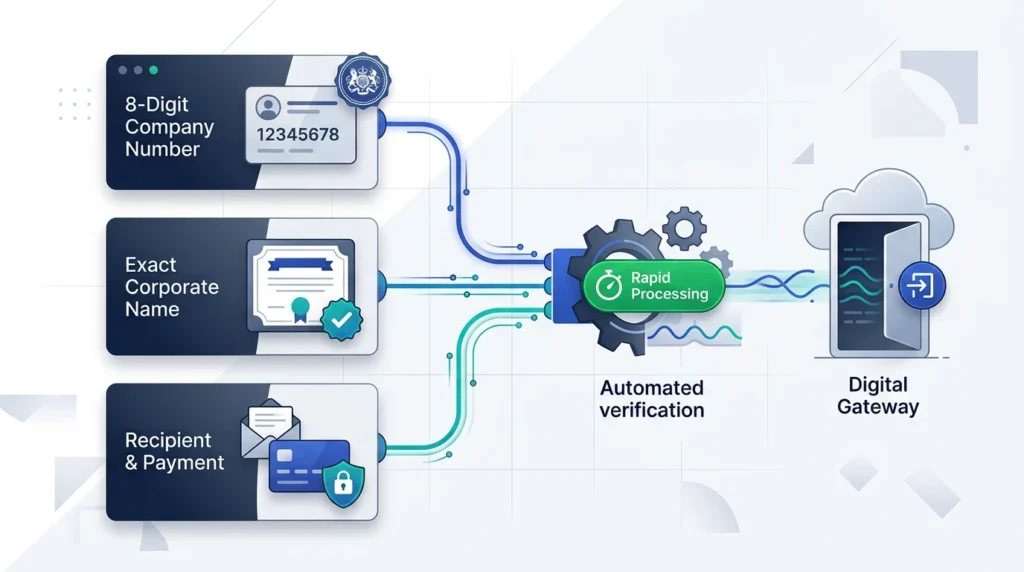
Submitting accurate corporate data prevents administrative rejection by registrar examination teams. When applicants enter incorrect registration numbers, processing systems generate immediate verification errors. Business owners must verify company register records on Companies House before initiating service orders.
Corporate entities undergoing recent name changes must provide historical transition data to ensure seamless document generation. If directors changed within the last week, applicants must confirm that statutory filings reflect those updates. Accurate data submission eliminates unnecessary correspondence and accelerates official document dispatch.
When corporate secretaries prepare applications, they compile registered office addresses and current officer names. This preparation ensures that the final PDF or hard copy matches current public register entries precisely. Maintaining data accuracy protects corporate transactions from legal challenges regarding identity misrepresentation.
How Does the Ordering Process Work Step by Step?
The ordering process involves submitting corporate identifiers, selecting dispatch speeds, and downloading the authenticated registrar document. This streamlined workflow eliminates administrative friction for busy company directors. Four operational steps define the digital workflow: entering company registration details, choosing standard or expedited delivery, completing secure payment, and receiving the final certificate.
Business owners initiate requests by visiting the Certificate of Good Standing service page. Once the system validates the company registration number, applicants select their preferred document format, such as digital PDF or apostilled hard copy. Secure payment processing completes the submission phase instantly.
Registrar agents cross-reference the application against live database records to confirm active compliance status. Once validation succeeds, official authentication seals are applied to the document. Digital copies arrive via email within hours, while physical copies dispatch via tracked courier services.
Corporate teams utilize these authenticated files to satisfy international compliance mandates efficiently. Because the entire pipeline operates digitally, administrative overhead remains exceptionally low. Directors bypass complex bureaucratic hurdles by leveraging specialized filing infrastructure.
What Are the Differences Between Single-Use and Regularly Renewed Certificates?
Single-use certificates satisfy immediate one-off regulatory demands, whereas regularly renewed documents support ongoing international operations. Strategic document management reduces long-term administrative expenditure for growing enterprises. Three strategic distinctions separate these choices: acquisition frequency, cost allocation, and regulatory applicability.
When companies evaluate single-use options, they review insights detailed in Comparing Single-Use vs Regularly Renewed Certificates of Good Standing. Organizations operating across multiple jurisdictions often require scheduled renewals to maintain uninterrupted banking access. Single documents suit isolated legal transactions, such as opening a single foreign subsidiary bank account.
Conversely, enterprises engaging in continuous cross-border trade benefit from recurring renewal schedules. Regular updates ensure that compliance files never expire during active commercial negotiations. Financial directors balance administrative costs against the risk of sudden operational freezes abroad.
Selecting the appropriate issuance frequency depends entirely on specific foreign regulatory demands. If a foreign tax authority mandates quarterly compliance checks, automated renewals prevent missed deadlines. Strategic planning eliminates emergency document orders and reduces expedited courier fees.
How Can Businesses Maintain Continuous Compliance Status Year-Round?
Businesses maintain continuous compliance by submitting annual confirmation statements and statutory accounts on time. Proactive corporate governance prevents the registrar from striking off compliant trading entities. Three compliance actions secure active status: filing statutory accounts annually, updating registered office addresses promptly, and recording officer changes immediately.
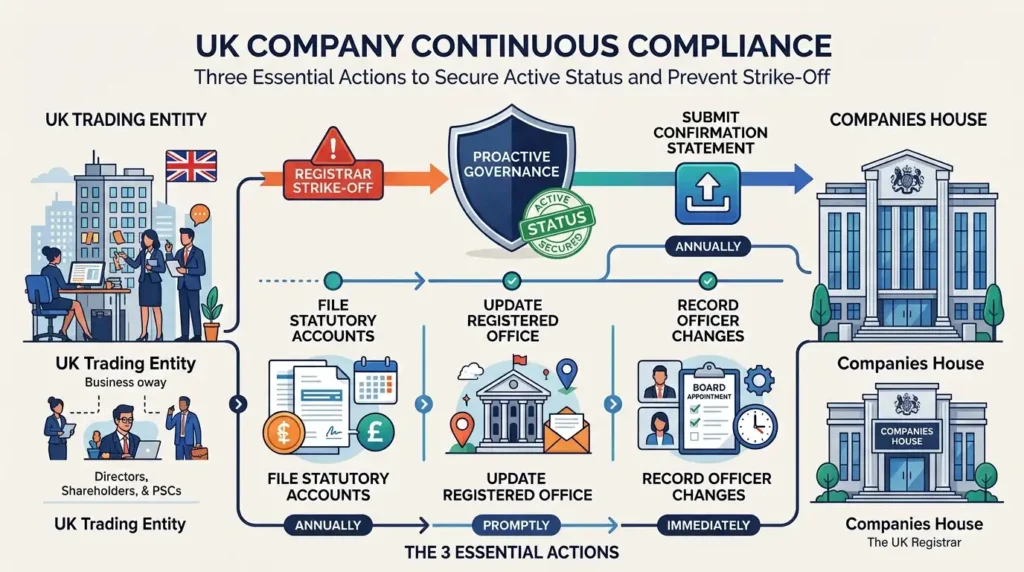
Companies seeking comprehensive guidance review strategies outlined in Why Does a Certificate of Good Standing Have an Expiry Date?. When statutory deadlines approach, corporate accountants upload financial statements directly to public registers. Timely filings ensure that the corporate record remains pristine and ready for instant document generation.
Maintaining an active status safeguards corporate reputation among international investors and banking partners. If compliance lapses occur, public registers mark the company as inactive, blocking all document requests. Restoring active status requires settling late-filing penalties and submitting overdue paperwork.
Corporate secretaries monitor filing calendars closely to avoid accidental administrative dissolution. By integrating compliance checks into quarterly reviews, businesses protect their legal standing indefinitely. Reliable operational habits ensure that every certificate request succeeds without delay.
Explore More Certificate of Good Standing Guide,
Renew Your Certificate of Good Standing Quickly With Form My Company
Get Your Company’s Good Standing Certificate for Contracts With Form My Company
Frequently Asked Questions
What is a Certificate of Good Standing for a UK company?
A Certificate of Good Standing is an official document issued by Companies House that confirms a UK company has been in continuous existence and has no administrative dissolution actions pending. Form My Company assists businesses in procuring this authenticated document to prove legal trading status to international authorities, foreign banks, and regulatory bodies.
How long is a UK Certificate of Good Standing valid?
A Certificate of Good Standing does not feature a fixed statutory expiry date printed on the paper, but international authorities typically reject documents older than three months. Foreign banks and regulatory agencies require fresh, in-date documentation to ensure that no recent compliance failures or late filings have occurred.
Can I get an apostilled Certificate of Good Standing for international use?
Yes, you can request an apostille alongside your Certificate of Good Standing to authenticate the document for use in foreign jurisdictions that are signatories to the Hague Convention. Form My Company coordinates both the registrar issuance and the foreign office legalization process to ensure cross-border compliance.
How quickly can Form My Company deliver my certificate?
Form My Company provides streamlined digital processing options that deliver electronic PDF certificates within hours of validation, alongside expedited courier delivery for physical copies. Processing speeds depend on Companies House verification queues and whether standard or express dispatch services are selected during checkout.
What information does Companies House require to issue the certificate?
Companies House requires the exact registered company name and the unique eight-digit company registration number to verify active compliance on the public register. If any recent director appointments or registered office address changes occurred, applicants must ensure those updates appear on the public record before ordering.