
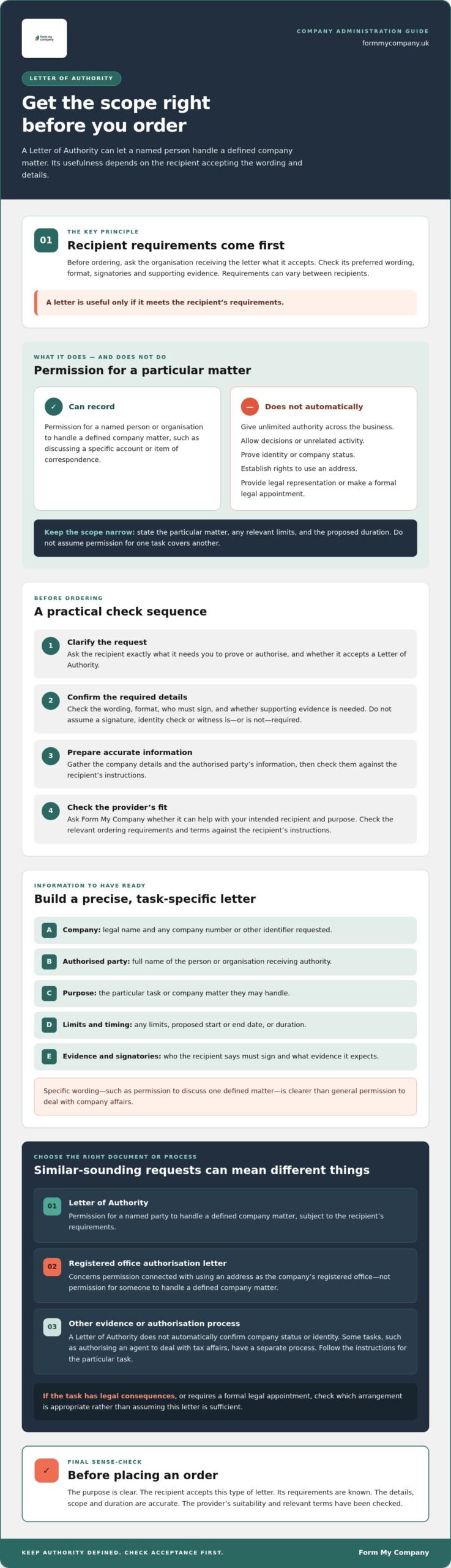
Before you Order Your Letter of Authority With Form My Company, check what the organisation receiving it will accept. The right scope, wording and supporting evidence can help prevent avoidable back-and-forth, but a letter is useful only if it meets the recipient’s requirements.
A Letter of Authority can record permission for someone to handle a specific company matter. It doesn’t give that person unlimited power to act for your business. The details should match the task and any instructions set by the organisation receiving the letter.
This guide explains what a Letter of Authority can cover, where its authority ends and what to check before ordering. It also sets out how to distinguish it from other company documents, what information to prepare and what to ask Form My Company before proceeding.
Key Takeaways
- Match the letter’s purpose and scope to the task you need someone to handle.
- Ask the recipient about accepted wording, format, signatories and any supporting evidence before ordering.
- Prepare your company details and the authorised party’s information, then check what the document needs to include.
- Distinguish a Letter of Authority from a registered office authorisation letter or company-status evidence by checking what the recipient is actually requesting.
- Before you Order Your Letter of Authority With Form My Company, confirm whether the provider can help with your intended recipient and purpose, and check the relevant terms.
Order a Letter of Authority: what the document does and when you may need one
A Letter of Authority records permission for a named person or organisation to act for a business within a defined scope. It can clarify who is allowed to handle a particular company matter, but its effect depends on the wording and on what the recipient accepts.
What does a Letter of Authority allow someone to do?
For example, a company might authorise a named person to discuss a specific account or item of correspondence with an organisation. The letter should identify the matter and, where relevant, set out any limits or time period. It doesn’t automatically allow the person to make decisions or act across all areas of the business.
A Letter of Authority doesn’t automatically prove someone’s identity, confirm the company’s status, establish rights to use an address or provide legal representation. It is also distinct from a formal legal appointment. For context on the broader concept of authorising someone to act for another, see power of attorney or letter of attorney. If the task requires a formal appointment or has legal consequences, check which arrangement is appropriate rather than assuming this letter will be sufficient.
When might a business be asked to provide one?
An organisation may ask for written permission before discussing a defined company matter with someone who isn’t its usual contact. This could be an enquiry about a company account or a request to handle particular correspondence. These are examples, not a guarantee that every organisation will accept the same document.
Ask the organisation whether it accepts a Letter of Authority and what the letter must include. Its requirements for wording, format, signatories and supporting evidence may differ from those of another recipient. Confirm these points before ordering so you can avoid preparing a document that misses a specific requirement.
Keep the purpose narrow. A letter prepared for one organisation or task may not suit another, and permission for one matter shouldn’t be assumed to cover unrelated activity. If the request is unclear, ask the recipient to explain exactly what authority it needs.
Don’t confuse a Letter of Authority with a registered office authorisation letter. The latter concerns permission connected with using an address as a company’s registered office, rather than permission for a named party to handle a defined company matter. First establish what the recipient is asking you to prove or authorise.
Before you Order Your Letter of Authority With Form My Company, contact the provider to confirm whether it can help with your intended purpose and recipient. Ask about the relevant ordering requirements and terms, then compare those details with the recipient’s instructions.
Before ordering a Letter of Authority, confirm its scope and recipient requirements
Before preparing an order, ask the organisation that will receive the letter exactly what it accepts. A quick check can help you avoid a document that has the right general purpose but lacks a required detail.
Confirm the recipient’s preferred wording and format, who must sign, and whether supporting evidence is needed. Don’t assume that a signature, identity check or witness is required, or that none is needed. Requirements can vary, so follow the recipient’s instructions.
Which details should you prepare for an order?
Gather accurate information and check it against the recipient’s request. Be ready to confirm:
- The company’s legal name and any company number or other identifier requested.
- The full name of the person or organisation receiving authority.
- The particular task or company matter they’re permitted to handle.
- Any proposed start date, end date, duration or limits on the authority.
- The requested signatories and any evidence the recipient expects.
Keep the scope narrow and specific. For example, permission to discuss one defined matter is clearer than wording that allows someone to deal with company affairs generally. Precise limits help everyone understand what has and hasn’t been authorised. Check the dates and duration too, especially if the recipient has specified how long the permission should apply.
Some company tasks use a separate authorisation process rather than relying on a general letter. For example, GOV.UK explains how to authorise an agent to deal with tax affairs. Follow the instructions for the particular task, as the recipient may require its own process or evidence.
How can you avoid ordering the wrong company document?
Start with the exact name and purpose in the request. A Letter of Authority concerns permission for someone to act within a defined scope. A registered office authorisation letter relates to permission connected with an address, while company-status evidence serves a different purpose. These documents aren’t interchangeable.
If the request concerns an address arrangement, clarify whether the recipient needs proof of permission to use an address rather than authority for a person to act. Form My Company provides a business address service. Check whether it relates to your situation and what evidence the recipient requires.
Once you’ve confirmed the purpose and requirements, you can Order Your Letter of Authority With Form My Company if the provider confirms it can assist. Check the relevant terms, ordering information, document format and delivery details before proceeding. To explore the company’s services, visit Form My Company.
Letter of Authority vs other company documents: choose the right route
Company documents can have similar-sounding names but serve different purposes. A Letter of Authority records permission for someone to act within an agreed scope. Company-status evidence, by contrast, provides information about the business. Let the recipient’s exact request guide your choice, rather than relying on a document’s title. For a broader perspective on how the term is used, see this Letter of Authority definition.
| Document | Purpose | Who may request it | What to verify |
|---|---|---|---|
| Letter of Authority | Records permission for a named party to handle a defined matter. | An organisation that needs permission before dealing with someone on the company’s behalf. | Accepted wording, scope, signatories, format and any supporting evidence. |
| Registered office authorisation letter | Relates to permission connected with using an address as a registered office. | A party asking about the company’s address arrangements. | Whether address-specific permission is required and what details it must contain. |
| Company-status evidence or records | Provides company information or supporting records, rather than permission for someone to act. | An organisation seeking evidence about the company or its records. | Which certificate, record or other document is specifically requested. |
Is a Letter of Authority the same as registered office permission?
No. The documents address different questions: a Letter of Authority concerns who may act on a company matter, while registered office permission concerns an address arrangement. If the enquiry is about broader company administration, clarify the task and the document needed before choosing a route. Don’t assume one form of permission proves the other.
When might company certificates or records be needed instead?
If an organisation asks you to prove company registration or status, an authority letter may not provide the evidence it needs. Ask whether it wants a certificate, a company record or permission for a named person to act. If supporting company documents are relevant, check the recipient’s requirements and see supplementary company documents for related information.
A company pack or certificate serves a different administrative purpose from an authorisation. Don’t treat these documents as interchangeable or order based on a title alone. Ask the recipient what it needs the document to establish, then confirm the accepted type and format.
Once you know which document is required, assess whether to Order Your Letter of Authority With Form My Company or pursue another route. First confirm whether the provider can assist with your intended purpose and check its terms.
How to order a Letter of Authority with Form My Company
Keep the process straightforward, but check the details rather than assuming what a provider includes. Contact Form My Company to confirm whether it can help with a Letter of Authority for your purpose. Before submitting an order, ask about its information requirements, document format, delivery method, turnaround and applicable terms.
A practical sequence is:
- Confirm the recipient’s requirements. Ask for its accepted wording and format, required signatories, supporting evidence and any limits on the authority.
- Prepare the details. Gather the company’s accurate legal name and requested identifiers, the authorised person’s details, the task, and any relevant dates or restrictions.
- Check the provider’s terms. Confirm what information and evidence Form My Company requires, whether it can assist with your intended recipient and purpose, and how the document will be supplied.
- Submit your order. Follow the provider’s confirmed instructions, then check the completed document carefully before approving or sending it.
Before approval, compare every name and identifier with reliable company records. Check the scope against the recipient’s request, and make sure dates, duration and limits are accurate. A mismatch can lead to extra queries, so pause if anything is unclear.
What should you check before submitting an order?
Make sure the authority describes the specific task the recipient expects, not a broader or different one. Confirm any required evidence and signatories, then ask Form My Company to clarify its terms and delivery details if they’re unclear. Don’t rely on an assumed format or turnaround. Confirm what applies to your order.
If you’re ready to proceed, you can Order Your Letter of Authority With Form My Company after checking the recipient’s instructions and the provider’s terms. This helps you make a clear enquiry, but it doesn’t guarantee the recipient will accept the letter.
What happens if the recipient rejects the letter?
Ask the recipient for the exact reason, then request the wording, format or supporting evidence it needs instead. Acceptance depends on that organisation’s requirements, so a general letter or template can’t guarantee approval.
Share the feedback with Form My Company and ask whether any requested changes fall within the scope of the service it can provide. If the issue is that the recipient needs a different document, clarify that first. Changing a Letter of Authority may not address a request for company-status evidence or another type of record.
To discuss the relevant administrative support, visit Form My Company.
Order your Letter of Authority and move your company administration forward
You’re ready to take the next step once you know who will receive the letter, what you need to authorise and which document they’ll accept. Match the scope to the task, then confirm whether Form My Company can assist and check its current ordering instructions before proceeding. A clear brief helps you make an informed choice, but only the recipient can confirm whether it will accept the document.
What information should you have ready?
Have the key details and the recipient’s instructions to hand before contacting the provider. This makes it easier to ask whether the service is suitable for your purpose and what information may be needed.
- The company’s accurate legal name and any identifier requested.
- The authorised person or organisation’s full details.
- A clear description of the task and the limits of the authority.
- The recipient’s written requirements, including any requested wording or format.
- Details of any supporting documents, signatories, dates or other confirmation the recipient requires.
Check these details against reliable company records and the recipient’s instructions. If a requirement is unclear, ask the recipient to explain it before placing an order. Also confirm directly with Form My Company whether it can assist with your recipient and purpose, what information it needs, and what terms, document format and delivery arrangements apply. Don’t assume a particular process or timescale.
Take the next step with confidence
Before you Order Your Letter of Authority With Form My Company, establish that this is the document your recipient wants and confirm whether the provider can help. Check the current ordering instructions and terms, and keep the recipient’s requirements close by so you can assess whether the proposed authorisation addresses the right task.
Start with a clear brief: contact Form My Company to confirm the relevant service details, then decide how to proceed once you understand the terms and the recipient’s document requirements. This gives you a practical next step without assuming acceptance or a particular outcome.
Take your next company admin step with confidence
A Letter of Authority is relevant when someone needs clear permission to handle a defined company matter. Before ordering, confirm the recipient accepts this document, clarify its required wording and evidence, and make sure the authority’s scope matches the task. If the request is actually for registered office permission or company-status evidence, check which document is needed instead.
Form My Company provides UK company formation and administrative services. Before you Order Your Letter of Authority With Form My Company, contact the provider to check whether it can assist, and confirm any relevant ordering instructions, terms and delivery details. Acceptance remains subject to the recipient’s requirements.
Have your company and authorised-party details ready, along with the recipient’s instructions, so you can make a clear enquiry. Contact Form My Company to discuss your requirements and choose your next step with the right information in hand.
Frequently Asked Questions
What is a Letter of Authority for a UK company?
A Letter of Authority records permission for a named person or organisation to act for a company within a defined scope. For example, it may allow someone to discuss a specified company matter with an organisation. Its effect depends on the wording and the recipient’s requirements. It doesn’t automatically prove identity or company status, grant unrestricted authority or replace a formal legal appointment.
How do I order a Letter of Authority with Form My Company?
First, ask the recipient what wording, format, signatories and supporting evidence it requires. Then contact Form My Company to confirm whether it can assist with your purpose and recipient, and ask about the current ordering instructions, terms, delivery method and timing. Confirm what the provider offers before proceeding. Order Your Letter of Authority With Form My Company only once you understand what is included and have checked the recipient’s requirements.
What information do I need to order a Letter of Authority?
Be ready with the company’s accurate legal name and any identifier requested, such as its company number. You’ll also need the authorised person or organisation’s details, the task they may handle, and any limits or relevant dates. Ask the recipient whether it needs specific wording, signatories or supporting evidence. Confirm with Form My Company which details and documents it requires before submitting an order.
Can a Letter of Authority authorise someone to deal with Companies House?
Don’t assume a general Letter of Authority is enough for someone to deal with Companies House on a company’s behalf. The appropriate authorisation may depend on the task and the process Companies House requires. Check the relevant Companies House instructions and ask whether it accepts the specific document you have in mind. If the task requires a particular form of authorisation, use that route rather than relying on a general letter.
Is a Letter of Authority the same as a registered office authorisation letter?
No. A Letter of Authority concerns permission for a named party to handle a defined company matter. A registered office authorisation letter relates to permission connected with using an address as a company’s registered office. They address different needs and aren’t automatically interchangeable. Check the exact document name and purpose in the recipient’s request, then ask what evidence it will accept before ordering or supplying paperwork.
How long does it take to get a Letter of Authority?
Ask Form My Company directly about the turnaround before ordering, as timing depends on the applicable service terms and any information or evidence required. Confirm the document format and delivery method too, and allow time to check the completed letter against the recipient’s requirements. Don’t rely on an assumed delivery date.
Can a recipient reject a Letter of Authority?
Yes. A recipient may reject a letter if its wording, format, scope, signatories or supporting evidence don’t meet its requirements, or if it needs a different document. Ask for the precise reason and what changes or evidence it requires. Then check with Form My Company whether it can help with any requested revisions. Acceptance depends on the recipient, so a general template can’t guarantee approval.