
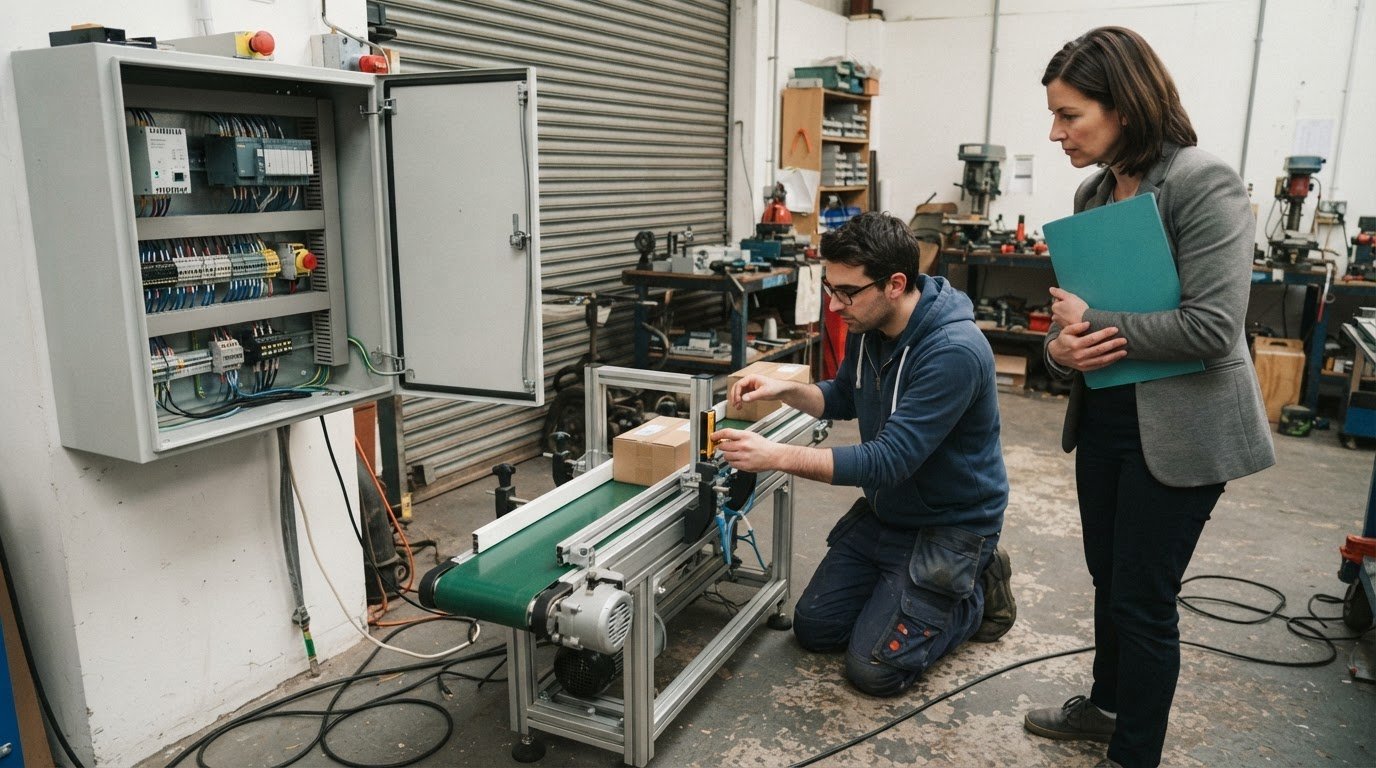
A PLC can be the right control system for a machine, but it isn’t automatically the best fit for every automation project. A programmable logic controller reads inputs from equipment and sensors, applies programmed rules, updates outputs and repeats the cycle. To understand what a PLC is and when you would need one, start with the process it must control and the complexity of the wider system.
Before choosing industrial control equipment, it helps to know how the options differ. The choice affects how machines respond to changing conditions and how easily the control system can adapt as requirements evolve.
This article explains what a PLC does, how it works with plant-floor devices and where its limits matter. It also compares PLCs with PACs, helping you assess which may suit a straightforward machine task or a broader automation system.
Key Takeaways
- A PLC uses programmed logic to turn equipment inputs into control actions, making it useful for repeatable industrial processes.
- Look at the number and type of devices involved, the control tasks and how the process may change when assessing whether a PLC fits.
- Fixed and modular PLCs offer different approaches to input and output needs, so the system’s scope matters when choosing between them.
- A PAC may suit projects that need broader control capabilities; the right choice depends on the demands of the automation system.
- If you’re establishing a UK business alongside your project, Form My Company offers company formation packages, including Public Limited Company formation.
PLC definition and industrial control role
A programmable logic controller, or PLC, is a computer designed to control machines and industrial processes. It uses hardware and software to respond to connected devices, following rules written for a particular task. For example, a PLC can read a temperature sensor and switch on a heater when the programmed condition is met.
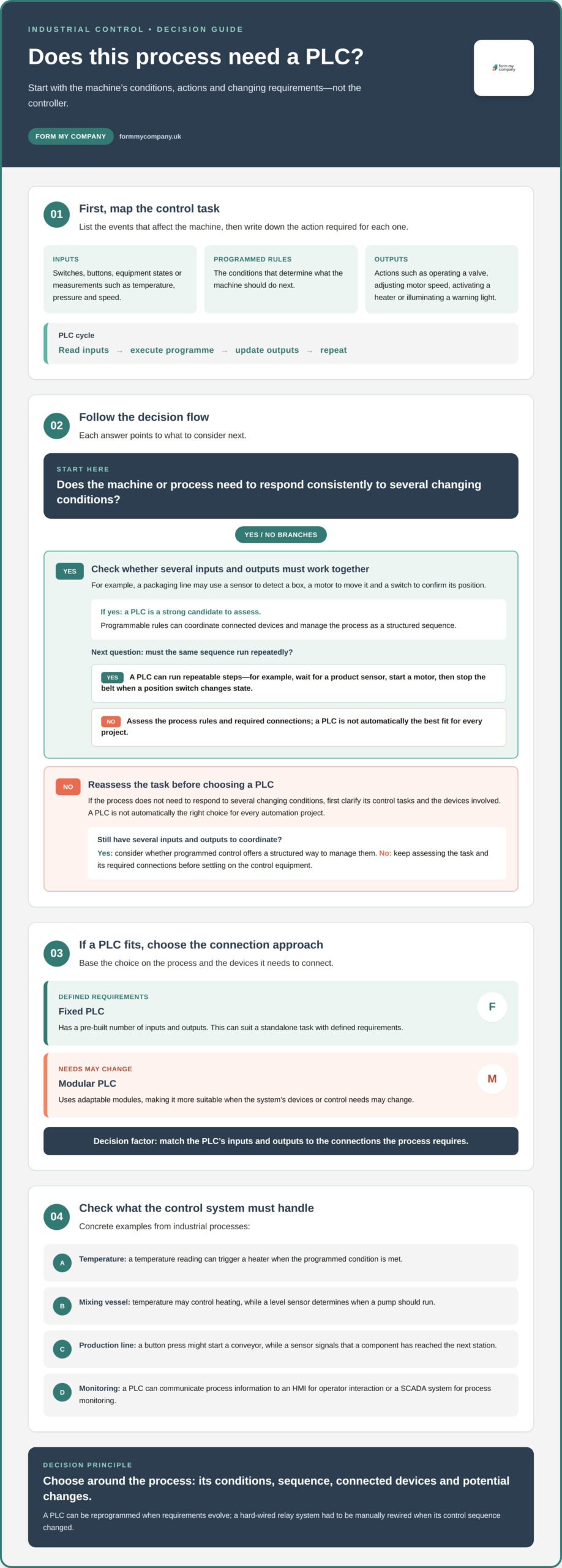
Its operating cycle is straightforward: read inputs, execute the programme, update outputs, then repeat. Inputs tell the controller what is happening; outputs tell connected equipment what to do. On a production line, a button press might start a conveyor, while a sensor signals that a component has reached the next station.
The input and output hardware connects the PLC to the process. Digital, or discrete, inputs have on/off states, such as a switch showing whether a guard is open. Analogue inputs carry measurements between fixed states, such as temperature, pressure or speed. Outputs can operate valves, adjust motor speed, activate heaters or illuminate warning lights.
A PLC’s central processing unit runs the software, using input information to decide which outputs to change. Its memory stores the programme, while input/output modules connect field devices to the controller. A communications interface can link the PLC to other equipment, including a human-machine interface (HMI) for operator interaction or a supervisory control and data acquisition (SCADA) system for process monitoring.
Programmers express control rules in languages suited to industrial automation. According to the International Electrotechnical Commission, IEC 61131-3 is the programming standard that includes ladder logic among its programming languages. Ladder logic resembles electrical relay diagrams, making a rule such as “if the start switch is on and the safety condition is met, run the motor” easier to follow visually.
Before PLCs, hard-wired relay systems controlled industrial processes. The first semiconductor-based PLC, Modicon, was developed by Richard E. “Dick” Morley in 1968. With a PLC, a control sequence can be changed by updating its programme rather than manually rewiring a relay system. That makes programmed control useful where operating requirements evolve, such as a line that adds a new inspection step.
- Manufacturing: A PLC can coordinate a conveyor, sensor and motor so products move through programmed stages.
- Process control: A temperature input can trigger a heater output when the programme’s condition is satisfied.
- Equipment control: A pump’s status can inform the logic, which then controls a valve or warning light.
- Operator monitoring: A PLC can communicate process information to an HMI or SCADA system.
PLC designs differ in how they provide connections. A fixed PLC has a pre-built number of inputs and outputs, which can suit a standalone task with defined requirements. A modular PLC uses adaptable modules, making it more suitable for a system whose devices or control needs may change. Choose according to the process and the connections it requires.
Industrial PLC hardware is built for environments where vibration and extreme temperatures are common. It keeps control logic close to the equipment while communicating process information to monitoring systems as needed. In short, a PLC links sensors and switches to output devices, turning programmed rules into repeatable actions in industrial automation.
In practice, a PLC uses inputs and programmed rules to control electromechanical processes in automation and manufacturing. Inputs may represent switch or button states, analogue measurements such as speed, pressure and temperature, or equipment conditions, such as whether pumps or valves are open or closed. Combining these signals lets the controller respond to the process. PLCs can also connect plant-floor devices with SCADA or HMI systems, supporting process monitoring and control through those systems as well as the controller’s programmed operation.
The hardware configuration affects how a PLC fits a particular installation. Fixed PLCs have a pre-built number of inputs and outputs, while modular PLCs are designed to be more adaptable. This distinction matters when a process needs a different arrangement of connected devices. Hard-wired relay systems were used to control industrial processes before PLCs were invented in the late 1960s. If requirements change, PLCs can be reprogrammed, whereas relay systems had to be manually rewired. The contrast helps explain why programmed control can accommodate evolving process rules without changing the control method by rebuilding its wiring.
When does a business or project need a PLC?
If you’re asking, “What is a PLC and when would I need one?”, start with the process, not the controller. A PLC can make sense when a machine or process must respond consistently to several changing conditions. On a packaging line, for instance, a sensor could detect a box, a motor move it forward, and a switch confirm its position. The controller coordinates those actions using programmed rules.
Map the process before choosing equipment. List the events that should affect the machine, then identify the required action for each. In a mixing vessel, for example, a temperature reading may control heating, while a level sensor determines when a pump should run. When several inputs and outputs must work together, programmable control offers a structured way to manage them.
A PLC is especially relevant when the same sequence must run repeatedly. On a conveyor, the programme might wait for a product sensor, start a motor, then stop the belt when a position switch changes state. It can also prevent the next action until the preceding event occurs, helping keep machine behaviour consistent across production cycles.
Changing requirements are another consideration. If a production process gains an inspection stage, its control logic may need updating. A PLC programme can be revised to include the new sensor and response, rather than changing a hard-wired relay arrangement. The work involved depends on the existing equipment, programme and connections.
Practical signs that a project may benefit from a PLC include:
- Several devices must coordinate: A sensor, conveyor motor and warning light need to respond to the same sequence.
- Conditions affect actions: A temperature reading should change heater operation, or a pump should respond to equipment status.
- The process repeats: A machine performs the same start, run and stop sequence for each product.
- Requirements may change: New steps or devices could require updates to the control logic.
- Operators need process information: A PLC can communicate with an HMI or SCADA system for monitoring alongside control.
A PLC may be unnecessary for a simple, isolated task. If one switch controls one device, with no sequence or changing conditions, a programmable system may add complexity without solving a real control problem. Focus on the relationship between the inputs, required actions and likely changes, not on whether the equipment is labelled “industrial”.
Controller capacity matters too. A fixed PLC has a pre-built number of inputs and outputs, which can suit a task with defined connections. A modular PLC can be adapted through its modules, making it more suitable for a system expected to grow. Identify the devices and signal types the process requires, then match them to the controller’s available connections.
For a project owner, “What is a PLC and when would I need one?” is easier to answer once the wider system is clear. A PAC, or programmable automation controller, may be worth considering for broader automation needs. Compare control tasks, devices, communications and expected changes rather than assuming one controller type is always best. A PLC can suit a clearly defined machine sequence; a wider system may call for a broader comparison.
Industrial PCs offer another point of comparison. They typically provide greater processor performance and storage than PLCs, while PLCs usually have a more limited range of input and output options. This matters when an application demands heavier computing or data storage. For direct equipment control, start by identifying the required inputs, outputs and process logic.
Choose according to what the system must do. Repeated sequences, connected devices or planned process changes can make a PLC useful; a small, fixed task may not need one. For larger automation designs, compare PLC and PAC options against the control tasks and system architecture before deciding which fits.
Form My Company
Form My Company helps entrepreneurs with UK company formation, a separate step from choosing industrial control equipment. If your automation project is becoming a new business, its formation packages can help you establish a company. Options include the Digital Package, Digital & Print Package and Entrepreneurs Choice Package, as well as Public Limited Company (PLC) Formation and Limited Liability Partnership (LLP) Formation.
A PLC controller and a public limited company are different things: one controls equipment, the other is a business structure. If your question about industrial automation has led you to consider setting up a company, explore the company formation packages and choose a relevant next step. For help with forming your business, contact Form My Company.
Plan your next move with confidence
Understanding what a PLC is and when you would need one helps you frame useful questions for an automation project. Before committing to a control design, set out the process goals, the devices involved and how the system may need to develop. This gives technical discussions a clear starting point and keeps equipment decisions connected to the wider business plan.
If the project is part of a new venture, company formation is a separate decision alongside the engineering work. Form My Company offers Digital, Digital & Print and Entrepreneurs Choice packages for business formation.
Take the next step that fits your plans. Contact Form My Company to discuss your needs, and move forward with a clearer business foundation.