
A PSC Register Compliance Audit is a formal examination of your company’s Persons with Significant Control register to ensure accuracy, eliminate filing errors, and satisfy legal obligations under UK company law.
Why Is a PSC Register Compliance Audit Necessary for Your Business?
A PSC Register Compliance Audit prevents statutory penalties by identifying inaccurate ownership data, rectifying missing details, and aligning your records with Companies House databases before enforcement actions occur.
Maintaining an accurate Persons with Significant Control register remains a strict legal requirement for every UK corporate entity. When regulations change, companies frequently overlook subtle updates regarding voting rights, share ownership, or individual control thresholds. Failing to maintain this statutory register invites severe financial penalties and potential criminal liability for company directors. Regulatory bodies actively monitor filing discrepancies between internal registers and public records. Conducting a thorough audit uncovers hidden discrepancies before statutory inspections take place.
Internal administrative oversights often lead to outdated corporate transparency data. When ownership structures shift through share transfers or appointments, staff members miss vital update windows. A structured review isolates these timing errors and enforces strict data synchronization.
External stakeholders also scrutinize corporate transparency during due diligence processes. When investors evaluate your enterprise, compliance failures signal poor governance standards. Resolving these vulnerabilities protects your corporate reputation and accelerates commercial transactions.
Professional oversight eliminates guesswork from statutory record-keeping. Form My Company provides comprehensive corporate governance solutions, including a specialized PSC Register compliance audit service, to secure your filing accuracy.
What Are the Immediate Risks of Inaccurate PSC Records?
Inaccurate PSC records trigger immediate financial penalties, personal director fines, potential criminal prosecution, and forced suspension of corporate borrowing capabilities across major UK financial institutions.
UK legislation empowers regulatory authorities to penalize entities that fail to maintain transparent ownership data. When filing omissions occur, companies face fixed penalty notices starting at 100 pounds and escalating based on duration. Continued non-compliance directly implicates the board of directors in personal liabilities. Courts can impose unlimited fines or disqualify individuals from acting as company directors for up to 15 years.
Commercial partners routinely examine statutory registers prior to finalizing contracts or extending credit lines. If your filings contain mismatched data, procurement teams immediately terminate negotiations. Banks also freeze business accounts when annual confirmation statements conflict with underlying register details. These operational disruptions halt daily revenue generation and damage long-term supplier trust.
Correcting these issues requires structured remediation protocols. Organizations must review past ownership transfers, update personal details, and submit correct notifications through official digital channels.
Businesses seeking deeper insights into ownership discrepancies can explore the guide on What Are the Warning Signs of a Non-Compliant PSC Register? to identify hidden vulnerabilities.
How Does the Audit Process Identify Compliance Gaps?
The audit process compares internal company registers against historical filing logs, verifies individual residential addresses, evaluates voting rights thresholds, and validates qualifying person data against official databases.
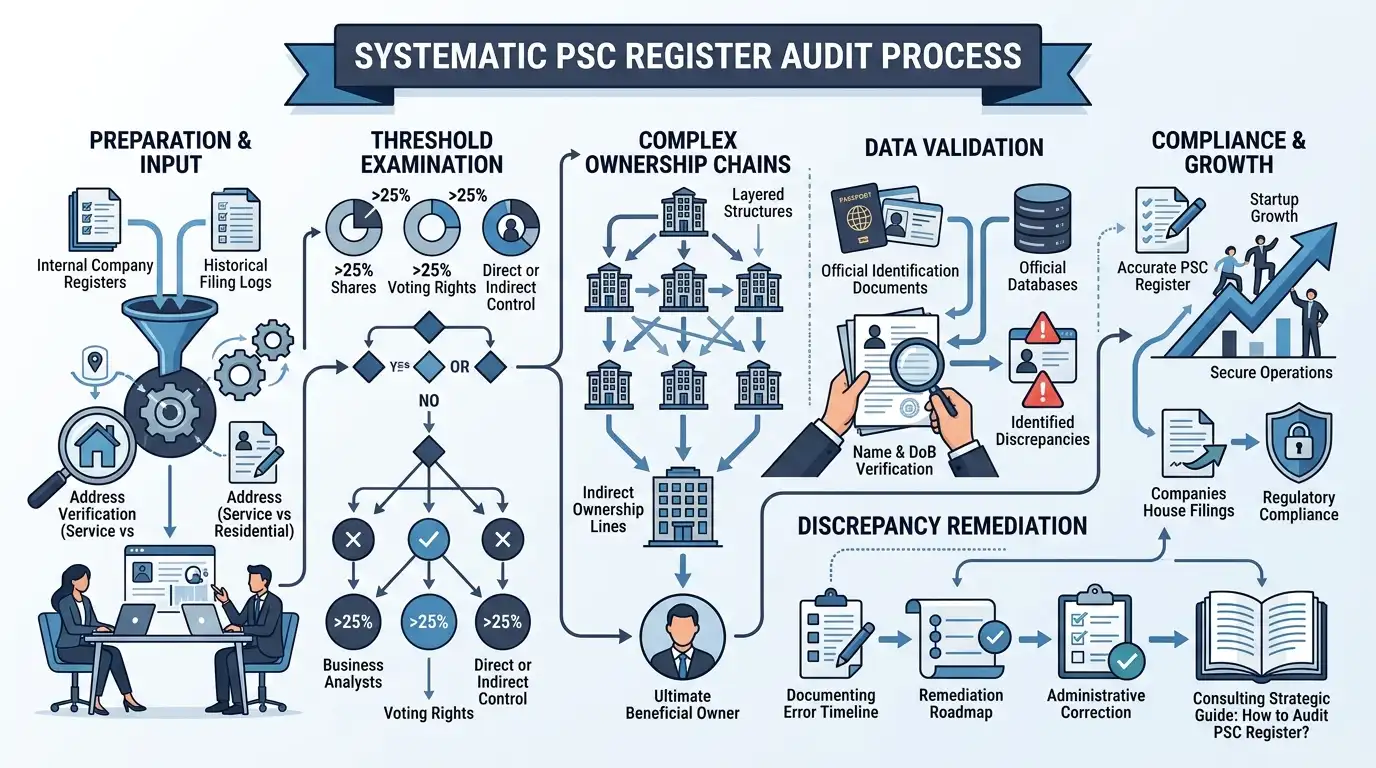
Executing a systematic review requires examining every threshold defining significant control. Analysts evaluate whether any individual holds more than 25% of shares or voting rights directly or indirectly. Complex corporate chains often obscure ultimate beneficial owners through layered holding structures. Reviewers trace these ownership lines to isolate the exact natural persons exercising control.
Data validation steps involve cross-referencing names, service addresses, and dates of birth with official identification documents. When discrepancies emerge between internal records and public filings, specialists document the exact timeline of the error. This diagnostic phase establishes a clear remediation roadmap for administrative staff.
Organizations must also understand the broader strategic framework before executing corrections. Reviewing foundational methods outlined in How to Audit Your PSC Register for Compliance Gaps? ensures internal teams follow recognized verification standards.
How Can Form My Company Secure Your Statutory Registers?
Form My Company delivers expert statutory compliance reviews, rectifies historical filing errors, updates public transparency data, and protects corporate directors from statutory enforcement actions.
Navigating complex company law demands dedicated administrative expertise and precise execution timelines. Form My Company assigns experienced corporate secretaries to review your historical filings, correct data omissions, and submit accurate updates to regulatory databases. This targeted intervention removes the administrative burden from internal finance teams.
Directors utilize these professional services to maintain absolute transparency and eliminate regulatory uncertainty. Form My Company ensures every corporate entity meets rigorous legal standards without interrupting daily business operations. Securing your enterprise today prevents tomorrow’s statutory penalties.
Explore our PSC Register guide,
Want to Buy Bank-Ready Company Certificates From Form My Company?
Want to Get Official Share Certificates From Form My Company?
Frequently Asked Questions
What is a PSC register compliance audit?
A PSC register compliance audit is a formal examination of a company’s Persons with Significant Control register to verify ownership data, correct filing errors, and ensure adherence to UK company law. Form My Company provides comprehensive reviews through their PSC Register service to protect businesses from statutory penalties.
Who is required to maintain a PSC register in the UK?
Every UK limited company, Societas Europaea, and limited liability partnership must identify and record the individuals who exercise significant control or ownership over the entity. Maintaining this public register ensures corporate transparency and compliance with regulations enforced by Companies House.
What happens if a company fails to update its PSC register?
Failing to update a PSC register results in severe financial penalties, daily default fines for company officers, and potential criminal prosecution for directors. Inaccurate disclosures also trigger strict administrative sanctions and damage business credibility with financial institutions.
How often should a company review its PSC register?
Companies should review their PSC register immediately whenever ownership structures shift, share allocations change, or voting rights thresholds are crossed. Regular internal reviews prevent discrepancies between internal statutory records and public filings submitted to regulatory authorities.
Can Form My Company handle updates to my PSC register?
Form My Company manages statutory record updates, corrects historical data errors, and submits accurate transparency filings to regulatory databases on behalf of corporate directors. Utilizing professional corporate secretarial solutions ensures complete adherence to current UK compliance frameworks.