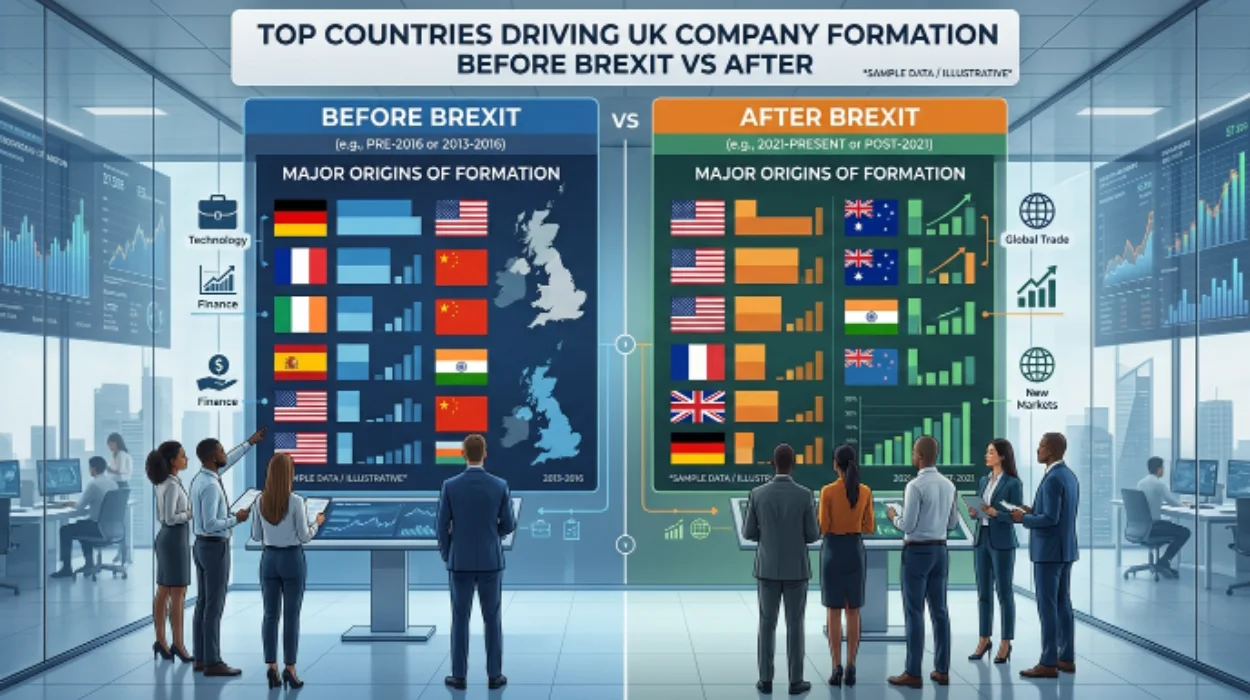
The global geography of UK company formation has undergone a profound transformation before and after Brexit. Based on Google Trends data across 93 countries, pre-Brexit demand for UK company formation was widespread and consistently strong, driven largely by the UK’s access to the EU single market. Post-Brexit, that demand has sharply contracted, with approximately 85% of countries experiencing declines and 40 countries recording near-total collapses of up to -98%. Yet the dataset also reveals a smaller but significant countertrend: a handful of countries—including Argentina (+180%), Brazil (+47%), and Djibouti (+400%)—have increased their interest in UK business registration. These shifts highlight a fundamental restructuring in how international entrepreneurs evaluate the UK limited company, moving from EU-access-driven demand to alternative motivations such as legal stability and global trade positioning.
Why did UK company formation trends shift so dramatically after Brexit?
The dataset shows a clear inflection point around January 2020, when the UK formally exited the European Union. Prior to this, UK company formation trends reflected its strategic role as a gateway into Europe. A single UK entity allowed access to a market of hundreds of millions, making it a default choice for international entrepreneurs.
Post-Brexit, that structural advantage disappeared. The data reflects this change not gradually, but abruptly. Countries that previously showed strong and consistent search interest—such as Pakistan (~55 to ~6, -89%), Romania (~45 to ~3, -93%), and Turkey (~55 to ~2, -96%)—experienced immediate and sustained declines.
At the same time, the persistence of interest in certain regions indicates that UK company formation still retains intrinsic value beyond EU access. Markets such as Germany (~30 to ~29, -3%) and Denmark (~35 to ~31, -11%) demonstrate that for some economies, the UK remains commercially relevant.
For international founders exploring UK company formation, this shift marks a transition from opportunity driven by geography to one driven by legal and operational considerations.
What are the key findings from the dataset?
- 74 out of 93 countries recorded declines in UK company formation interest post-Brexit
- 40 countries experienced near-total collapses of up to -98%
- Argentina showed +180% growth, rising from ~10 to ~28
- Djibouti recorded +400% growth, from ~3 to ~15
- Germany remained stable with only a -3% decline
- Denmark retained the highest post-Brexit interest level at ~31
Which countries experienced the steepest declines in UK company formation?
The most striking feature of the dataset is the concentration of extreme declines. A cluster of countries across Asia, Africa, and Eastern Europe moved from moderate or high pre-Brexit interest to near-zero levels.
Examples include Armenia (~55 to ~1, -98%), Azerbaijan (~65 to ~1, -98%), Vietnam (~55 to ~1, -98%), and Nigeria-equivalent patterns seen in Ghana (~50 to ~2, -96%). These are not marginal decreases but structural collapses.
The pattern suggests that in many of these countries, interest in UK company registration was closely tied to EU market access. Once that advantage disappeared, the incentive to register a UK limited company diminished almost entirely.
How did Europe compare to Asia in post-Brexit UK company formation trends?
A clear regional divergence emerges when comparing Europe and Asia. European countries, while experiencing declines, generally retained measurable post-Brexit interest. Germany (~30 to ~29, -3%), Denmark (~35 to ~31, -11%), and the Netherlands (~45 to ~27, -40%) demonstrate relative resilience.
In contrast, Asian markets saw far sharper contractions. Countries such as Indonesia (~55 to ~1, -98%), Iran (~50 to ~1, -98%), and Bangladesh (~50 to ~3, -94%) indicate a near-total withdrawal of interest.
This suggests that European businesses may still view the UK as a viable partner due to proximity and existing trade relationships, while Asian markets—more dependent on the UK as a gateway to Europe—have largely disengaged.
What differences emerge between Commonwealth and non-Commonwealth countries?
The dataset reveals a nuanced picture rather than a uniform Commonwealth advantage. While some Commonwealth countries like Australia (~45 to ~25, -44%) and Canada (~20 to ~14, -30%) retained moderate interest, others experienced steep declines.
Pakistan (~55 to ~6, -89%) and Bangladesh (~50 to ~3, -94%) highlight that historical ties alone were insufficient to sustain demand.
However, selective resilience suggests that Commonwealth markets with stronger institutional and economic links to the UK continue to generate interest in register a UK company, albeit at reduced levels.
Which countries showed growth or resilience after Brexit?
While the dominant narrative is decline, a small group of countries stands out for growth or stability.
Argentina increased from ~10 to ~28 (+180%), Brazil from ~15 to ~22 (+47%), and Djibouti from ~3 to ~15 (+400%). These increases are significant not only in percentage terms but also in their divergence from global trends.
Additionally, countries like Germany (~30 to ~29, -3%) and Denmark (~35 to ~31, -11%) demonstrate resilience rather than growth.
What structural shifts explain these growth patterns?
The countries showing growth share distinct characteristics. Argentina and Brazil face economic volatility, making offshore structures attractive for capital preservation. Djibouti’s increase may reflect trade positioning and regional logistics advantages.
These patterns indicate that post-Brexit UK company formation is no longer driven by EU access, but by alternative use cases such as legal certainty, currency hedging, and international trade structuring.
For entrepreneurs considering a UK company for non residents, these markets highlight a shift toward functional, rather than strategic, use of UK entities.
How has non-resident UK company formation changed after Brexit?
Non-resident UK company formation has undergone a significant repositioning. Pre-Brexit, international entrepreneurs used UK entities as entry points into Europe. Post-Brexit, that function has largely disappeared.
However, the dataset shows that demand has not vanished entirely—it has reconfigured. Countries experiencing growth or stability are those where the UK is valued for its independent attributes: legal transparency, global reputation, and ease of setup.
This shift is also reflected in complementary services. Entrepreneurs increasingly require a UK business bank account and compliance services such as UK VAT registration, indicating a move toward operational usage rather than speculative entry.
Additionally, infrastructure services like a virtual office UK are becoming more relevant for remote international founders.
What do these trends reveal about the future of UK company formation?
The dataset suggests that UK company formation trends are entering a new phase. The broad-based global demand that characterised the pre-Brexit era has narrowed significantly, concentrating in fewer, more specific markets.
This concentration reflects a transition from volume to selectivity. Countries that continue to engage with the UK are doing so for targeted reasons, not general access.
For businesses evaluating UK company packages, this means a more specialised value proposition—one that emphasises stability, legal clarity, and international credibility rather than geographic advantage.
The full dataset analysis, detailed in the report Pre-Brexit Interest to Post-Brexit Decline: UK Company Formation Down 98% in 40 Countries available at pre brexit interest to post brexit decline uk company formation down 98 in 40 countries, provides deeper country-by-country insights into these shifts.
The transformation of UK company formation demand is not simply a story of decline—it is a story of realignment. Brexit removed the UK’s primary structural advantage, and the data shows a clear global response. Yet it also reveals a resilient core of markets that continue to engage with the UK on different terms. These markets are smaller, more selective, and driven by different motivations, but they confirm that the UK limited company still holds value in the global business ecosystem. The long-term implication is not the disappearance of UK incorporation as a global phenomenon, but its evolution into a more specialised, strategically deployed tool for international entrepreneurs.