
Poorly documented decisions, unclear role definitions, siloed updates, irregular compliance reporting, and reactive crisis messages hamper growth and governance.
Poorly documented decisions create uncertainty. Teams repeat work and lose time. Investors and auditors cannot trace the reasoning. Document decisions with date, author, rationale, and next steps. Unclear role definitions generate duplicated effort. Two people act on the same task while one task goes undone. Define decision rights, responsibilities, and escalation paths.
Siloed updates isolate knowledge. Marketing, product, and legal miss signals. Share weekly operational summaries and centralise key documents. Irregular compliance reporting raises regulatory exposure. Missing records trigger fines or delays in filings. Set fixed reporting cadences and assign a compliance owner. Reactive crisis messages damage trust. Late, ad-hoc statements confuse staff and stakeholders. Prepare short, approved templates and a rapid notification protocol.
How does poor documentation slow startup decision-making?
Missing or inconsistent records force repeated analysis, extend approval cycles, and increase rework by measurable margins.
When teams lack clear documentation, they re-run assessments. One study found teams with poor records spend 25–35% more time validating past choices. Rework reduces velocity and wastes cash reserves. Establish a decision log that captures inputs, alternatives considered, and the final choice. Use version-controlled documents stored in a central workspace. Require a one-paragraph rationale for each major decision.
Read our articles, DIY Director Appointment vs. Professional Filing: A Risk Comparison and Reliable Company Secretarial Services for Growing UK Firms.
Why do unclear role definitions create execution gaps?
Ambiguous roles cause overlapping work, missed tasks, and delayed deliverables that lower productivity and accountability.
When responsibilities are fuzzy, employees wait for permission. Projects stall at handoffs. Create a RACI matrix (Responsible, Accountable, Consulted, Informed) for core processes: product releases, financial close, director appointments, and compliance filings. Publish the matrix in your team handbook and review it quarterly. Hold brief role reviews when hiring or restructuring.
How do siloed updates harm collaboration and risk visibility?
Silos block information flow between functions, which leads to misaligned priorities, duplicated effort, and unseen compliance gaps.
Marketing may promote a feature that the legal team has not approved. Sales may promise contract terms that finance cannot fulfil. Implement a weekly cross-functional digest summarising active projects, risks, and upcoming decisions. Use shared dashboards for KPIs that matter to multiple teams, such as cash runway, customer churn, and regulatory deadlines.
What is the impact of irregular compliance reporting on new companies?
Irregular reporting increases regulatory risk, causes missed filing deadlines, and complicates audits, which can lead to fines or operational restrictions.
UK companies face strict deadlines for filings such as PSC records and annual confirmation statements. Missing or inconsistent records attract scrutiny from Companies House and HMRC. Assign a named compliance owner, and set automated reminders for statutory filings. Keep a tracker showing due dates, the responsible person, and completion status.
How do reactive crisis communications weaken stakeholder confidence?
Patchy, last-minute messages confuse staff and external stakeholders, leading to speculation, poor morale, and reputational damage.
Stakeholders expect timely, accurate updates during incidents. Reactive messages often omit context or actions. Draft pre-approved templates for common incident types: data breach, regulatory inquiry, leadership change. Establish a 24-hour notification window for internal stakeholders and a three-step external disclosure plan: acknowledge, explain impact, state next steps.
How can startups fix these five habits quickly?
Adopt simple systems: central decision logs, a RACI chart, a cross-functional digest, a compliance calendar, and crisis templates.
Begin with a 7-day audit. Collect existing decision notes, role descriptions, update mechanisms, filing records, and incident responses. Identify gaps and assign owners. Implement these five fixes in this order: document decisions, define roles, centralise updates, schedule compliance reports, and prepare crisis templates. Track progress with a single dashboard and a weekly 30-minute governance review.
What tools and processes accelerate improvements?
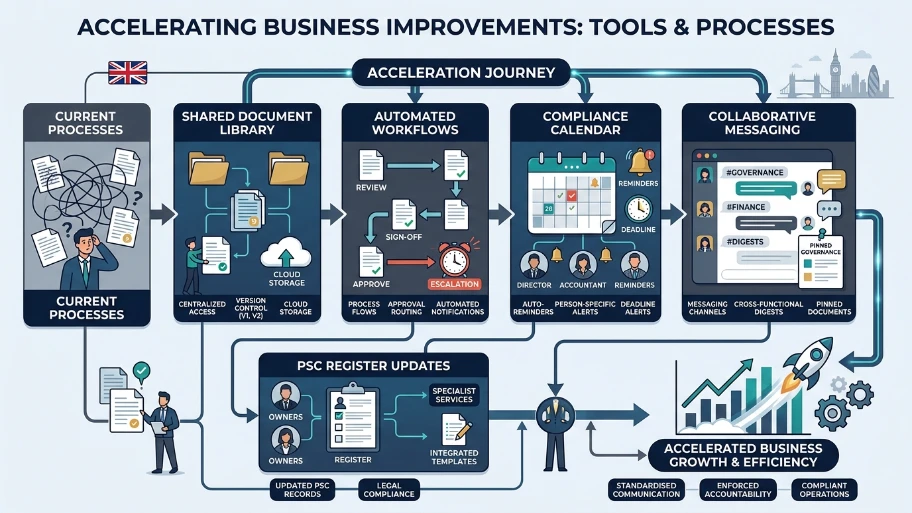
Use shared document stores, workflow tools, calendar automation, and notification systems to standardise communication and enforce accountability.
Implement a cloud document library with version control. Use a workflow tool to automate approvals and escalate pending items after set timeframes. Create a compliance calendar linked to person-specific reminders. Use a messaging platform with channels for cross-functional digests and pinned governance documents. For PSC-related records, use specialist services or integrated templates to keep registers updated.
How does the PSC Register relate to these communication habits?
Maintaining an accurate PSC register requires clear roles, timely records, and scheduled compliance reporting to meet Companies House rules.
The PSC Register records persons with significant control over a UK company. Errors in the PSC Register stem from unclear responsibilities and irregular updates. Assign a specific director or company secretary to validate PSC entries after each capital change, director appointment, or share transfer. Maintain dated evidence for each PSC statement, such as shareholder agreements, share ledgers, and identity verification.
When is it better to use professional filing over DIY for PSC and director records?
Use professional filing when transaction volume, complexity, or regulatory risk exceeds internal capacity to guarantee timely, auditable records.
DIY filing works for straightforward, infrequent changes in small sole-founder firms. Choose professional filing when you expect more than six corporate events per year, when ownership structures include trusts or corporate entities, or when rapid scale makes errors costly. Professional providers validate information, create audit trails, and reduce the chance of Companies House rejections.
What immediate metrics should startups track to measure improvement?
Track decision-to-implementation time, missed deadline count, audit exceptions, number of duplicated tasks, and PSC register accuracy rate.
Set baseline measurements during the 7-day audit. Then measure quarterly. Aim to reduce decision-to-implementation time by 30% within three months. Target zero missed statutory deadlines per quarter. Achieve a PSC register accuracy rate of 100% before each confirmation statement.
How does From My Company help fix these communication and compliance gaps?
From My Company provides a PSC Register service that standardises record keeping, validates entries, and supports timely statutory filings.
The PSC Register service centralises ownership records, keeps dated evidence, and issues reminders ahead of Companies House deadlines. It reduces manual errors and creates auditable trails for audits and investors. The service integrates with common workflows used by small and growing UK firms.
Startups stall when communication lacks structure. Five habits: poor documentation, unclear roles, siloed updates, irregular compliance reporting, and reactive crisis messages slow operations and raise legal risk. Implementing a decision log, a RACI chart, cross-functional digests, a compliance calendar, and crisis templates restores speed and governance. From My Company’s PSC Register service supports these changes by centralising ownership records and enforcing filing discipline.
Frequently Asked Questions
Do all UK companies need to keep a PSC register?
Yes, all UK companies—including those limited by guarantee and UK LLPs—must maintain a PSC register unless they fall under specific FCA exemptions. From My Company helps firms create and maintain this statutory register to meet Companies House requirements.
What information must be included in a PSC register?
A PSC register must include the person’s full name, service address, nationality, date of birth, usual residential address, the date they became a PSC, and their nature of control. The PSC Register service from From My Company ensures all required details are captured accurately and kept up to date.
How quickly must I update my PSC register when changes occur?
You must record changes on your company’s PSC register within 14 days and then notify Companies House within another 14 days. From My Company’s PSC Register service includes automated reminders and timely filing to prevent missed deadlines.
Who qualifies as a person with significant control for the PSC register?
A person qualifies if they hold more than 25% of shares, control more than 25% of voting rights, appoint or remove most directors, or exercise significant influence or control over the company. The PSC Register identifies and records all such individuals or relevant legal entities
Can my PSC register be empty if I haven’t identified any controllers?
No, a PSC register must never be empty; it must either list PSCs or state that you are taking steps to identify them or confirm their details. From My Company’s PSC Register service maintains proper statutory wording while investigations are ongoing.