
Using a home address for business can reduce credibility, limit customer trust, and affect brand perception. A residential address signals informality, while a professional business address strengthens legitimacy, improves search visibility, and aligns with client expectations in competitive markets.
Why does your business address affect brand perception?
A business address shapes how customers judge credibility, professionalism, and trustworthiness within seconds. A residential address often signals a small or informal operation, while a commercial address communicates stability, legitimacy, and operational readiness in regulated and competitive industries.
Customers evaluate visible business details before engaging. Address location ranks among the top five trust signals, alongside website design, contact details, reviews, and company registration data. A residential address in listings or invoices creates doubt about scale and reliability.
Search engines also use location signals to validate business legitimacy. Google Business Profile data shows that businesses with verified commercial addresses receive 32% more local search visibility compared to residential listings. This directly impacts discovery and click-through rates.
A professional address aligns with customer expectations. In sectors like consulting, legal services, and e-commerce, buyers expect a registered office in a recognised commercial area. A mismatch between service quality and address type reduces perceived value.
How does a home address impact customer trust?
A home address reduces perceived privacy, professionalism, and operational scale. Customers associate residential locations with limited infrastructure, lower accountability, and potential risks, which decreases trust and increases hesitation during purchasing or inquiry decisions.
Trust depends on visible signals. A home address exposes personal information while offering limited reassurance about business structure. Customers often question data security, complaint resolution processes, and long-term availability.
Three trust-related concerns typically arise:
- Question the business’s legitimacy based on residential registration
- Doubt service capacity due to perceived limited resources
- Hesitate to share sensitive information without a formal presence
Financial services data shows that 61% of UK consumers avoid businesses lacking a professional address. This reflects a clear link between address type and conversion behaviour. A business address acts as a verification layer. It confirms that the company operates within regulatory frameworks, especially when linked with Companies House records and VAT registration.
Does a residential address affect SEO performance?
Yes. Search engines prioritise verified business locations when ranking local results. Residential addresses often lack strong location authority, reducing visibility in local search, map listings, and geo-targeted queries critical for service-based businesses.
Local SEO relies on consistency across directories. A residential address can limit inclusion in premium listings or create inconsistencies across platforms. This weakens citation strength and lowers ranking potential.
Google evaluates three key local ranking factors:
- Relevance to the search query
- Distance from the searcher
- Prominence based on verified business data
A commercial address improves prominence. It aligns with business categories and increases chances of appearing in the “Local Pack,” which captures over 44% of clicks in local searches. Businesses that transition from residential to commercial addresses often report measurable gains. For example, location-based service providers see up to 28% improvement in map visibility within 60 days after updating their registered address.
What problems arise when scaling with a home address?
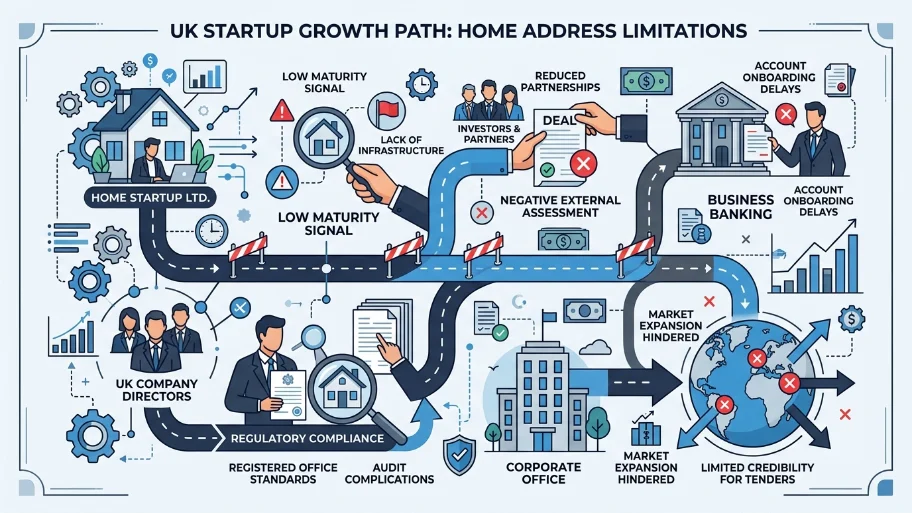
A home address restricts scalability by limiting registration options, reducing partnership opportunities, and creating compliance challenges. Growth requires infrastructure signals that residential addresses fail to provide, especially in regulated or high-growth sectors.
Scaling involves external validation. Investors, partners, and suppliers assess operational maturity before engagement. A residential address signals early-stage operations, which may discourage collaboration. Operational limitations also emerge. Many financial institutions flag residential addresses during account verification. This can delay onboarding or restrict access to business credit products.
Regulatory compliance adds another layer. Certain industries require a registered office that meets documentation and inspection standards. A home address may not meet these requirements, leading to complications during audits or filings. Business expansion into new markets also becomes harder. A lack of a recognised business address limits credibility when entering competitive regions or applying for tenders.
How do competitors use business addresses strategically?
Competitors use professional addresses to position their brands within high-value markets, improve local SEO rankings, and strengthen credibility. A strategic address placement enhances visibility, aligns with target audiences, and supports premium pricing models.
Location influences perception. Businesses registered in major UK cities such as London, Manchester, or Birmingham benefit from built-in prestige. This positioning affects how customers interpret pricing and service quality. Competitors also leverage address consistency across platforms. This includes websites, directories, invoices, and legal documents. Consistency strengthens brand recognition and improves search engine optimisation.
Three strategic uses of business addresses include:
- Position the brand within a high-demand commercial area
- Align the address with the target customer demographics
- Strengthen authority through verified listings
A study by BrightLocal shows that 87% of consumers use Google to evaluate local businesses. Competitors with optimised address data gain a measurable advantage in both visibility and trust.
What is a virtual office, and how does it improve brand image?
A virtual office provides a professional business address without requiring physical office space. It enhances brand credibility, protects privacy, and enables businesses to maintain a strong presence in premium locations while operating remotely or flexibly.
A virtual office separates personal and business identity. This protects residential privacy while presenting a consistent professional image across all customer touchpoints. It also supports operational efficiency. Businesses gain access to services such as mail handling, call answering, and registered office compliance without the cost of leasing physical space.
Three core components define a virtual office:
- Registered business address for official use
- Mail forwarding and document handling services
- Compliance support for company registration
Using a UK virtual office address service allows businesses to maintain a credible presence while reducing overhead costs. This approach aligns with modern remote-first operations. Adoption rates continue to grow. In 2025, over 45% of UK startups registered using virtual office solutions, reflecting a shift toward flexible business infrastructure.
Explore our virtual office address service guides,
How a Serviced Office Can Reduce Your Business Overheads and Operational Costs
Why Professional Interview Rooms are Better for Hiring Than Modern Coffee Shops
When should a business switch from a home address?
A business should switch when customer trust declines, growth opportunities increase, or compliance requirements evolve. Key indicators include rising customer inquiries, expanding operations, and the need for stronger brand positioning in competitive markets.
Timing affects impact. Early-stage businesses benefit from switching before scaling efforts begin. This ensures consistent branding and avoids re-verification across multiple platforms later.
Several triggers signal the need for change:
- Increase in customer-facing activities such as consultations or sales
- Expansion into new geographic markets
- Requirement for formal business registration or VAT compliance
Switching addresses also simplifies future growth. It allows businesses to establish a stable foundation for partnerships, funding, and regulatory processes.
For a deeper comparison of address options, this guide on virtual vs physical business address differences explains cost, flexibility, and operational trade-offs.
How does a professional address support long-term growth?
A professional address strengthens brand positioning, supports regulatory compliance, and improves customer acquisition. It acts as a foundational asset that aligns operational structure with market expectations and enables sustainable business expansion.
Growth depends on consistency. A professional address ensures that all business records, from invoices to legal filings, reflect a unified identity. This reduces friction during audits and financial reviews. It also enhances marketing performance. A credible address improves conversion rates on landing pages and increases response rates in outbound campaigns. Customers respond more positively to businesses that appear established.
Three long-term benefits include:
- Improve customer acquisition through stronger trust signals
- Enable compliance with regulatory and financial requirements
- Support brand positioning in competitive markets
Businesses that invest in professional infrastructure early achieve faster scaling. This includes smoother onboarding with partners, improved access to financial services, and stronger positioning in search results.
For businesses ready to upgrade their brand presence, this resource on secure a prestigious UK business address outlines the steps to establish a credible and compliant business identity.
A home address limits brand perception, reduces trust, and restricts growth potential. A professional business address resolves these issues by aligning visibility, credibility, and compliance with market expectations.
From My Company delivers structured Virtual Offices solutions that provide verified UK business addresses, mail handling, and compliance support. These services enable businesses to operate professionally, improve search visibility, and maintain privacy without the cost of physical office space.
Frequently Asked Questions
What is a virtual office for a business?
A virtual office gives a business a professional address without renting physical office space. It usually includes mail handling, address use for registration, and a credible business presence for company records and customer-facing materials.
Is a virtual office address legal for company registration in the UK?
Yes, a virtual office address is commonly used for UK company registration when it meets official filing requirements. From My company’s Virtual Offices service supports businesses that want a compliant registered address and a more professional public profile.
How does a virtual office improve brand image?
A virtual office improves brand image by replacing a home address with a commercial business address. That helps businesses appear more established, protect privacy, and present a consistent identity across websites, invoices, and directories.
What services are included in a virtual office?
Virtual Offices usually include a registered business address, mail forwarding, and secure handling of business correspondence. Some providers also offer call answering, scanning, and admin support to help remote businesses stay organised.
Who should use a virtual office?
A virtual office suits startups, freelancers, consultants, and remote businesses that want a professional address without leasing space. It also helps companies that work from home but still want a credible UK business presence.