
Registering a company in the UK delivers unmatched limited liability protection, competitive 19–25% corporation tax rates, and instant global credibility through Companies House registration, attracting clients and investors worldwide. This structure suits entrepreneurs seeking a stable base for e-commerce, tech, trading or services, with online incorporation available to non-residents. The UK’s business-friendly reforms enhance these advantages, making it a top choice for scalable growth.
The UK stands as a global business powerhouse, where registering a company unlocks a suite of strategic benefits rooted in its world-class legal system, economic stability and transparent corporate registry. Under the Companies Act 2006, forming a private limited company (Ltd) provides entrepreneurs with limited liability—shielding personal assets from business debts—while enabling seamless access to international markets. Companies House, the official registrar, processes over 1 million incorporations annually, many by non-UK residents drawn to English law contracts, double-tax treaties with 130+ countries, and incentives like R&D tax credits worth millions.
Semantic keywords such as “UK company formation benefits,” “limited company advantages,” and “Companies House registration perks” highlight why founders choose Britain: lower compliance burdens than many EU peers, no minimum share capital, and post-Brexit trade deals covering 2 billion consumers. For directors and shareholders worldwide, a UK registered office elevates professionalism, easing banking with HSBC or Wise and platforms like Amazon. Yet, realising these benefits demands understanding VAT thresholds (£90,000), PAYE for employees, and 2026 fee hikes (incorporation to £100). This authoritative guide dissects advantages, steps, risks and compliance, empowering informed decisions for sustainable success.
Step-by-Step Process to Unlock UK Company Benefits
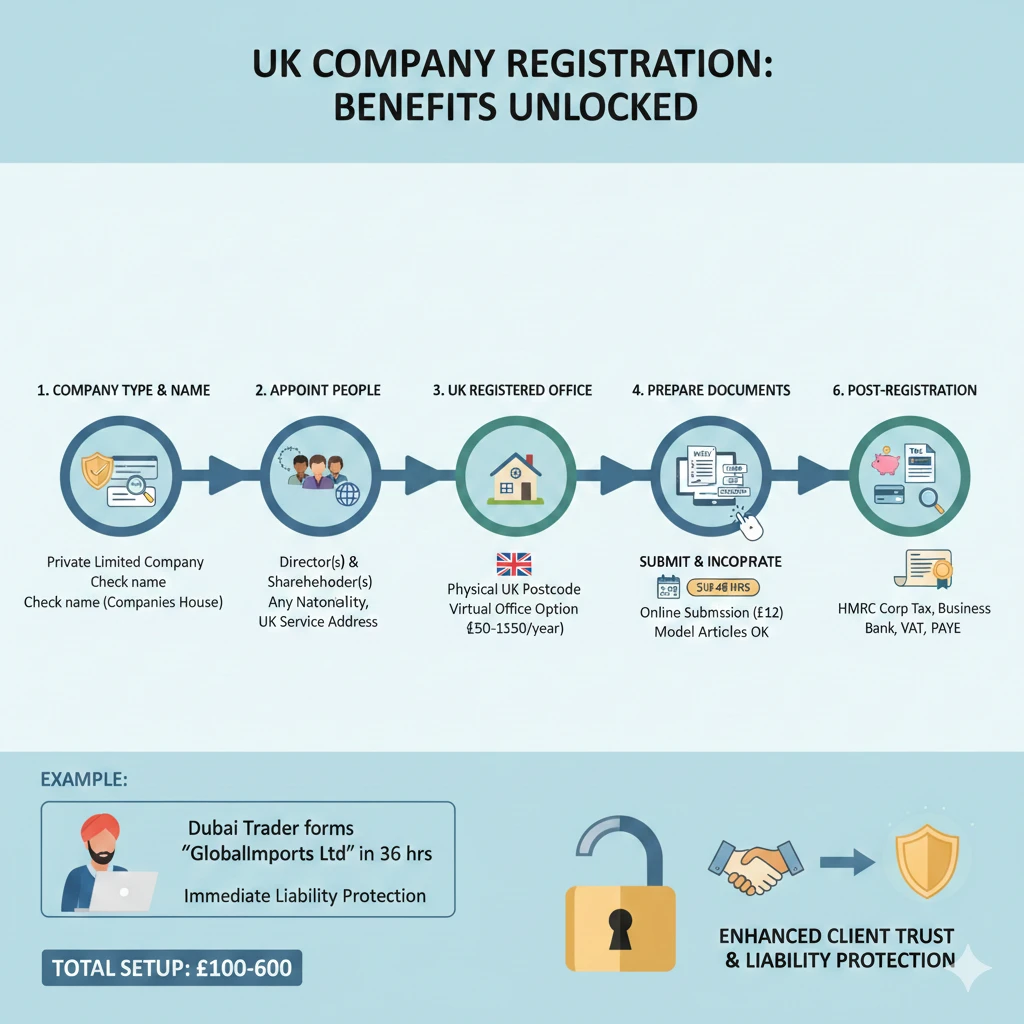
Accessing UK registration benefits begins with selecting a private limited company structure, ideal for most due to its flexibility and liability cap. Start by verifying a unique name via the Companies House online checker—avoid trademarks or sensitive terms like “University.” Appoint at least one director (any nationality, no residency needed) and shareholder, detailing names, DOBs, nationalities, occupations, private residential addresses and public service addresses. Secure a UK registered office—a physical postcode for statutory documents, often via virtual services at £50–£150 yearly.
Prepare digital Form IN01: memorandum of association (shareholder formation intent), articles of association (model rules suffice), SIC codes (e.g., 62020 IT consultancy), share capital (e.g., 100 £1 shares) and PSC register (>25% control holders). Submit online (£12 now, £100 from Feb 2026) for 24–48 hour approval, yielding a Certificate of Incorporation. Follow with HMRC Corporation Tax registration (within 3 months trading), business banking, VAT assessment (£90k threshold) and PAYE if hiring. A Dubai trader forms “GlobalImports Ltd” in 36 hours, claiming immediate liability protection. Total setup: £100–£600, with benefits materialising via enhanced client trust.
Key Benefits of a UK Registered Company
The paramount benefit is limited liability: shareholders risk only unpaid shares, not personal wealth—crucial for high-risk ventures like tech startups facing lawsuits. Corporation tax at 19% (profits <£50k) or 25% (higher) undercuts many peers, with full expensing allowing 100% asset deductions instantly. R&D credits reclaim up to 27% of qualifying spend, fuelling innovation; in 2025, claims topped £8 billion.
Global prestige elevates a UK Ltd: banks prioritise them for accounts, marketplaces like eBay approve faster, and investors favour English law share structures. Double-tax treaties prevent dual taxation—e.g., UK-US DTA credits American taxes. No capital minimum enables bootstrapping, while SEIS/EIS schemes offer 50–30% investor reliefs, raising funds cheaply. Post-Brexit, 140+ trade deals open markets sans EU red tape. A Manila freelancer registers, securing Stripe and doubling clients via credibility. Drawbacks like filings pale against scalability.
Potential Risks and How to Mitigate Them
While benefits abound, risks include compliance failures: late confirmation statements (£50 fee) or accounts trigger £150–£1,500 fines, risking strike-off. 2026 identity verification mandates (GOV.UK One Login) snag unprepared directors. AML scrutiny delays non-resident banking—weeks for high-risk countries without source-of-funds proof.
Tax pitfalls loom: “central management” from abroad may shift residency, inviting foreign claims. VAT oversights (£90k compulsory) lead to back-taxes; PAYE errors for UK staff incur HMRC penalties. Currency fluctuations erode profits. Mitigate via accountants (£300–£800/year), automated tools (Xero), and agents for filings. A Berlin founder avoids £10k fine via timely VAT registration. Proactive planning harnesses benefits sans pitfalls.
Legal and Compliance Framework Explained
Directors face fiduciary duties under Companies Act 2006: promote success, independent judgment, avoid conflicts—breaches invite disqualification. Annual obligations: confirmation statement (officers/PSCs), accounts (micro-entity <£632k turnover), CT600 returns. PSC transparency publicises >25% owners. VAT mandatory >£90k (voluntary reclaims inputs), filed quarterly. PAYE/NI for employees (RTI real-time). GDPR demands data safeguards (£17.5m fines).
Regulated sectors need FCA authorisation. Fees rise 2026: incorporation £100, confirmation £50. Non-residents verify ID digitally. EEAT compliance via Form My Company ensures robust setups, from SIC accuracy to dormant filings.
Common Mistakes When Registering and Claiming Benefits
Founders overlook name checks, facing rejections (20% rate). Invalid registered offices (no PO Boxes) dissolve firms. Generic articles spark shareholder disputes. SIC mismatches delay HMRC. Post-incorp neglect—40% skip CT registration—hits penalties. Assuming auto-banking ignores KYC rigour. VAT procrastination triggers audits. A Mumbai startup refiles thrice over blurry ID. Agents pre-audit averts.

Practical Tips and Best Practices for Maximising Benefits
Align SIC precisely. Budget £400–£1.2k year one. Cloud accounting integrates PAYE/VAT. EORI for exports. Claim R&D proactively. Virtual London offices boost prestige. Annual compliance reviews. SEIS for funding. Outsource to scale.
FAQs on UK Company Registration Benefits
What is the top benefit of a UK Ltd?
Limited liability protects personal assets, capping risk at shares.
Are non-residents eligible?
Yes, no residency; verify ID online.
Corporation tax rates 2026?
19% small, 25% large profits.
VAT threshold?
£90k taxable turnover.
Ongoing costs?
£50 confirmation + £400–£900 services.
UK registration benefits—liability shield, tax efficiency, prestige—propel growth when compliant.
If you’re ready to register your company with confidence, Form My Company provides fast, fully online company formation with expert compliance support. Get started today and let our specialists handle the paperwork while you focus on growing your business.