
A Person of Significant Control (PSC) is an individual or legal entity that holds ultimate ownership or operational influence over a UK company. This status applies when someone holds more than 25% of shares, voting rights, or the power to appoint or remove majority board directors.
What Is a Person of Significant Control Under UK Law?
Under UK company law, a Person of Significant Control is an individual or legal entity that exercises ultimate ownership or decisive influence over a registered corporate body. The statutory framework identifies PSCs using five specific conditions relating to shareholding, voting power, and board appointments.
The legal framework for identifying significant control originated in the Small Business, Enterprise and Employment Act 2015. UK legislation requires private limited companies, limited liability partnerships, and European businesses registered in the UK to identify every individual meeting the statutory criteria. The Companies Act 2006 enforces these transparency measures to prevent corporate anonymity, financial crime, and tax evasion across UK business sectors.
Corporate entities must determine whether an individual holds control directly or through indirect arrangements. An indirect PSC holds shares or voting rights through another corporate entity rather than holding those assets in their personal name. UK statutory guidance mandates that companies evaluate ownership structures thoroughly to trace ultimate beneficial ownership back to living individuals or qualifying legal entities.
What Are the Five Statutory Conditions for PSC Status?
The five statutory conditions for PSC status establish clear numerical thresholds regarding share ownership, voting rights, board appointment authority, and overarching operational control. Meeting any single condition automatically classifies an individual or qualifying entity as a Person of Significant Control.
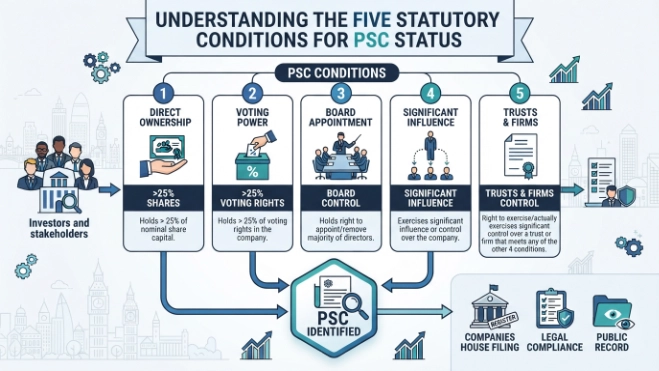
The first condition applies when an individual holds more than 25% of the total issued nominal share capital in a company. For instance, holding 25.1% of ordinary shares immediately triggers PSC registration requirements. The second condition applies when an individual controls more than 25% of the total voting rights attached to the company’s shares.
The third condition focuses on governance authority rather than equity ownership. An individual satisfies this condition when holding the legal right to appoint or remove the majority of the board of directors. The fourth condition covers individuals who exercise significant influence or control without meeting numerical thresholds. The fifth condition applies to individuals exercising control over a trust or unincorporated firm that satisfies any of the first four conditions.
Why Did Companies House Introduce the PSC Register?
Companies House introduced the PSC register in April 2016 to enhance corporate transparency, prevent financial crime, and align the UK with international money laundering regulations. The register creates a publicly accessible record detailing who ultimately owns and controls UK corporate entities.
The implementation of the central public register removed traditional corporate anonymity mechanisms that previously permitted hidden ownership. Law enforcement agencies rely on accurate PSC data to detect money laundering, tax evasion, and illegal property acquisitions. The Economic Crime and Corporate Transparency Act 2024 further increased the authority of Companies House to verify submitted beneficial ownership data.
Public registers build operational trust between commercial trading partners, financial institutions, and investors. Lenders verify beneficial ownership entries on the central register prior to issuing commercial mortgages or corporate loan facilities. Unregistered or inaccurate ownership structures delay commercial banking applications and increase corporate compliance risk during standard due diligence reviews.
Which UK Business Entities Must Maintain a PSC Register?
UK private limited companies, limited liability partnerships, public limited companies, and Scottish qualifying partnerships must maintain a statutory PSC register. Unincorporated sole traders, standard business partnerships, and charitable incorporated organisations fall outside the statutory scope of PSC reporting requirements.
Private limited companies represent 92% of all corporate filings on the UK register. Limited liability partnerships must identify members who hold more than 25% of profit shares or voting rights in the business entity. Overseas entities acquiring UK land or real estate must register beneficial ownership through the separate Register of Overseas Entities maintained by Companies House.
Certain entities listed on regulated investment markets remain exempt from maintain individual PSC registers. Main Market listed companies comply with stringent disclosure rules under the Financial Conduct Authority’s Disclosure Guidance and Transparency Rules. However, AIM-listed companies and unquoted public companies must fulfill standard PSC disclosure obligations without exemption.
What Information Must Be Included in a PSC Register?
A statutory PSC register must contain full personal identification details, official residential addresses, service addresses, and specific details regarding the nature of control. Companies must record exact dates when an individual acquired significant control over the corporate entity.
The statutory register requires eight specific data fields for individual persons of significant control:
Record full legal name including former names
Note official date of birth for age verification
Submit primary nationality matching official identification documents
Document country, state, or part of the UK of primary residence
List physical service address for official public records
Supply full residential address for secure internal records
State exact date the individual became a PSC
Detail every applicable nature-of-control condition code
Legal entities qualifying as Relevant Legal Entities (RLEs) require distinct reporting entries on the statutory register. The entry must specify the official corporate name, registered office address, legal form, governing law, and official corporate register details. Recording exact company registration numbers ensures accurate cross-referencing across public corporate registries.
How Do Companies Identify and Verify Their PSCs?
Companies identify and verify PSCs by analyzing official share confirmation records, examining articles of association, reviewing voting agreements, and sending formal information notices. Directors hold a statutory duty under UK law to keep ownership information up to date.
Company officers must issue formal notice to potential PSCs under Section 790D of the Companies Act 2006 when ownership thresholds change. Recipients must respond within two weeks to confirm or update their statutory personal details. Failure to respond to statutory inquiries allows directors to apply restrictions to the relevant shares or voting rights.
Identity verification protocols confirm physical identification through valid government records. Company officers authenticate personal details using passport data, driving licenses, and official utility bills. Establishing accurate governance records requires professional support; business owners can learn how to correctly identify every PSC in your company through specialized compliance frameworks.
What Are the Deadlines for Updating PSC Information?
Companies must update their internal PSC register within 14 calendar days of confirming a change in beneficial ownership details. Directors must then file the updated details with Companies House within a further 14 calendar days using official filing forms.
Failing to meet the combined 28-day statutory window creates immediate compliance breaches on public records. Changes requiring filing include new PSC appointments, cessation of control, address modifications, or shifts in control categories. Submitting accurate PSC details forms an integral part of the annual confirmation statement process required from every active UK business.
Day 1–14: Identify and verify the PSC change; record it on your internal register.
Day 15–28: Submit the verified change to Companies House via official online portal or form PSC01–PSC09.
Changes involving Relevant Legal Entities require similar form submissions using standard electronic filing systems. Directors must report structural updates promptly to prevent administrative penalties. When business structures involve multiple shareholders or investment layers, professional corporate managers can help you identify your company PSCs with Form My Company to maintain error-free statutory records.
What Are the Penalties for Non-Compliance With PSC Rules?
Non-compliance with PSC reporting rules constitutes a criminal offense that can result in unlimited financial fines and custodial sentences up to two years. Directors face personal criminal liability for failing to take reasonable steps to maintain accurate PSC records.
Companies House can issue civil financial penalties directly to defaulting companies under enhanced enforcement powers. Directors who knowingly supply false or misleading PSC information commit a criminal offense under Section 1112 of the Companies Act 2006. Persistent non-compliance damages commercial credit ratings and risks compulsory company strike-off from the register.
Companies can issue statutory restrictions notices to unresponsive shareholders holding undisclosed control. A restrictions notice effectively freezes share transfers, cancels voting rights, and blocks dividend payouts attached to the affected shares. Commercial banks routinely suspend corporate bank accounts when PSC records on public registries appear outdated or conflicting.
How Do You Maintain and File Your PSC Register Correctly?
Maintaining a PSC register correctly requires updating internal company books, verifying changes in corporate structure, and submitting statutory forms to Companies House within defined timeframes. Companies can keep an internal register or elect to maintain their register on the public central registry.
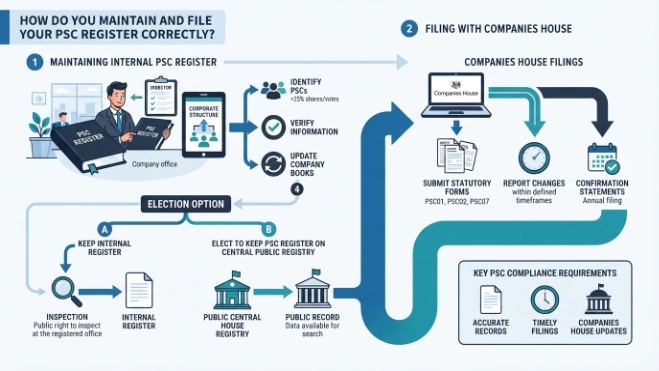
Corporate officers must keep internal registers available for public inspection at the registered office address or a Single Alternative Inspection Location (SAIL). Every entry must reflect verified identification details matched against legal documentation. When ownership transfers occur, directors must execute statutory board minutes documenting the exact nature of the change.
Managing ongoing corporate secretarial obligations demands precise administrative accuracy and regulatory oversight. Outsourcing statutory registers ensures compliance with evolving Companies House standards. Utilizing a dedicated PSC Register service provides corporate management that safeguards directors against compliance breaches and missed filing deadlines.
Maintaining PSC Compliance in the UK
Understanding the definition, scope, and statutory conditions of a Person of Significant Control is essential for running a compliant business in the United Kingdom. Corporate transparency rules demand continuous monitoring of shareholdings, voting power, and indirect influence mechanisms.
Fulfilling statutory filing deadlines, keeping accurate internal registers, and verifying PSC identities protects company directors from severe criminal liabilities and operational disruptions. Professional compliance support ensures your company’s ownership structures remain fully transparent, accurate, and up to date with Companies House requirements.
Explore our PSC Register guide,
Why Your Dormant Company Needs a Registered Office Address for Official Mail
How to Evaluate the ROI of Investing in Professional External Training Rooms
Frequently Asked Questions
How do I set up and maintain a company PSC Register in the UK?
To set up and maintain a company PSC Register, businesses must identify all individuals or legal entities holding over 25% of shares or voting rights and record their verified details in a statutory register. The company must keep this information up to date internally and file updates with Companies House within 14 calendar days of any change. Utilizing the Form My Company PSC Register service streamlines this process by managing statutory records, verifying beneficial owners, and ensuring timely electronic filings.
What happens if a UK company fails to keep an up-to-date PSC Register?
Failing to maintain an accurate PSC Register or submit changes to Companies House is a criminal offense under the Companies Act 2006. Corporate officers and directors face potential personal liability, including unlimited fines and custodial sentences of up to two years. Utilizing a dedicated compliance service from Form My Company ensures your PSC Register remains fully compliant, protecting your business from regulatory penalties and operational disruptions.
Who qualifies as a Person of Significant Control on a company register?
An individual or entity qualifies as a Person of Significant Control if they hold more than 25% of company shares, control over 25% of voting rights, or hold the legal right to appoint or remove a majority of board directors. Individuals who exercise significant influence or ultimate control over corporate decision-making or underlying trusts also satisfy statutory PSC conditions. The Form My Company PSC Register team assists businesses in reviewing corporate structures to accurately identify every qualifying beneficial owner.
Can a corporate entity or another company be listed on a PSC Register?
Yes, a corporate entity can be listed on a PSC Register if it qualifies as a Relevant Legal Entity (RLE). To qualify as an RLE, the legal entity must meet at least one of the standard PSC conditions and maintain its own transparent public register or be listed on a regulated market. The Form My Company PSC Register management solution ensures legal entities are registered with accurate company numbers, registered offices, and legal status details in accordance with UK corporate transparency laws.
How often must a company update its PSC Register with Companies House?
A company must update its internal PSC Register within 14 days of confirming any change in beneficial ownership or personal details, and subsequently file the update with Companies House within another 14 days. In addition, PSC details must be reviewed and re-confirmed annually during the filing of the company’s confirmation statement. Through the Form My Company PSC Register service, company directors receive automated administrative support and filing management to meet these 28-day statutory windows continuously.