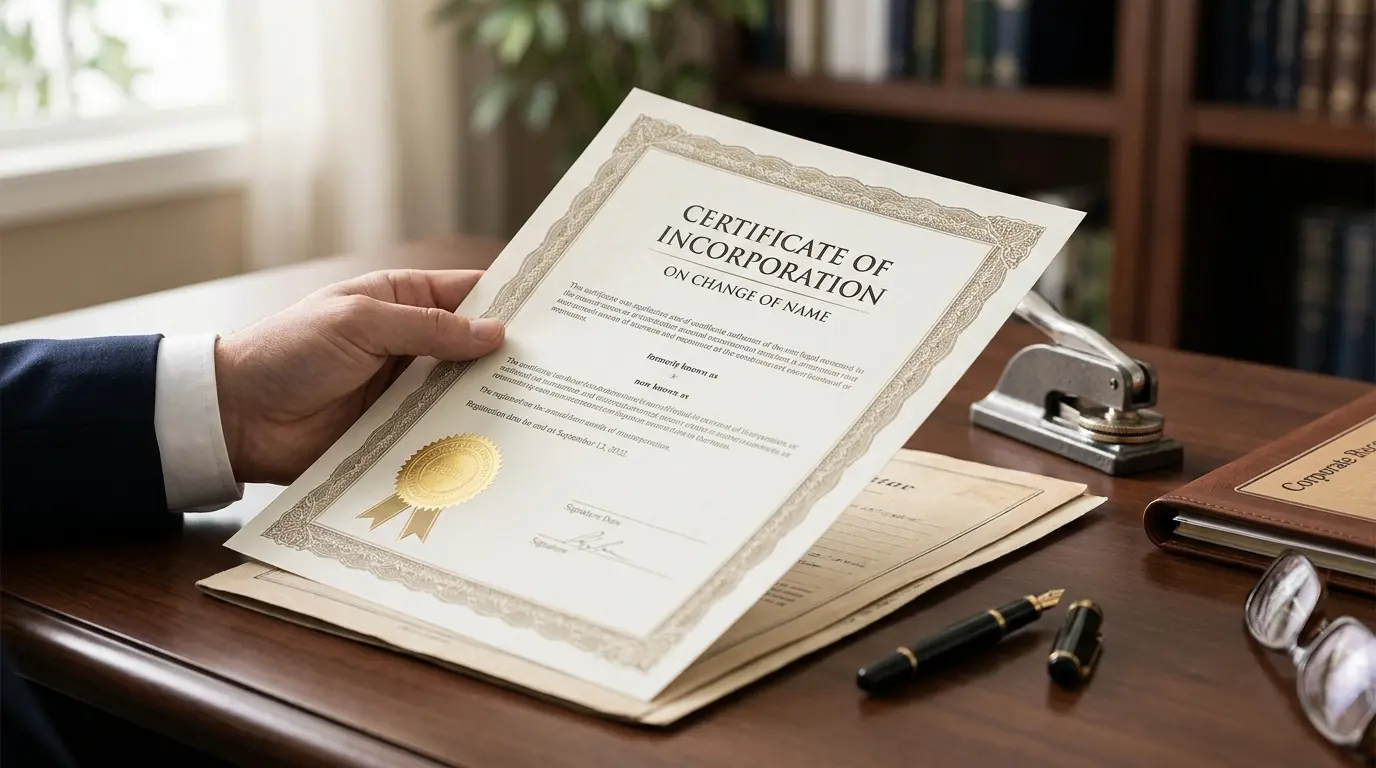
A Change of Name Certificate of Incorporation is an official legal document issued by Companies House that confirms a UK company has lawfully registered a new corporate name. It proves legal continuity while certifying your business operates under its updated registered entity name.
What Is a Change of Name Certificate of Incorporation?
A Change of Name Certificate of Incorporation is an official legal document issued by Companies House. It confirms that a UK registered business has completed a legal name change while retaining its original company registration number, legal status, and existing corporate liabilities.
Companies House issues this official document once a company successfully processes Special Resolution NM01 or statutory filing procedures. The document acts as conclusive legal evidence of a corporate identity update under the Companies Act 2006. It records the previous legal name, the newly approved corporate name, and the exact date the change took effect.
The certificate does not create a new legal entity or alter internal ownership structures. Instead, it maintains unbroken legal continuity for the business. All existing commercial contracts, financial obligations, operational liabilities, and legal rights automatically transfer to the updated corporate name.
Regulators, financial institutions, tax authorities, and commercial partners require this document to verify legal identity. Presenting an updated certificate ensures statutory compliance across banking systems, licensing bodies, and HMRC registries.
Why Do UK Companies Change Their Registered Name?
UK companies change their registered name to reflect strategic rebranding, corporate restructuring, merger activities, or brand protection needs. Updating the registered name ensures commercial alignment across trading markets, regulatory registers, tax authorities, and legal contracts.
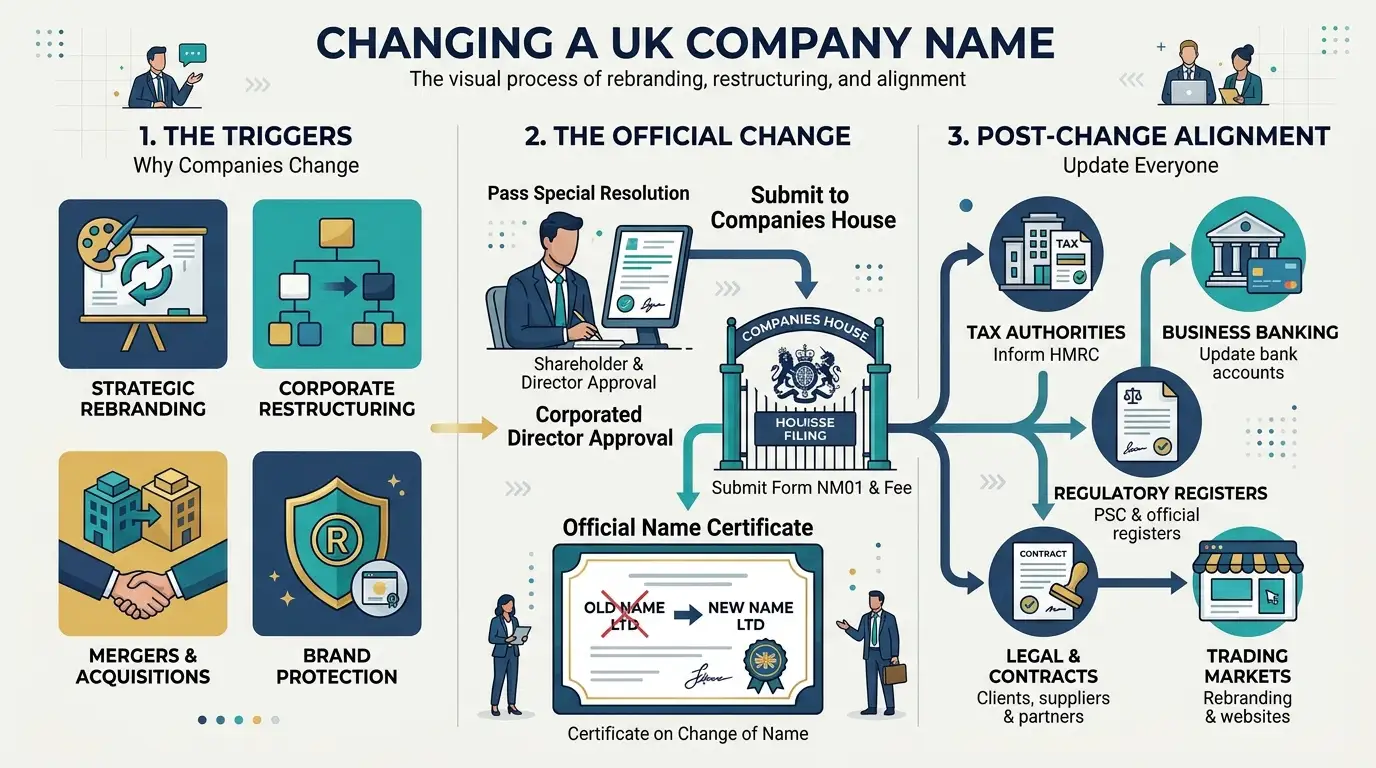
Commercial rebranding represents a primary driver for corporate name changes in the UK market. A business often updates its statutory identity to reflect expanded service lines, target new audience demographics, or modernise market positioning.
Corporate acquisitions, statutory mergers, and structural realignments also demand updated entity documentation. When two corporate entities combine, management teams frequently register a unified company name to streamline legal administration and commercial operations.
Intellectual property conflicts and trademark enforcement often force name updates. Companies must select names that avoid infringement on existing registered trademarks or protected trade names across official registers.
Business owners must manage documentation changes efficiently to ensure full legal validity across all operating environments. Securing comprehensive supplementary company documents helps businesses maintain clear regulatory records during corporate structure updates.
What Information Appears on the Certificate?
A Change of Name Certificate contains the original company name, the newly approved statutory name, the unique UK company registration number, the official seal or signature of Companies House, and the precise legal date of statutory issue.
The document header displays the official coat of arms or seal of Companies House. This marking authenticates the document as an official extract from the central UK registrar of public companies.
The primary body of the certificate explicitly states the former corporate name alongside the newly registered business name. This dual recording establishes an indisputable audit trail between past legal actions and current corporate undertakings.
The unique company registration number remains displayed across the document center. Because the registration number never alters, legal registers track continuous business history despite changes in public name branding.
The official issue date marks the exact legal timestamp of the identity change. Legal frameworks recognize the updated name as enforceable starting from 00:01 AM on the statutory issue date specified.
How Does Companies House Process Name Changes?
Companies House processes name changes by validating proposed names against strict statutory rules, checking special resolution submissions, verifying director credentials, and issuing an updated certificate upon full regulatory approval.
The legal process begins when board directors draft a formal resolution proposing a brand update. Company shareholders must formally pass a Special Resolution, requiring a 75% majority vote to approve the corporate name modification legally.
Upon successful voting, the company officer or appointed legal agent files Form NM01 with Companies House. This statutory filing includes the passing date of the resolution alongside the exact spelling of the proposed corporate name.
Examiners at Companies House review the application against statutory sensitive word restrictions and existing trademark entries. If the proposed title matches an existing entity, examiners reject the application immediately to prevent public deception.
When official checks confirm statutory compliance, the registrar archives the submission into the public register. Companies House then generates and certifies the official electronic or printed change of name documentation.
When Must a Company Present This Certificate?
A company must present this certificate when updating corporate bank accounts, revising commercial supplier contracts, amending property leases, notifying tax authorities, and renewing statutory operational licenses with UK regulatory bodies.
Financial institutions require verified name change documentation before updating commercial banking profiles. Banks must inspect the official certificate to maintain strict Know Your Customer compliance and prevent identity fraud across active corporate accounts.
Contractual counterparties mandate documentation before executing formal contract amendments. Supplying certified proof allows corporate legal teams to update existing vendor agreements, client contracts, and service level commitments without breaching legal terms.
Government bodies require immediate notification following a registered identity change. HM Revenue and Customs, statutory trade registers, and local planning authorities update tax profiles and operational permits based on the official issue date.
To maintain compliance across banking networks and trade registries, business directors often review guides on how to get an updated certificate after a company name change to avoid operational downtime.
What Is the Legal Difference Between Trading Name and Registered Name?
A registered name is the official corporate identity recorded at Companies House, whereas a trading name is an informal operational title used for customer marketing without separate legal personality or independent incorporation.
A registered name establishes the legal entity that owns property, incurs liabilities, executes contracts, and pays corporate taxes. Every UK private limited company must possess one unique registered name that appears on formal business correspondence and invoices.
A trading name functions purely as a commercial alias used for branding and marketing activities. Multiple business divisions can operate under different trading names while sharing one underlying registered corporate name.
Trading names do not require formal incorporation filings or dedicated certificate issues at Companies House. However, businesses must state their full legal registered name on official documentation, including legal notices, payment demands, and website footers.
Operating under a trading name does not protect trade marks or grant exclusive legal ownership of the phrasing. Business owners who require complete legal protection must formally register name changes directly with statutory authorities.
How Do Company Numbers Ensure Unbroken Legal Identity?
Company numbers ensure unbroken legal identity by providing a permanent eight-digit numeric identifier that remains attached to the business entity regardless of how many times the corporate trading name changes.
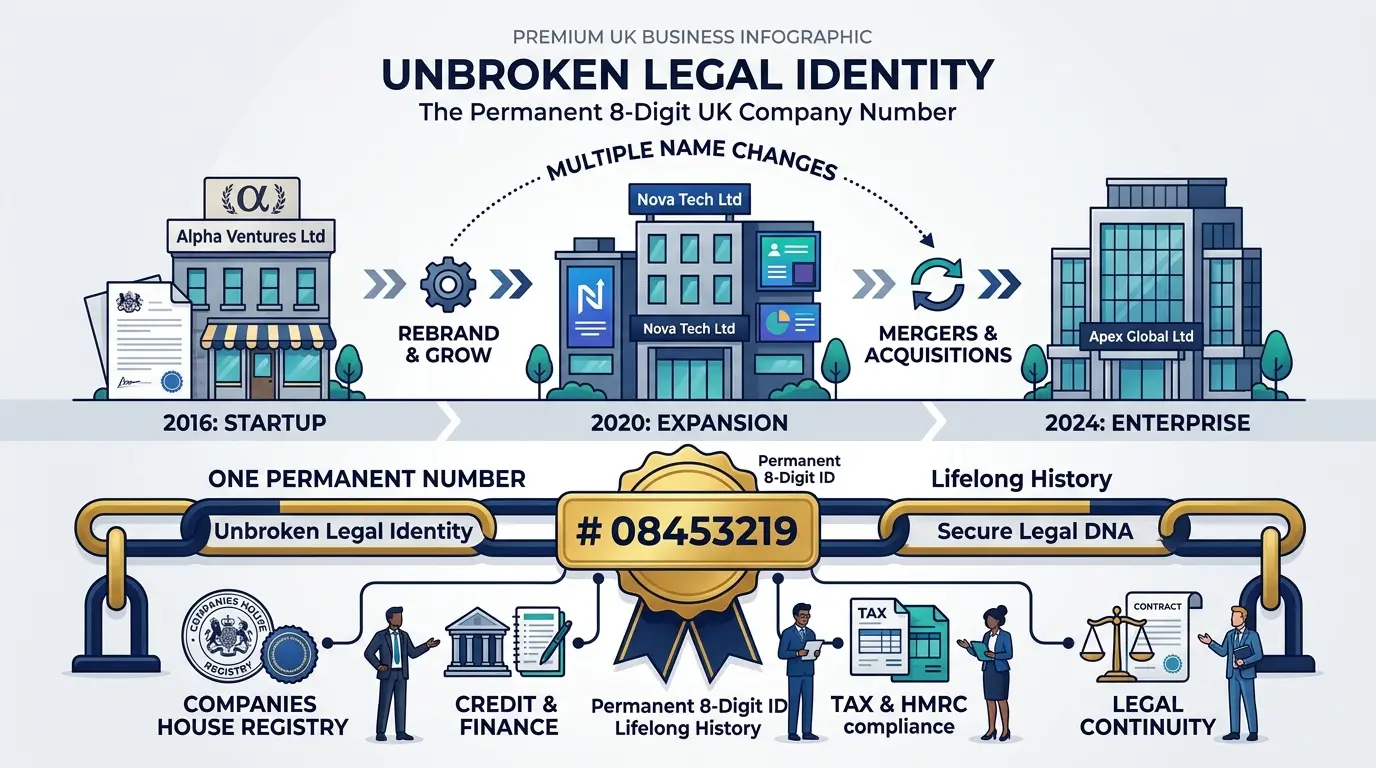
Companies House assigns an eight-digit numeric or alphanumeric code upon initial company formation. This unique identifier tracks the business entity across its entire operational lifespan, through corporate restructuring, rebrandings, and ownership changes.
Contractual agreements cite the permanent company number alongside the statutory corporate name. Because the company number remains constant, existing legal rights, credit histories, property titles, and litigation obligations remain fully enforceable after a name change.
Regulatory registers track compliance using this permanent numeric identity. Tax filings, annual confirmation statements, and public account submissions link directly to the company number rather than shifting keyword text.
Maintaining accurate public records helps prevent legal disputes with financial institutions and commercial partners. Company administrators can directly request an updated incorporation certificate with Form My Company to ensure all corporate filings remain fully compliant with statutory rules.
How Does Form My Company Help Update Corporate Records?
Form My Company assists UK businesses by handling statutory filings, preparing formal corporate resolutions, checking name availability, and securing official certified documents directly from Companies House registers.
Managing statutory identity updates requires strict adherence to legal compliance frameworks and filing deadlines. Form My Company simplifies administrative procedures by verifying name availability against statutory rules before formal application submission.
Specialist teams prepare compliant Special Resolution documentation and complete Form NM01 filings accurately. This precise administrative review prevents application rejections, avoids filing fee forfeitures, and minimizes processing delays.
Form My Company delivers authentic electronic and paper certificates issued directly by statutory authorities. Corporate management teams receive fully certified documentation suitable for immediate submission to financial institutions, legal advisers, and international trade bodies.
Professional administrative support ensures your business maintains operational continuity during identity transitions. Relying on expert filing services protects corporate records while maintaining full regulatory compliance.
Explore More Supplementary Company Documents Guide,
What Do Investors Look for in Your Articles of Association?
What Are the Share Transfer Rules in Articles of Association?
Frequently Asked Questions
What supplementary company documents do UK businesses usually need?
UK businesses typically require supplementary company documents such as official Change of Name Certificates, Certificates of Good Standing, Certificates of Incumbency, and certified copies of the Memorandum and Articles of Association. These official filings verify a company’s statutory status, legal entity name, and current management structure for external compliance reviews. Form My Company provides these certified documents directly from Companies House registers to help businesses satisfy regulatory and financial requirements.
Why do banks require certified supplementary company documents?
Financial institutions require certified supplementary company documents to complete mandatory Know Your Customer (KYC) checks and verify a business’s legal identity before opening or updating accounts. Documents like a Change of Name Certificate or Certificate of Good Standing prove that the entity is active, legally registered, and operating in full compliance with UK corporate law. Form My Company assists corporate clients in procuring fully authenticated document packages to ensure uninterrupted banking operations.
How do I get an official copy of a Change of Name Certificate?
You can obtain an official Change of Name Certificate by submitting a request to Companies House directly or by using a corporate service provider. The certificate provides conclusive legal proof that a registered company has formally updated its corporate name while retaining its original registration number. Form My Company streamlines the application process through its Supplementary Company Documents service to deliver fast, verified electronic or paper certificates.
What is the difference between a Certificate of Incorporation and supplementary corporate documents?
A Certificate of Incorporation is the initial legal document issued when a company is first formed to confirm its legal creation. Supplementary company documents consist of additional statutory certificates and official register extracts—such as name change certificates, status updates, or constitutional amendments—issued throughout the lifespan of a business. Form My Company helps corporate management teams maintain an up-to-date portfolio of statutory records for audit, legal, and commercial purposes.
How long does it take to obtain supplementary company documents from Companies House?
Standard electronic delivery of supplementary company documents usually takes between 3 to 24 hours depending on the specific certificate requested and registry processing times. Physical hard copies requiring apostille, legalization, or official registry seals may take several working days. Form My Company coordinates the retrieval and dispatch of supplementary company documents to minimize administrative delays for business owners and legal teams.