Pre-registration VAT is the value-added tax paid on legitimate business purchases made before your official UK VAT registration date. HM Revenue and Customs allows businesses to reclaim this tax on eligible goods acquired within four years and services incurred within six months prior to registration.
What Is Pre-Registration VAT and How Does HMRC Define It?
Pre-registration VAT represents the tax incurred on commercial purchases made before your business officially registers with HM Revenue and Customs. UK tax law permits registered entities to recover this input tax subject to strict evidence standards, usage conditions, and statutory deadlines.
HM Revenue and Customs (HMRC) establishes clear rules governing pre-registration input tax recovery under UK VAT regulations. Newly registered UK businesses often incur substantial startup costs before issuing their first tax invoice. HMRC allows enterprises to recover value-added tax on these historic expenditures to prevent double taxation on early stage operations.
Eligible purchases must relate directly to making taxable supplies within the business model. HMRC evaluates claims based on whether expenses support ongoing commercial operations. Owners must preserve detailed records, valid tax invoices, and accounting proof to validate historic VAT figures.
UK law sets explicit time limits on historic claims depending on whether expenditures purchase tangible goods or operational services.
What Are the Exact Time Limits for Claiming Pre-Registration VAT?
HMRC enforces two strict statutory time frames for reclaiming pre-registration VAT: four years for physical goods still held by the business and six months for operational services consumed prior to your official registration date.
HMRC maintains a four-year time boundary for reclaiming VAT on physical goods purchased prior to registration. The calculation begins precisely four years back from your official VAT registration date. Goods qualify only if your enterprise still owns them or uses them within active business operations on the date of registration. If your firm sold, consumed, or disposed of products before registering, HMRC prohibits any input tax recovery on those items.
Services operate under a much tighter statutory deadline. HMRC restricts historic service claims to expenses incurred within six months immediately preceding your registration date. Services must relate strictly to business activities, such as legal setup fees, accountancy charges, software subscriptions, or facility rental expenses.
Missing these deadlines forfeits your statutory right to claim input tax adjustments. Businesses must verify purchase dates against bank records and supplier invoices to prevent non-compliant submissions.
Which Business Expenses Qualify for Pre-Registration VAT Recovery?
Qualifying pre-registration expenses include physical inventory, capital machinery, tools, commercial vehicles, accountancy fees, web development, professional consultancy, and office rental incurred strictly for business purposes and supported by valid invoices.
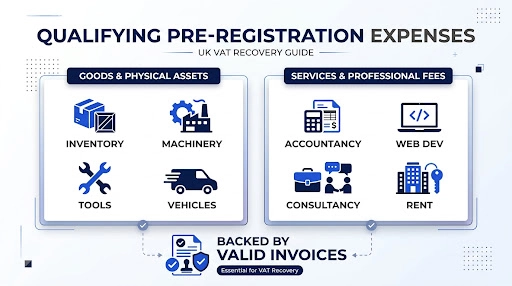
Physical assets bought for ongoing business creation form a core category of eligible claims. Equipment, computers, office furniture, tools, and raw materials purchased up to four years prior qualify for recovery. Inventory intended for resale also qualifies, provided the stock remains in your possession on your official registration day.
Professional services consumed during early operational stages fall under the six-month rule. Three common qualifying services include accountancy setup fees, specialized legal advice, and marketing consultancies. Web hosting, software subscriptions, and commercial premise leases also satisfy HMRC criteria when documented accurately.
Exclusions apply to items consumed before registration. Petrol used for completed journeys, electricity used in past months, or raw materials processed and sold prior to your effective date fail HMRC eligibility tests. Personal purchases missing direct commercial utility remain strictly non-claimable.
What Documents Do You Need to Prove Past VAT Expenses to HMRC?
HMRC requires valid tax invoices displaying the supplier’s registration number, invoice date, total cost, VAT amount, detailed purchase descriptions, and corresponding proof of payment matching your official business records.
Every claim submitted to HMRC must rely on valid tax documentation. Standard commercial receipts often lack necessary tax breakdowns required for statutory compliance. Invoices must show the supplier’s name, full address, unique nine-digit VAT number, tax point date, and applicable VAT rates.
Invoices exceeding £250 require itemized breakdowns separating net cost, tax rate, and final VAT total. For purchases below £250, HMRC accepts simplified invoices containing the supplier’s VAT number alongside total inclusive prices.
Bank records and accounting logs must substantiate every invoice. HMRC tax inspectors inspect cross-references between bank transactions and submitted invoices during compliance audits. Discrepancies between payment amounts and invoice totals risk claim rejection and potential financial penalties.
Preserving physical or secure digital records remains mandatory for at least six years following submission. Maintaining clear audit trails protects businesses during retrospective HMRC reviews.
How Do You Calculate and Submit Pre-Registration VAT Claims?
You calculate pre-registration VAT by totaling tax paid on qualifying goods and services, then report this sum on Box 4 of your first official VAT return submitted through Making Tax Digital software.
Calculating pre-registration input tax requires segregating historical expenditures into goods purchased within four years and services bought within six months. Check that all physical goods remain in business ownership on your registration date. Exclude any items resold, damaged, or fully consumed before that point. Total the VAT amounts from all valid invoices across both categories.
Submission occurs exclusively on your first formal VAT return. HMRC integrated pre-registration claims into regular reporting cycles via Box 4, which records total input tax. Add your historic input tax directly to regular input tax incurred during your initial accounting period.
UK regulations mandate submitting returns through Making Tax Digital (MTD) compliant software. Ensure your digital bookkeeping software records pre-registration adjustments accurately to preserve digital links across financial records.
Proper initial setup prevents delays in receiving early tax refunds. Seeking specialized VAT Registration Assistance ensures your business establishes compliant tax accounts right from inception.
What Are Common Errors That Trigger HMRC Pre-Registration Audits?
HMRC triggers compliance audits when businesses claim VAT on goods sold before registration, submit invalid receipts missing VAT numbers, miscalculate six-month service limits, or claim tax on personal expenses.
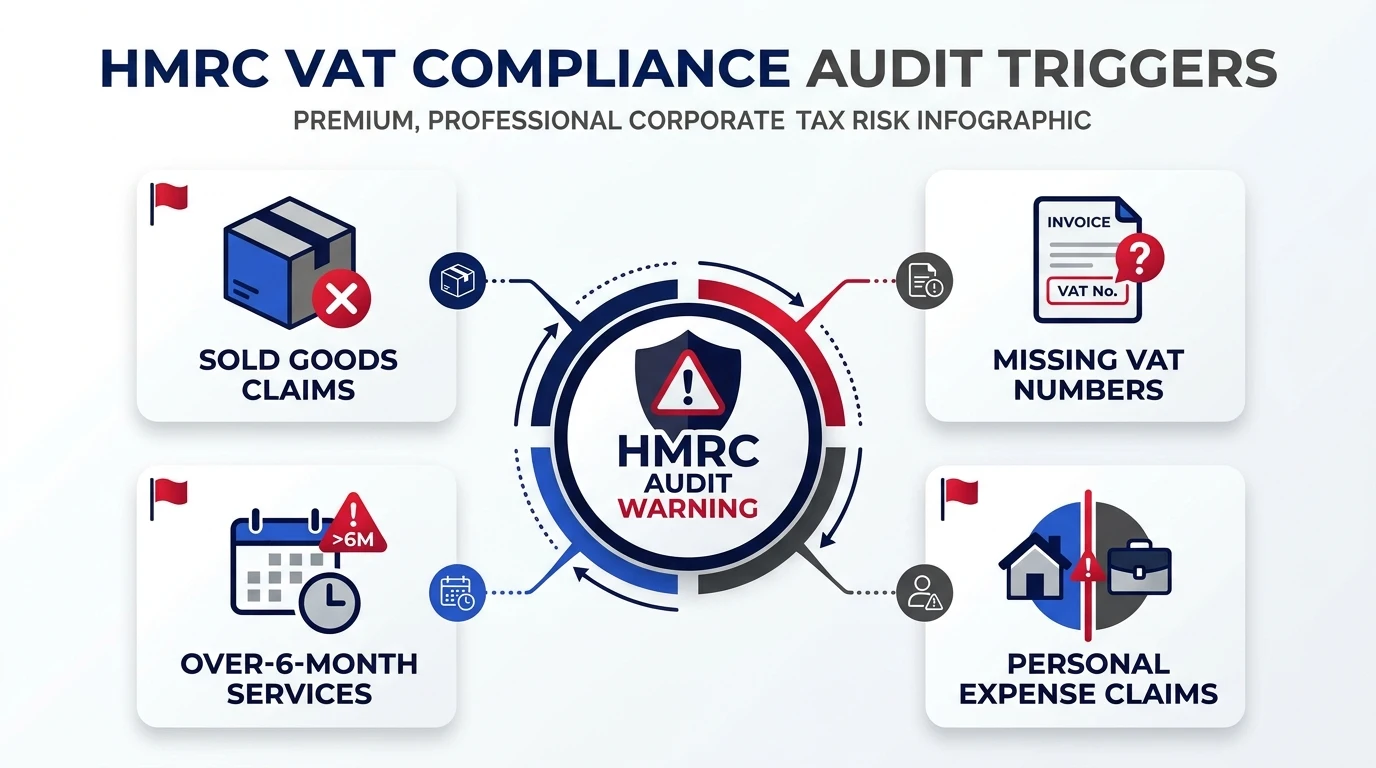
Claiming input tax on physical goods no longer owned remains the most frequent audit trigger. HMRC cross-references early asset claims against historical sales logs. Claiming tax on equipment sold, discarded, or converted to personal use before registration constitutes a serious compliance violation.
Submitting incomplete documentation frequently leads to rejected claims. Standard credit card slips, bank statements, or delivery notes do not replace full tax invoices. Invoices omitting the seller’s valid VAT number render claims invalid during HMRC inspections.
Misinterpreting service timelines also generates inquiry flags. Applying four-year time horizons to professional services instead of enforcing strict six-month limits results in immediate claim adjustments.
Claiming non-deductible expenses like client entertainment or personal travel causes compliance flags. Separating personal expenditure from legitimate corporate transactions preserves claim integrity and reduces audit risks.
How Does Pre-Registration VAT Interact With Different Accounting Schemes?
Pre-registration VAT adjustments apply directly to your first return under the standard scheme, but require careful handling when transitioning into cash accounting or specialized flat rate frameworks.
Standard VAT accounting records input tax based on invoice dates, making initial pre-registration calculations straightforward. You aggregate historic valid invoices and enter the total input tax on your first standard submission.
The cash accounting framework calculates VAT based on actual cash payment dates rather than invoice issuance dates. When using cash accounting, businesses must verify that historic payments cleared bank accounts before including them in initial calculations. To master these framework transitions, read How to Transition from the Standard VAT Scheme to Digital Cash Accounting.
The Flat Rate Scheme restricts standard input tax recovery, replacing itemized deductions with fixed percentage calculations. However, HMRC permits flat rate businesses to make pre-registration VAT claims on initial setup expenses prior to joining the flat rate structure.
Choosing appropriate tax accounting structures impacts ongoing cash flow management. Evaluate options thoroughly by reviewing Expert Scheme Selection: How Form My Company Helps You Pick Between Standard and Cash Accounting.
Form My Company simplifies corporate setup by guiding UK enterprises through registration formalities, tax structuring, and compliance requirements. Their registration specialists ensure new companies establish proper tax profiles while maximizing eligible historical tax claims.
Explore More VAT Registration Assistance Guide,
Get Fast Certified Formation Documents From Form My Company
Skip the Solicitor Visit With Certified Documents From Form My Company
Frequently Asked Questions
What is included in Form My Company’s VAT Registration Assistance?
Form My Company provides comprehensive VAT Registration Assistance to guide UK businesses through every step of HM Revenue and Customs tax registration. The service handles eligibility assessments, document preparation, HMRC application submission, and the setup of Making Tax Digital compliant accounts. This ensures new enterprises secure their official VAT registration number without administrative delays or rejection risks.
Who needs professional assistance when registering for UK VAT?
Businesses approaching the statutory £90,000 UK turnover threshold, or those choosing voluntary registration to reclaim input tax, benefit from professional registration guidance. Complex corporate structures, overseas director requirements, or historic expense claims often introduce compliance hurdles during the application process. Form My Company ensures applications satisfy strict HMRC verification standards to prevent common processing delays.
How long does VAT registration take with Form My Company?
HMRC typically processes standard business VAT applications within 10 to 30 working days after submission. Form My Company expedites this timeline by verifying all director identity documents, business bank details, and trade evidence before filing. Using professional VAT Registration Assistance reduces processing times by eliminating administrative errors and missing evidence requests from tax inspectors.
Can Form My Company help reclaim pre-registration VAT during setup?
Yes, Form My Company helps businesses structure their accounting to recover eligible pre-registration VAT on historical start-up expenses. UK tax law permits reclaiming VAT paid on qualifying physical goods bought up to four years prior and operational services incurred within six months of registration. Incorporating this historical data into your initial HMRC submission optimizes early business cash flow.
Which VAT scheme should a new business select during registration?
Selecting between the Standard VAT Scheme, Cash Accounting Scheme, or Flat Rate Scheme depends on your business model, customer payment terms, and annual turnover forecasts. Form My Company evaluates your operational cash flow to recommend the most tax-efficient structure during the registration phase. Expert scheme selection prevents unexpected tax liabilities and simplifies ongoing Making Tax Digital compliance obligations.