
Form My Company configures your Making Tax Digital (MTD) compliant VAT setup by handling official HMRC registration, selecting compatible accounting software, linking digital records directly to HMRC gateways, and configuring automated tax calculations to ensure total regulatory accuracy for UK businesses.
Setting up a digital compliance framework requires precise alignment with HM Revenue and Customs (HMRC) standards. Making Tax Digital is a mandatory UK government initiative requiring businesses to maintain digital accounting records and submit returns using MTD-compatible software. Modern enterprises often face technical hurdles when transitioning manual record-keeping systems into fully digital compliance pipelines. Operating without an MTD-ready system risks financial penalties, submission delays, and auditing friction.
Establishing digital tax compliance requires a structured deployment strategy. Professional corporate services guide businesses through initial documentation, digital gateway configuration, and API verification. This end-to-end setup transforms complex tax obligations into an automated, streamlined operational workflow.
Why Is an MTD-Ready VAT Setup Essential for Modern UK Businesses?
An MTD-Ready VAT setup is essential because HMRC mandates digital record-keeping and API-enabled tax submissions for all VAT-registered UK businesses to eliminate manual calculation errors and ensure real-time financial reporting compliance.
HMRC expanded the Making Tax Digital mandate to encompass all VAT-registered entities regardless of taxable turnover thresholds. Businesses must maintain digital logs for every sale, purchase, and tax adjustment. Manual data entries into HMRC web portals are no longer legally permitted under current UK tax laws.
digital record keeping safeguards corporate operations from human error. Systems automatically track output tax on sales and input tax on business expenses. Companies gain full visibility over their net VAT liabilities before quarterly submission deadlines arrive.
Implementing digital compliance protects organizations from default surcharges and accuracy-related penalties. Automated systems ensure data integrity across the entire accounting ledger. Businesses gain audit-proof financial records while reducing administrative overhead costs significantly.
How Does the Initial VAT Registration Process Work for UK Companies?
The initial VAT registration process involves collecting corporate verification documents, determining the correct accounting scheme, submitting an application via the HMRC gateway, and receiving a unique nine-digit VAT identification number.
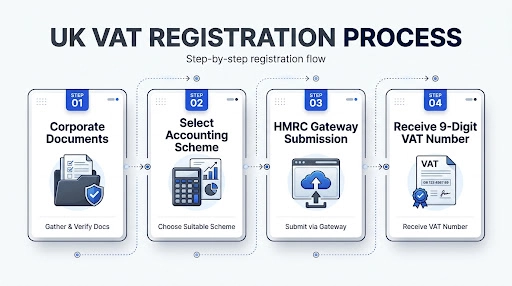
VAT registration requires identity authentication and business validation. Companies must submit certificate of incorporation details, director identity proofs, and primary business bank account documentation. Preparing accurate documentation prevents unnecessary HMRC processing delays or formal rejections.
Selecting an appropriate VAT scheme directly affects cash flow management. Businesses choose between standard accounting, flat rate schemes, and cash accounting options. To understand alternative structures, explore what is Annual Accounting VAT and what are its main benefits? to evaluate whether annual reporting suits your operational model.
Once submitted, HMRC reviews the corporate structure and issues a official VAT certificate. This document contains the firm’s nine-digit VAT number, effective registration date, and assigned quarterly accounting periods. Obtaining these credentials is the mandatory prerequisite for integrating digital tax submission software.
How Does Form My Company Configure Your Digital Tax Infrastructure?
Form My Company configures your digital tax infrastructure by submitting official registration files, linking specialized MTD accounting software to HMRC APIs, verifying digital bridge connections, and testing live tax submission channels.
Executing a compliant digital setup demands exact technical alignment between software and government portals. Form My Company manages the technical integration process to guarantee error-free data transmission. Specialized specialists handle software authorization, API key generation, and system testing.
Our specialists integrate corporate accounts with leading MTD-compliant platforms such as Xero, QuickBooks, and FreeAgent. For existing setups, we implement API-based bridging software to connect legacy spreadsheets directly to HMRC servers. This approach avoids full infrastructure replacement while satisfying digital compliance rules.
Businesses seeking professional deployment can utilize our dedicated VAT registration assistance to establish an automated, fully compliant tax infrastructure from day one. Proper configuration eliminates manual copy-pasting, securing data transfers through encrypted digital links.
How Do Digital Links Guarantee HMRC Compliance and Audit Trails?
Digital links guarantee compliance by creating an unbroken, electronic transfer of data between accounting software components, eliminating manual data entry, and preserving immutable transaction logs for HMRC audit inspections.
HMRC compliance rules strictly define digital links as electronic data transfers between functional compatible software systems. Acceptable digital links include automated data feeds, API connections, database imports, and linked spreadsheet cells. Unlinked manual copy-pasting between software tools violates federal compliance regulations.
A continuous digital audit trail tracks financial data from source documents to final return submissions. Every transaction logs the supply time, net value, and applicable VAT rate. The audit trail records three core data elements: transaction date, taxable amount, and calculated tax value.
Maintaining automated digital links simplifies internal accounting workflows. Systems automatically aggregate digital invoice data into the nine standard MTD return boxes. This seamless integration ensures your submissions reflect exact ledger balances during regulatory reviews.
How Do You Integrate MTD-Compliant Software into Everyday Operations?
Integrating MTD-compliant software into everyday operations requires setting up automated bank feeds, mapping tax rates to product catalogs, training staff on digital invoicing, and scheduling recurring quarterly review procedures.
Operational integration begins with automated bank reconciliation feeds. Direct banking APIs import daily business expenses and customer revenues straight into your accounting software. Automated rules match bank transactions against digital receipts instantly.
Staff members must adopt digital invoicing protocols for all sales transactions. Software platforms generate compliant digital tax invoices containing registered business details, tax rates, and total amounts. To master software configuration step-by-step, review how to set up Making Tax Digital (MTD) compliant software for your business to ensure seamless staff adoption.
Establishing internal review schedules guarantees on-time quarterly filings. Compliance teams verify data links, reconcile outstanding ledger items, and approve draft returns prior to digital transmission. Regular internal audits prevent last-minute filing panics and maintain compliance standards year-round.
What Common VAT Setup Mistakes Can Businesses Easily Avoid?
Businesses avoid common VAT setup mistakes by selecting proper effective registration dates, applying correct tax exemption codes, maintaining strict digital links, and pairing accounting software with HMRC APIs prior to deadlines.
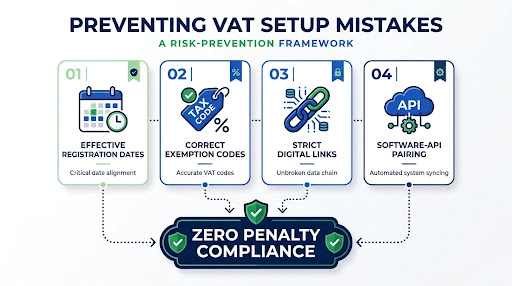
Incorrect registration dates create immediate accounting complications. Selecting an improper effective date forces companies to calculate VAT retroactively or forfeit legitimate input tax claims. Business owners must align registration timing with actual trading milestones.
Misclassifying product tax rates leads to severe financial inaccuracies. Companies must differentiate between standard rate (20%), reduced rate (5%), zero-rate (0%), and exempt goods. Misapplying zero-rate classifications to standard goods results in unpaid tax liabilities during HMRC audits.
Failing to establish digital links remains a frequent compliance oversight. Using non-linked spreadsheets to summarize calculations before manually typing figures into returns violates HMRC mandates. Deploying certified MTD tools prevents these costly operational errors entirely.
How Does Form My Company Secure Long-Term MTD Compliance Support?
Form My Company delivers long-term MTD compliance support through ongoing tax portal monitoring, scheme optimization reviews, automated submission tracking, and direct liaison services for HMRC inquiries.
Compliance management extends far beyond initial account registration. Business growth, evolving tax laws, and changing revenue thresholds require continuous system monitoring. Form My Company provides ongoing technical assistance to keep digital reporting systems optimized.
Our specialists review quarterly filings to confirm digital link integrity before transmission. We analyze sales data to evaluate whether switching accounting schemes improves corporate working capital. System updates are applied automatically whenever HMRC updates its digital API standards.
Partnering with professional corporate advisors provides operational peace of mind. Form My Company handles regulatory updates, manages technical software connections, and ensures your organization maintains an audit-proof compliance framework indefinitely.
Explore More Supplementary Company Documents Guide,
Get Sponsor Licence-Ready Company Documents From Form My Company
Order a Sale-Ready Company Document Pack From Form My Company
Frequently Asked Questions
How long does the HMRC VAT registration process take in the UK?
The standard HMRC VAT registration process typically takes between 10 to 30 working days from the date of application submission. Using VAT Registration Assistance from Form My Company helps accelerate processing times by ensuring all corporate documents, identity verification, and accounting details are error-free before submission.
Is VAT registration mandatory for all UK businesses?
VAT registration becomes legally mandatory when a UK company’s taxable turnover exceeds £90,000 within a rolling 12-month period, or if the business expects to breach the threshold in the next 30 days. Businesses earning below this limit can still complete voluntary registration through Form My Company to reclaim input VAT on legitimate commercial purchases.
What documents are required to register a business for VAT?
To apply for a UK VAT number, a company must provide its certificate of incorporation, corporate bank account details, proof of business activity, and primary director identification documents. Form My Company compiles and audits these compliance documents to prevent application rejections or processing delays from HMRC.
Can non-UK residents register a UK company for VAT?
Yes, non-UK resident directors operating a UK company can register for VAT, provided they establish a business taxable presence or sell taxable goods and services within the UK market. Form My Company provides tailored VAT Registration Assistance to help overseas founders navigate Non-Established Taxable Person (NETP) regulations and establish an MTD-ready tax structure smoothly.
What is the difference between standard and cash accounting VAT schemes?
Under the standard VAT accounting scheme, tax is due based on invoice issuance dates, whereas the cash accounting scheme allows businesses to pay VAT only when customer payments are cleared. Form My Company evaluates company revenue flows during registration to advise on the most tax-efficient accounting setup for long-term financial health.