
Budget meeting spaces offer basic facilities at low cost, focusing on functionality and short-term use. Premium executive business centres provide high-end environments, advanced technology, administrative support, and flexible services designed to enhance productivity, client perception, and operational efficiency for professional business activities.
What defines a budget meeting space?
Budget meeting spaces are cost-focused venues that provide essential meeting infrastructure such as tables, chairs, and basic connectivity, with minimal additional services, limited customisation options, and standardised layouts designed for short-duration or low-priority business interactions.
Budget meeting spaces operate on a volume-based model. Providers maximise occupancy and minimise service layers. These venues typically include three core elements: seating arrangements, basic Wi-Fi, and presentation screens. The setup remains fixed, with limited flexibility in room configuration. Businesses use these spaces for internal meetings, quick discussions, or low-stakes presentations. For example, startups conducting weekly team updates or freelancers hosting client check-ins often choose budget venues.
Operational support remains minimal. Reception services, catering, and IT assistance are either absent or offered as paid add-ons. This structure reduces overhead but limits the user experience. Location also reflects cost efficiency. Budget meeting spaces are commonly located outside prime business districts or within shared office buildings that prioritise affordability over prestige.
What defines a premium executive business centre?
Premium executive business centres provide fully serviced environments with high-end interiors, advanced communication technology, dedicated administrative support, and flexible room configurations designed to support client-facing meetings, strategic discussions, and professional brand positioning.
Premium executive business centres operate on a service-integrated model. They combine infrastructure with operational support. These centres include five key components: high-speed secure internet, video conferencing systems, reception services, catering options, and on-site technical assistance.
Room design focuses on flexibility. Spaces adapt to different formats such as board meetings, training sessions, or investor presentations. Furniture and layouts can be reconfigured within minutes. Technology plays a central role. Integrated systems include HD video conferencing, wireless screen sharing, and soundproof environments. These features ensure seamless communication during hybrid or international meetings.
Location is strategic. Premium centres are typically positioned in central business districts such as London, Manchester, or Birmingham. This positioning enhances accessibility and strengthens brand perception. Businesses seeking professional-grade environments often explore fully serviced meeting rooms that combine infrastructure with support services.
How do cost structures differ between budget and premium options?
Budget meeting spaces follow a low-cost, pay-per-use pricing model with limited inclusions, while premium executive business centres use tiered pricing that reflects added services, advanced technology, and enhanced user experience, resulting in higher but value-driven costs.
Budget venues charge hourly or daily rates with minimal inclusions. For example, a standard room may cost £15 to £30 per hour, covering only space and basic utilities. Additional services, such as printing or refreshments, increase the total cost incrementally. Premium executive centres adopt bundled pricing. A single booking often includes multiple services such as reception handling, IT support, and refreshments. Rates typically range from £40 to £120 per hour, depending on location and facilities.
Cost evaluation depends on usage intent. If a business hosts one internal meeting per week, a budget space provides sufficient value. If a company conducts client presentations or investor meetings, premium environments deliver measurable returns through improved perception and efficiency. Hidden costs also differ. Budget spaces often introduce unexpected charges for equipment or overtime usage. Premium centres provide transparent pricing structures that reduce uncertainty.
How does technology integration compare in both options?
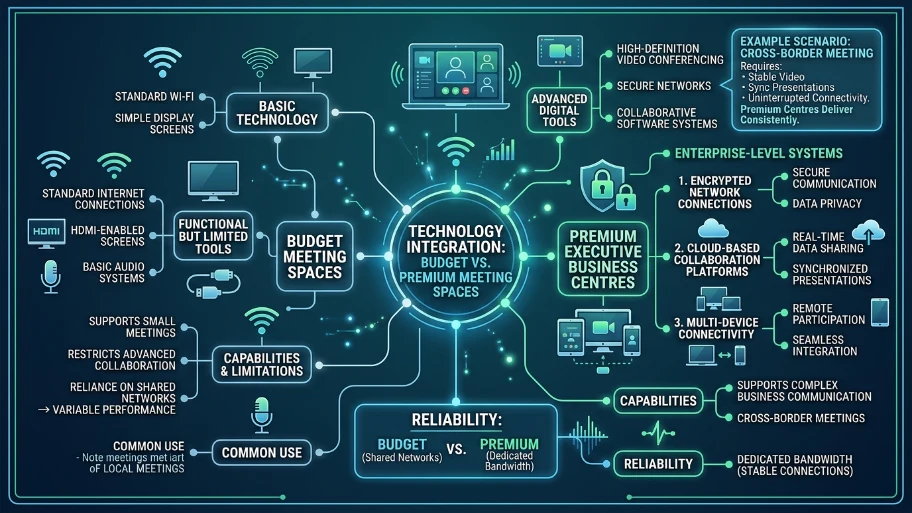
Budget meeting spaces provide basic technology such as standard Wi-Fi and simple display screens, while premium executive business centres integrate advanced digital tools, including high-definition video conferencing, secure networks, and collaborative software systems that support complex business communication needs.
Technology in budget spaces remains functional but limited. Common tools include standard internet connections, HDMI-enabled screens, and basic audio systems. These tools support small meetings but restrict advanced collaboration. Premium centres integrate enterprise-level systems. These include three primary technologies: encrypted network connections, cloud-based collaboration platforms, and multi-device connectivity. This setup supports remote participation, real-time data sharing, and secure communication.
For example, a company conducting a cross-border meeting with teams in three countries requires stable video conferencing, synchronised presentations, and uninterrupted connectivity. Premium centres deliver this capability consistently. Technology reliability also differs. Budget venues rely on shared networks, which can reduce performance during peak usage. Premium centres allocate dedicated bandwidth to ensure stable connections.
To understand how modern meeting environments integrate these tools, explore advanced video conferencing and digital meeting tools and order a fully managed meeting room service for a stress-free event
What level of support services can businesses expect?
Budget meeting spaces offer minimal or self-service support, while premium executive business centres provide dedicated staff, including receptionists, IT specialists, and event coordinators, ensuring smooth execution of meetings and professional handling of client interactions.
Support services define the operational experience. Budget venues typically operate on a self-service basis. Users manage setup, troubleshoot technical issues, and coordinate logistics independently. Premium centres assign trained staff to each booking. These teams handle five key tasks: greet attendees, manage scheduling, configure technology, arrange catering, and resolve technical issues in real time.
Reception services add another layer of professionalism. Visitors are welcomed, registered, and directed efficiently. This process enhances the client experience from entry to exit.IT support ensures uninterrupted operations. For example, if a video call disconnects or a presentation fails to load, on-site specialists resolve the issue immediately.
Event coordination also improves efficiency. Businesses hosting training sessions or workshops benefit from structured planning and execution support.
How does brand perception differ between the two options?
Budget meeting spaces project a functional and cost-conscious image, while premium executive business centres enhance brand perception by offering professional environments, high-end design, and seamless service that reflect credibility, stability, and attention to detail.
Brand perception influences business outcomes. Meeting environments shape how clients, partners, and investors evaluate a company. A basic room with minimal design communicates efficiency but lacks impact. Premium environments create a strong first impression. Elements such as modern interiors, ergonomic furniture, and well-lit spaces contribute to a professional atmosphere. These features signal operational maturity and reliability.
Client-facing meetings benefit significantly from premium settings. For example, a financial consultancy presenting investment strategies in a high-end boardroom strengthens trust and credibility. Consistency also matters. Premium centres maintain uniform standards across locations. This consistency ensures predictable experiences for recurring meetings. Businesses that prioritise brand positioning often select environments that align with their market image and service quality.
Explore our meeting rooms guides,
Why Renting a Meeting Room is the Best Solution for Client Interviews
The Advantages of Booking Meeting Rooms with Dedicated Refreshment and Breakout Areas
When should a business choose a premium executive business centre?
Businesses select premium executive business centres when meetings involve clients, investors, or strategic decisions, require advanced technology, or demand a professional environment that supports brand positioning, operational efficiency, and high-stakes communication outcomes.
Decision-making depends on meeting the purpose. Three scenarios justify premium selection: client presentations, investor discussions, and executive strategy sessions. These situations require precision, reliability, and strong visual impact. Frequency also influences choice. Companies hosting more than 8 to 10 meetings per month benefit from consistent service quality and time savings offered by premium centres.
Industry standards play a role. Sectors such as finance, legal services, and consulting operate in environments where professionalism directly affects outcomes. Premium spaces align with these expectations. Operational efficiency improves with integrated services. Businesses reduce setup time, avoid technical disruptions, and maintain structured meeting flows. Companies ready to upgrade their meeting experience often evaluate premium solutions through services like ordering a fully managed meeting room service for a stress-free event.
The difference between budget meeting spaces and premium executive business centres lies in service depth, technology integration, and overall business impact. Budget options deliver cost efficiency for basic needs. Premium environments provide structured support, advanced tools, and a professional setting that enhances outcomes.
From My Company delivers fully equipped meeting rooms that combine technology, support services, and strategic locations. These environments enable businesses to conduct meetings with efficiency, consistency, and professional credibility. Companies that prioritise performance and perception gain measurable advantages from premium meeting solutions.
Frequently Asked Questions
What are meeting rooms used for?
Meeting rooms are used for client meetings, team discussions, presentations, interviews, and training sessions. For From My company, meeting rooms provide a professional setting with the space and setup needed for focused business conversations.
What features should I expect in meeting rooms?
Most meeting rooms include tables, chairs, Wi-Fi, presentation screens, and basic refreshments. From My company meeting rooms are designed for practical business use, with features that support smooth meetings and clear communication.
How do meeting rooms differ from coworking spaces?
Meeting rooms are private spaces reserved for scheduled discussions, while coworking spaces are shared work environments. Meeting rooms are better for confidential meetings, presentations, and client-facing sessions that require privacy and control.
How do I book meeting rooms for business use?
Business users usually book meeting rooms by selecting the room size, time slot, and required facilities. From My company offers meeting rooms for short meetings, longer sessions, and professional events with flexible booking options.
Are meeting rooms suitable for hybrid meetings?
Yes, many meeting rooms support hybrid meetings with video conferencing, reliable internet, and screen-sharing tools. From My company meeting rooms are suitable for in-person and remote participants, making them useful for modern business communication.