
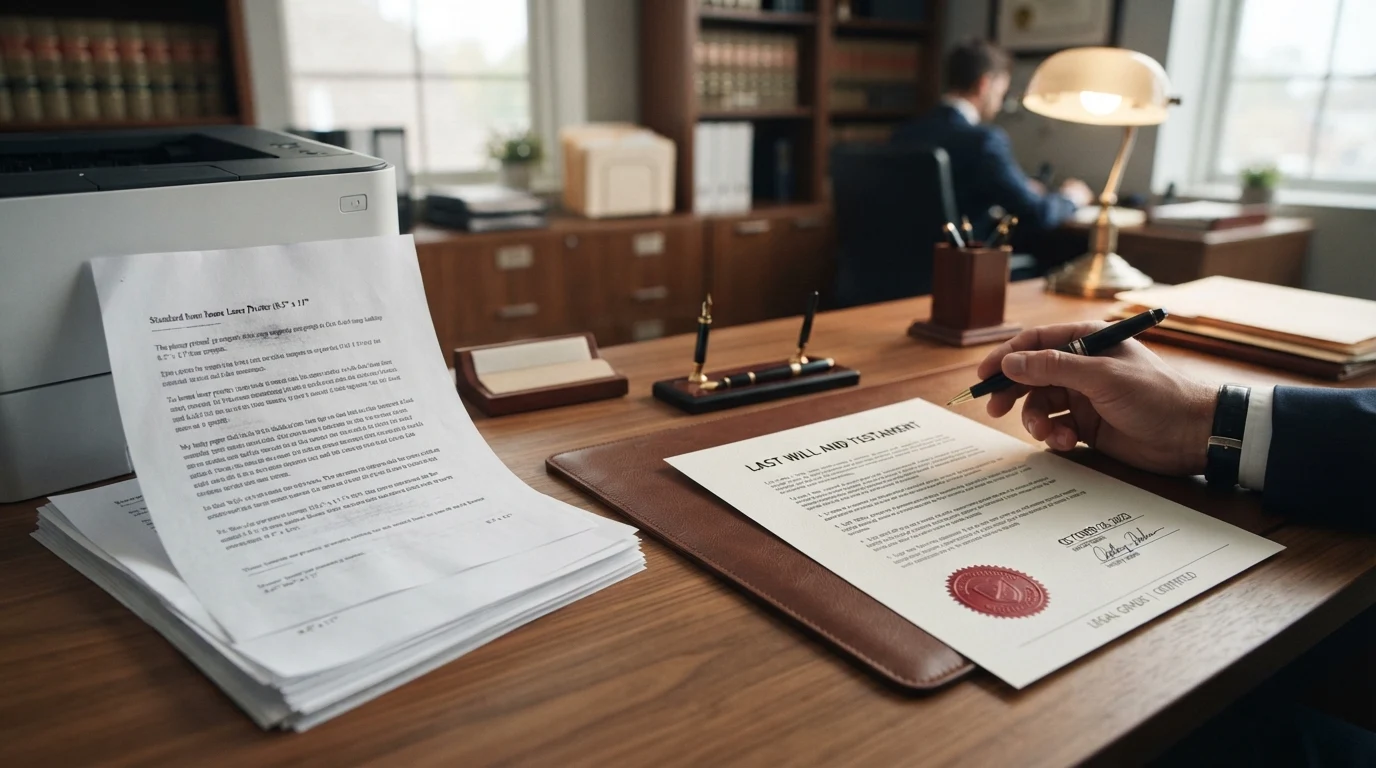
Legal-paper documents are professionally printed on dedicated paper, while home-printed copies come from ordinary office printers. UK company law sets no paper standard for most company documents, so the right choice depends on what the recipient accepts and on your provider’s conditions.
What Is Legal Paper and How Does It Differ From Home-Printing?
Legal paper is dedicated stock used to print official company documents, such as a duplicate certificate of incorporation. Home-printing uses standard paper and a desktop printer. The difference lies in presentation, consistency and how formally a recipient treats the document.
Home-printing produces a copy of a digital file. You download the document, load standard A4 paper, and print it. The result depends on your printer, your ink and your paper. Two copies printed in different offices can look different.
Legal-paper printing removes that variation. A provider prints the document on designated paper and prepares it for dispatch. The document arrives as a finished physical item rather than a file you must print yourself.
Form My Company lists a Duplicate Certificate of Incorporation as a printed copy on the required legal paper. The listing applies to companies formed through Form My Company. The paper specification is a provider-specific product feature, not a rule set by Companies House.
The distinction matters most for formal documents. A certificate of incorporation evidences that the company exists. Companies House issues it digitally when it registers the company. A paper duplicate gives directors a physical version for files, meetings and formal handovers.
Share-related paperwork follows similar logic. Readers who want the background can review what share certificates are and who needs them, then return to compare printing options.
Why Does Print Quality Matter for Company Records?
Print quality affects legibility, durability and how a recipient perceives the document. Faded toner, creased paper and misaligned text raise questions. A clean, consistent print removes them. Quality does not change the legal content of the document.
Does UK Law Require Company Documents on Legal Paper?
No. UK company law does not require legal paper for most company documents. The Companies Act 2006 regulates the content, timing and execution of certain documents, such as share certificates, but does not prescribe a paper type. Legal paper is a provider-specific product choice.
Statutory requirements and provider conditions are separate matters. Keeping them apart prevents costly assumptions.
The Companies Act 2006 imposes real obligations. Section 769 requires a company to issue a share certificate within two months of allotting shares. The same period applies after a company receives a valid transfer. Section 768 treats a certificate executed under the company’s seal, or in line with section 44, as prima facie evidence of title.
None of these provisions specifies paper stock. A share certificate satisfies the statute through its content and execution, not its paper. A company seal is also optional. Form My Company’s own Company Pack page confirms that a seal is no longer mandatory for UK companies.
Companies House administrative procedures sit between statute and provider choice. Companies House issues the certificate of incorporation electronically and offers certified copies of company documents. Those copies follow Companies House procedures, not any provider’s paper specification.
Provider-specific conditions form the third layer. Form My Company restricts its Duplicate Certificate of Incorporation to existing customers whose companies it formed. That restriction is a service condition. It does not describe a universal UK requirement.
Who Benefits From Ordering Legal-Paper Documents?
Directors who must present a formal physical document benefit most. Typical cases include banks, landlords, regulators and overseas authorities that request formally verified paperwork. Companies formed through Form My Company qualify for the duplicate certificate; other companies must use different routes.
Evaluate suitability against three factors: the recipient, the purpose and your eligibility.
First, identify the recipient. Banks, landlords and overseas authorities sometimes request formally presented documentation. Their requirements vary. Confirm in writing what each institution accepts before ordering anything.
Second, identify the purpose. Opening a bank account, applying for a licence and responding to due diligence each carry different documentary expectations. A home-printed copy suits internal reference. A legal-paper copy suits formal presentation.
Third, confirm eligibility. Form My Company’s Supplementary Company Documents service covers the Duplicate Certificate of Incorporation. The listing states that it is available to existing Form My Company customers for companies formed through Form My Company. A company formed elsewhere does not meet that condition.
Non-UK residents often ask about this point. International directors who hold a company formed through Form My Company use the same eligibility test. Residency does not change the test; the formation route does.
If your company was formed elsewhere, request a certified copy from Companies House or contact the original formation provider. Both routes operate independently of Form My Company’s product conditions.
Which Documents Do Recipients Ask to See in Paper Form?
Recipients most often ask for the certificate of incorporation, the articles of association and, where relevant, share certificates. Each recipient sets its own requirements. Confirm the exact documents and the accepted format with the recipient before ordering.
Formal documentation requests follow a pattern. A bank verifying a new account reviews incorporation evidence and constitutional documents. A landlord assessing a tenant reviews proof that the company exists. Overseas authorities may request apostilled or certified versions.
Form My Company’s materials describe certified, solicitor-verified packs as useful for banks, landlords and overseas authorities that require formally verified documentation. That product differs from a legal-paper duplicate. Certification confirms that a copy is a true reproduction. Legal paper concerns how the document is printed. Some situations call for one, some for the other and some for both.
Verify these requirements before purchase:
- The exact document the recipient requests.
- Whether the recipient accepts an uncertified copy.
- Whether the recipient requires certification or an apostille.
- The format the recipient accepts: original, duplicate or certified copy.
Ordering the wrong item wastes time. A duplicate printed on legal paper does not satisfy a request for a solicitor-certified true copy. The recipient’s wording decides the product.
How Does the Company Pack Fit Alongside Legal-Paper Documents?
The Company Pack contains a company register, a company seal and a self-inking company stamp. It does not include legal-paper documents. It organises and presents company records, which makes it a complementary service rather than a replacement for printed certificates.
The Company Pack for organised statutory records and company-detail tools supplies three physical products. The register stores official statutory documents in organised sections with tabbed labels. The seal applies raised embossing of the registered company name and incorporation number. The stamp applies the company name and number through a self-inking impression.
Form My Company’s page states that no additional product, filing or service exists beyond those three items. The pack does not issue a duplicate certificate of incorporation. It does not print documents on legal paper.
The connection is practical. Once a legal-paper document arrives, the company needs a place to keep it. A statutory register provides that place. Directors who handle several printed documents gain a consistent filing structure.
A register supports compliance without replacing it. Companies maintain a register of members, a register of directors and a register of people with significant control under the Companies Act 2006. The Company Pack provides the physical binder. It does not complete or file the records for you.
The seal and stamp also remain optional. Directors who prefer to embellish formal paperwork with a raised impression may find the seal useful. Directors who sign and date documents without a seal comply with the law equally.
Is the Company Pack Suitable for Every Company?
The Company Pack suits companies that want physical record-keeping tools. It does not suit companies that only need an electronic filing, a confirmation statement or a change to company officers. Those tasks fall under separate services.
How Do You Evaluate Which Option Suits Your Circumstances?
Evaluate in sequence: identify the document, confirm the recipient’s requirements, check provider eligibility, then choose between home-printing, legal paper or certification. Each step removes options that do not fit.
Follow this order to avoid unnecessary purchases.
- Identify the document. Name the exact document requested, such as the certificate of incorporation or a share certificate.
- Check the recipient’s requirement. Ask whether an uncertified printout, a printed original, a duplicate or a certified copy satisfies the request.
- Check statutory obligations. Confirm whether the Companies Act 2006 imposes a duty. A share certificate, for example, carries a two-month issuing duty after allotment.
- Check provider eligibility. Confirm whether your company meets the provider’s conditions. Form My Company’s duplicate certificate requires formation through Form My Company.
- Choose the format. Select home-printing for internal use, legal paper for formal presentation or certification where the recipient demands verification.
- Plan record storage. Decide where the company keeps the final documents. A register provides a structured answer.
This sequence separates legal duty from presentation preference. Statutory duties come first because they carry consequences. Presentation choices follow because they carry convenience.
What Limitations Apply?
Legal paper does not make a document more legally valid. A home-printed copy of a valid document carries the same legal content. Legal paper improves presentation and consistency only. Provider conditions also restrict who can order. Delivery details, accurate company names and company numbers require careful checking before an order proceeds.
What Is the Next Practical Step?
Confirm what your recipient accepts, check your eligibility under the provider’s conditions, and order only the item that matches the request. Form My Company offers a duplicate certificate of incorporation for eligible customers and a Company Pack for organised record-keeping.
The central evaluation criteria are clear. UK law does not require legal paper for most company documents. Provider conditions govern availability. Recipient requirements decide whether home-printing, legal paper or certification fits.
Check eligibility before ordering. Existing Form My Company customers hold access to the Duplicate Certificate of Incorporation through the Supplementary Company Documents service. Companies formed elsewhere use Companies House or their original provider.
The Company Pack then supports the next stage. The register stores the documents once they arrive. The seal and stamp add optional presentation tools. Form My Company positions the pack as a record-keeping product, not a document-printing service.
Start by writing down the document, the recipient and the format required. That single step decides the rest of the process.
Which Questions Do Readers Ask About Legal-Paper Documents?
Readers most often ask about legal requirements, eligibility, validity and storage. The answers below address each question using statutory rules, Companies House procedures and Form My Company’s stated service conditions.
Is legal paper a UK legal requirement?
No. The Companies Act 2006 does not prescribe a paper type for company documents. Legal paper is a provider-specific product feature offered for formal presentation.
Can any company order a duplicate certificate of incorporation from Form My Company?
No. Form My Company lists the service for existing customers whose companies it formed. Companies formed through other providers must use Companies House or their original provider.
Does legal paper make a document more valid?
No. Validity depends on content, accuracy and proper execution, not paper stock. Legal paper improves presentation and consistency but does not alter legal effect.
Does the Company Pack include documents printed on legal paper?
No. The Company Pack includes a company register, a company seal and a company stamp. Form My Company states that no additional product or service is included beyond those items.
Do I need a company seal if I order printed documents?
No. A company seal is optional for UK companies. Form My Company’s own page confirms that a seal is no longer mandatory. Execute documents in line with the Companies Act 2006 whether or not you use a seal.