
HMRC and Companies House send official letters to your registered office because UK corporate law mandates a public, legally recognized address to serve statutory notices, tax assessments, compliance reminders, and enforceable legal documents to corporate entities.
Why Is a Registered Office Address Legally Required in the UK?
UK law requires every incorporated company to maintain an official registered office address to establish a legal jurisdiction, accept statutory government communications, and provide a verified location where public compliance records and corporate registers remain accessible for inspection.
The Companies Act 2006 dictates that every limited company registered in England, Wales, Scotland, or Northern Ireland must designate a physical address within its region of incorporation. This requirement establishes the legal jurisdiction under which the entity operates and ensures that regulatory authorities hold a reliable point of contact. Statutory corporate records, including the register of directors, register of members, and board meeting minutes, must reside at this address unless the company files an official notice of an Alternative Inspection Location.
Regulatory bodies rely on this address to enforce corporate transparency and maintain public accountability across the UK business landscape. When legal claims arise, claimants serve formal court documents directly to the registered office, creating an immediate obligation for the company to respond. Failure to maintain an active registered address violates statutory duty and leads directly to compliance penalties or company dissolution.
What Types of Mail Do HMRC and Companies House Send?
HMRC and Companies House send statutory tax reminders, legal filing notices, confirmation statement alerts, VAT assessments, corporation tax demands, penalty notices, and official registration certificates to your registered office address.
Companies House issues official communications regarding corporate maintenance and public disclosures. These notices include annual confirmation statement reminders, accounts filing deadlines, notifications of director changes, and warnings regarding potential striking-off actions. Receiving these notices promptly allows directors to maintain the active status of the company on the public register and prevents administrative penalties.
HMRC sends legal notices concerning corporate taxation obligations, payroll assessments, and financial compliance. Key items include Corporation Tax filing reminders, VAT registration certificates, Pay As You Earn notice codes, and formal audit requests. Statutory documents delivered by HMRC carry strict response deadlines, making immediate processing critical for avoiding financial surcharges.
What Are the Consequences of Missing Official Post?
Missing official post leads directly to severe financial surcharges, late filing penalties, statutory tax audits, court judgments by default, loss of good standing, and automatic striking off from the official Companies House register.
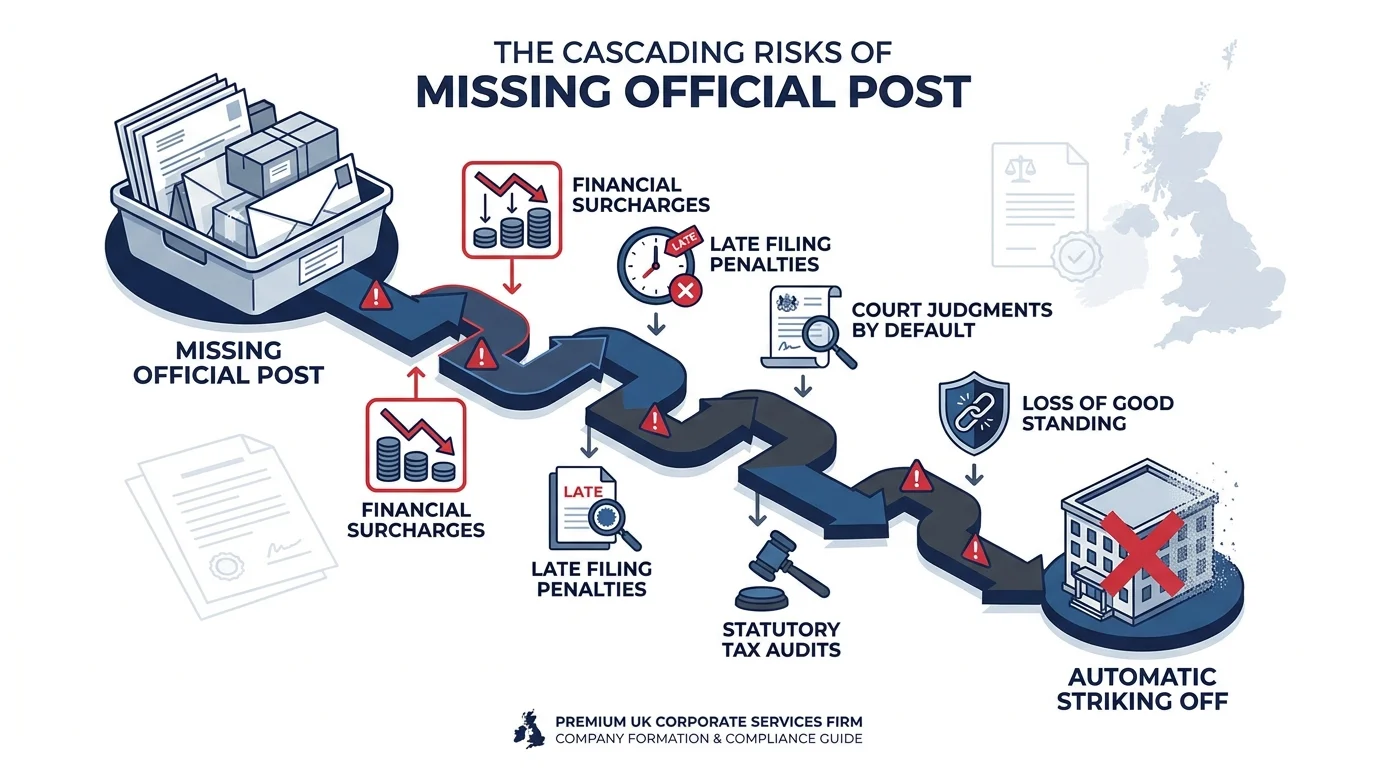
Ignoring or missing statutory notices creates immediate exposure to financial penalties. Companies House applies fixed monetary fines automatically when annual accounts miss statutory submission dates. These penalties double when filings remain overdue for two consecutive financial years, creating compounding liabilities for small businesses.
HMRC imposes immediate interest charges and escalating surcharges on unpaid tax liabilities when demands go unanswered. Unanswered statutory demands frequently lead HMRC to initiate legal enforcement proceedings against corporate directors. A failure to respond to court summonses delivered to the registered office results in default court judgments that harm credit ratings.
Prolonged statutory non-compliance prompts Companies House to initiate compulsory strike-off procedures. The registrar publishes formal notices in the Gazette, giving notice of intent to dissolve the corporate entity. Upon final striking off, company assets transfer directly to the Crown as bona vacantia, freezing business bank accounts overnight.
How Does Official Mail Delivery Impact Corporate Compliance?
Official mail delivery impacts corporate compliance by establishing legally binding notice dates, triggering statutory response timers, validating corporate status, and verifying that directors maintain active oversight of regulatory obligations.
Under UK corporate law, serving a document to a registered office creates a statutory presumption of successful delivery. Courts consider documents legally served upon arrival at the address, regardless of whether a director opens or reads the physical letter. The delivery date initiates strict statutory windows for appealing tax decisions, filing corporate returns, or lodging defense claims.
Efficient mail handling processes ensure that compliance teams process statutory notices before regulatory deadlines expire. Timely responses demonstrate proactive governance and preserve the commercial reputation of the firm. Maintaining smooth mail reception protocols protects directors from civil claims regarding breach of fiduciary duties.
Who Is Authorised to Accept and Process Official Mail?
Company directors, designated corporate officers, legally authorized company formation agents, and professional mail handling providers are authorized to accept, handle, and forward official correspondence received at a registered office.
Company directors retain primary statutory responsibility for securing, reading, and acting upon official government post. Directors frequently delegate the physical receipt and scanning of incoming documents to authorized corporate services providers. Professional mail handlers operate under strict data security protocols to process sensitive legal notices rapidly.
External service providers must hold verified anti-money laundering registration to handle official correspondence legally. These providers authenticate incoming items, digitize emergency notices, and dispatch physical letters to nominated director addresses. Utilizing qualified corporate service professionals ensures that sensitive documents reach decision-makers without operational delay.
Establishing formal oversight over incoming post requires organizing official documentation systematically. Businesses streamline compliance management by securing certified statutory records through dedicated services designed for UK corporate structures. You can access essential filings and legal status proof through supplementary company documents to verify statutory compliance across all public registers.
Why Do Businesses Use a Virtual Registered Office Address?
Businesses use virtual registered office addresses to protect personal residential privacy, maintain a prestigious commercial location, meet statutory UK address requirements, and ensure continuous mail handling without maintaining physical office premises.
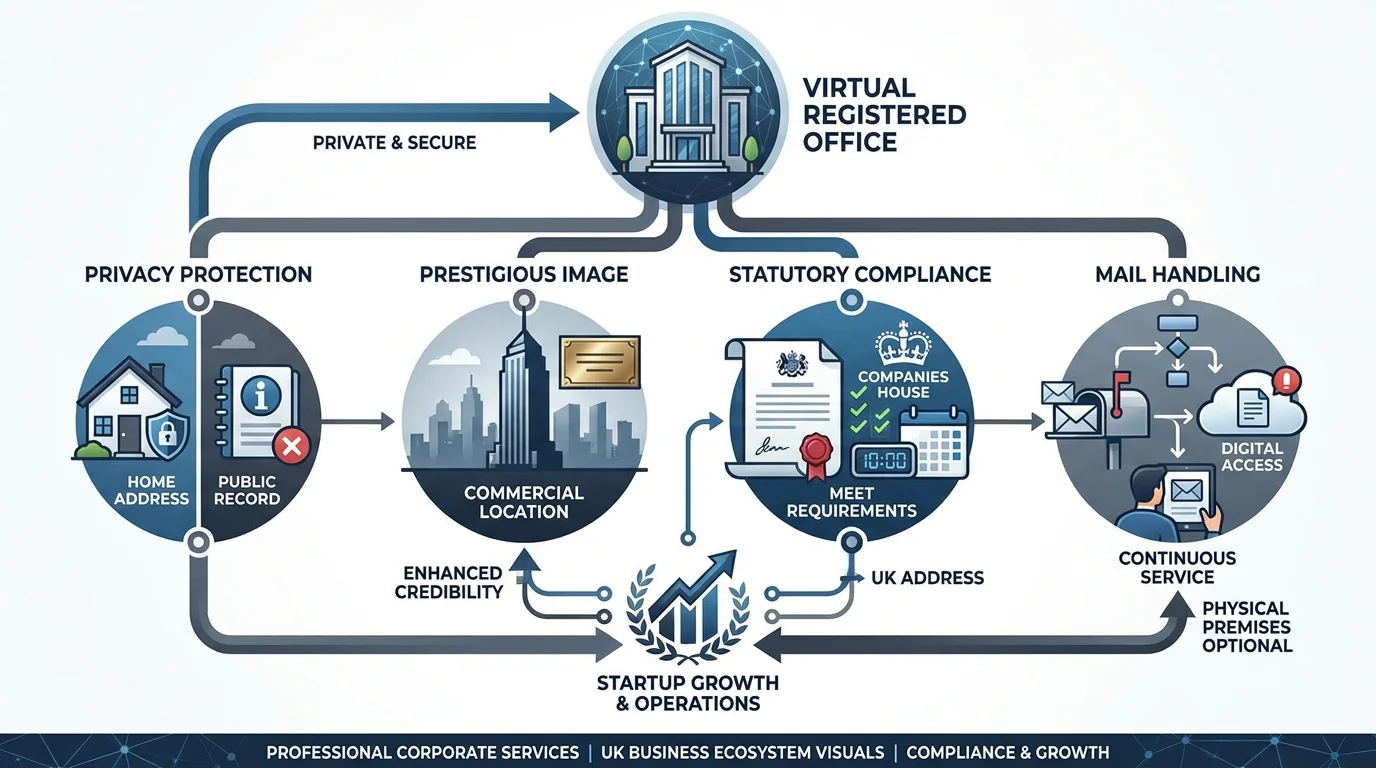
Residential address privacy represents the primary reason directors choose virtual registered office services. Without a virtual address, a director’s home address appears permanently on the public Companies House register, exposing personal residences to unsolicited junk mail, cold callers, and security risks. Using a commercial virtual address keeps personal living details completely off public databases.
Virtual addresses provide international owners and remote entrepreneurs with a legal presence inside UK jurisdiction without the overhead of physical real estate. Professional virtual address facilities guarantee that trained staff receive, sign for, and log official post continuously during standard business hours. Continuous reception prevents missed deliveries caused by travel, seasonal absences, or remote work arrangements.
Maintaining complete oversight of corporate post across geographically dispersed teams requires structured postal workflows. Discover how to make sure official post reaches your registered office by establishing reliable scanning, digitizing, and legal handling protocols for every incoming regulatory letter.
How Do You Update Your Registered Office Address with Government Bodies?
You update your registered office address by filing Form AD01 electronically or via paper with Companies House, which automatically updates official records and notifies statutory authorities across the United Kingdom.
Changing a registered office requires formal approval by the board of directors through a board resolution. Once approved, the company submits Form AD01 to the Registrar of Companies within 14 days of the change. Electronic submissions update the public register within 24 hours, whereas paper submissions require longer processing times.
The address change takes legal effect only when Companies House completes official registration. Documents served at the old address remain legally valid for 14 days following the registration date of the change. Directors must update HMRC tax accounts separately to ensure that local tax offices update their physical mailing routes immediately.
Managing ongoing corporate mail requirements across multiple entities demands continuous operational integration. You can pair mail handling and a letter of authority with Form My Company to streamline regulatory communications and authorize professional service managers to process statutory post on your behalf.
HMRC and Companies House write to your registered office address to uphold statutory compliance, serve legally binding notices, and maintain corporate accountability under UK law. Missing statutory post leads to financial fines, legal claims, tax surcharges, and potential company dissolution. Operating a professional, reliable registered office address ensures that statutory correspondence is received, digitized, and acted upon immediately. Form My Company provides professional address services, mail management solutions, and corporate document services to keep UK businesses fully compliant with regulatory standards.
Explore More Supplementary Company Documents Guide,
What Do Investors Look for in Your Articles of Association?
What Are the Share Transfer Rules in Articles of Association?
Frequently Asked Questions
What are supplementary company documents in the UK?
Supplementary company documents are official legal certificates and administrative filings beyond basic incorporation papers that verify a UK business’s standing, ownership structure, and statutory history. These official items include Certificates of Good Standing, copies of filed Memorandum and Articles of Association, official change of name certificates, and apostilled company records. Businesses acquire supplementary company documents through Form My Company to satisfy bank KYC requirements, complete international trade agreements, and fulfil due diligence demands.
Why do banks request supplementary company documents from a business?
Banks request supplementary company documents to complete regulatory anti-money laundering (AML) checks and confirm a corporate entity’s legal authority before opening commercial accounts or issuing loans. Documents like an official Certificate of Incumbency prove current directorships and shareholder distributions beyond standard public register summaries. Form My Company assists business owners by procuring certified supplementary company documents directly from Companies House to meet strict financial institution compliance standards.
How quickly can you obtain certified supplementary company documents?
Certified supplementary company documents can typically be issued and dispatched within 24 to 48 hours, depending on whether physical legalisation or apostille services are required. Standard digital copies from Companies House are often delivered on the same working day, while physical certified paper copies take longer for official processing and postal delivery. Form My Company expedites the retrieval of certified supplementary company documents to ensure time-sensitive legal and commercial transactions proceed without delay.
What is the difference between standard filing records and certified supplementary documents?
Standard filing records are unverified public register extracts downloaded for general informational purposes, whereas certified supplementary documents carry official registry seals or legal verification proving their authenticity in court. Foreign government bodies, international banks, and overseas registries strictly require certified copies or apostilled corporate papers to recognize a UK company’s legal status. Form My Company supplies verified supplementary company documents that meet international legal criteria and statutory compliance requirements.
Can foreign entities use UK supplementary company documents abroad?
Yes, foreign entities and international registries accept UK supplementary company documents provided they carry an official Hague Apostille or legal authentication from the Foreign, Commonwealth & Development Office (FCDO). Overseas legal jurisdictions require this official certification to validate that the document originated from a recognised UK authority like Companies House. Business owners order legalised supplementary company documents through Form My Company to execute cross-border contracts, establish overseas branches, and satisfy international regulatory authorities.