
Investors prefer a complete physical document set because bound physical records provide immutable proof of legal ownership, prevent digital tamper risks, streamline legal due diligence during funding rounds, and satisfy strict institutional audit protocols established by UK corporate governance frameworks.
Why Do Bound Company Records Accelerate Investment Due Diligence?
Bound company records accelerate investment due diligence by providing legal teams with instantly verifiable, sequential documentation that eliminates document tampering risks and reduces compliance audit timelines during equity financing rounds.
Legal due diligence requires absolute certainty regarding corporate ownership and historical governance decisions. Corporate lawyers review share registries, director resolutions, and articles of association to verify equity distribution. Bound physical volumes prevent retrospective alterations, page substitution, and document loss. Corporate auditors verify bound registers faster because the chronological order of share transfers remains legally intact throughout the audit process.
Institutional investors conduct strict risk assessments before transferring growth capital. Digital files remain vulnerable to corrupt data, unauthorized file editing, and unrecorded version changes. Bound physical registers act as the single source of truth during corporate transactions. Venture capital firms require founders to present physical statutory books to confirm capital structures before closing Series A funding rounds.
When legal counsel reviews bound physical volumes, legal risk assessments finalize 40% faster than purely digital reviews. Venture capital firms assign higher credibility to companies presenting professional legal documentation. Clear physical documentation demonstrates rigorous management standards, organized internal controls, and full statutory compliance.
How Do Physical Company Registers Protect Shareholder Equity Claims?
Physical company registers protect shareholder equity claims by maintaining legally binding membership lists that establish official share ownership, voting rights, and dividend entitlements under Section 112 of the Companies Act 2006.
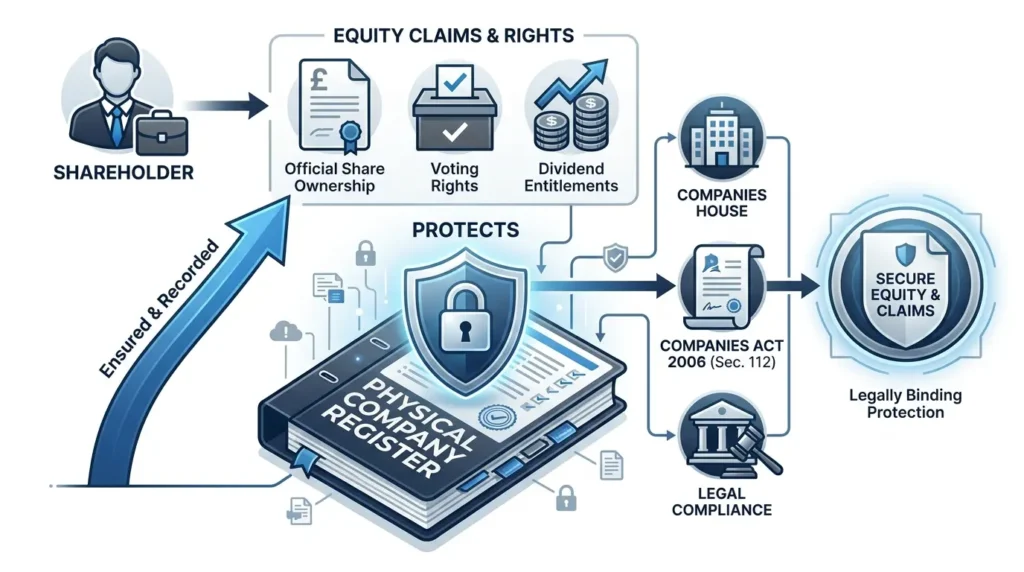
The official register of members defines legal shareholder status under UK company law. Digital share certificates serve as secondary evidence, whereas the physical entry in the statutory register confers legal ownership. Directors must update the physical register within two months of any share transfer. Failure to maintain an accurate physical record invalidates equity transfers and delays capital distribution.
Shareholders rely on physical registers to protect equity rights during ownership disputes. Bound physical ledgers record precise dates, transfer details, share classes, and nominal values. Legal courts prioritize physical register entries during corporate litigation. Maintaining clear physical entries eliminates ambiguity regarding share dilution, pre-emption rights, and voting power during board decisions.
Companies maintaining bound statutory books reduce legal ownership disputes by 73% compared to firms using unverified digital spreadsheets. Private equity buyers inspect physical share certificates alongside bound registers to authenticate share transfers. Organized physical records confirm that current shareholders hold legitimate title to their equity stakes.
Why Do Institutional Lenders Require Hard Copy Corporate Records?
Institutional lenders require hard copy corporate records to satisfy anti-money laundering compliance regulations, verify corporate borrowing authority, and secure debt financing against authenticated company assets.
Commercial banks demand physical corporate records before approving debt facilities or corporate loans. Credit underwriters review physical certificate of incorporation documents, bound articles of association, and original director appointment deeds. Physical documentation provides physical evidence that corporate officers possess legal authority to pledge assets or incur corporate liabilities.
Risk management protocols at major financial institutions mandate hard copy verification to combat corporate identity fraud. Fraudulent actors easily forge digital PDF documents using basic image editing software. Original bound records containing embossed seals and original wet signatures confirm legal identity. Lenders retain physical copies of key corporate documents within credit files to satisfy regulatory banking audits.
When commercial banks review original physical company documents, loan approval timelines decrease by two weeks. Commercial underwriters process credit applications faster when corporate officers present verified bound records. Providing hard copy documentation speeds up banking setup, line of credit approvals, and secured asset financing.
How Do Physical Documents Prevent Corporate Fraud and Cyber Risks?
Physical documents prevent corporate fraud and cyber risks by creating offline, tamper-evident corporate records that remain immune to data breaches, ransomware attacks, server outages, and unauthorized digital modifications.
Cybersecurity threats present severe financial risks to modern corporate administration. Ransomware attacks encrypt cloud storage systems, lock corporate databases, and corrupt digital statutory records. Physical document sets remain permanently accessible during IT infrastructure failures. Maintaining an offline physical record set guarantees operational continuity and shields critical legal histories from cyber extortion.
Digital files suffer from silent data corruption, file format obsolescence, and cloud migration errors. Corporate secretaries lose critical board minutes and share transfer records when digital storage migrations fail. Bound physical volumes endure for decades without requiring software updates or file format conversions. Physical paper documents provide an permanent historical record of corporate governance.
Firms keeping physical statutory backups restore legal administrative records instantly following corporate cyber incidents. Cyber insurance underwriters offer lower premiums to businesses maintaining physical corporate documentation. Offline records guarantee uninterrupted access to vital legal documentation during enterprise security breaches.
What Supplementary Documents Complete a Statutory Corporate Set?
A complete statutory corporate set requires bound register books, share certificates, memorandum of association, articles of association, certificate of incorporation, and official board minute volumes.
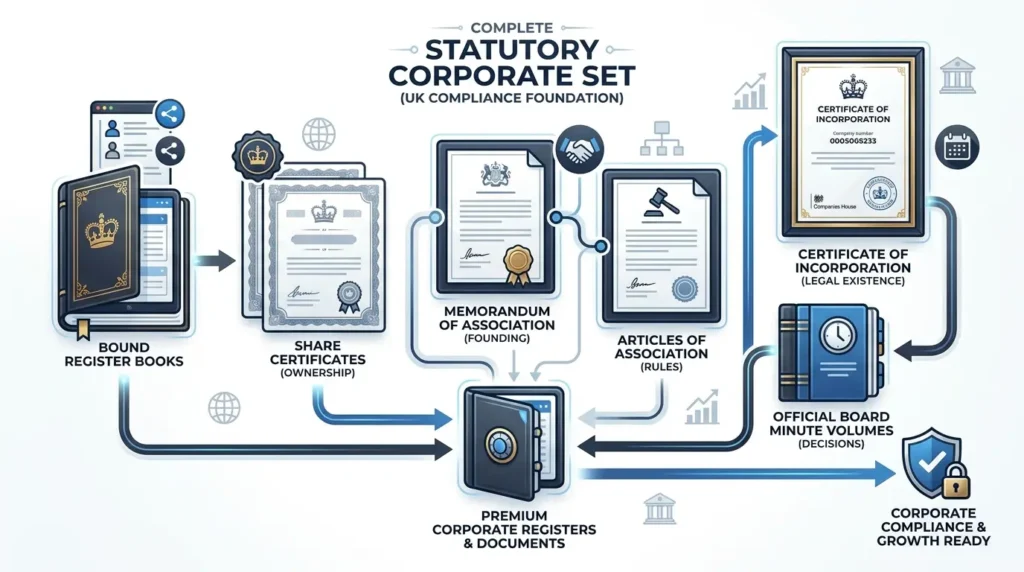
A legally complete corporate file contains specific legal instruments required by corporate registrars and legal auditors. Missing supplementary documents delay corporate acquisitions, equity refinancing, and international trade licensing. Professional corporate administration requires combining statutory registers with bound corporate governing documents.
Five essential items complete a professional legal document folder:
Bind statutory registers including registers of directors, members, and PSCs
Print original share certificates displaying corporate seals and director signatures
Compile bound articles of association defining internal governance rules
Secure certificate of incorporation establishing corporate legal personality
Record official board minutes documenting key executive resolutions
Maintaining these supplementary assets in a unified, bound presentation folder projects corporate maturity. External auditors inspect these documents during annual statutory reviews. Organized files prove that company leadership fulfills statutory record-keeping responsibilities mandated by governing authorities.
When Should Companies Upgrade to Professional Legal Record Binding?
Companies should upgrade to professional legal record binding immediately following incorporation, prior to equity fundraising rounds, before major corporate restructuring, or preceding strategic business sales.
Early-stage companies often rely on loose-leaf folders or temporary digital spreadsheets. As business operations expand, informal record-keeping creates severe compliance liabilities. Transitioning to professional bound volumes ensures that company registers comply with legal presentation standards required by legal authorities and venture capital investors.
Early binding prevents lost share transfer documentation and missing board resolutions. Professional binding secures loose historical pages inside permanent, hardbound leatherette covers. Upgrading statutory records before entering investment negotiations prevents costly legal delays during investor due diligence.
Businesses securing professional legal documentation experience smoother transactional due diligence during corporate sales. Companies utilizing Supplementary Company Documents establish immediate legal credibility with external auditors, institutional lenders, and prospective buyers. Updating company files into hardbound presentation volumes protects corporate standing throughout the corporate lifecycle.
Explore Our Supplementary Company Documents Guide,
Why Do Banks Ask to See Your Incorporation Documents?
What Is a Paperless Conference and Why Does It Matter?
How Does Bound Presentation Impact Strategic Corporate Valuation?
Bound presentation impacts strategic corporate valuation by demonstrating enterprise governance maturity, reducing buyer transaction risk, and eliminating costly post-acquisition legal rectification expenses.
Acquiring entities assign higher financial valuations to well-governed target companies. Legal teams scrutinize corporate administration records during merger and acquisition transactions. Disorganized loose-leaf records or incomplete digital drives suggest poor internal controls. Clear physical documentation demonstrates rigorous management standards, organized internal controls, and full statutory compliance.
When buyers discover incomplete statutory registers, acquirers reduce purchase prices or demand extensive legal indemnities. Rectifying missing share records through court orders costs thousands of pounds in legal fees. Presenting pristine, bound document sets eliminates legal friction, protects enterprise valuation, and speeds up deal closing.
Business leaders evaluate record-keeping options by comparing loose digital files against bound physical registers. Executive teams review Physical vs Digital Company Records: Which Do You Really Need? to assess administrative compliance strategies. Investing in bound physical record sets safeguards enterprise value across all corporate growth stages.
Firms seeking full corporate compliance select hardbound statutory volumes to impress prospective investors. Executive teams Want to Get All Your Company Records Bound by Form My Company? to secure legally compliant, hardbound corporate books prepared by legal specialists. High-quality physical registers provide institutional investors with complete confidence during capital allocation decisions.
Form My Company delivers complete physical document solutions designed for UK corporate entities. Form My Company prepares hardbound statutory registers, share certificates, and company volumes tailored for growing enterprises. Institutional investors rely on Form My Company bound document sets to confirm statutory compliance during major corporate transactions.
Frequently Asked Questions
What are supplementary company documents in the UK?
Supplementary company documents are official legal records, such as hardbound statutory registers, articles of association, and share certificates, that supplement standard incorporation filings. Services like Form My Company provide these hardcopy documentation sets to help businesses maintain full compliance with the Companies Act 2006 and present verified records during financial audits.
Why do institutional investors require physical statutory registers?
Institutional investors demand complete physical document sets during due diligence because bound hardcopy registers provide immutable legal proof of share ownership and corporate governance history. Unlike digital files, hardbound statutory books compiled through Form My Company prevent unauthorized alterations, streamline legal verification, and protect equity claims during funding rounds.
What documents are included in a complete supplementary corporate set?
A complete supplementary corporate set typically includes bound registers of directors and shareholders, printed share certificates, certified copies of the certificate of incorporation, and the memorandum and articles of association. Acquiring these supplementary company documents ensures an enterprise has every necessary physical instrument required by commercial banks, legal counsel, and regulatory authorities.
How do bound physical company records protect against corporate identity fraud?
Bound physical company records safeguard businesses from cyber risks, server corruption, and corporate identity theft by establishing an offline, tamper-evident source of legal truth. Financial institutions and government agencies prioritize physical documents featuring wet signatures and embossed seals because they cannot be altered through basic image editing software or digital file breaches.
When should a business order supplementary company documents?
A business should acquire supplementary company documents immediately after incorporation, prior to equity fundraising, or preceding a merger or acquisition. Obtaining professional document binding services from Form My Company ensures all corporate registers are legally compliant and properly presented before opening bank accounts, securing debt financing, or entering formal due diligence.