
Remote founders need a UK virtual office address to meet Companies House registered office requirements, project professionalism to clients and banks, and handle mail securely without a physical presence. This essential service provides a prestigious business address, mail forwarding, and call handling for limited companies post-incorporation, separating personal and business matters while supporting compliance with VAT and PAYE obligations. Costing just £20-50 monthly, it enables global operations from anywhere without lease risks.
Remote founders launching limited companies through Companies House registration face unique challenges in establishing credibility without a fixed UK base, often resorting to home addresses that expose directors to privacy risks and client scepticism. A virtual office address resolves this by providing a compliant registered office in prime locations like London or Manchester, complete with mail scanning and professional reception services. This is particularly crucial during the formation phase when handling confirmation statements, HMRC registrations for VAT and PAYE, and initial client outreach.
For sole directors or multi-shareholder structures operating distributed teams, a virtual office bridges geographical gaps, ensuring seamless communication with authorities and stakeholders. According to FSB reports, 40% of remote startups cite address credibility as a barrier to banking and supplier contracts. By securing a business address that aligns with statutory needs under the Companies Act 2006, founders maintain compliance while focusing on growth, avoiding the pitfalls of PO Boxes or overseas setups rejected by Companies House. This foundational tool empowers remote entrepreneurship with local legitimacy.
How Virtual Office Addresses Work for Remote Founders: Step-by-Step
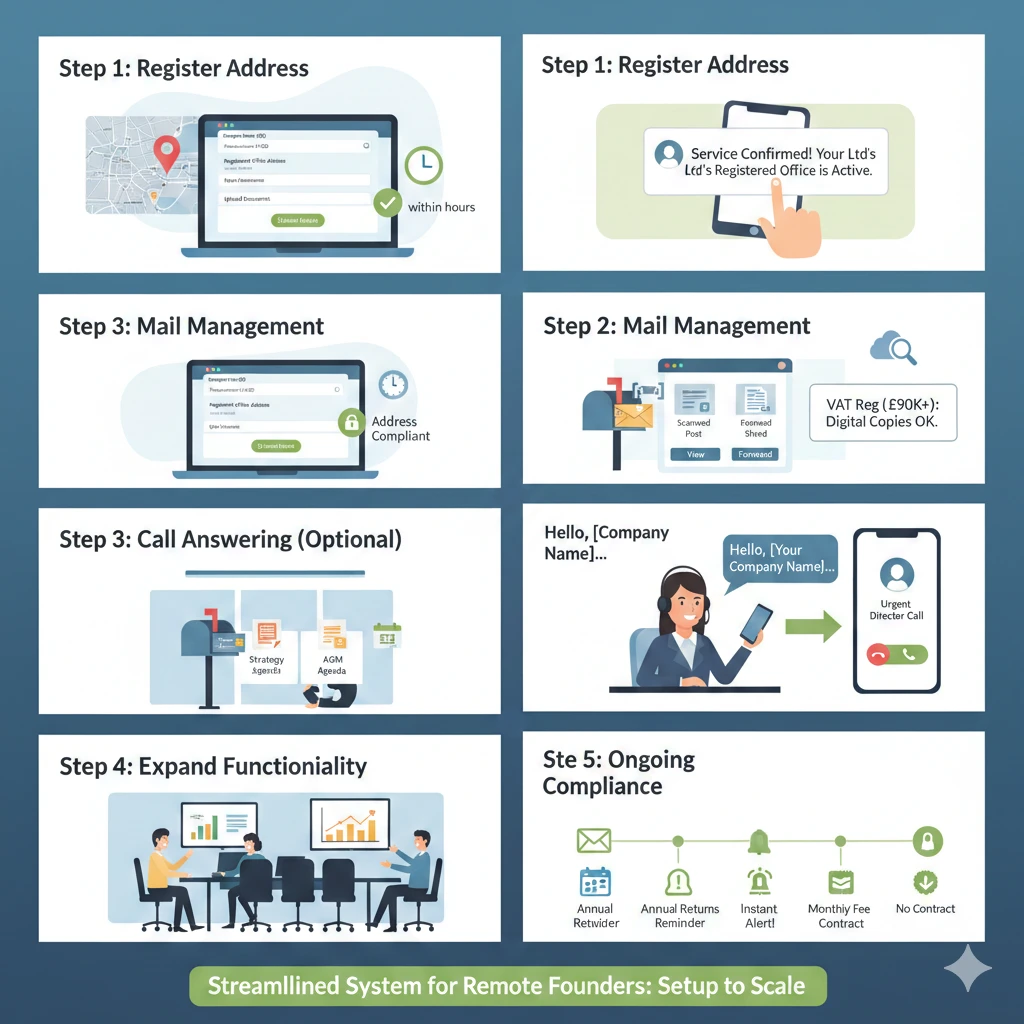
The process starts with selecting a provider offering addresses compliant for Companies House filings, typically in business districts with daily mail collection. Step one involves registering the address during company formation upload documents online, and the service confirms acceptance for your Ltd’s registered office within hours.
Step two covers mail management: incoming post from HMRC, shareholders, or banks gets scanned to your secure portal, forwarded physically or securely shredded, eliminating personal address use. For VAT registration exceeding £90,000 turnover, digital copies suffice for submissions. Third, call answering integrates optionally, with UK-based receptionists handling enquiries in your company name, transferring urgent director calls via app.
Fourth, expand functionality: many include meeting room access for occasional shareholder AGMs and director strategy sessions. Fifth, ongoing compliance: providers monitor for statutory mail like annual returns reminders, alerting you instantly. Monthly fees cover all, with no long-term contracts. This streamlined system supports remote founders from setup to scale, ensuring uninterrupted operations across business structures.
Key Benefits and Potential Risks of Virtual Offices
Benefits centre on professionalism: a Mayfair address instantly elevates remote startups, securing 30% more bank approvals per industry surveys, vital for PAYE payroll setup or VAT reclaim funding. Privacy protection shields directors’ home details from public Companies House records, reducing spam and security risks for families.
Cost savings dominate £30/month versus £2,000 office rents frees capital for marketing or shareholder dividends. Scalability shines: upgrade to full serviced offices seamlessly as teams grow. Mail handling prevents missed HMRC deadlines, safeguarding compliance. A tech founder in Spain used this to land UK clients, scaling revenue 150% without relocation.
Risks include provider reliability delays in mail forwarding could miss Companies House notices, risking strikes. Non-prestigious addresses might underwhelm high-end clients. Over-reliance without physical backup complicates urgent collections. Hidden fees for extras like same-day scans inflate costs. Selecting accredited services with SLAs mitigates these effectively.
Legal and Compliance Considerations for UK Businesses
Virtual offices fully satisfy Companies Act 2006 section 87 requirements for registered offices capable of receiving official mail during business hours, with providers legally obligated to accept Companies House documents. HMRC accepts them for VAT and PAYE registrations, provided digital forwarding evidences timely responses.
GDPR compliance mandates secure scanning and encryption for shareholder correspondence or director details, requiring providers’ data processing agreements. For regulated sectors, ensure FCA-aligned call scripts if bundled. Annual confirmation statements list the virtual address publicly, but directors’ residential details remain private.
Business rates and insurance fall to providers, simplifying director liabilities. Overseas founders qualify fully, but confirm provider handles international mail. Non-compliance risks director disqualification fines up to £5,000. Reputable services hold professional indemnity, protecting limited companies through growth phases.
Common Mistakes to Avoid When Choosing Virtual Offices
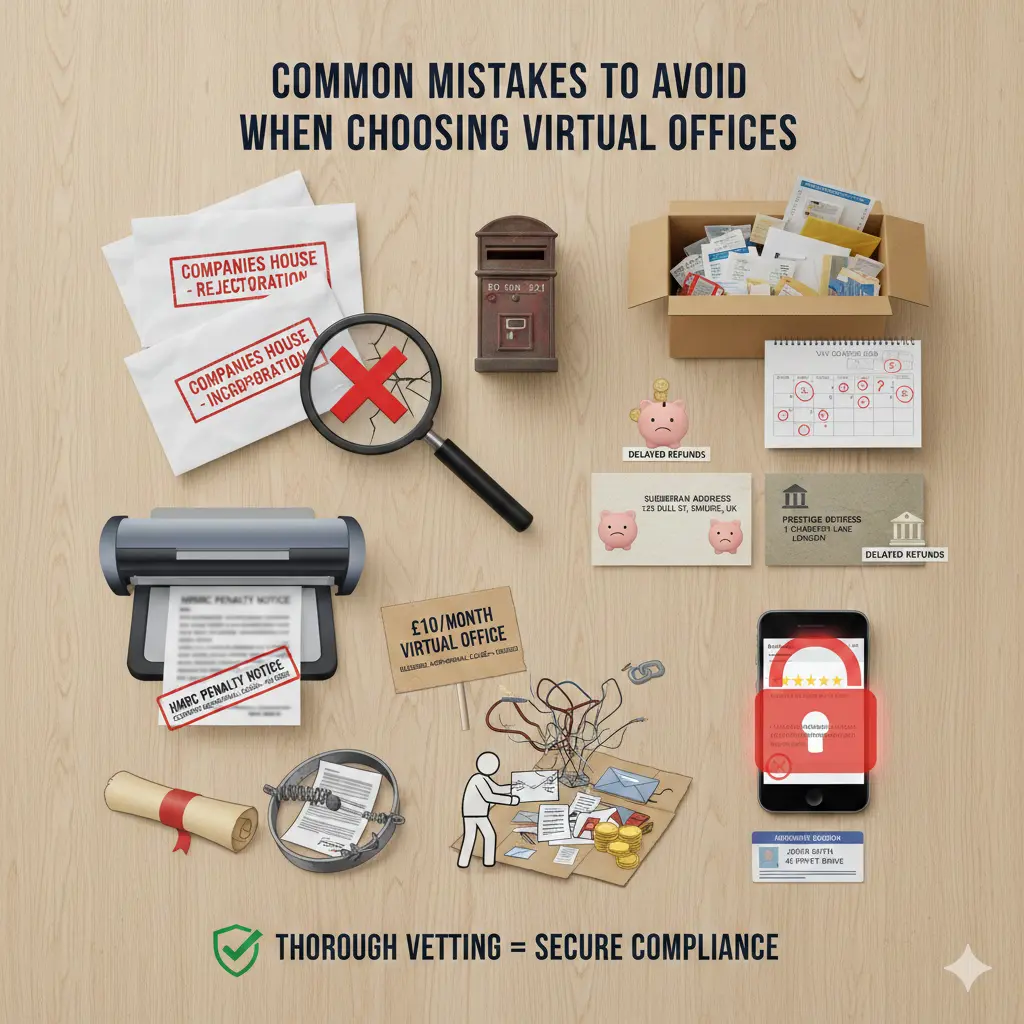
Selecting PO Box equivalents fails Companies House scrutiny, leading to rejection during incorporation. Overlooking mail volume capacities causes backlogs in peak periods like VAT quarter ends, delaying refunds. Ignoring location prestige picks suburban addresses that fail to impress banks for business loans.
Neglecting scanning quality results in illegible HMRC notices, triggering penalties. Failing to read contracts accepts auto-renewals without exit clauses, mimicking lease traps. Budget traps chase £10/month deals lacking portals, forcing manual checks. Skipping provider reviews risks unreliable forwarding, stranding shareholder communications.
Using personal addresses temporarily exposes data, breaching privacy best practices. Thorough vetting prevents these, securing smooth compliance journeys.
Practical Tips and Best Practices for Remote Founders
Audit needs first: project mail volume tied to growth forecasts, choosing unlimited scans for VAT-heavy firms. Verify addresses via Companies House search tools pre-signup. Integrate portals with Google Workspace for auto-routing to directors and shareholders. Set alerts for statutory postcodes.
Test mail handling with sample letters, confirming 24-hour turnaround. Bundle call services for full reception, scripting PAYE queries to HMRC. Promote the address on websites and LinkedIn, boosting SEO for “UK virtual office for remote business.” Track ROI via secured contracts post-adoption.
Review annually against scaling transition to serviced offices seamlessly. Pair with formation agents for one-stop compliance. These steps maximise value.
UK virtual office addresses provide remote founders with indispensable legitimacy, privacy, and compliance support, enabling fearless global scaling.
If you’re ready to register your company with confidence, Form My Company provides fast, fully online company formation with expert compliance support, virtual office addresses, VAT & PAYE handling. Get started today and let our specialists manage the essentials while you build from anywhere.
Frequently Asked Questions
Can virtual offices be used as Companies House registered office?
Yes, explicitly designed for it providers accept and forward official mail, fully compliant under statutory rules.
How much do UK virtual office addresses cost monthly?
£15-£60, including mail handling; premium London spots at £40+, VAT-reclaimable for registered companies.
Do they help with VAT and PAYE registrations?
Absolutely digital mail access speeds submissions to HMRC, with professional addresses aiding approvals.
What if I’m an overseas founder?
No issue services cater to international clients, handling all UK compliance mail for seamless incorporation.
Are there risks of address rejection by banks?
Minimal with established providers; 95% acceptance rates versus home addresses, per user testimonials.