
Secure delivery protects sensitive corporate documents from interception, forgery, and unauthorized access during transit. Companies prevent costly legal liabilities, safeguard intellectual property, and maintain regulatory compliance by using tracked delivery services that guarantee chain-of-custody verification.
Corporate documents represent the legal foundation and operational lifeline of any enterprise. When businesses dispatch sensitive materials such as company incorporation certificates, shareholder registers, and share certificates, transit vulnerabilities multiply. Postal delays, misdeliveries, and physical theft expose corporate entities to corporate espionage and identity fraud. Implementing rigorous delivery protocols ensures that vital paperwork reaches authorized recipients intact.
Corporate growth relies heavily on establishing trust with stakeholders, financial institutions, and regulatory bodies. Paperwork containing director details, memorandum of association files, and statutory registers demands the highest level of physical security. Unauthorized interception of these records enables bad actors to execute fraudulent transactions or alter ownership structures. Protecting transit pathways preserves corporate integrity and prevents devastating administrative disruptions.
What Are the Primary Risks of Standard Mail for Company Documents?
Standard mail lacks tracking mechanisms, identity verification requirements, and tamper-evident packaging, leaving corporate documents vulnerable to loss, theft, and interception. Unmonitored transit systems increase corporate exposure to unauthorized access and severe regulatory penalties.
Standard postal services treat corporate documents like ordinary correspondence without recognizing their legal weight. Traditional mail carriers rarely require signatures upon delivery, leaving packages unattended on doorsteps or shared reception desks. This lack of oversight creates open opportunities for mail theft and document tampering. Enterprises using standard mail sacrifice visibility over their most critical assets.
Operational disruptions compound when essential incorporation papers vanish in transit. Replacing lost statutory certificates requires navigating complex administrative procedures with regulatory bodies like Companies House. Delays stall commercial banking setups, commercial lease agreements, and investor fund transfers. Businesses waste valuable weeks untangling bureaucratic red tape caused by unreliable delivery choices.
Financial exposure also escalates when confidential data leaks during unmonitored shipping. Unauthorized individuals access bank account details, tax identification numbers, and proprietary shareholder data. Corporate identity theft thrives when documents bypass strict verification gates. Implementing robust shipping safeguards prevents these vulnerabilities and secures foundational business operations.
How Do Tracked Delivery Services Protect Corporate Information?
Tracked delivery services utilize end-to-end scanning, mandatory recipient signatures, and chain-of-custody logs to secure corporate information in transit. These systems provide real-time location data and restrict package handover strictly to verified individuals.
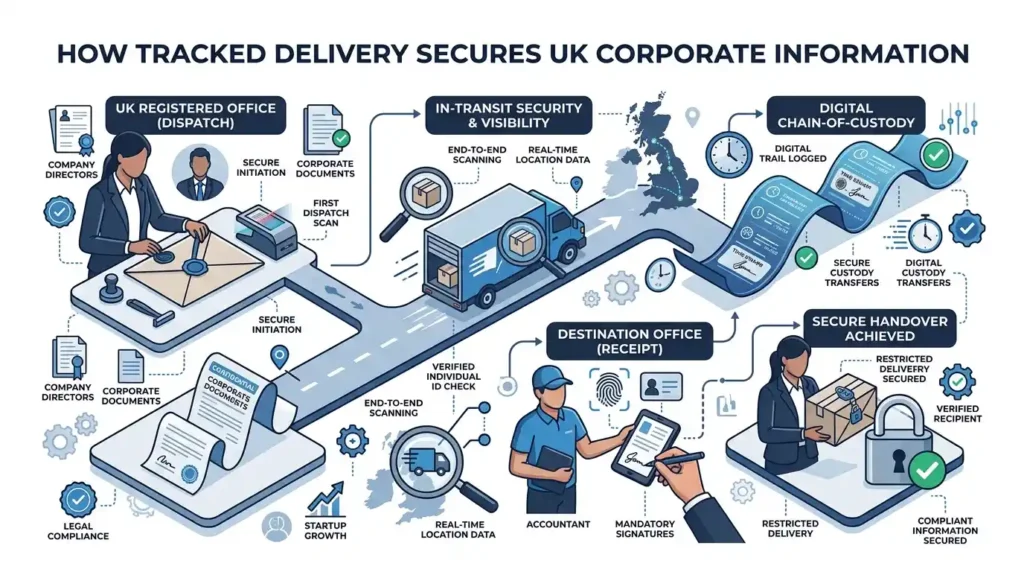
Logistics networks implement comprehensive scanning protocols at every sorting facility and transit milestone. Dispatch managers monitor package movement through digital dashboards that update delivery timestamps instantly. Real-time visibility eliminates uncertainty and pinpoints potential delays before they impact business timelines. Advanced routing protocols reduce handling points and minimize exposure to theft.
Recipient verification reinforces physical security by demanding official identification before package release. Couriers match government-issued credentials against recipient manifests to block fraudulent handovers. Mandatory signature capture creates an immutable audit trail for every dispatched item. Companies maintain complete oversight of who handles their sensitive documentation.
Tamper-evident packaging adds another layer of defense against unauthorized inspection. Specialized security seals change color or display warning patterns if compromised during transit. Couriers immediately flag damaged parcels and initiate internal investigations to protect sensitive contents. Physical protection measures work alongside digital tracking to guarantee absolute document security.
Why Do Regulators Demand Secure Handling for Statutory Records?
Regulators demand secure handling for statutory records to prevent corporate fraud, ensure accurate public registers, and enforce data protection compliance. Official compliance frameworks require verifiable proof of delivery when submitting legal instruments to governing bodies.
Regulatory authorities enforce strict oversight to maintain the transparency of national corporate registries. Statutes mandate that company formation documents and director records travel through secure channels to prevent falsification. When businesses fail to protect statutory filings, they face severe administrative censures and statutory fines. Compliance officers rely on verifiable transit methods to satisfy legal mandates.
Data protection legislation adds further urgency to secure document logistics. Regulations require enterprises to implement appropriate technical and organizational measures protecting personal data. Transporting director home addresses or financial statements via unverified postal routes violates statutory privacy obligations. Secure delivery frameworks fulfill these legal requirements by encrypting tracking data and restricting physical access.
Auditors frequently inspect corporate records management procedures during annual financial reviews. Companies must present complete documentation trails proving that statutory registers remain uncompromised. Secure shipping logs serve as tangible evidence of rigorous internal controls. Maintaining meticulous transit records satisfies auditor inquiries and reinforces corporate governance standards.
How Does Document Loss Impact Business Operations and Finances?
Document loss disrupts core business operations, halts commercial banking activities, and triggers expensive emergency replacement procedures. Enterprises suffer immediate financial setbacks through delayed transactions and extended administrative downtime.
Commercial banking relationships depend entirely on verified corporate credentials. Banks freeze corporate accounts or reject new loan applications when businesses cannot produce original incorporation certificates. Financial transactions stall completely while management waits for replacement paperwork to arrive. This operational paralysis prevents companies from executing timely commercial agreements.
Emergency replacement protocols drain internal resources and inflate administrative expenses. Staff members spend productive hours liaising with government agencies, paying expedited processing fees, and notarizing duplicate documents. Direct costs accumulate quickly through rush shipping charges and legal consultation fees. Indirect losses mount as management focus shifts away from revenue-generating activities.
Reputational damage compounds financial losses when key stakeholders experience administrative failures. Investors, clients, and partners lose confidence in leadership teams that mismanage critical paperwork. Corporate credibility erodes when basic operational logistics break down. Preventing document loss through professional shipping safeguards preserves business reputation and financial stability.
Explore Our Company Pack Guide,
Why Do Banks Ask to See Your Incorporation Documents?
What Is a Paperless Conference and Why Does It Matter?
How Can Businesses Streamline Secure Delivery for New Companies?
Businesses streamline secure delivery for new companies by centralizing fulfillment through professional incorporation services that integrate tracked shipping into formation packages. Integrating document generation with secure logistics eliminates manual handoffs and transit vulnerabilities.
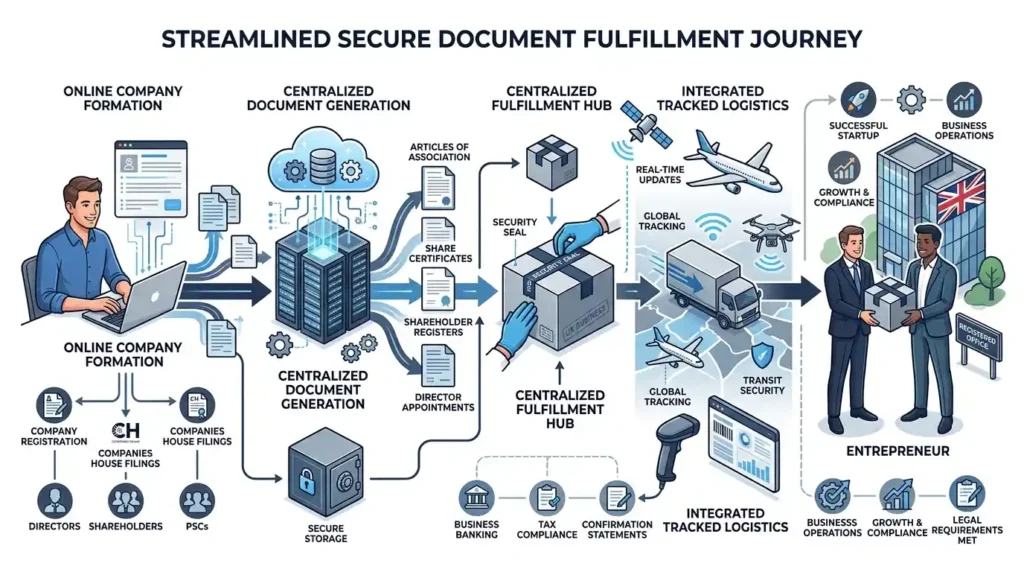
Establishing a new enterprise involves coordinating multiple legal filings and statutory registers simultaneously. Professional formation providers bundle secure dispatch directly into their core offerings to protect these sensitive initial documents. For comprehensive setup support, review the Company Pack to see how verified delivery secures your foundational paperwork from day one. Centralizing document production and shipping reduces coordination errors and accelerates business launch timelines.
Operational efficiency improves when third-party logistics experts manage the entire document lifecycle. Providers print, bind, authenticate, and dispatch statutory registers using established secure carrier networks. Management avoids the administrative burden of selecting separate couriers and monitoring individual tracking numbers. Automated dispatch notifications keep founders informed throughout the transit cycle.
Strategic document management also supports future corporate milestones such as corporate restructuring or equity financing. When companies maintain organized, secure records from inception, subsequent legal reviews proceed without friction. Founders ensure long-term operational resilience by prioritizing secure logistics during the initial setup phase. For further guidance on selecting appropriate transit protocols, read How to Choose Secure Tracked Delivery for Corporate Items?.
Why Choose Professional Services for Corporate Document Dispatch?
Professional services guarantee compliance, mitigate transit risks, and utilize specialized courier networks designed specifically for confidential corporate documents. Leveraging expert logistics infrastructure eliminates human error and ensures absolute peace of mind for business leaders.
Managing corporate logistics internally often strains administrative resources and exposes workflows to security gaps. Dedicated corporate service providers maintain established relationships with high-security courier networks specializing in confidential legal instruments. These partnerships guarantee priority handling and dedicated routing for every dispatched parcel. Experts handle complex international and domestic shipping requirements seamlessly.
Risk mitigation forms the core value proposition of professional document dispatch services. Providers absorb transit liabilities and maintain comprehensive insurance coverage protecting the full commercial value of shipped items. If a package experiences transit anomalies, rapid intervention protocols resolve the issue before business operations suffer. Organizations minimize legal exposure by delegating logistics management to qualified specialists.
Ultimately, secure document dispatch empowers leadership teams to focus on strategic growth rather than postal tracking. When founders partner with Form My Company to handle their statutory paperwork, they secure reliable, verifiable delivery for every critical asset. Professional execution ensures that corporate documents arrive safely, supporting uninterrupted business success. To initiate your secure document delivery today, explore Want to Get Tracked Delivery of Your Company Pack From Form My Company?.
Frequently Asked Questions
What is included in a corporate company pack from Form My Company?
A company pack from Form My Company typically contains essential legal instruments such as the certificate of incorporation, memorandum and articles of association, and statutory registers. These physical and digital documents serve as the foundational proof of a business entity’s legal existence and official compliance status.
How does Form My Company ensure secure delivery for sensitive corporate documents?
Form My Company utilizes tracked courier networks, tamper-evident packaging, and mandatory recipient signature verification to secure transit pathways. These rigorous logistics protocols protect confidential statutory records from interception, loss, and unauthorized access during delivery.
Why is tracked delivery necessary for corporate incorporation certificates?
Tracked delivery guarantees real-time visibility and an immutable chain of custody for critical legal instruments required by commercial banks and regulatory bodies. Utilizing tracked shipping eliminates transit uncertainties and prevents costly operational delays associated with misplaced paperwork.
Can I track the delivery status of my statutory company registers?
Yes, shipments containing statutory company registers feature end-to-end digital tracking that updates delivery milestones instantly via online carrier portals. Business founders monitor package movement continuously until authorized recipients provide official verification upon handover.
What happens if corporate documents are lost during transit?
Lost corporate documents trigger administrative downtime, bank account setup delays, and expensive emergency replacement procedures with regulatory authorities like Companies House. Utilizing professional secure delivery services mitigates these financial and operational risks by guaranteeing verified, insured transit.