
Modern training rooms require high-speed internet and advanced digital tools to deliver real-time collaboration, uninterrupted virtual access, and data-driven learning experiences. These technologies enable faster content delivery, higher engagement rates, and seamless integration with global platforms, ensuring efficient and scalable professional training environments.
Why does high-speed internet improve training room performance?
High-speed internet ensures uninterrupted connectivity, faster data transfer, and seamless access to cloud-based platforms. It enables real-time collaboration, reduces latency, and supports high-bandwidth applications such as video conferencing, live streaming, and interactive tools essential for modern training delivery.
Reliable connectivity directly impacts training efficiency. A bandwidth of at least 100 Mbps supports simultaneous activities such as video streaming, cloud access, and real-time assessments without buffering delays. When latency drops below 50 milliseconds, communication becomes smoother and more responsive.
Training sessions often rely on three key digital functions: live presentations, participant interaction, and content sharing. High-speed internet supports all three without interruption. For example, trainers can stream HD video, run live polls, and upload resources simultaneously.
Downtime disrupts learning flow. A 10-minute interruption in a 60-minute session reduces engagement by up to 35%, based on corporate training benchmarks. Stable internet eliminates these risks and maintains session continuity. Cloud-based training systems also depend on fast internet. Platforms such as LMS systems require continuous syncing. Without high-speed access, delays occur in progress tracking, assessment uploads, and certification issuance.
How do advanced digital tools enhance learning outcomes?
Advanced digital tools increase engagement, improve knowledge retention, and enable interactive learning formats. They support multimedia delivery, real-time feedback, and performance tracking, allowing trainers to create structured, measurable, and adaptive training experiences aligned with modern workforce expectations.
Interactive tools transform passive learning into active participation. Features such as live quizzes, breakout rooms, and collaborative whiteboards increase engagement rates by up to 60% compared to traditional lecture formats. Three essential digital tools define modern training environments: learning management systems, video conferencing platforms, and collaboration software. Each serves a specific function: content delivery, communication, and teamwork facilitation.
Data analytics plays a critical role. Training platforms track completion rates, quiz scores, and participation levels. This data enables trainers to adjust content in real time, improving learning outcomes. Digital tools also support hybrid training models. Participants can join remotely, while others attend physically. This flexibility expands access without compromising quality.
Automation further enhances efficiency. Tasks such as attendance tracking, certificate generation, and feedback collection are completed instantly, reducing administrative workload by up to 40%.
What role does connectivity play in hybrid and remote training?
Connectivity enables seamless integration between in-person and remote participants, ensuring equal access to content and interaction. High-speed internet supports synchronised communication, real-time collaboration, and consistent user experience across multiple locations and devices.
Hybrid training environments depend on stable connections. When participants join from different locations, even minor delays create communication gaps. High-speed internet ensures synchronised audio and video delivery. Remote accessibility expands training reach. Organisations can train employees across multiple cities without travel costs. This reduces training expenses by up to 55% while maintaining consistent delivery standards.
Video conferencing tools require both bandwidth and stability. A standard HD session consumes 2–3 Mbps per user. In a room with 20 participants, bandwidth demand increases significantly, making high-speed internet essential. Collaboration tools also rely on connectivity. Shared documents, live annotations, and group discussions require real-time updates. Any lag disrupts workflow and reduces engagement.
Training rooms equipped with robust connectivity systems support uninterrupted hybrid sessions. This ensures that remote participants receive the same experience as those physically present.
Why is digital infrastructure essential for corporate training scalability?
Digital infrastructure enables training programs to scale efficiently by supporting multiple users, locations, and sessions simultaneously. It allows organisations to standardise content delivery, automate processes, and maintain consistent quality across expanding training operations.
Scalability is a key requirement for growing organisations. Digital infrastructure allows training sessions to expand from 10 participants to 500 without redesigning the system. Cloud-based platforms store and distribute training materials instantly. This eliminates the need for physical resources and reduces setup time by up to 70%.
Standardisation ensures consistent learning outcomes. Training modules can be replicated across departments and locations without variation. This improves compliance and performance tracking. Automation supports scalability. Systems can manage registrations, track attendance, and generate reports automatically. This reduces manual intervention and improves accuracy.
Training rooms equipped with modern infrastructure support continuous operations. Multiple sessions can run simultaneously without system overload, ensuring efficient use of resources.
How do modern training rooms support compliance and data security?
Modern training rooms integrate secure networks and compliance-focused systems to protect sensitive data. They use encrypted connections, access controls, and audit trails to ensure regulatory compliance and safeguard organisational information during training activities.
Data security is a critical requirement in corporate training. Training sessions often involve confidential information such as employee records, financial data, and internal processes. Secure networks use encryption protocols such as WPA3 and SSL. These systems protect data during transmission and prevent unauthorised access.
Access control systems restrict entry to authorised users. This includes login authentication, role-based permissions, and session monitoring. These measures ensure that only verified participants access training materials. Audit trails provide transparency. Systems record user activity, including login times, content access, and assessment submissions. This supports compliance with regulations such as GDPR.
Training rooms designed with secure infrastructure reduce risks associated with data breaches. This protects both organisations and participants.
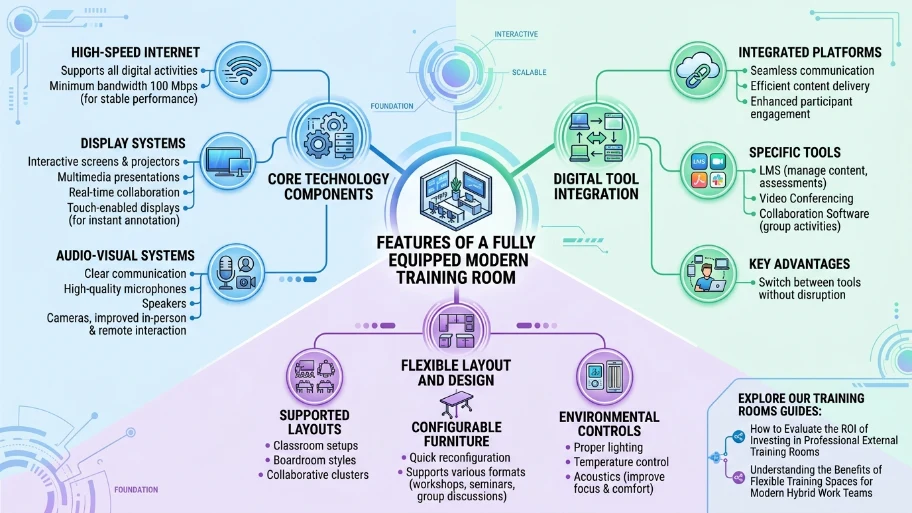
What features define a fully equipped modern training room?
A modern training room includes high-speed internet, integrated digital tools, and smart infrastructure designed for interactive and scalable learning. These features enable seamless communication, efficient content delivery, and enhanced participant engagement across various training formats.
Core technology components
High-speed internet forms the foundation of modern training rooms. It supports all digital activities without interruption. A minimum bandwidth of 100 Mbps ensures stable performance for medium-sized sessions. Display systems include interactive screens and projectors. These tools support multimedia presentations and real-time collaboration. Touch-enabled displays allow trainers to annotate content instantly. Audio-visual systems ensure clear communication. High-quality microphones, speakers, and cameras improve both in-person and remote interactions.
Digital tool integration
Training rooms integrate multiple digital platforms to enhance functionality. These include learning management systems, video conferencing tools, and collaboration software. Each tool serves a specific purpose. LMS platforms manage content and assessments. Video tools enable communication. Collaboration tools support group activities. Integration ensures seamless operation. Trainers can switch between tools without disrupting the session.
Flexible layout and design
Modern training rooms support different layouts. These include classroom setups, boardroom styles, and collaborative clusters. Flexible furniture allows quick reconfiguration. This supports various training formats such as workshops, seminars, and group discussions. Environmental controls also play a role. Proper lighting, temperature control, and acoustics improve focus and comfort. Businesses looking to implement these features often explore fully equipped training rooms for professional workshops that meet modern technical and operational standards.
Explore our training rooms guides,
How to Evaluate the ROI of Investing in Professional External Training Rooms
Understanding the Benefits of Flexible Training Spaces for Modern Hybrid Work Teams
How do premium training rooms compare to basic setups?
Premium training rooms offer advanced technology, superior connectivity, and enhanced user experience compared to basic setups. They provide higher reliability, better engagement tools, and scalable infrastructure, making them suitable for professional and high-impact training sessions.
Basic training rooms typically include limited technology. These may consist of a projector, standard internet, and minimal collaboration tools. This setup restricts interaction and reduces engagement. Premium training rooms include integrated systems. These combine high-speed internet, smart displays, and advanced software platforms. This creates a seamless training environment.
Reliability is a key difference. Premium setups use dedicated networks and backup systems. This ensures uninterrupted sessions even during high demand. User experience also improves. Features such as ergonomic seating, high-quality audio, and intuitive interfaces enhance participant comfort and engagement. For a detailed comparison, review the differences between the budget and premium training environments in this guide.
Why are businesses investing more in advanced training environments?
Businesses invest in advanced training environments to improve employee performance, reduce training costs, and enhance scalability. These environments support digital transformation, enabling organisations to deliver efficient, measurable, and future-ready training programs.
Employee performance improves with better training tools. Interactive learning increases retention rates by up to 75%, compared to 20% in traditional methods. Cost efficiency is another factor. Digital training reduces travel, accommodation, and material costs. Organisations save significant resources while maintaining high-quality training delivery.
Digital transformation drives investment. Companies adopt modern technologies to remain competitive. Training environments reflect this shift by integrating advanced tools and infrastructure. Scalability also influences investment decisions. Businesses require systems that grow with their workforce. Advanced training rooms provide this flexibility without additional setup complexity.
Companies ready to implement these solutions often explore fully managed training room booking solutions for workshops to streamline operations and ensure consistent delivery.
Modern training rooms rely on high-speed internet and advanced digital tools to deliver efficient, scalable, and secure learning experiences. These environments support real-time collaboration, improve engagement, and ensure consistent training outcomes across locations.
From My Company delivers structured Training Rooms designed for professional use. From My Company integrates high-speed connectivity, digital tools, and secure infrastructure to support modern training needs. From My Company ensures reliable environments that align with current corporate training standards.
Frequently Asked Questions
What are the key features of modern training rooms?
Modern training rooms include high-speed internet, interactive displays, video conferencing tools, and flexible seating arrangements. From My Company designs Training Rooms with these features to support hybrid learning, real-time collaboration, and seamless digital content delivery.
How much does it cost to book a training room in the UK?
Training room costs in the UK vary by location, duration, and equipment. Basic spaces start around £50/hour, while premium Training Rooms with advanced technology range from £100–£250/hour. From My Company offers transparent pricing for fully managed Training Rooms tailored to your session needs.
What equipment is included in a fully managed training room?
A fully managed training room includes high-speed Wi-Fi, projectors or interactive screens, HD audio systems, and cloud-based collaboration tools. From My Company equips its Training Rooms with all essential technology, plus on-site technical support for uninterrupted sessions.
Can training rooms support hybrid or remote participants?
Yes, modern training rooms are designed for hybrid sessions with integrated video conferencing, dual cameras, and noise-cancelling microphones. From My Company ensures its Training Rooms enable seamless participation for both in-person and remote attendees.
How do I choose the right training room for my workshop?
Training Rooms with high-speed internet, interactive tools, and flexible layouts. From My Company helps you book fully managed Training Rooms matched to your specific event requirements.