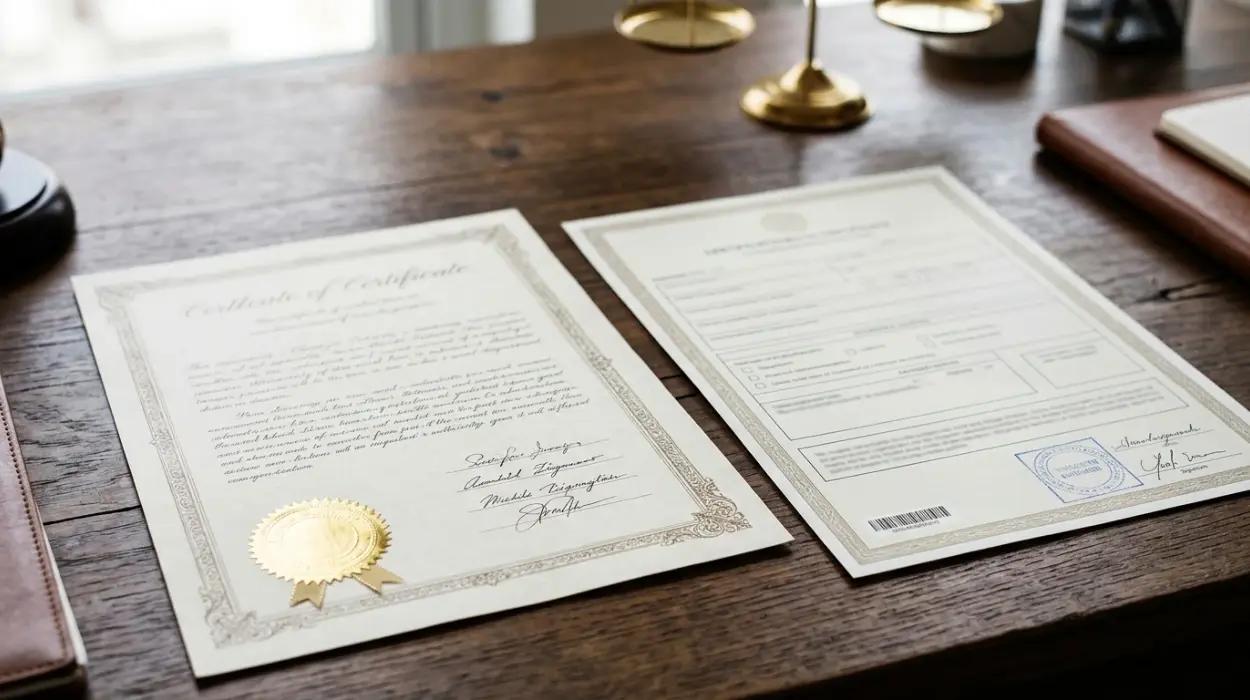
Official share registers and annual confirmation statements establish legal UK company ownership by recording verified shareholder names, exact share quantities, and voting rights mandated by the Companies Act 2006.
Legal ownership of a registered corporate entity relies on verifiable statutory records maintained by company directors. The primary statutory instrument is the Register of Members. This document records every shareholder, their residential address, the number of shares held, and the classes of shares owned. Companies House maintains a public digital mirror of these records through annual confirmation statements and historical incorporation filings.
When establishing corporate control, third-party institutions require certified extracts from these registers. Publicly accessible filings provide initial baseline transparency. Private corporate registers provide definitive legal proof when corporate disputes arise regarding share allocations. Directors must maintain these registers at the registered office address or a designated single alternative inspection location. Failure to maintain accurate registers violates statutory regulations and incurs daily financial penalties for non-compliant directors.
How Do Certificates of Incorporation Prove Corporate Existence?
The Certificate of Incorporation proves a UK company legally exists by displaying a unique company registration number, official incorporation date, and the validating signature of the Registrar of Companies.
Companies House issues this foundational document upon successful review of incorporation applications. This document validates that a business entity operates as a legal corporate body distinct from its individual founders. Financial institutions inspect this certificate to verify corporate legitimacy before opening business bank accounts. Commercial partners review the registration number to authenticate vendor credentials against government databases.
The document displays the exact date when corporate liability protections take effect for founding members. Limited company structures rely on this foundational proof to shield personal assets from business liabilities. When expanding operations globally, international agencies require apostilled copies of this certificate to authenticate corporate origins. Form My Company ensures this critical foundational document is delivered securely through an all-inclusive Company Pack designed for seamless regulatory onboarding.
What Role Do Share Certificates Play in Ownership Verification?
Share certificates act as formal legal receipts issued by the company, proving exact equity ownership quantities and confirming fully paid capital contributions for individual shareholders.
Private limited companies issue these physical or digital instruments to document individual equity stakes. Each certificate displays the registered company name, shareholder identity, certificate number, and specific share classes. When investors acquire equity, directors execute and deliver these instruments within two months of share allotment. Legal ownership transfers require both updated register entries and physical certificate endorsement.
Auditors examine share certificates during financial due diligence to verify capitalization tables. Lenders inspect these documents to evaluate collateral security before approving corporate credit facilities. If companies undergo structural changes, original certificates must be surrendered for cancellation and reissue. Companies requiring structured administrative compliance utilize professional services like Form My Company to streamline documentation workflows through a standardized Company Pack.
How Do Persons with Significant Control Registers Reveal Ultimate Owners?
The Register of Persons with Significant Control reveals ultimate company owners by documenting individuals holding more than 25% of shares, voting rights, or exercising dominant corporate influence.
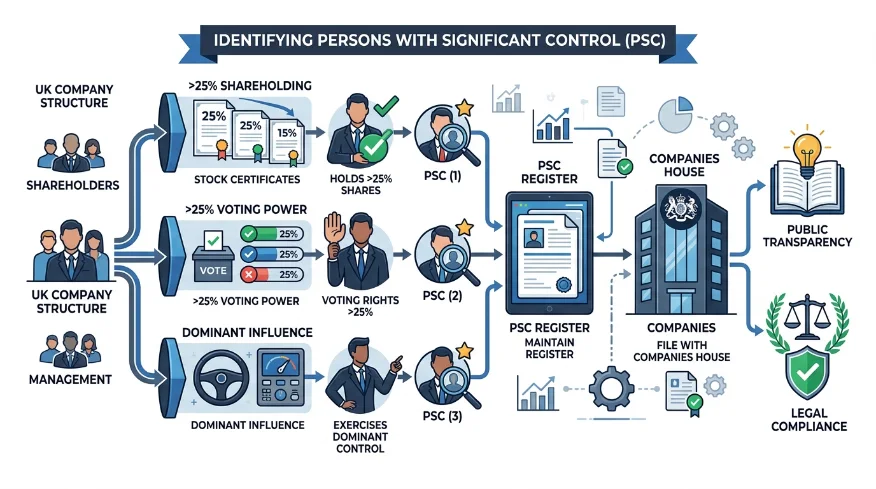
UK legislation mandates that all limited companies identify and record individuals possessing ultimate operational control. This register prevents anonymous corporate structures and deters illicit financial activities through mandatory transparency. Companies House mandates public disclosure of these beneficial owners within fourteen days of establishing control parameters. Entities examine voting thresholds, appointment powers, and economic rights to determine reportable beneficial owners accurately.
Compliance officers cross-reference these filings with internal ownership charts during mandatory anti-money laundering assessments. Regulatory bodies penalize organizations that fail to investigate and update their beneficial ownership registers promptly. Understanding these disclosure requirements helps founders navigate broader compliance steps outlined in guidance on how to present company documents for AML and due diligence.
How Do Annual Confirmation Statements Maintain Ownership Accuracy?
Annual confirmation statements maintain ownership accuracy by requiring directors to review, update, and re-verify capital structures, shareholder details, and control registers every twelve months.
Companies House uses this administrative filing to ensure public corporate records reflect real-time business realities. Directors must submit this review within fourteen days following each twelve-month incorporation anniversary. The filing confirms standard details including registered office addresses, shareholder capital breakdowns, and primary business activity codes. Filing accurate statements prevents administrative dissolution proceedings initiated by the registrar for inactive entities.
Stakeholders rely on these updated public records to assess ongoing corporate solvency and stability. Business partners review recent confirmation filings to verify active trading status before signing long-term contracts. Maintaining these administrative schedules protects corporate directors from statutory fines and operational restrictions. Organizations seeking efficient administrative management often acquire a structured Company Pack to simplify annual filing obligations.
Establishing definitive UK company ownership requires coordinating statutory registers, government filings, and verified corporate certificates. Accurate record-keeping protects shareholder rights, satisfies regulatory mandates, and facilitates smooth commercial operations. Form My Company assists founders through this administrative landscape by providing an organized Company Pack designed to secure foundational business credentials efficiently.
Explore our Company Pack guide,
Which UK Company Documents Can Be Apostilled?
How to Get Printed Certificate of Incorporation and Share Certificates?
Frequently Asked Questions
What is included in a UK company formation pack?
A standard UK company formation pack typically includes the Certificate of Incorporation, Memorandum and Articles of Association, and initial share certificates. When founders order the specialized Company Pack from Form My Company, it also provides physical statutory registers, a company seal, and a customized company stamp to support ongoing administrative compliance. These bundles ensure new limited companies possess all essential legal and operational documentation immediately after registration.
Why do I need a physical company register and seal?
Physical statutory registers and company seals provide a secure, centralized method for recording shareholder transfers, director appointments, and executing formal corporate documents. Form My Company includes these tangible items within its comprehensive Company Pack to help businesses maintain orderly internal records alongside digital filings. Having physical documentation readily available simplifies corporate audits, legal reviews, and verification checks from financial institutions.
How do I get replacement corporate documents for my UK company?
Founders can request replacement digital or printed corporate documents directly through their formation agent or by downloading public copies from the Companies House registry. Form My Company streamlines this process for existing clients by providing secure access to core business records, certificates, and registers. Maintaining accessible backups of these foundational files prevents operational delays during commercial contracts or banking updates.
Are physical share certificates legally required for UK companies?
UK companies must maintain an updated electronic or physical Register of Members, though issuing paper share certificates to individual investors is standard practice. Form My Company supplies necessary documentation components within its professional Company Pack to verify equity distribution accurately. These certificates serve as formal legal evidence of share ownership for shareholders and external auditors.
What is the difference between a Certificate of Incorporation and a Memorandum of Association?
The Certificate of Incorporation acts as the official birth certificate issued by Companies House to confirm a business exists as a legal corporate entity. Conversely, the Memorandum of Association is a statutory statement signed by initial subscribers confirming their agreement to form the company and take at least one share. Form My Company bundles both foundational documents inside their standard Company Pack to establish complete legal transparency.