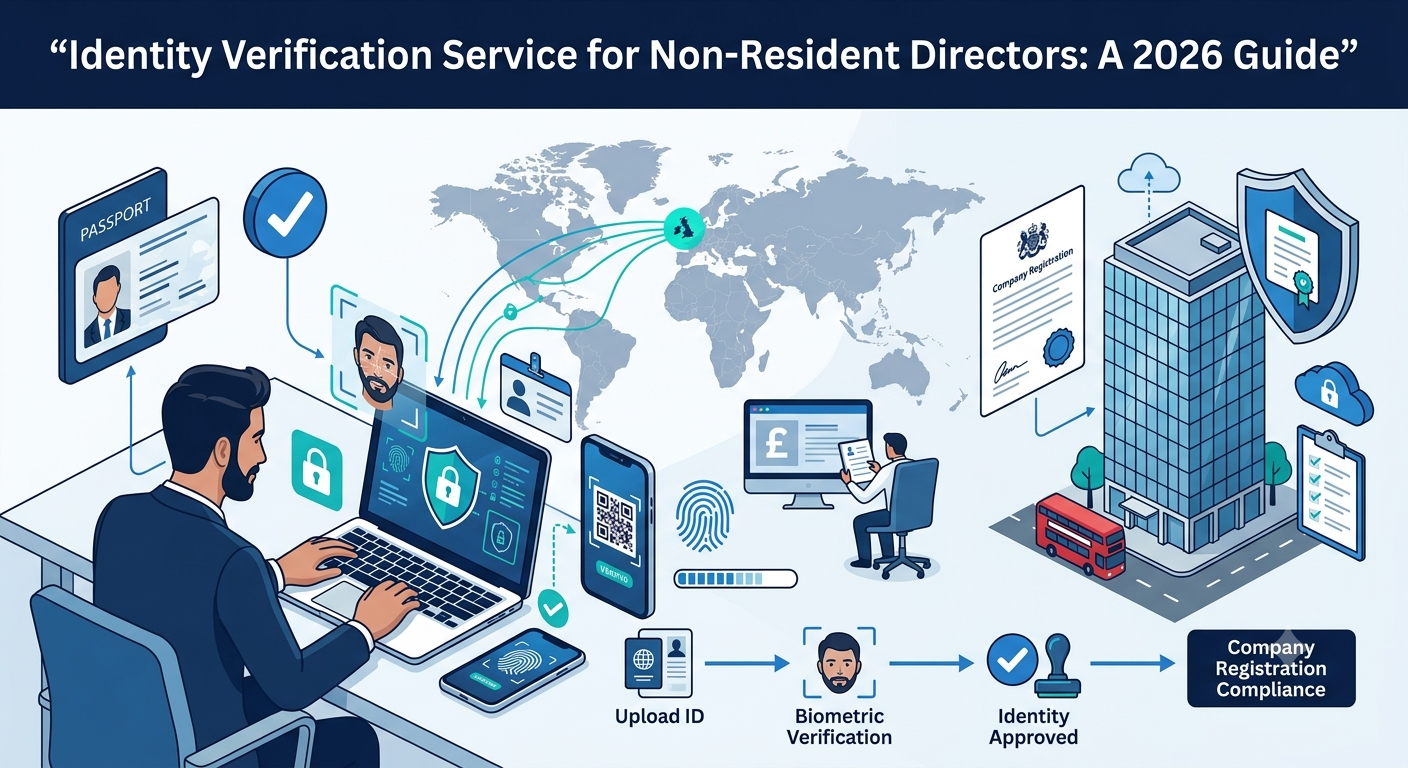
Identity Verification Service
If you’re a non-resident director of a UK limited company, identity verification isn’t optional any more. Under the Economic Crime and Corporate Transparency Act (ECCTA), every director, Person with Significant Control (PSC), and LLP member must verify their identity with Companies House, and doing this from abroad can be more complicated than for UK residents. As an Authorised Corporate Service Provider (ACSP), Form My Company offers an identity verification service designed specifically to help non-resident directors meet the requirement quickly, remotely, and correctly.
This guide explains what the ID verification rules mean for non-resident directors, why an ACSP-supported route often works better from abroad, and how our service makes compliance simple.
What ID Verification Means for Non-Resident Directors
The ECCTA introduced mandatory identity verification (IDV) for anyone forming, running, or filing at Companies House on behalf of a UK company. This applies just as strictly to non-resident directors as it does to UK-based ones. There are no exemptions based on residency, nationality, or where you’re based when you incorporate.
In practice, this means:
- You must complete IDV before acting as a director. Any newly appointed director on a new or existing UK company must have their identity verified before their appointment is filed with Companies House.
- Existing directors have deadlines to comply. Directors already in role have specific deadlines depending on when their next confirmation statement is due or when they were born, depending on the situation.
- Verification is a legal obligation, not a formality. Acting as an unverified director is a criminal offence, and companies that allow it can face serious penalties.
- Verification is generally a one-off exercise. Once verified, you receive a unique personal code that stays with you, so you don’t need to re-verify every time you take on a new role, in most cases.
For non-resident directors, this creates a specific challenge: how to meet a strict UK regulatory requirement from anywhere in the world.
The Two Verification Routes and Why the ACSP Route Often Works Better for Non-Residents
There are two ways to verify your identity for Companies House:
- Direct verification with Companies House. Using the GOV.UK One Login service, either through an app or in-person at a UK post office (which is free but not practical from abroad).
- Verification via an Authorised Corporate Service Provider (ACSP). An ACSP is a regulated provider authorised under the ECCTA to verify identities on behalf of Companies House. They handle the verification, confirm it to Companies House, and issue you with the same official status.
Both routes give you the same “verified” outcome, but for non-resident directors, the ACSP route often works better for several practical reasons:
- Better handling of international ID documents. ACSPs have compliance teams experienced with passports and identity documents from a wide range of countries, whereas the direct app-based flow can occasionally struggle with less common document types.
- Faster resolution of edge cases. If your document has a slight discrepancy, an old name change, or an unusual format, an ACSP can often resolve it quickly instead of leaving you stuck in an automated rejection.
- Support in your own language and time zone. Working with a service provider gives you actual help rather than a self-service portal.
- Combined with your company formation. Doing IDV alongside your incorporation with the same provider avoids duplicated verification steps and keeps everything in one place.
- Audit trail. ACSPs provide clear records of the verification, which can be useful for banking applications and other due diligence.
For UK-based directors with a straightforward UK biometric passport, direct verification is usually fine. For non-residents, an ACSP route is generally smoother.
What Non-Resident Directors Need to Verify
To complete identity verification, you’ll typically need:
- A valid, in-date government-issued photo ID. A biometric passport is the most widely accepted document worldwide. Depending on the route, driving licences and national identity cards may also be accepted, but a passport is the most reliable choice for non-residents.
- Biometric verification. Usually a selfie or short video prompt via a mobile app, checking that you’re a real person matching your ID.
- Personal details. Your full name, date of birth, and current residential address (this stays private, unlike your service address).
- Consistent information. Everything must match across your ID document, your Companies House record, and any supporting documents. Mismatches are the single most common cause of verification delays.
For non-residents, having a good-quality biometric passport and a stable internet connection for the biometric check is usually all that’s needed.
Who Needs to Verify
Under the ECCTA, identity verification applies to:
- Directors. Every director of a UK limited company, whether resident or non-resident.
- Persons with Significant Control (PSCs). Anyone who owns or controls more than 25% of shares or voting rights.
- LLP members. Members of a Limited Liability Partnership, including designated members.
- Filing agents. Individuals filing at Companies House on behalf of a company must be verified themselves.
This means for a non-resident who forms a UK company and acts as the sole director and shareholder, they’ll typically need IDV in both their director and PSC capacity, though the same verification covers both roles.
What Happens if You Don’t Verify
The consequences of non-compliance are significant and enforced:
You can’t legally act as a director. Acting as an unverified director is a criminal offence.
Your company can’t file certain documents. Statutory filings can be blocked until verification is complete, disrupting confirmation statements and other filings.
Personal penalties. Fines of up to £30,000 per offence can apply, along with potential director disqualification for up to 15 years.
Criminal sanctions. Deliberate evasion can lead to criminal prosecution, with Companies House now empowered to pursue this.
Company strike-off risk. In serious cases, Companies House can begin strike-off proceedings against companies where directors haven’t complied.
For non-resident directors, the practical takeaway is simple: identity verification is not something to leave until later or hope to work around. Handling it correctly at the point of incorporation, or promptly after appointment, avoids all of these risks.
How Our Identity Verification Service Works
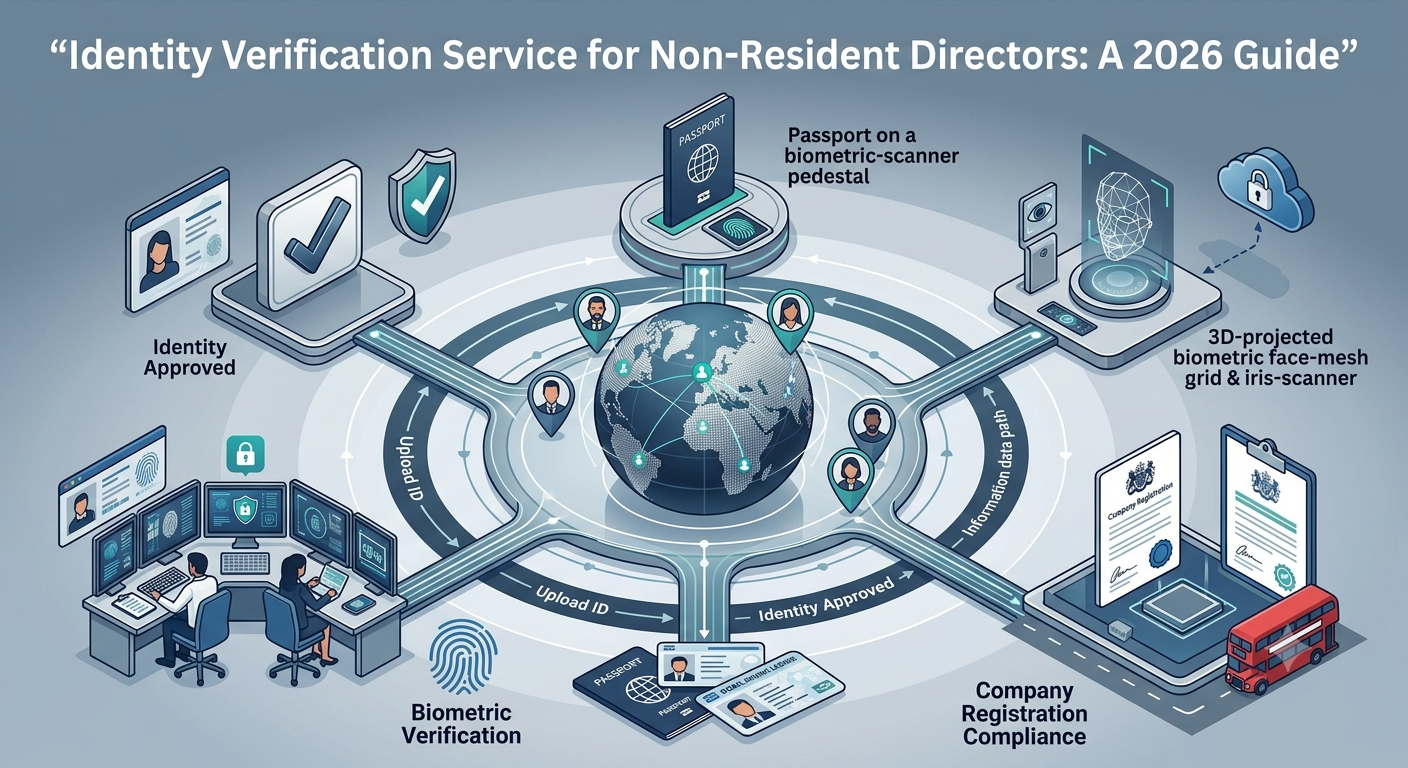
As an Authorised Corporate Service Provider, Form My Company offers an identity verification service designed for non-resident directors and PSCs. Here’s how it works:
Step 1: Prepare Your ID and Details
Have your valid, in-date biometric passport ready, along with your personal details and the details of your UK company.
Step 2: Complete Verification Remotely
Our secure digital process guides you through document upload and biometric verification, entirely online. Most cases are handled in minutes rather than hours or days.
Step 3: We Confirm Verification to Companies House
As an ACSP, we submit your verified status to Companies House, and you receive your unique personal code confirming compliance.
Step 4: You’re Fully Compliant
Your verification is complete, your Companies House record is updated, and you can act as a director without any restrictions.
Combining IDV with UK Company Formation for Non-Residents
For non-residents forming a UK limited company, doing identity verification alongside your incorporation is the smoothest approach. Our Non-Residents package brings the whole setup together:
- Fast UK limited company formation with Companies House
- A compliant UK registered office address in Bolton BL1
- A director’s service address to keep your home address off the public register
- Identity verification support as part of your setup
- Banking partner introductions for non-resident-friendly providers
- Ongoing compliance help including confirmation statements
This means you go from starting the process to being a fully verified, fully compliant UK director in one coordinated setup, without needing to piece services together from different providers.
Common Verification Issues for Non-Residents (and How to Avoid Them)
A few issues come up regularly, and they’re usually preventable:
Expired or damaged ID. Check that your passport is in date and in good condition well before starting verification.
Poor-quality photos. Follow the app’s instructions for lighting and angle. Blurry or off-angle photos are a common cause of rejections.
Name mismatches. Make sure the name on your Companies House record matches your ID exactly, including middle names and any special characters.
Address inconsistencies. Your residential address on Companies House must match what you provide during verification.
Old name changes. If you’ve legally changed your name, be prepared to provide supporting documentation.
Unusual ID document types. If you don’t have a standard biometric passport, contact us in advance so we can advise on the smoothest route.
Preparing well in advance is the single biggest factor in a fast, smooth verification.
Get Your ID Verification Done Today
Under the ECCTA, identity verification is now a fundamental part of running a UK company as a non-resident director. The good news is that with the right ACSP support, it’s fast, remote, and fully manageable from anywhere in the world. With Form My Company, you can complete verification as part of your UK company formation or as a standalone service, so you meet the requirement correctly and can act as a director without any restrictions. Get started today and stay compliant with the new rules.
Frequently Asked Questions
Do non-resident directors need to complete identity verification?
Yes. Under the ECCTA, every director of a UK limited company must complete identity verification with Companies House, regardless of where they live. There are no exemptions based on residency or nationality.
What’s the difference between direct verification and using an ACSP?
Both routes give you the same verified status. Direct verification uses the GOV.UK One Login service, while an ACSP handles the process on your behalf and confirms it to Companies House. For non-residents, an ACSP route is often smoother, especially for international ID documents.
What ID do I need as a non-resident director?
A valid, in-date biometric passport is the most widely accepted document worldwide. Some routes may accept other government-issued photo ID, but a passport is the most reliable choice for non-residents completing verification remotely.
How long does identity verification take?
For straightforward cases with a good-quality biometric passport, verification through an ACSP is often completed within minutes. More complex cases can take longer, but still typically remain a same-day or next-day process.
What happens if I don’t verify my identity?
Acting as an unverified director is a criminal offence. You can’t legally act as a director, statutory filings can be blocked, and penalties include fines of up to £30,000 per offence, director disqualification for up to 15 years, and potential criminal sanctions.
Do I need to verify separately as a PSC and a director?
No. A single identity verification covers all your roles. If you’re both a director and a PSC (which is common for sole directors and shareholders), one verification satisfies the requirement for both.
Can I combine identity verification with company formation?
Yes, and it’s often the smoothest approach. Our Non-Residents package handles incorporation, UK registered office, director’s service address, and identity verification together in one coordinated setup, so you’re fully compliant from day one.