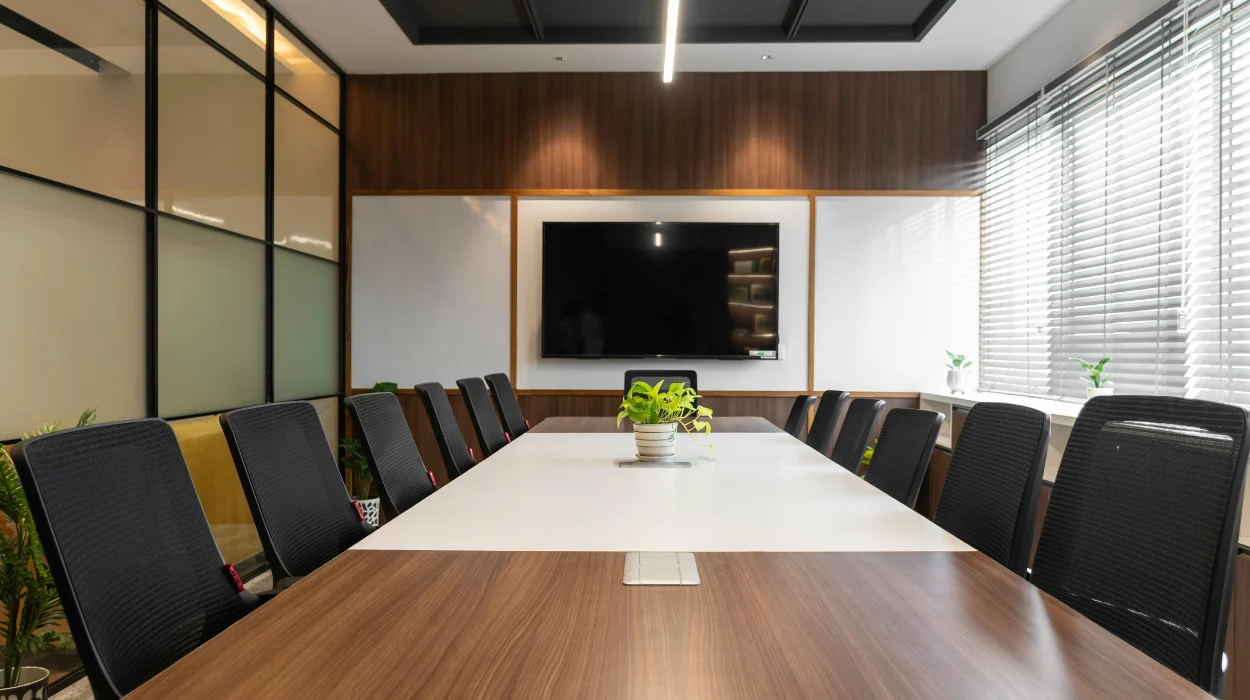
Standard meeting rooms support everyday business collaboration with basic amenities, while executive boardrooms provide premium environments designed for strategic decision-making, senior leadership meetings, and confidential discussions requiring enhanced technology, security, and presentation capabilities.
Standard meeting rooms focus on functionality. They include essential tools such as tables, chairs, Wi-Fi, and presentation screens. These rooms suit team meetings, training sessions, and operational reviews where efficiency matters more than prestige.
Executive boardrooms elevate both environment and capability. They include three core enhancements: advanced AV systems, soundproofing for confidentiality, and premium furnishings. These features directly support high-level decision-making and stakeholder presentations.
The difference also extends to perception. A boardroom communicates authority and professionalism. This matters during investor meetings, board reviews, and regulatory discussions where impression influences outcomes.
When is a standard meeting room the right choice?
Standard meeting rooms are ideal for routine collaboration, internal training, and operational meetings involving small to medium-sized teams, where functionality, cost-efficiency, and accessibility take priority over prestige and advanced technological requirements.
Standard rooms perform best during structured, repeatable activities. These include weekly team check-ins, onboarding sessions, and internal workshops. The layout supports interaction without unnecessary complexity.
Cost efficiency becomes a measurable advantage. Businesses reduce overhead when using standard spaces for recurring sessions. For example, a company running 12 monthly training sessions avoids premium costs without sacrificing productivity.
Standard meeting rooms also integrate well with structured learning environments. Businesses seeking flexible layouts and scalable capacity often rely on professional Meeting Rooms designed for corporate learning outcomes that support presentations, breakout discussions, and assessments. You can explore tailored environments through this dedicated service, Meeting Rooms
When does an executive boardroom become essential?
Executive boardrooms become essential during high-stakes meetings involving senior stakeholders, investor negotiations, or confidential discussions where privacy, advanced presentation tools, and a professional environment directly influence decision quality and business outcomes.
Certain meetings carry measurable risk. Board-level discussions, merger negotiations, and legal consultations require strict confidentiality. Soundproofing and controlled access ensure sensitive information remains protected.
Technology also plays a decisive role. Executive boardrooms include integrated systems such as 4K displays, video conferencing platforms, and multi-device connectivity. These tools enable seamless communication with remote stakeholders across different regions.
Decision-making environments influence cognitive performance. Research shows that structured, distraction-free spaces improve focus and reduce decision fatigue. Executive boardrooms are designed to support this outcome through controlled lighting, acoustics, and ergonomic seating.
How do meeting objectives determine the right room type?
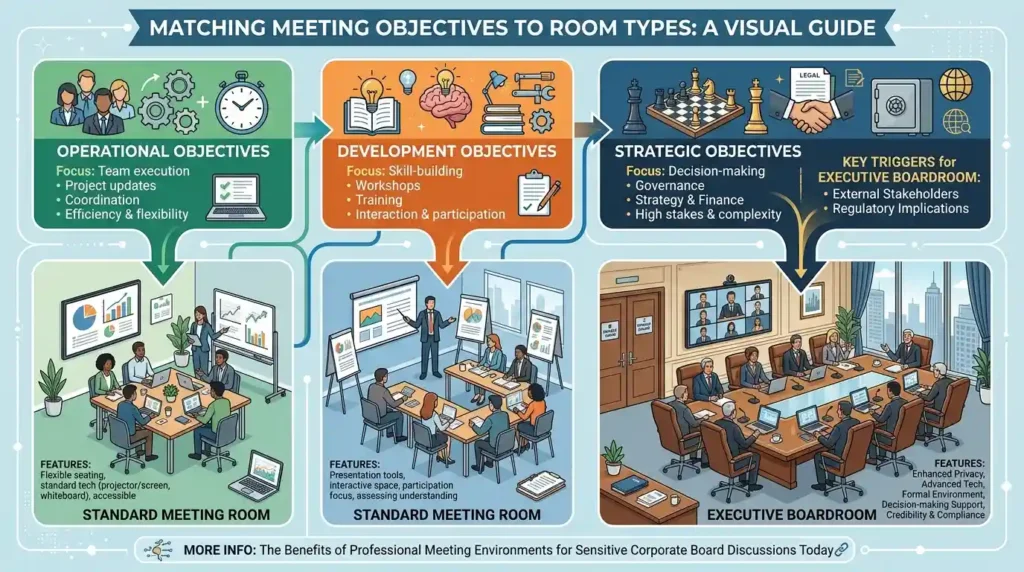
Meeting objectives determines room selection by aligning functional needs with available features; operational meetings require efficiency and flexibility, while strategic or confidential objectives demand enhanced privacy, advanced technology, and a formal environment that supports critical decision-making processes.
Every meeting has a defined output. This output determines the required environment. For example, a training session aims to transfer knowledge and assess understanding. A board meeting aims to approve strategy or financial decisions.
Three objective categories clarify the choice:
- Operational objectives: focus on execution, such as project updates and team coordination
- Development objectives: focus on learning, such as workshops and skill-building sessions
- Strategic objectives: focus on decision-making, such as governance and financial approvals
Operational and development objectives align with standard meeting rooms. Strategic objectives require executive boardrooms due to higher stakes and complexity. If a meeting includes external stakeholders or regulatory implications, the environment must support credibility and compliance. This requirement automatically shifts the preference toward executive boardrooms.
For deeper insights into how professional environments influence sensitive discussions, review this guide: The Benefits of Professional Meeting Environments for Sensitive Corporate Board Discussions Today
What role does technology play in choosing between the two?
Technology requirements directly influence room selection, as standard meeting rooms provide basic presentation tools, while executive boardrooms offer integrated systems such as high-definition displays, secure video conferencing, and multi-device connectivity essential for complex and remote-enabled discussions.
Technology determines how information flows during a meeting. Standard rooms support simple presentations using laptops and projectors. This setup works well for internal collaboration, where data sharing remains straightforward.
Executive boardrooms support advanced communication needs. These include three key capabilities:
- Enable real-time collaboration across locations using secure video conferencing
- Display complex data sets through high-resolution screens and multi-display setups
- Integrate multiple input devices for seamless presenter transitions
Security also becomes critical when handling sensitive data. Executive boardrooms often include encrypted networks and restricted access systems that protect information integrity. When meetings involve external stakeholders across different regions, advanced technology ensures continuity and clarity. This reduces delays and improves decision speed.
Explore our Meeting Rooms guides,
How to Find Affordable Meeting Rooms with Premium Audio Visual Facilities Online
Why Hiring a Professional Meeting Space is More Cost Effective Than Hotels
How does the attendee profile influence the decision?
Attendee profile influences room selection by aligning the environment with participant seniority, expectations, and decision-making authority; senior executives, investors, and board members require formal, high-spec settings, while internal teams function effectively in standard collaborative spaces.
The level of attendees directly impacts expectations. Senior executives expect structured environments that reflect professionalism and control. A mismatch between the attendee profile and meeting space reduces credibility.
For example, a meeting involving directors and investors requires a setting that supports formal presentations and confidential dialogue. Executive boardrooms meet this requirement through layout, acoustics, and visual design.
Internal team meetings operate differently. These sessions prioritise interaction and flexibility rather than formality. Standard meeting rooms allow quick setup changes, making them suitable for collaborative tasks. Matching attendee expectations with the environment ensures smoother communication and stronger engagement. This alignment directly improves meeting outcomes.
How do cost and value compare between the two options?
Cost and value differ significantly, as standard meeting rooms offer lower hourly rates suitable for frequent use, while executive boardrooms justify higher costs through advanced features, enhanced privacy, and improved decision-making environments for high-impact meetings.
Cost analysis involves frequency and purpose. Businesses conducting daily meetings benefit from the affordability of standard rooms. This reduces operational expenses over time. Executive boardrooms represent a higher investment. However, their value lies in outcomes rather than frequency. A single strategic meeting that leads to a successful partnership or investment offsets the higher cost.
Value can be measured through three factors:
- Improve decision accuracy using controlled environments
- Reduce communication errors through advanced technology
- Enhance stakeholder confidence during critical discussions
When meetings directly impact revenue or compliance, investing in a premium environment becomes a rational decision rather than an expense. For organisations evaluating premium facilities, this resource provides a clear overview: Get Exclusive Access to Our State-of-the-Art Meeting Room Facilities
How do training and development needs fit into this decision?
Training and development needs align more closely with standard meeting rooms or specialised training environments, as these spaces support interactive learning, scalable seating, and structured layouts designed for knowledge transfer rather than executive-level decision-making.
Training sessions require adaptability. Facilitators often switch between presentations, group work, and assessments. Standard meeting rooms support this flexibility through modular layouts and accessible tools.
However, dedicated Meeting Rooms provide a more refined solution. These environments are designed specifically for learning outcomes. They include features such as adjustable seating arrangements, whiteboards, and integrated presentation systems.
Training environments also support measurable outcomes. For example, structured layouts improve engagement rates during sessions, while clear visibility enhances information retention.
Businesses that prioritise employee development benefit from choosing spaces designed for education rather than decision-making. This ensures alignment between the environment and the objective.
Choosing between standard meeting rooms and executive boardrooms depends on aligning environment with the purpose, attendees, and required capabilities. Standard rooms support routine collaboration and training, while executive boardrooms enable high-stakes discussions with advanced tools and privacy controls.
From My Company provides structured solutions through specialised Meeting Rooms and premium meeting environments that align directly with business objectives. Their approach focuses on matching space capabilities with measurable outcomes, ensuring each meeting environment supports its intended purpose.
Frequently Asked Questions
What are Meeting Rooms used for in a business setting?
Meeting Rooms are used for staff development, onboarding, workshops, and skill-based presentations. They provide a structured environment where teams can learn, discuss, and complete exercises without office distractions.
How do I choose the right training room for my event?
Choose a training room based on attendee count, layout, technology, and session format. From My Company offers Meeting Rooms that support presentations, group work, and practical learning tasks.
What facilities are usually included in Meeting Rooms?
Training rooms typically include seating, tables, presentation screens, Wi-Fi, and audio-visual equipment. Some spaces also support breakout activities, note-taking, and laptop-based learning.
Are Meeting Rooms suitable for corporate workshops?
Yes, Meeting Rooms are well suited to corporate workshops because they support interaction and focused learning. They work especially well for sessions that combine presentation time with group discussion or practical exercises.
Why use a dedicated training room instead of an office meeting space?
A dedicated training room reduces distractions and improves learning flow. It also gives businesses a more suitable layout for teaching, assessment, and participant engagement than a standard office meeting area.