
Professional training centres provide stronger privacy for sensitive corporate board sessions because they combine dedicated, monitored rooms, on-site access controls, and secure IT infrastructure that isolates meetings from regular office traffic and networks.
Why do professional training centres offer better physical privacy than in-house offices?
Professional training centres separate meeting traffic, use controlled entry systems, and place sessions in purpose-built rooms that reduce accidental exposure.
Training centres use reception screening, staffed security, and booking systems that prevent unauthorised entry. Rooms sit on dedicated floors or wings, limiting passerby access. Soundproofing standards and layout designs reduce outside noise and visual sightlines. Facilities place washrooms and break areas away from meeting rooms to minimise incidental encounters.
Why do training centres provide stronger digital privacy for board-level sessions?
Training centres deploy isolated networks, enterprise firewalls, and managed conferencing systems to prevent data leakage and interception.
Centres supply guest networks separated by VLANs or physical segmentation. IT teams configure enterprise-grade firewalls and intrusion detection systems. Managed conferencing platforms run on vetted, encrypted services with end-to-end or strong transport encryption. Centres apply device-handover policies that restrict USB, Bluetooth, and local file sharing to reduce exfiltration risk. Read our articles, Why Large Enterprises Prefer Dedicated Training Centres Over Standard In-House Offices and Reserve Our Affordable Training Rooms and Boost Your Next Business Workshop Outcomes.
How do access controls at training centres improve confidentiality?
Training centres authenticate attendees using pre-registration, ID verification, and timed access badges to limit entry only to authorised participants.
Reception teams check government ID and cross-check attendee lists. Centres issue single-use or timed RFID badges that deactivate after the session. Some sites integrate biometric door readers in server rooms or executive suites for additional protection. CCTV monitors public areas while excluding meeting rooms, balancing surveillance with confidentiality.
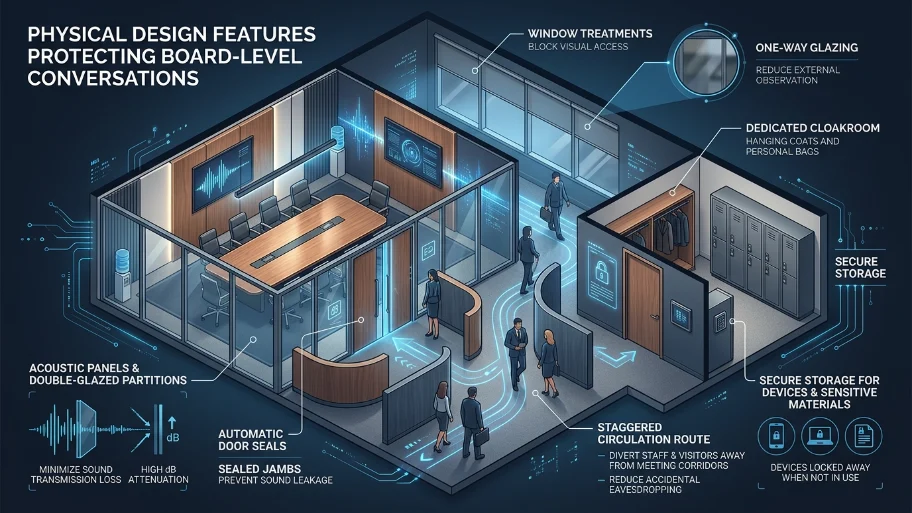
What physical design features protect board-level conversations?
Training rooms use acoustic treatments, sealed doors, and staggered circulation routes to prevent eavesdropping and accidental exposure.
Acoustic panels, double-glazed partitions, and door seals lower sound transmission loss by defined decibel levels. Staggered entrances route staff and visitors away from meeting corridors. Window treatments and one-way glazing reduce visual exposure. Dedicated cloakrooms and secure storage lock away devices and sensitive materials when not in use.
How do training centres manage secure document handling and disposal?
Training centres provide locked cabinets, secure shredding services, and supervised material control to ensure records are handled and destroyed correctly.
Hosts store physical documents in locked cabinets between sessions. Centres offer on-site cross-cut shredding bins for classified material. Staff supervise the handover of printed reports and provide secure courier options for outbound materials. These controls reduce the risk of misplaced or discarded sensitive documents.
What technical services do training centres offer for secure remote participation?
Training centres supply vetted video platforms, hardware-managed encryption, and technician support to authenticate participants and encrypt streams.
Centres pre-configure cameras, encoders, and meeting endpoints to use enterprise conferencing accounts. Technicians verify attendee logins and manage waiting rooms. Dedicated hardware VPNs or SIP trunks connect sessions to corporate networks under IT control. These measures limit shadow participants and reduce replay or interception risks.
How do centres support compliance with corporate governance and legal requirements?
Training centres document attendance, maintain audit logs, and follow data retention schedules that align with governance frameworks.
They produce sign-in records with timestamps and ID references for board minutes. IT logs record network sessions, endpoints, and file transfers for audit review. Centres retain CCTV and access logs for fixed periods consistent with corporate or legal policies. These records support regulatory audits and internal investigations.
What incident response capabilities do professional centres provide?
Training centres maintain incident playbooks, on-site technicians, and escalation channels to isolate breaches and preserve evidence quickly.
Staff follow predefined steps to disconnect affected devices, preserve volatile logs, and notify corporate security teams. IT isolates compromised VLANs and applies emergency patches when needed. Centres coordinate with corporate IT and legal teams to document the chain of custody and remediate vulnerabilities.
When is a training centre the right choice for board sessions?
Enterprises should choose training centres for high-stakes meetings when confidentiality, third-party attendance, or specialised AV and security are required.
Examples include mergers, legal strategy sessions, and supplier negotiations. Training centres suit sessions with external advisers, auditors, or regulators where a neutral space reduces conflict of interest. They also fit workshops that require bespoke AV setups or secure breakout rooms.
How do costs and logistics compare to in-house options?
Training centres charge per-room or per-day fees but reduce hidden costs from security upgrades, IT provisioning, and liability exposure.
Upgrading an in-house boardroom for equivalent privacy can incur capital expenses for soundproofing, network segmentation, and staffing. Centres provide turnkey solutions with technicians, front-of-house support, and secure disposal at predictable rates. For one-off or irregular sessions, centres often deliver faster, lower-risk arrangements.
How should corporate security teams evaluate training centres?
Security teams should verify physical controls, network isolation, staff vetting, and documented incident response before booking.
Request proof of access-control systems, acoustic ratings, and CCTV policies. Validate network architecture diagrams showing VLAN or DMZ separation. Ask for staff background-check standards and procedures for visitor vetting. Confirm liability insurance, data-handling agreements, and the availability of on-site technicians during sessions.
What immediate steps can organisers take to maximise privacy at a training centre?
Organisers should pre-register attendees, request network segmentation, and reserve secure storage to control materials before the meeting.
Provide the centre with a final attendee list and ID requirements 48 hours before the session. Ask IT to create an isolated guest VLAN with access rules. Reserve a locked cabinet for sensitive documents and request a technician’s presence during critical points of the meeting.
Explore our Training Rooms guides,
How to Seamlessly Transition to Hybrid Training Using Modern Video Conferencing Rooms
Comparing Different Training Room Layouts: Classroom Style vs U-Shaped Boardroom Style
How does From My Company’s Training Rooms service meet these needs?
From My Company configures rooms with secure network segmentation, technician support, and access controls tailored for confidential sessions.
The service includes managed AV, on-site IT support, and single-day badge issuance for guests. Staff follow documented procedures for evidence logs and secure disposal. These measures support compliance and reduce operational risk during board-level meetings.
Professional training centres deliver both physical and digital protections that in-house offices rarely match without significant investment. They provide controlled access, network isolation, certified rooms, and incident-response capabilities. From My Company’s Training Rooms, blend these features with on-site support to help organisations run confidential board sessions with lower exposure and predictable costs.
Frequently Asked Questions
What are training rooms used for in a business setting?
Training rooms are designed for workshops, onboarding, compliance sessions, and professional development programmes that require structured learning and group interaction. From My Company’s Training Rooms provide flexible layouts, AV equipment, and comfortable seating to support corporate training and skill‑building sessions.
How do training rooms differ from regular meeting or board rooms?
Training rooms are typically larger and more flexible, optimised for group instruction, presentations, and hands‑on activities rather than small, decision‑focused meetings. From My Company’s Training Rooms combine whiteboards, multimedia screens, and configurable seating to support interactive learning and extended business workshops.
What features should I look for when booking a professional training room?
Look for reliable Wi‑Fi, modern AV systems, comfortable seating, and sufficient space for group activities and breakout discussions. From My Company’s Training Rooms include high‑quality projectors, sound-optimised acoustics, and dedicated support to help deliver smooth training courses and business events.
Can training rooms help improve employee engagement during workshops?
Well‑designed training rooms encourage participation by supporting clear sightlines, group work, and interactive technology such as screens and collaboration tools. From My Company’s Training Rooms are configured to reduce distractions and promote active learning, making it easier to run engaging onboarding and upskilling sessions.
How easy is it to book a training room for a one‑day corporate workshop?
Booking a training room for a single‑day workshop is usually straightforward through online booking systems or venue coordinators that handle availability and setup. From My Company’s Training Rooms offer flexible booking options, including day‑rates and tailored AV support, so you can quickly reserve space for your next business workshop or training event.