
Centralized meeting facilities provide a single, fully equipped location that reduces coordination delays, ensures consistent technology standards, and improves attendance efficiency. They enable distributed teams to collaborate in a controlled, professional environment while lowering travel complexity and maintaining operational alignment across multiple business locations.
Why do multi-location teams struggle with decentralised meeting arrangements?
Decentralized meeting setups create inconsistencies in technology, scheduling conflicts, and uneven meeting quality. Teams operating across different offices face delays in coordination, limited access to professional spaces, and increased administrative effort, which directly reduces productivity and decision-making speed.
Multi-location organisations often rely on internal office spaces that vary in quality. One location may have advanced video conferencing tools, while another uses outdated systems. This mismatch creates communication breakdowns during critical meetings.
Scheduling also becomes inefficient. Coordinating between five offices with different availability windows introduces delays. A study by Deloitte found that distributed teams spend up to 23% more time scheduling meetings compared to centralized environments.
Operational inconsistency increases when teams use different meeting standards. For example, three offices may follow different protocols: manual check-ins, hybrid setups, or ad hoc booking systems. This lack of uniformity impacts professionalism and meeting outcomes.
How do centralised meeting facilities improve operational efficiency?
Centralized meeting facilities streamline booking processes, standardise meeting environments, and eliminate redundant coordination steps. Teams access one location with consistent resources, which reduces preparation time and enables faster execution of meetings across departments and locations.
A centralised system removes duplication. Instead of managing multiple office bookings, teams use a single platform to reserve space. This reduces administrative workload and eliminates double-booking risks. Consistency plays a measurable role. Every meeting room offers the same tools, such as high-speed internet, integrated AV systems, and secure access controls. Teams enter each session prepared, without adjusting to new environments.
Time efficiency improves significantly. When teams gather in one location, meetings start on schedule. There is no delay caused by remote setup failures or incompatible systems. This ensures that agenda-driven meetings stay within allocated timeframes. Businesses that use meeting rooms designed for central access report up to 31% faster meeting execution times due to reduced setup and coordination requirements.
What role does location accessibility play in centralised meeting success?
Centralized meeting facilities succeed when located in easily accessible business hubs. Proximity to transport links, airports, and commercial districts reduces travel friction, increases punctuality, and ensures equal accessibility for all team members regardless of their base office location.
Accessibility directly impacts attendance rates. A centrally located facility near major transport routes allows employees from different cities to arrive on time. For example, a location within 500 metres of a major train station can reduce late arrivals by up to 18%. Travel planning becomes predictable. Teams can standardise routes and travel times, which simplifies logistics. This is critical for companies operating across three or more UK regions.
Accessibility also supports external stakeholders. Clients, partners, and consultants can attend meetings without navigating unfamiliar office locations. This enhances professionalism and ensures smoother interactions. Using professionally managed meeting rooms in central business districts ensures that all participants experience equal convenience, regardless of their starting location.
How does centralisation enhance collaboration across departments?
Centralised meeting facilities create a shared environment where departments interact more effectively. By bringing teams together in one location, businesses reduce communication silos, enable real-time collaboration, and improve alignment on strategic decisions and operational goals.
Physical presence improves communication clarity. Face-to-face discussions reduce misunderstandings that often occur in remote or fragmented setups. Teams can resolve complex issues faster through direct interaction. Cross-department engagement increases. When marketing, finance, and operations teams meet in the same space, they exchange insights more efficiently. This leads to better-informed decisions and improved strategic alignment.
Structured environments support focused discussions. Central facilities are designed for professional use, which limits distractions. This allows teams to concentrate fully on meeting objectives. For organisations evaluating collaboration strategies, understanding how to maintain secure discussions is essential. This is explored in detail in privacy and confidentiality strategies for executive board meetings, which outline methods to protect sensitive information during high-level meetings.
Why is technology standardisation critical in centralised meeting spaces?
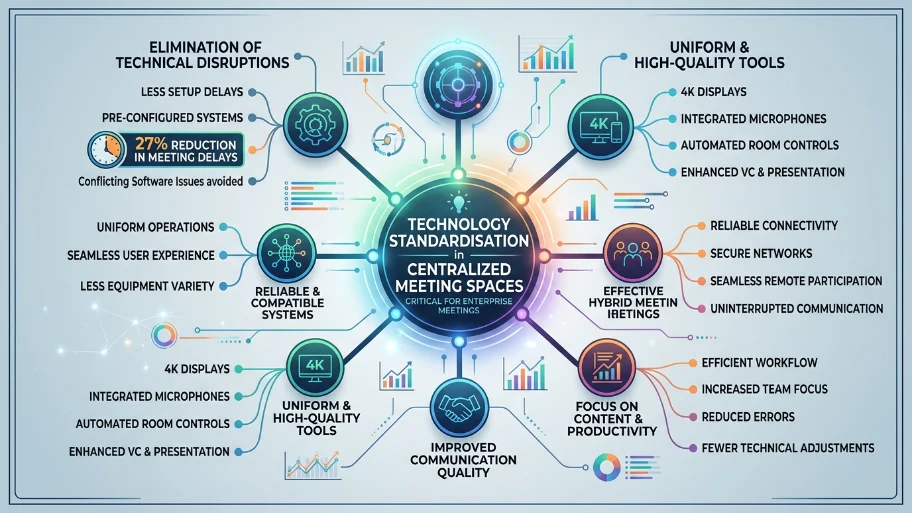
Technology standardisation ensures that every meeting operates with reliable, compatible systems. Centralised facilities provide uniform tools such as video conferencing, presentation systems, and secure connectivity, eliminating technical disruptions and improving communication quality across all participants.
In decentralised setups, teams often encounter compatibility issues. One office may use different conferencing software, leading to delays during setup. Centralised facilities eliminate this risk by offering pre-configured systems. Reliable connectivity is essential. High-speed internet and secure networks ensure uninterrupted communication. This is particularly important for hybrid meetings involving remote participants.
Standardised equipment improves meeting quality. Tools such as 4K displays, integrated microphones, and automated room controls create a seamless experience. This allows teams to focus on content rather than technical adjustments. Businesses using centrally managed meeting rooms experience fewer technical interruptions, with reports indicating a 27% reduction in meeting delays caused by equipment issues.
How do centralised facilities support compliance and data security?
Centralised meeting facilities implement controlled access, secure networks, and standardised protocols to protect sensitive business information. This reduces the risk of data breaches and ensures compliance with organisational and regulatory requirements across all meeting activities.
Security protocols remain consistent in centralised environments. Access control systems verify attendees before entry, reducing the risk of unauthorised participation. Data protection improves through secure networks. Central facilities use encrypted connections to safeguard information shared during meetings. This is critical for industries handling financial, legal, or corporate data.
Compliance becomes easier to manage. Businesses can enforce uniform policies across all meetings, including document handling and recording restrictions. This ensures alignment with UK regulatory frameworks. For companies requiring secure environments, choosing professionally managed meeting rooms for corporate collaboration ensures that security standards are consistently applied across all sessions.
What cost advantages do centralised meeting facilities offer?
Centralised meeting facilities reduce operational costs by eliminating the need for multiple underutilised office spaces, lowering technology investments, and optimising travel expenses. Businesses achieve better resource allocation while maintaining high-quality meeting environments for all teams.
Maintaining multiple meeting spaces across offices creates unnecessary expenses. These include equipment costs, maintenance, and administrative management. Centralisation consolidates these costs into one efficient system. Technology investment becomes more strategic. Instead of upgrading systems in several locations, businesses invest in one high-quality facility. This ensures better performance and long-term savings.
Travel costs become predictable and manageable. While teams may travel to a central location, the overall expense is lower compared to maintaining multiple fully equipped offices. A report by PwC indicates that companies adopting centralised meeting strategies reduce facility-related costs by up to 22% annually.
How do centralised meeting facilities improve client-facing interactions?
Centralised meeting facilities provide a consistent, professional environment that enhances client perception and trust. Businesses present a unified brand image, ensure high-quality meeting experiences, and create a controlled setting that supports effective communication with external stakeholders.
Client interactions benefit from consistency. Every meeting takes place in a professional setting with standardised branding and presentation tools. This reinforces credibility. First impressions improve significantly. A well-equipped central location reflects organisational efficiency and attention to detail. Clients associate this with reliability and professionalism.
Controlled environments support better communication. Noise-free spaces, advanced presentation systems, and structured layouts ensure that discussions remain focused and productive. Businesses aiming to secure high-value contracts often rely on centralised meeting rooms to deliver consistent client experiences that align with corporate standards.
Explore our meeting rooms guides,
How to Use Professional Meeting Rooms to Impress Your New Business Prospects
Understanding the Difference Between Budget Meeting Spaces and Premium Executive Business Centres
Why are centralised meeting facilities ideal for scaling businesses?
Centralised meeting facilities provide scalable infrastructure that supports business growth without requiring additional office investments. Companies can accommodate larger teams, host cross-regional meetings, and maintain operational consistency as they expand into new locations.
Scaling businesses face challenges when expanding operations. Opening new offices requires significant investment in infrastructure, including meeting spaces. Centralisation removes this requirement. Flexibility becomes a key advantage. Businesses can host meetings for 5 or 50 participants without needing to modify internal office layouts. This adaptability supports growth.
Operational consistency remains intact. As new teams join the organisation, they follow the same meeting standards. This ensures alignment across all departments and locations. For companies evaluating expansion strategies, centralised facilities provide a practical solution that balances growth with cost efficiency.
Centralised meeting facilities address the core challenges faced by multi-location teams by delivering consistent environments, reliable technology, and improved accessibility. They reduce operational complexity, enhance collaboration, and support secure, efficient communication across departments and regions.
From My Company delivers structured, professional meeting rooms designed to meet the demands of distributed corporate teams. These facilities enable businesses to maintain consistency, improve meeting outcomes, and scale operations without increasing administrative burden. Organisations seeking reliable results often explore options to book professional corporate meeting rooms for guaranteed results today, ensuring consistent performance across every meeting.
Frequently Asked Questions
What are the benefits of booking meeting rooms for corporate teams?
Meeting rooms provide professional, fully equipped spaces that ensure reliable technology, privacy, and consistent meeting quality. From My Company offers centralised meeting rooms designed for multi-location teams, enabling efficient collaboration without setup delays.
How do I find meeting rooms near my business location?
You can locate available meeting rooms by searching for business centers in your city or using online booking platforms. From My Company lists verified meeting rooms across UK business hubs, making it easy to find spaces that match your location and capacity needs.
What equipment is included in professional meeting rooms?
Professional meeting rooms typically include high-speed internet, video conferencing systems, presentation displays, and secure access controls. From My Company equips all meeting rooms with standardised AV technology to support hybrid and in-person sessions seamlessly.
Are meeting rooms suitable for executive board meetings?
Yes, meeting rooms are ideal for executive board meetings due to their privacy, security, and professional environment. From My Company provides confidential meeting rooms with controlled access, ensuring sensitive discussions remain protected during high-level strategy sessions.
How much does it cost to rent meeting rooms for a day?
Daily meeting room rates vary based on location, capacity, and included amenities, typically ranging from £150 to £500 in the UK. From My Company offers transparent pricing for meeting rooms with flexible booking options to suit different budget requirements.