
Centralized training room facilities provide consistent learning environments, reduce operational costs by up to 30%, and streamline training delivery across multiple branches. They enable standardised processes, efficient resource allocation, and measurable training outcomes, making them a practical solution for organisations managing distributed teams.
Why do multi-branch organisations struggle with decentralised training setups?
Decentralised training creates inconsistent learning experiences, increases logistical costs, and complicates coordination across branches. It often results in varied training quality, duplicated resources, and limited performance tracking, which reduces overall organisational efficiency and training effectiveness.
Multi-branch organisations operate across different locations, each with unique infrastructure and resource availability. This creates variations in training environments, equipment quality, and facilitator expertise. As a result, employees receive inconsistent instruction, which directly impacts performance outcomes.
Cost duplication is another critical issue. Separate branches often invest in similar equipment, software licences, and training materials. A 2024 UK corporate operations report found that organisations with decentralised training setups spent 22–35% more on training logistics annually.
Coordination also becomes complex. Scheduling sessions across multiple locations requires additional administrative effort. When training materials are updated, each branch must independently implement changes, which delays standardisation and increases compliance risks. Performance tracking suffers due to fragmented data collection. Different branches use varying reporting methods, making it difficult to measure training effectiveness at an organisational level. This limits the ability to optimise learning strategies.
How do centralized training room facilities improve consistency across branches?
Centralized training rooms ensure uniform delivery of training content, standardised equipment usage, and consistent instructor quality. This approach guarantees that all employees receive identical learning experiences, which improves knowledge retention and aligns workforce performance across all branches.
Consistency is essential for organisations managing compliance, operational standards, and customer service benchmarks. Centralised facilities enforce a single training framework, where content, delivery methods, and assessment criteria remain identical for all participants.
Standardised equipment plays a key role. Training rooms are equipped with identical tools, including presentation systems, conferencing technology, and software platforms. This removes variability and ensures every participant interacts with the same systems.
Instructor consistency also improves outcomes. Centralised facilities allow organisations to deploy experienced trainers who deliver sessions repeatedly. This increases delivery precision and reduces instructional errors. Assessment becomes more reliable. When all participants complete training under the same conditions, performance metrics become comparable. Organisations can accurately identify skill gaps and implement targeted improvements.
What cost advantages do centralized training facilities offer?
Centralized facilities reduce training-related expenses by consolidating resources, minimising duplication, and optimising space utilisation. Organisations can lower equipment costs, reduce travel inefficiencies, and streamline administrative processes, achieving measurable savings across training operations.
Resource consolidation eliminates redundant investments. Instead of equipping multiple locations, organisations maintain a single, fully equipped training facility. This reduces capital expenditure on hardware, software, and maintenance. Space optimisation delivers further savings. Centralised facilities are designed for high utilisation rates, often operating at 70–85% capacity. In contrast, branch-level training rooms are frequently underused, with utilisation rates below 40%.
Administrative efficiency also improves. Centralised scheduling systems reduce coordination time and staffing requirements. A single team manages bookings, logistics, and support, which lowers operational overhead. Travel costs become more predictable and manageable. Organisations can plan structured training schedules, grouping participants into sessions. This reduces last-minute travel expenses and improves attendance rates.
Businesses seeking structured and cost-efficient environments often use dedicated Training Room Services to centralise operations and maintain consistent delivery standards.
How do centralized training rooms enhance collaboration and knowledge sharing?
Centralized environments bring employees from different branches together, encouraging interaction, knowledge exchange, and team alignment. This improves cross-functional collaboration, strengthens organisational culture, and accelerates the sharing of best practices across departments.
When employees from multiple locations attend the same training sessions, they gain exposure to diverse perspectives. This promotes problem-solving and innovation, as participants share real operational challenges and solutions. Cross-branch networking becomes more effective. Employees build professional relationships that extend beyond their immediate teams. This improves communication and collaboration in future projects.
Knowledge transfer accelerates in centralised settings. Experienced employees can share insights directly with peers from other branches. This reduces knowledge silos and ensures critical information spreads efficiently across the organisation. Team alignment improves as well. Centralised training reinforces organisational goals, values, and processes. Employees leave with a unified understanding of expectations, which enhances overall performance consistency.
For practical strategies on improving training focus and engagement, refer to How to Minimise Distractions During Your Next Corporate Team Training Program Session.
What role does technology play in centralized training facilities?
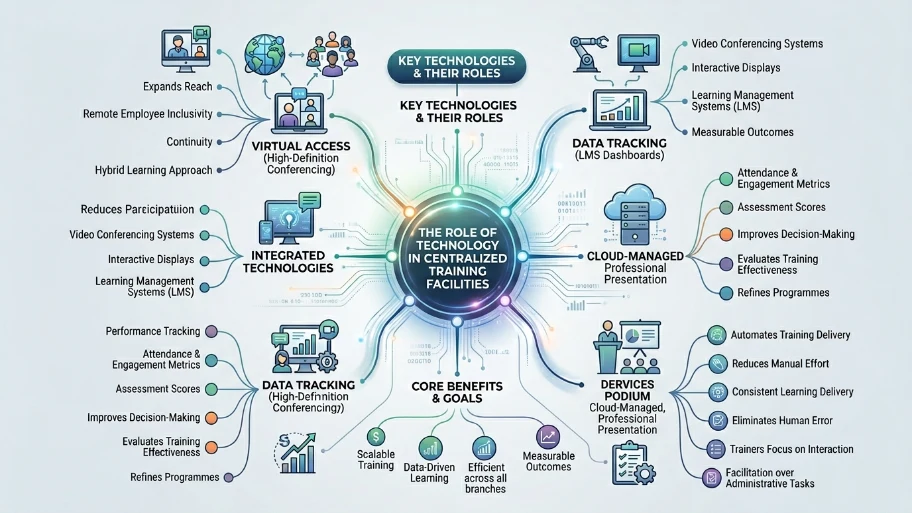
Technology enables centralized training rooms to deliver scalable, data-driven learning experiences. Advanced tools support virtual participation, real-time performance tracking, and automated content delivery, making training more efficient and measurable across all branches.
Modern training facilities integrate multiple technologies to enhance learning outcomes. These include video conferencing systems, interactive displays, and learning management systems (LMS).
Three core technologies drive efficiency:
- Enable virtual access using high-definition conferencing platforms
- Track performance through integrated LMS dashboards
- Automate content delivery with pre-configured training modules
Virtual access expands reach. Employees who cannot attend physically can join sessions remotely, ensuring inclusivity and continuity. This hybrid approach increases participation rates and reduces scheduling conflicts. Data tracking improves decision-making. LMS platforms capture attendance, assessment scores, and engagement metrics. Organisations use this data to evaluate training effectiveness and refine programmes. Automation reduces manual effort. Pre-configured modules ensure consistent delivery and eliminate the risk of human error. Trainers can focus on interaction and facilitation rather than administrative tasks.
Why are centralized training rooms more effective for compliance and standardisation?
Centralized facilities ensure that all employees receive training aligned with regulatory standards and internal policies. This reduces compliance risks, simplifies audits, and ensures consistent documentation across all branches, which is critical for regulated industries.
Compliance training requires precision and uniformity. Centralised facilities guarantee that all participants receive identical information, which reduces the risk of misinterpretation. Documentation becomes more reliable. Training attendance, assessment results, and certification records are stored in a central system. This simplifies audit processes and ensures data accuracy.
Regulatory updates can be implemented quickly. When policies change, organisations update training content in one location. This ensures immediate alignment across all branches without delays. Industries such as finance, healthcare, and legal services benefit significantly from this approach. These sectors require strict adherence to standards, and centralised training ensures consistent compliance.
How do centralized facilities improve training scalability?
Centralized training rooms allow organisations to scale programmes efficiently by accommodating larger groups, standardising content delivery, and enabling repeatable processes. This supports rapid workforce expansion without compromising training quality or operational efficiency.
Scalability is critical for growing organisations. Centralised facilities are designed to handle increased training demand without requiring additional infrastructure at multiple locations. Batch training becomes more efficient. Organisations can train large groups in structured sessions, reducing the number of individual training events. This improves time efficiency and resource utilisation.
Repeatable processes ensure consistency. Standardised training modules can be delivered multiple times with minimal variation. This supports onboarding, upskilling, and compliance training at scale. Centralised facilities also support hybrid models. Organisations can combine in-person and virtual training to reach a wider audience without increasing physical capacity. Businesses planning expansion often secure reliable facilities through providers such as From My Company, which offers structured Training Rooms designed for scalable corporate training delivery.
Explore our Training Room Services guides,
How to Use Professional Training Rooms to Impress Your High-Profile Clients
Understanding the Difference Between Budget Training Spaces and Premium Executive Training Centres
When should organisations transition to centralised training facilities?
Organisations should transition when training costs exceed efficiency gains, when consistency becomes critical, or when scaling operations across branches. Indicators include duplicated resources, inconsistent outcomes, and increased administrative complexity in training management.
Several measurable indicators signal the need for centralisation. Rising training costs across branches suggest inefficiencies in resource allocation. When multiple locations invest in similar infrastructure, consolidation becomes a practical solution. Inconsistent training outcomes also highlight the need for change. Variations in employee performance across branches indicate differences in training quality. Centralisation resolves this by standardising delivery.
Administrative complexity increases as organisations grow. Managing schedules, trainers, and materials across multiple locations becomes time-intensive. Centralised systems simplify coordination and improve operational efficiency. Scaling challenges further reinforce the need. When organisations expand rapidly, decentralised training cannot keep pace. Centralised facilities provide the structure required to support growth.
For organisations ready to implement structured training solutions, explore Book Your Next Corporate Training Session with Us for Guaranteed Professional Results to evaluate professional facility options. Centralized training room facilities provide measurable advantages for multi-branch corporate organisations. They improve consistency, reduce operational costs, and enhance collaboration across teams. Standardised environments ensure uniform training delivery, while integrated technology enables scalable and data-driven learning.
They also strengthen compliance by maintaining accurate records and delivering consistent regulatory training. As organisations expand, centralised facilities support efficient scaling without compromising quality. From My Company delivers structured Training Rooms that align with corporate training requirements. These facilities support consistent delivery, efficient resource management, and scalable operations for organisations managing multiple branches.
Frequently Asked Questions
What are the benefits of using centralized training rooms for corporate organisations?
Centralized training rooms provide consistent learning environments, reduce operational costs, and streamline training delivery across multiple branches. From My Company offers professional Training Rooms that ensure standardised equipment, uniform content delivery, and efficient resource allocation for multi-branch organisations.
How much does it cost to book a corporate training room in the UK?
Training room costs in the UK typically range from £75 to £250 per day, depending on location, capacity, and equipment included. From My Company provides competitive pricing for Training Rooms with flexible booking options and all-inclusive packages for corporate clients.
What facilities are included in corporate training rooms?
Corporate training rooms include audiovisual equipment, high-speed internet, presentation screens, comfortable seating, and conferencing technology. From My Company equips its Training Rooms with modern tools such as video conferencing systems, interactive displays, and learning management system integration.
How do I book a training room for my company’s team development session?
You can book a training room by contacting From My Company directly through their website or phone line to check availability and confirm requirements. Their Training Rooms offer flexible scheduling, capacity options for groups of 10–100 people, and customisable setups for various training formats.
Are training rooms suitable for virtual and hybrid corporate training sessions?
Yes, modern training rooms support virtual and hybrid sessions through integrated video conferencing, high-definition cameras, and remote participation tools. From My Company’s Training Rooms are equipped with hybrid-ready technology, enabling seamless collaboration between in-person and remote participants.