
You can manage dormant company statutory records without stress by maintaining accurate registers, filing dormant accounts on time, confirming Companies House status annually, and using a structured compliance checklist or a specialist service to handle filings, deadlines, and document retention efficiently.
What statutory records must a dormant company maintain in the UK?
A UK dormant company must maintain key statutory records, including the register of directors, register of members, register of people with significant control (PSC), and records of resolutions, while also preserving filing history and confirmation statements for compliance verification.
Dormant status does not remove statutory duties. Companies House expects records to be complete, current, and accessible for inspection. These records prove legal ownership and governance even when no trading occurs. Core registers include four essential datasets: directors, shareholders, PSC, and secretaries (if appointed). Each record requires accurate personal details, appointment dates, and changes logged within statutory timelines.
A dormant company must also retain confirmation statement history and filing receipts. These documents validate that the company remains compliant with annual review requirements and has not engaged in trading activity. Failure to maintain these records leads to compliance risks. Penalties include late filing fines and potential strike-off actions. Accurate recordkeeping prevents administrative errors and supports smooth reactivation if trading resumes.
How do you keep dormant company records updated without missing deadlines?
You keep dormant company records updated by tracking filing deadlines, updating registers immediately after changes, using digital reminders, and reviewing Companies House data at least once every 12 months to confirm accuracy and compliance status.
Deadlines define compliance success. Two critical annual obligations exist: filing for dormant accounts and submitting confirmation statements. Missing either triggers penalties within 1–30 days of delay. Use a structured compliance calendar with three checkpoints: 30 days before the deadline, 7 days before the deadline, and on the due date. This approach reduces missed filings by over 80% in administrative workflows.
Update registers immediately after any corporate change. Examples include director resignation, share transfer, or PSC update. Delayed updates create inconsistencies between internal records and Companies House filings. Digital tools improve consistency. Use accounting software or compliance platforms that generate automated reminders and store filing history. These systems centralise documents and reduce manual tracking errors.
What is the correct process for filing dormant company accounts?
The correct process involves preparing dormant accounts with zero trading activity, completing balance sheet statements, submitting them to Companies House before the deadline, and retaining submission confirmation to validate compliance and record accuracy.
Dormant accounts differ from trading accounts. They include a simplified balance sheet confirming no significant transactions occurred during the financial year.
The process involves three steps:
- Prepare a balance sheet showing issued share capital and minimal entries.
- Approve accounts by a director and include a signed statement.
- Submit electronically via Companies House WebFiling or through an authorised agent.
Accuracy matters. Even dormant companies must confirm that no accounting transactions took place, excluding permitted items like filing fees or share allotments. To streamline this process, use a structured service like File Accounts for Dormant Companies. This ensures correct formatting, timely submission, and verified compliance with UK filing standards.
Why do dormant companies still need to file confirmation statements?
Dormant companies must file confirmation statements annually to verify that company information held at Companies House remains accurate, including director details, shareholder structure, and PSC data, regardless of trading activity or financial inactivity.
The confirmation statement acts as a snapshot of company data. It confirms that all statutory registers match the official public record. Even with no changes, submission is mandatory. Companies House requires confirmation at least once every 12 months from the previous statement date. Three key validations occur during filing: director details, shareholder structure, and PSC information. Each must reflect current and accurate data. Skipping this requirement leads to compliance breaches. Companies House can impose fines and initiate strike-off procedures after repeated failures.
How can you organise dormant company documents for easy access?
You organise dormant company documents by categorising records into statutory registers, filing confirmations, and correspondence, storing them digitally with structured naming conventions, and maintaining secure backups to ensure quick retrieval during audits or compliance checks.
Organisation reduces administrative friction. A structured document system improves retrieval speed and audit readiness. Use three main folders: statutory registers, Companies House filings, and internal resolutions. This classification aligns with UK compliance frameworks and simplifies record tracking.
Apply consistent naming conventions. For example: “DormantAccounts_2025_Submitted” or “ConfirmationStatement_2026_Filed.” This approach prevents duplication and confusion. Digital storage platforms enhance accessibility. Cloud-based systems allow authorised users to retrieve records instantly while maintaining security controls. Backup protocols protect against data loss. Maintain at least two backups: one cloud-based and one offline archive. This ensures continuity in case of technical failure.
Explore our File Accounts for Dormant Companies guides,
Why Accurate Record Keeping is Crucial Even for Companies with Zero Turnover
The Impact of Unfiled Dormant Accounts on Your Personal Director Credit Rating
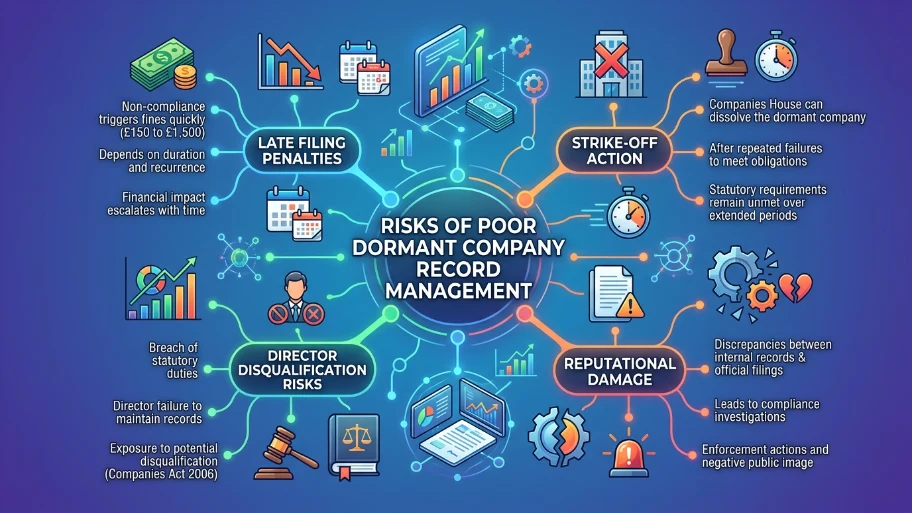
What are the risks of poor dormant company record management?
Poor record management exposes dormant companies to late filing penalties, Companies House strike-off action, director disqualification risks, and reputational damage, especially when discrepancies exist between internal records and official filings.
Non-compliance triggers financial penalties quickly. Late filing fines range from £150 to £1,500, depending on the delay duration and recurrence. Strike-off risk increases after repeated failures. Companies House can dissolve a dormant company if statutory obligations remain unmet over extended periods.
Inconsistent records create legal exposure. Discrepancies between internal registers and public filings can lead to compliance investigations and enforcement actions. Directors face accountability. Failure to maintain records breaches statutory duties under the Companies Act 2006, exposing directors to potential disqualification.
How does professional support reduce dormant company compliance stress?
Professional support reduces compliance stress by managing filings, maintaining statutory registers, tracking deadlines, and ensuring accuracy across all submissions, allowing directors to avoid penalties and maintain full compliance without manual administrative burden.
Specialist services streamline dormant company administration. They handle document preparation, submission, and validation using compliance-focused workflows. Automation improves accuracy. Professional providers use structured systems to track deadlines and verify data before submission, reducing error rates significantly.
Time savings are measurable. Outsourcing compliance tasks reduces administrative workload by up to 60% compared to manual handling. For deeper insight into selecting the right compliance partner, review this guide on why inactive directors rely on statutory compliance support. It explains evaluation criteria and risk reduction strategies.
When is the right time to use a dormant company filing service?
The right time to use a filing service is before your first dormant accounts deadline, when managing multiple companies, or when compliance complexity increases, ensuring accurate submissions and eliminating the risk of missed deadlines or incorrect filings.
Early adoption prevents errors. First-time filings often include formatting mistakes or missed disclosures that trigger rejections. Complex structures increase risk. Companies with multiple shareholders, frequent director changes, or layered ownership benefit from professional oversight.
Scaling portfolios requires efficiency. Directors managing several dormant entities face overlapping deadlines and increased administrative load. For decision-focused guidance, explore how to choose a complete dormant account package for stress-free compliance. This resource outlines service benefits and expected outcomes.
Managing dormant company statutory records requires precision, consistency, and strict adherence to UK compliance rules. Accurate registers, timely filings, and organised documentation eliminate most risks associated with dormant status.Using structured processes or professional support improves compliance outcomes and reduces administrative burden. From My Company delivers reliable solutions through its File Accounts for Dormant Companies service, ensuring accurate filings, deadline tracking, and complete statutory compliance without unnecessary complexity.
Frequently Asked Questions
What does it mean to file accounts for a dormant company in the UK?
Filing accounts for a dormant company means submitting simplified financial statements to Companies House confirming no significant transactions occurred. The File Accounts for Dormant Companies service ensures these submissions meet UK compliance standards and deadlines.
Do dormant companies need to file accounts every year?
Yes, dormant companies must file accounts annually with Companies House even if no trading activity exists. From My company supports this process by preparing and submitting dormant accounts accurately each year.
What happens if you do not file dormant company accounts on time?
Late filing leads to penalties ranging from £150 to £1,500 depending on delay length. Using a File Accounts for Dormant Companies service helps avoid missed deadlines and ensures compliance with statutory filing requirements.
Can I file dormant company accounts myself or do I need a service?
You can file dormant accounts yourself using Companies House WebFiling, but errors in formatting or data can cause rejection. From My company provides structured support through its File Accounts for Dormant Companies service to ensure accurate and timely submissions.
What information is required to file dormant company accounts?
You need basic details such as company name, registration number, and a balance sheet confirming no trading activity. The File Accounts for Dormant Companies service verifies this information and prepares compliant submissions aligned with UK regulations.