
Non-UK residents can register a private limited company with Companies House and operate it from abroad.
Non-residents register a private limited company (Ltd) by filing incorporation documents with Companies House. Directors do not have to be UK residents. A UK-registered address for the company is mandatory for official correspondence. Companies House processes electronic incorporations within 24–48 hours for standard filings.
Why this matters: registering creates a legal UK entity that can open UK business bank accounts, enter contracts, hire staff, and invoice UK customers under UK law.
What are the statutory documents required for incorporation?
Provide Articles of Association, Form IN01 (or online equivalent), company name, registered office address, and director details.
Articles of Association define internal rules; most companies use the model articles. Form IN01 collects company name, registered address, share capital, director and shareholder details, and PSC (persons with significant control) information. For online incorporations, Companies House requires digital identity verification and payment of the incorporation fee (£12 standard online fee as of 2026). Provide accurate dates of birth and usual residential addresses for directors on the IN01.
Companies must also confirm at least one subscriber (initial shareholder) and specify share classes and nominal values when issuing shares.
Read our articles, Legal Requirements for Non-UK Directors Explained, and Can Non-Residents Start a UK Company in 2026?
Can non-resident directors legally serve on UK companies?
Yes. Non-UK nationals can act as directors, subject to legal capacity and absence of disqualifications.
UK company law permits foreign nationals to act as directors. Companies must ensure directors are not disqualified under the Company Directors Disqualification Act 1986. Directors must provide their usual residential address to Companies House, although this can be protected as a service address in some cases. Directors must comply with UK fiduciary duties, tax reporting obligations, and anti-money laundering (AML) checks where applicable.
Practical step: appoint a company secretary if needed and keep statutory registers updated. Many non-residents use a professional service to maintain records and handle official filings.
Is a UK-registered office required, and how is it supplied?
Yes. A UK-registered office address is mandatory and must be in the same jurisdiction as the company (England and Wales, Scotland, or Northern Ireland).
The registered office receives legal notices and must accept service of process. Non-residents commonly use registered office providers or formation agents to meet this requirement. The registered office appears on the public Companies House register. Ensure the provider forwards mail promptly or scans documents digitally.
Example: use a registered office service that forwards mail within 48 hours and integrates with your accounting or company secretarial provider.
How does identity verification and AML compliance work for non-residents?
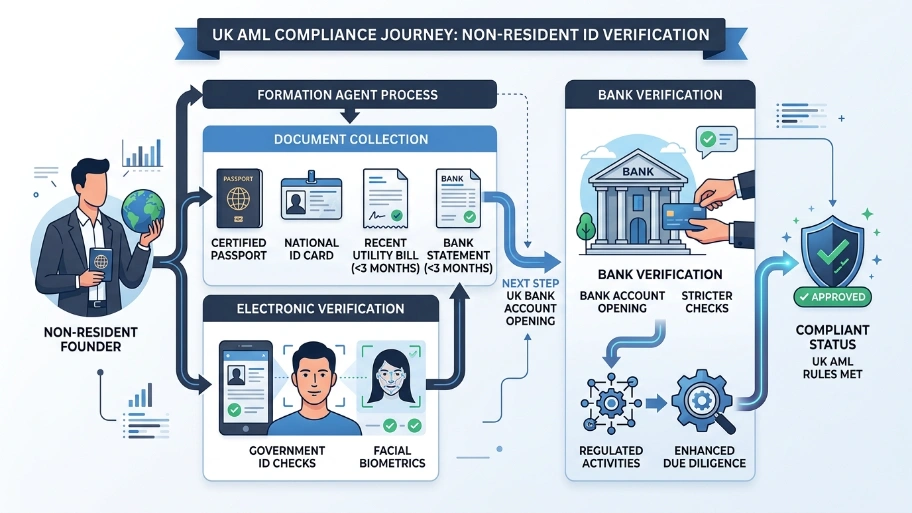
Under UK AML rules, formation agents and banks verify identity using passports, utility bills, and biometric or electronic identity services.
Formation agents collect certified copies of passports and proof of address, for example: passport, national ID, recent utility bill, or bank statement dated within three months. Electronic verification methods include government ID checks and facial biometrics. Companies engaging in regulated activities must perform enhanced due diligence. Financial institutions apply stricter checks when opening bank accounts.
Practical list:
- Provide certified passport copy.
- Provide proof of address dated within three months.
- Complete electronic identity verification where available.
Can a UK company opened by a non-resident open a UK bank account?
Yes, but bank account opening involves enhanced KYC and often an in-person meeting or specialist business banking solutions.
Major UK banks require comprehensive documentation: certificate of incorporation, memorandum and articles, PSC register, director identification, and proof of business activity. Banks commonly request evidence of expected turnover and a business plan. Remote account opening is possible with challenger banks and fintech providers, though they still perform AML checks. Expect account approval to take 2–6 weeks, depending on the bank and complexity.
Tip: Use a formation package that includes bank introduction services or choose fintech banks that specialise in non-resident business accounts.
What tax and reporting obligations apply to non-resident directors and UK companies?
A UK company must file annual accounts, a confirmation statement, and a Corporation Tax return; directors must keep statutory records and may face UK tax on UK-source income.
Companies House requires annual accounts and a confirmation statement (usually every 12 months). HMRC requires registration for Corporation Tax within three months of starting a business. Corporation Tax applies to UK company profits worldwide. Directors who perform duties in the UK or receive UK income may create personal UK tax liabilities and National Insurance obligations depending on residency and presence rules. Non-resident directors should consult a UK tax adviser for cross-border tax planning.
Key deadlines:
- Register for Corporation Tax within 3 months of trading.
- File the Corporation Tax return within 12 months of the accounting period end.
- File a confirmation statement every 12 months.
How do intellectual property and contracts work for non-resident-owned UK companies?
Register trademarks and domain names under the company’s name and sign contracts using the company’s registered details.
Registering an IP through the UK Intellectual Property Office protects brand assets in the UK. Contracts should be executed by an authorised director and should state the company’s registered office and company number. Use governing law and jurisdiction clauses to reduce cross-border disputes. Store originals of executed contracts at the registered office and keep scanned copies with the company records.
Actionable step: register a trademark and secure the .uk and .com domains within 30 days of trading to protect the brand.
Explore our Iraq guide,
Start Your UK Company from Iraq Today with Form My Company
What are common formation pathways for non-residents?
Use a professional formation agent, incorporate directly via Companies House online, or engage a UK law firm for bespoke structures.
Formation agents offer packages including registered office, formation, and PSC filing. Direct online incorporation with Companies House is quickest for simple structures. Law firms provide tailored advice for complex ownership structures, cross-border tax planning, or regulated sectors. Choose the pathway that matches business complexity and risk profile.
Example: use a formation agent for standard e-commerce startups; use a law firm for regulated financial services.
How does “From My Company” support non-residents?
From My Company provides formation, registered office, and compliance services tailored for non-UK residents to simplify incorporation and ongoing filings.
From My Company helps incorporate a UK company, supply a UK-registered office, and manage Companies House filings. The service streamlines identity verification and prepares statutory registers. Use the non-UK resident package when you want a single provider to handle formation and compliance while you operate from abroad.
Frequently Asked Questions
Can non-UK residents start a UK company in 2026?
Yes, non-UK residents can start a UK company through the Non-Uk resident service by From My company. Directors don’t need to live in the UK, but the company must have a UK-registered office address and comply with Companies House filing requirements.
What documents are needed to register a UK company as a non-resident?
Non-residents need a certified passport copy, proof of address (dated within 3 months), and Company Articles of Association when using From My company’s Non-Uk resident package. The service also handles Form IN01 submission and Persons with Significant Control (PSC) registration.
Do non-UK directors need a UK bank account for their company?
Yes, a UK company opened by a non-UK resident typically needs a UK business bank account to receive payments and pay taxes. From My company’s Non-Uk resident service includes bank introduction support, though approval depends on the bank’s KYC and AML checks.
How long does it take to form a UK company for non-residents?
Standard online incorporation takes 24–48 hours via Companies House when processed through From My company’s Non-Uk resident package. Additional time (2–6 weeks) may be needed for bank account opening and identity verification completion.
Is there a minimum share capital requirement for non-resident UK companies?
No, there is no minimum share capital—companies can start with £1 nominal value. From My company’s Non-Uk resident service sets up the company with flexible share classes and handles initial shareholder registration without extra fees.