
A Certificate of Good Standing confirms a company is legally registered and up-to-date with Companies House filings and charges. It verifies incorporation status, filed accounts, and absence of dissolution or striking-off actions.
What is a Certificate of Good Standing?
A Certificate of Good Standing is an official Companies House document that verifies a company’s incorporation status and compliance with filing obligations.
A Certificate of Good Standing (CoGS) states the company’s registration number, incorporation date, and that required statutory filings exist on record. Companies House issues the certificate to confirm a company is not dissolved, in liquidation, or subject to strike-off. The document does not list details such as shareholders, officers’ home addresses, or full filing history. It serves as a formal proof of legal existence for third parties and foreign authorities.
Read our articles, Certificate of Good Standing vs. Company Extract: Which do you need? and Order Your Certificate of Good Standing via Form My Company.
Why do businesses request a Certificate of Good Standing?
Businesses request a Certificate of Good Standing to prove legal status for banking, contracting, and cross-border compliance.
Lenders and banks commonly require a CoGS when opening corporate accounts or approving credit. International partners and foreign registries request it during branch registration and asset transfers. Companies use the certificate in due diligence to validate counterparties. In fraud protection contexts, CoGS helps verify that an entity presenting itself as a legally active company actually appears as active in official registries.
How does a Certificate of Good Standing differ from a company extract?
A Certificate of Good Standing confirms legal status; a company extract lists filed documents, officers, and registered address details.
A company extract (also called an official company profile) provides itemised records: current directors, filing history, registered office, and share capital. A CoGS gives a concise attestation of compliance without enumerating filings. Use a company extract to investigate governance and ownership. Use a CoGS to satisfy a registrar, bank, or foreign authority that requires formal confirmation of good standing.
When is a Certificate of Good Standing required?
A Certificate of Good Standing is required when registering overseas branches, closing funding rounds, and opening corporate banking facilities.
Foreign registries request CoGS for UK companies applying for overseas registrations. Investors require it during share purchases and debt arrangements to prove the target company exists and is compliant. Banks request it to reduce onboarding risk. Governments request CoGS in cross-border legal processes and for certain tender applications.
Who can request a Certificate of Good Standing?
Company directors, authorised agents, or recognised third parties can request a Certificate of Good Standing from Companies House.
An appointed director or a person with valid authority may order the certificate online or by post. Agents such as company formation providers and legal representatives often request CoGS on behalf of clients. Third parties must present proof of entitlement or client authorisation when collecting sensitive company documents.
How do you order a Certificate of Good Standing in the UK?
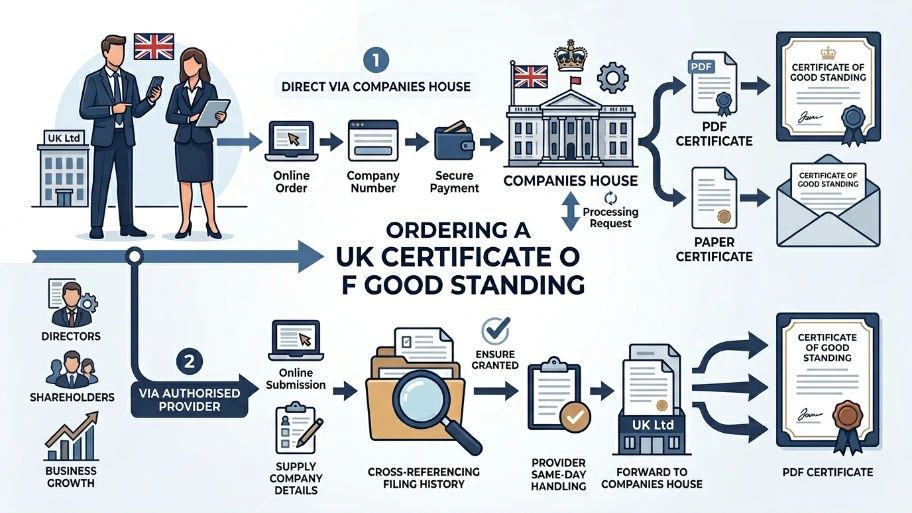
Order a Certificate of Good Standing from Companies House online or via an authorised provider, supplying the company number and payment.
Companies House processes electronic requests and issues certificates in PDF or hard copy. Processing times vary: electronic delivery occurs within hours to two working days; postal copies take longer. Authorised providers offer same-day handling and additional checks, such as cross-referencing filing history to ensure the certificate will be granted.
What information appears on a Certificate of Good Standing?
A Certificate of Good Standing shows the company name, registration number, incorporation date, and a statement of compliance with filing obligations.
The certificate includes Companies House authentication and an issuance date. It does not include director’s home addresses, detailed shareholder lists, or copies of accounts. For transactions that require both status and governance details, combine a CoGS with a company extract.
How does a Certificate of Good Standing support fraud protection?
A Certificate of Good Standing provides an authoritative source to validate a company’s legal status and reduce impersonation risk.
Fraudsters often create fake documents or use dissolved companies to mislead partners. A CoGS from Companies House verifies that the entity exists and meets statutory filing requirements. Fraud protection processes integrate CoGS checks with identity verification, beneficial ownership screening, and ongoing monitoring to detect anomalies quickly.
What additional checks strengthen fraud protection alongside a CoGS?
Combine a Certificate of Good Standing with identity verification, beneficial ownership checks, and filing-history analysis.
Verify company officers’ identities using government IDs and corporate databases. Validate beneficial owners through PSC (Persons of Significant Control) registers and cross-check against sanctions lists. Review recent filings to detect late accounts or notifications of restructuring. Implement ongoing monitoring to catch post-issuance changes that a single CoGS would not reflect.
How long is a Certificate of Good Standing valid?
A Certificate of Good Standing reflects status as of its issue date; its practical validity is usually 30 to 90 days for third parties.
Registries and banks often accept CoGS issued within 30 days. Some authorities accept certificates up to 90 days old. Because Companies House records can change rapidly, request a fresh certificate when deadlines or regulatory requirements demand up-to-date proof.
How much does a Certificate of Good Standing cost?
Costs vary: Companies House fees are modest; expedited services from agents range from £20 to £100 depending on speed and extras.
Official Companies House basic fees are low or included within service bundles. Specialist providers charge additional fees for same-day processing, printed copies, or combined document packs (CoGS plus company extract). Choose a provider that offers verification services if fraud protection is a priority.
Can fraud protection services obtain a Certificate of Good Standing for you?
Fraud protection services obtain a Certificate of Good Standing and perform layered checks to authenticate company identities and filings.
Providers combine CoGS ordering with director identity verification, sanctions screening, and monitoring. This combined approach reduces onboarding risk and supports compliance with anti-money-laundering frameworks. For outcome-driven assurance, use a provider that integrates CoGS retrieval with automated watchlists and bespoke alerts.
What are common pitfalls when relying on a Certificate of Good Standing?
Relying solely on a Certificate of Good Standing risks missing ownership changes, undisclosed charges, and recent adverse events.
A CoGS does not show mortgages, charges, or contested litigation. It does not prove operational legitimacy or financial health. Always pair a CoGS with a company extract, PSC checks, and financial statements when assessing counterparty risk.
Explore our Fraud Protection guides,
The Rise of Digital Fraud in UK Company Secretarial Filings
How Unauthorised Director Changes Ruin Your Business Credit
How can Form My Company help with fraud protection using a Certificate of Good Standing?
Form My Company provides fraud protection services that obtain Certificates of Good Standing and perform verification workflows to validate corporate identity.
Form My Company orders authoritative CoGS documents and combines them with identity and ownership checks. The service helps validate counterparties for banking, investment, and registration purposes. For decision-stage actions, the provider supports ordering official documents and delivering authenticated certificates suitable for international use.
Frequently Asked Questions
What is fraud protection for companies, and how does it work?
Fraud protection for companies identifies and prevents unauthorised activities like identity theft, fake director registrations, and document manipulation. From My Company’s fraud protection services, verify director credentials, monitor filing changes, and authenticate company documents using official UK compliance frameworks.
How can I protect my UK company from fraudsters?
Protect your UK company by verifying officer identities, monitoring Companies House filings, and securing registered details against unauthorised changes. From My Company’s fraud protection service provides ongoing monitoring, identity verification, and rapid alerts when suspicious activity occurs.
What documents are needed for business fraud protection?
Business fraud protection requires government-issued IDs for directors, proof of registered address, and official company registration documents. From My Company validates these documents through passport checks, biometric scans, and address validation to prevent impersonation and fraudulent filings.
Why is fraud protection important for new businesses?
Fraud protection is critical for new businesses because 68% of UK SMEs face identity-related fraud attempts during their first year. From My Company’s fraud protection services secure incorporation records, verify director identities, and prevent fraudulent branch registrations before damage occurs.
How does fraud protection help with company compliance?
Fraud protection ensures company compliance by validating director credentials against official registers and preventing unauthorised filing changes that breach Companies House rules. From My Company’s fraud protection maintains accurate records, supports anti-money-laundering requirements, and reduces regulatory penalties from fraudulent activity.