
Appointing a director yourself lowers immediate cost but increases legal, compliance, and reputational risk; professional filing reduces errors, ensures PSC Register compliance, and limits penalties and director liability.
What is the main difference in risk between a DIY director appointment and a professional filing?
DIY appointments carry higher procedural and compliance risk; professional filing transfers compliance duty to specialists and reduces error-related penalties.
DIY filing exposes companies to registration errors, missed PSC updates, and incorrect filings with Companies House. These errors trigger fines, corrective filings, and potential director investigations. Professional filing uses validated processes, compliance checks, and record-keeping. That reduces the chance of late notices, inaccurate Persons with Significant Control (PSC) records, and regulatory intervention.
How often do errors occur with DIY filings compared with professional services?
Companies House data and industry audits show DIY error rates range from 8–22%, while specialist services report error rates below 2%.
DIY errors include wrong dates, misspelt names, and incomplete consents. Small mistakes lead to resubmissions and administrative penalties. Specialist providers use checklists and automated validation. They verify identity, confirm residential and correspondence addresses, and validate statutory consent forms. This lowers rework and administrative fines.
Read our articles, 5 Communication Habits Holding Back Your New Startup and Reliable Company Secretarial Services for Growing UK Firms.
What financial penalties or costs arise from DIY mistakes?
Incorrect or late filings generate fixed fines, rectification costs, and indirect costs such as lost contracts and increased director exposure.
Companies House imposes late filing penalties and mandates corrections for inaccurate PSC entries. Rectification requires re-filing and sometimes professional advice, costing between £50 and £500 for basic corrections and more for legal assistance. Indirect costs include delayed banking, stalled investor due diligence, and possible contract breaches when company data does not match other records.
Which compliance tasks create the greatest legal risk when done incorrectly?
PSC registration, director consent, and confirmation statement updates create the largest legal and enforcement risk if handled incorrectly.
PSC registration requires the timely identification and registration of persons with significant control. Incorrect PSC data can trigger criminal offence inquiries and civil penalties. Director consent and appointment forms must be correctly executed and dated. Misdated or missing consents expose directors to personal liability. Confirmation statements must reflect accurate officer and PSC data; inaccuracies lead to compliance notices.
What operational risks affect governance and decision-making with DIY appointments?
Poor record-keeping, delayed updates, and unclear authority lines undermine governance and create contractual risk.
DIY processes often lack a central register and version control. That results in outdated officer lists and inconsistent signatory authority. Banks and counterparties reject documents that do not align with Companies House records. Professional services maintain audited records and certify appointment dates, enabling reliable board resolutions, banking mandates, and investor reporting.
How does professional filing reduce reputational and investor risk?
Professional filing produces verifiable records and audit trails that reassure investors, lenders, and partners.
Investors review Companies House filings and PSC registers during due diligence. Clean, accurate filings speed funding rounds and decrease investor queries. Professional providers often supply certified copies and timestamped evidence of filings. That reduces negotiation friction and shows strong governance practices.
What verification steps do professionals typically perform that DIY filers miss?
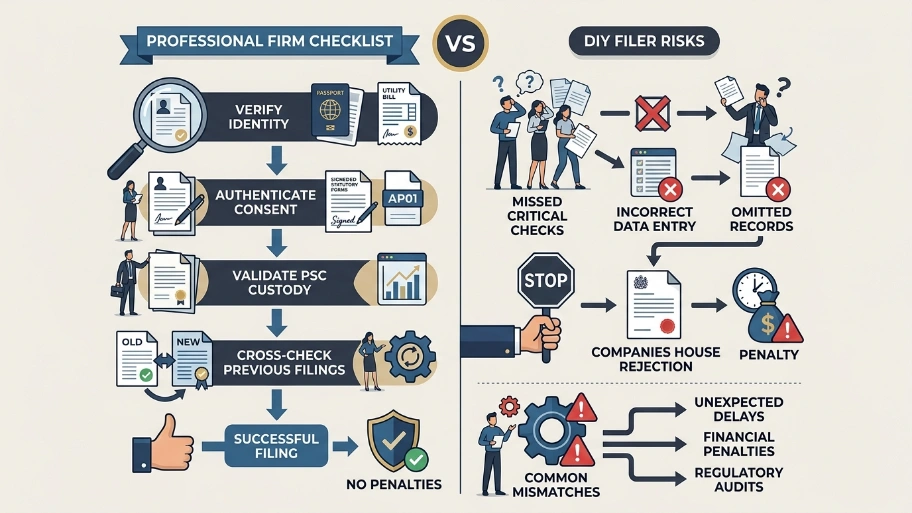
Professionals verify identity, confirm statutory consents, validate address records, and cross-check prior filings against current submissions.
Typical professional checks:
- Verify identity using government-issued ID and address proof.
- Authenticate director consent using signed statutory forms.
- Validate PSC custody using ownership and control documents.
- Reconcile new filings with previous Companies House entries.
These steps prevent common mismatches that cause penalties or rejections.
How does the PSC Register service support ongoing compliance for director appointments?
PSC Register services maintain accurate control records, provide timely reminders, and execute corrections when lawfully required.
A PSC Register service records significant control changes, issues update schedules, and prepares confirmation statements. It monitors legal thresholds for control (such as 25% shareholding or significant influence) and triggers updates when thresholds change. This reduces missed update windows and improves statistical accuracy.
When is DIY filing an acceptable option?
DIY is acceptable for sole directors with simple, unchanged shareholder structures and strong familiarity with Companies House requirements.
If a company has one director-owner, no PSC complexity, and no immediate investor or banking requirements, DIY filing can save costs. The filer must accurately complete appointment forms, collect signed consents, and update the PSC register immediately. Any uncertainty about ownership thresholds or address disclosure requires professional input.
When should a company use professional filing?
Use professional filing when multiple directors exist, PSC complexity is present, an imminent investment or bank application exists, or when strict audit trails are required.
Complexity increases the chance of errors. Multiple beneficial owners, nominee arrangements, overseas directors, or third-party funding all require validated records. Professional filing safeguards against regulatory scrutiny and supports rapid due diligence.
Appointing a director yourself reduces upfront expense but increases legal, compliance, and operational risks. Professional filing reduces error rates, maintains audit trails, and protects directors and the company from fines and reputational harm. From My Company’s PSC Register service supports accurate PSC records, automated reminders, and certified filing evidence to keep companies compliant and due-diligence ready.
Frequently Asked Questions
What is a PSC Register and why do UK companies need it?
A PSC Register is a statutory record of people with significant control over a UK company, required under the Small Business, Enterprise and Employment Act 2015. From My Company ensures your PSC Register remains accurate and compliant with Companies House filing requirements.
How often must I update my PSC Register?
You must update your PSC Register within 14 days when control changes occur, then file updates with Companies House within another 14 days. From My Company’s PSC Register service automates reminders and handles timely filings to prevent compliance breaches.
What information must be included in a PSC Register?
A PSC Register requires full name, service address, nationality, date of birth, usual country of residence, date of becoming registrable, and nature of control for each person. From My Company validates all PSC details against official UK compliance frameworks to ensure accuracy.
What are the penalties for not maintaining a PSC Register?
Failure to maintain a PSC Register is a criminal offence that can result in fines up to £1,000, prison terms of up to two years, or both for company officers. From My Company’s PSC Register service protects your business from penalties through continuous compliance monitoring.
Who qualifies as a person with significant control for PSC Register purposes?
A person with significant control holds 25% or more shares or voting rights, can appoint/remove directors, or has significant influence over company decisions. From My Company identifies and registers all qualifying PSCs correctly to maintain your statutory compliance.