Choosing the best business bank account for ecommerce means looking beyond monthly fees. Online sellers need reliable marketplace payouts, payment gateway compatibility, competitive foreign exchange rates, efficient supplier payments and clear transaction records. The right account helps protect profit margins, simplify bookkeeping and support business growth.
Whether you sell through Shopify, Amazon, eBay, Etsy or your own online store, your banking requirements depend on where your customers are based, which currencies you receive and how you pay suppliers. Form My Company helps entrepreneurs establish UK limited companies and explore suitable business banking options, including options for founders living outside the UK.
This guide compares the main account options, explains the features ecommerce businesses should prioritise and outlines how to choose an account that fits your business model.
Best Ecommerce Bank Accounts Compared
There is no single best ecommerce bank account for every seller. Some providers specialise in international payments and multiple currencies, while others focus on UK banking, business administration and day-to-day transactions.
The following comparison highlights the main options to investigate. Availability, eligibility, fees and features depend on the provider’s current terms.
| Provider | Best suited to | Features to compare | Important consideration |
|---|---|---|---|
| Wise Business | Ecommerce businesses receiving and sending international payments | Multi-currency balances, local account details and currency conversion | Wise Business is an e-money service rather than a fully licensed UK bank |
| Airwallex | Businesses operating internationally | Multi-currency accounts, international transfers, cards and integrations | Check eligibility, supported countries and pricing |
| Revolut Business | Growing online businesses with international activity | Multiple currencies, business cards, payment tools and team features | Features and eligibility vary by plan and location |
| Tide | UK-focused small ecommerce businesses | App-based account management, UK payments and business administration tools | Check account eligibility and the specific banking provider |
| Starling Bank | Eligible UK-based businesses seeking digital banking | Business banking app, payment management and accounting integrations | Residency and address requirements may affect overseas founders |
Use this comparison as a shortlist rather than a guarantee of approval or a definitive ranking. Before applying, review each provider’s current fee schedule, supported business activities, eligibility rules and deposit-protection arrangements.
Best Business Account for Ecommerce: How to Compare Providers
When comparing the best business accounts for ecommerce, consider the total cost of operating your store rather than focusing only on the advertised monthly price.
Review these factors:
- Monthly account fees and transaction allowances.
- Charges for receiving and sending payments.
- Foreign exchange rates and conversion fees.
- Supported currencies and local receiving details.
- Compatibility with your payment gateways and marketplaces.
- Supplier payment options and transfer times.
- Accounting integrations and transaction reporting.
- Eligibility for your business structure, location and product category.
- Customer support and account security features.
A low-cost account may suit a small domestic store, while an international seller may benefit more from multi-currency functionality and transparent conversion charges.
Features to Look for in a Bank Account for Ecommerce Business
The best bank account for an ecommerce business should support the complete payment cycle, from receiving customer revenue to paying suppliers and reconciling transactions.
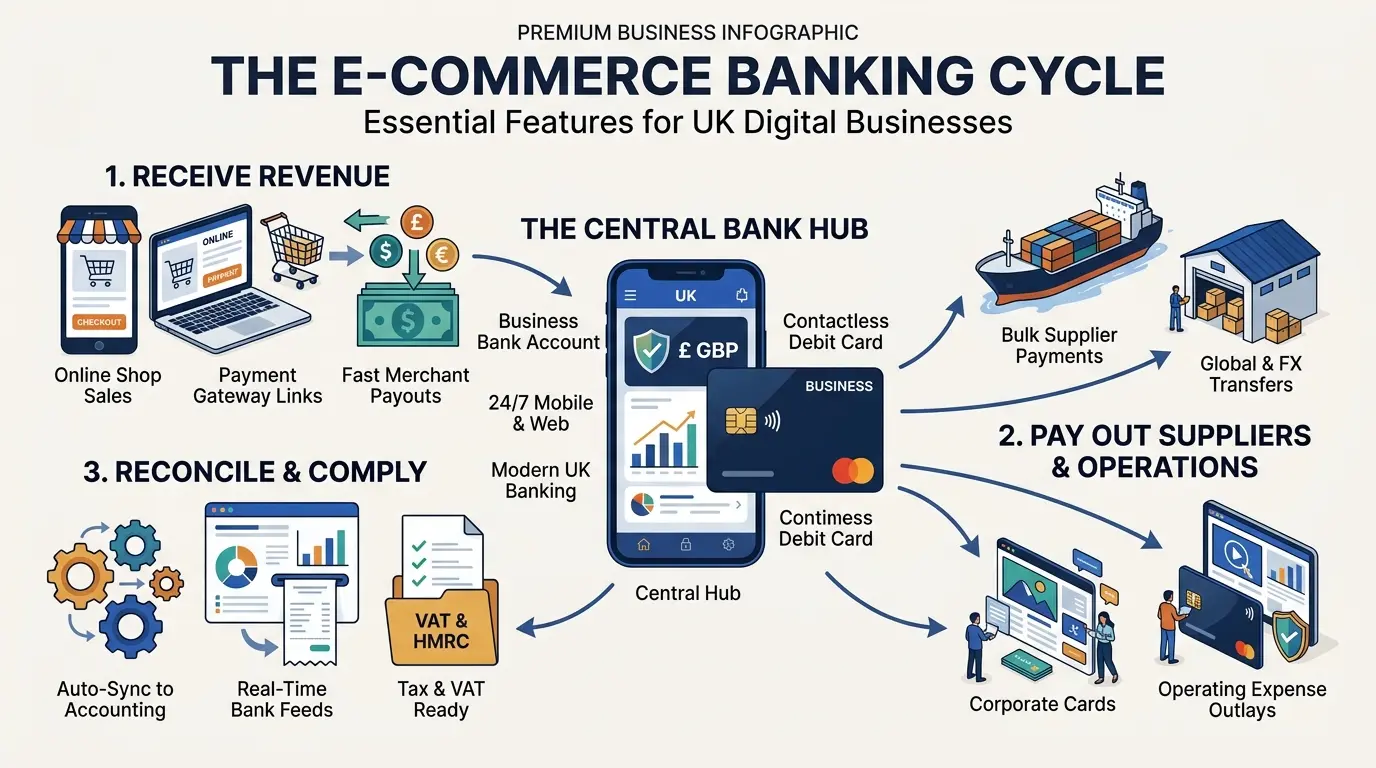
Payment Gateways and Ecommerce Platforms
Your business account is where funds may arrive after being processed by payment providers. Platforms and gateways such as Shopify Payments, Stripe and PayPal for Business have their own onboarding requirements, fees and payout arrangements.
Before choosing an account, check whether the provider supports the payout method you intend to use. Confirm that the account name and business details meet the payment provider’s requirements, and review any restrictions on receiving payments from particular platforms.
A suitable setup should help you:
- Receive payouts from your chosen payment gateways.
- Track deposits against sales reports.
- Reconcile refunds, chargebacks and transaction fees.
- Transfer funds to suppliers and business service providers.
- Maintain clear records for bookkeeping and tax reporting.
An account that receives payments successfully but creates additional reconciliation work may not be the most efficient choice for a growing online store.
Multi-Currency Accounts and Foreign Exchange
Multi-currency functionality is particularly useful when customers pay in one currency and suppliers invoice in another. Depending on the provider, you may be able to hold balances in supported currencies, receive local payments and decide when to convert funds.
For example, a UK ecommerce company selling to customers in Europe and the United States may receive revenue in euros, US dollars and pounds sterling. A suitable international account can help the business manage these balances and compare conversion costs before transferring money.
Compare the exchange rate used, conversion fees, international transfer charges and any limits on receiving or holding foreign currencies. A small difference in the total cost can become significant when transactions occur frequently.
Businesses with substantial overseas payment activity should also read our guide to UK business accounts for international payments.
Marketplace Payouts and Supplier Payments
Marketplace sellers need to understand how each platform sends revenue to their business account. Payout schedules, supported currencies and account-detail requirements can vary by marketplace and seller location.
Before opening an account, check whether it supports the receiving details required by your sales channels. Then compare how easily you can pay manufacturers, wholesalers, fulfilment companies and other overseas suppliers.
A practical account setup should make it straightforward to track:
- Marketplace deposits and settlement reports.
- Supplier invoices and outgoing transfers.
- Refunds and customer disputes.
- Currency conversion costs.
- Operating expenses and available cash.
These records help sellers understand their actual cash position instead of relying solely on gross sales figures.
Accounting Integration and Business Administration
As order volumes grow, manual bookkeeping becomes harder to maintain. An account with suitable accounting integrations, downloadable statements and searchable transaction records can simplify financial administration.
Check whether the provider connects with your accounting software or supports a reliable export process. Also consider whether it offers user permissions, business cards, expense controls and other tools needed by employees or contractors.
If bookkeeping automation is a priority, explore our guide to business bank accounts that integrate with accounting software.
Best Business Bank Account for Ecommerce UK: Pricing and What Is Included
The best business bank account for ecommerce in the UK is not necessarily the one with the lowest monthly fee. The total cost depends on your transaction volume, payment methods, currencies and additional services.
| Cost or feature | What to check |
|---|---|
| Monthly subscription | Whether the account has a free plan, paid plans or a one-off setup fee |
| Domestic payments | Charges for transfers, direct debits and other UK transactions |
| International transfers | Transfer fees, intermediary charges and delivery times |
| Currency conversion | Exchange-rate margin and separate conversion fees |
| Receiving payments | Fees or conditions for receiving local and international funds |
| Business cards | Card costs, spending limits and foreign transaction charges |
| Additional tools | Expense management, accounting integrations and team access |
| Support and protection | Customer support arrangements and applicable safeguarding or deposit-protection rules |
What may be included: Depending on the provider and plan, an account may include business payment details, app-based account management, transfers, payment cards, transaction records, multi-currency features or accounting integrations. These services are not included in every account, so confirm the precise package before applying.
Ecommerce sellers should estimate their typical monthly payment volume and calculate the combined cost of account fees, receiving payments, currency conversion and supplier transfers. This provides a more meaningful comparison than the headline subscription price alone.
Online and Digital Banks vs High-Street Banks
An online business bank account can be convenient for ecommerce sellers who manage their operations remotely. However, the right choice depends on eligibility, the services required and the legal status of the provider.
Online and Digital Business Accounts
Digital providers typically allow customers to complete much of the application and account-management process online. Depending on the provider, their services may include multi-currency balances, international transfers, business cards and integrations.
These features can suit businesses with international customers, remote teams or overseas suppliers. However, digital onboarding does not mean that every applicant will qualify. Providers still conduct identity, company and business-activity checks.
Traditional High-Street Banks
Traditional banks may offer a broader range of established banking services and access to branches. They can be suitable for businesses that meet their eligibility requirements and value in-person support.
For founders who live abroad, the application process can be more difficult if a bank requires UK residency, particular proof-of-address documents or an in-person appointment. Requirements differ between banks, so confirm them before preparing an application.
Is an Online Bank Account Better for Ecommerce?
An online account may be a better fit when remote management, international transfers and currency functionality are central to your operations. A traditional bank may suit a business that qualifies for its services and prioritises branch access or other banking facilities.
Compare the actual features and costs instead of assuming that all digital providers offer the same services or that every high-street bank applies identical eligibility rules.
Accounts for Non-Resident Ecommerce Founders
A founder living outside the UK may operate an ecommerce business through a UK limited company. In this situation, company registration and banking approval are separate processes. Incorporating a company does not automatically guarantee that a provider will open an account.
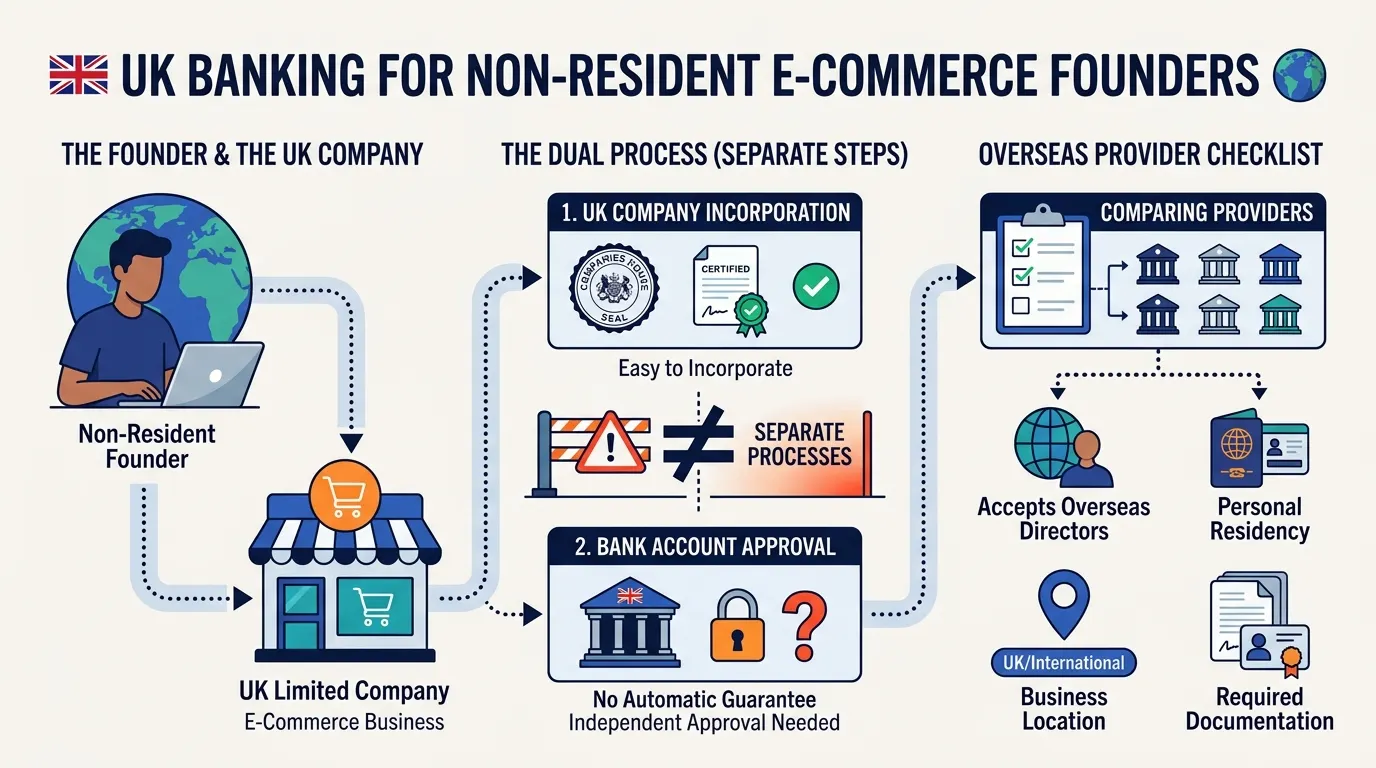
Non-resident founders should compare providers that accept applications from overseas directors and review the personal residency, business-location and documentation requirements carefully.
Can Non-Residents Open a UK Ecommerce Business Account?
Some providers accept applications from eligible overseas founders, while others have residency or address restrictions. Approval depends on the provider’s rules, company details, ownership structure, business activity and verification checks.
The best option for a non-resident seller will depend on where the director lives, where the company operates, which currencies it uses and the products it sells.
For a broader comparison focused on overseas founders, see our guide to the best UK business bank account for non-residents.
What Overseas Directors Should Check
Before applying, confirm whether the provider accepts your country of residence and whether it requires a UK personal address or accepts overseas proof of address. Check its requirements for directors, beneficial owners and the registered company.
You should also confirm that the provider supports your ecommerce business model. Some providers restrict particular product categories or business activities under their acceptable-use policies.
How to Open a Business Bank Account for Ecommerce
Opening an ecommerce business account generally involves choosing an eligible provider, preparing company and identity documents, submitting an application and completing verification. Processing times vary, and an application may require additional information.
Documents and Information Required
Depending on the provider, applicants may need:
- UK company registration details, including the company number.
- Certificate of Incorporation or other company documents.
- Valid photo identification for directors and relevant beneficial owners.
- Proof of residential address, which may need to be from a country accepted by the provider.
- Information about company ownership and business activity.
- Details of expected transaction volumes, currencies and countries served.
- A website, online storefront or marketplace seller profile.
- Information about suppliers, customers and the source of business funds, where requested.
Prepare consistent and accurate information across the application. If the company is newly formed, make sure its business description clearly explains what it sells, how it receives payments and how it pays suppliers.
How Long Does Account Opening Take?
There is no universal approval time. Some applications proceed quickly when all information is complete, while others require further documents or additional compliance checks. International ownership, complex company structures and certain business activities may lead to further review.
Check the provider’s current application guidance and avoid committing to a launch date on the assumption that an account will be approved by a particular day.
How to Choose the Best Ecommerce Business Bank Account
The best ecommerce bank account depends on the way your business earns and spends money. Use the following process to narrow the options.
Choose Based on Your Sales Channels
List the marketplaces, ecommerce platforms and payment gateways you use. Confirm that each provider supports your intended payout arrangements and that its account details meet the relevant requirements.
Compare the Total Cost of Payments
Estimate the monthly value and number of transactions you expect to receive. Include international payments, currency conversions, refunds and supplier transfers in your calculations.
Match the Account to Your Currency Needs
A business selling only in the UK may prioritise GBP transactions and straightforward administration. A cross-border seller may need multiple currency balances, local receiving details and competitive international transfer costs.
Check Eligibility Before Applying
Review the provider’s residency rules, supported jurisdictions, business categories and verification requirements. This is especially important for overseas directors and sellers operating in product categories subject to additional restrictions.
Consider Your Future Requirements
An account that suits a small store may not meet the needs of a business expanding into new markets or adding employees. Consider transaction limits, team access, cards, expense management and reporting tools.
Newly incorporated businesses should also compare their banking needs with our guide to business bank accounts for non-resident startups.
Important: Safeguarding and FSCS Protection
Do not assume that every account marketed as a business account is provided by a licensed bank or carries the same deposit protection.
Eligible deposits held with authorised banks may qualify for protection under the Financial Services Compensation Scheme, subject to the applicable rules and limits. E-money institutions generally safeguard customer funds under the relevant regulatory framework, which is different from FSCS deposit protection.
Before depositing substantial funds, identify the legal provider of the account and check the protection arrangements that apply to your specific product. Where an account is provided through a partner bank, confirm how the arrangement works and whether the relevant protection requirements are met.
Ecommerce businesses should consider both day-to-day payment efficiency and the treatment of funds held in their accounts.
Product Restrictions and Account Suitability
Not every provider accepts every type of ecommerce business. Depending on its policies, a provider may restrict products or activities such as gambling, tobacco, alcohol, weapons, certain pharmaceutical products, cryptocurrency-related services or other higher-risk categories.
Check the current acceptable-use policy before applying. Describe your business accurately and provide clear information about your products, sales channels and expected payment activity. This can help avoid delays caused by an application that does not match the provider’s requirements.
How Form My Company Helps Ecommerce Founders
Form My Company helps entrepreneurs establish UK limited companies and navigate the practical steps involved in setting up a business. For international ecommerce founders, this includes support with company formation and introductions to banking partners that may suit their circumstances.
Our support helps you prepare for the next steps by ensuring you understand the company information commonly required during onboarding. We can also help you explore potential banking options based on your business model and location.
Banking providers conduct their own verification and make their own approval decisions. Company formation or a banking introduction does not guarantee that an account will be opened.
Set Up Your UK Ecommerce Company
Choosing the best business bank account for ecommerce in the UK starts with understanding how your store receives customer payments, manages currencies and pays suppliers. Compare the full cost of operating each account, confirm gateway compatibility and check eligibility before applying.
If you plan to trade through a UK limited company, Form My Company can help with company formation and guide you towards suitable next steps for your business setup.
Start your UK company formation with Form My Company and prepare your ecommerce business for its next stage of growth.
Frequently Asked Questions
What Is the Best Business Bank Account for Ecommerce?
The best account depends on your sales channels, transaction volumes, currencies and eligibility. Wise Business and Airwallex are options to investigate for international payments, while Tide and Starling may suit eligible businesses with UK-focused requirements. Compare current fees and terms before choosing.
What Is the Best Bank Account for an Ecommerce Business in the UK?
There is no single best account for every UK ecommerce business. Compare monthly fees, payment gateway compatibility, marketplace payouts, international transfers, accounting tools and the provider’s eligibility requirements.
Can I Use a Business Account With Shopify, Stripe or PayPal?
An account may receive payouts from Shopify Payments, Stripe or PayPal for Business if the relevant provider supports the account details and the business meets its requirements. Check the current payout rules and make sure the business and account information match.
Do Ecommerce Businesses Need a Multi-Currency Account?
Not always. A business selling exclusively in the UK may operate effectively with a GBP account. Sellers receiving foreign-currency payouts or paying overseas suppliers should compare multi-currency features and the total cost of converting and transferring funds.
Can a Non-Resident Open a UK Business Account for Ecommerce?
Some providers accept eligible non-resident founders, while others impose residency or address requirements. Applicants should confirm supported countries, identity-verification rules and company requirements before applying.
What Documents Do I Need to Open an Ecommerce Business Account?
Common requirements include company registration details, identity documents, proof of address and information about the business, its owners and expected transactions. Exact requirements vary by provider and applicant.
How Much Does an Ecommerce Business Bank Account Cost?
Costs vary by provider and plan. Consider monthly fees, payment charges, international transfer costs, foreign exchange fees and any additional service charges. Compare the estimated total cost based on your expected transaction activity.
Can I Use One Account for Marketplace Payouts and Supplier Payments?
In many cases, an account can receive eligible marketplace payouts and support supplier payments. However, supported currencies, transfer methods and provider restrictions vary. Check the account’s capabilities against the payment requirements of your business.
Does My Product Category Affect My Application?
Yes. Providers may restrict certain products or activities under their acceptable-use policies. Check these policies before applying and ensure your application accurately describes what your ecommerce business sells.
Should a Small Ecommerce Business Have More Than One Account?
Some businesses use one account for routine UK payments and another for international receipts or currency management. Whether this is worthwhile depends on fees, operational complexity, payment needs and the protection arrangements offered by each provider.