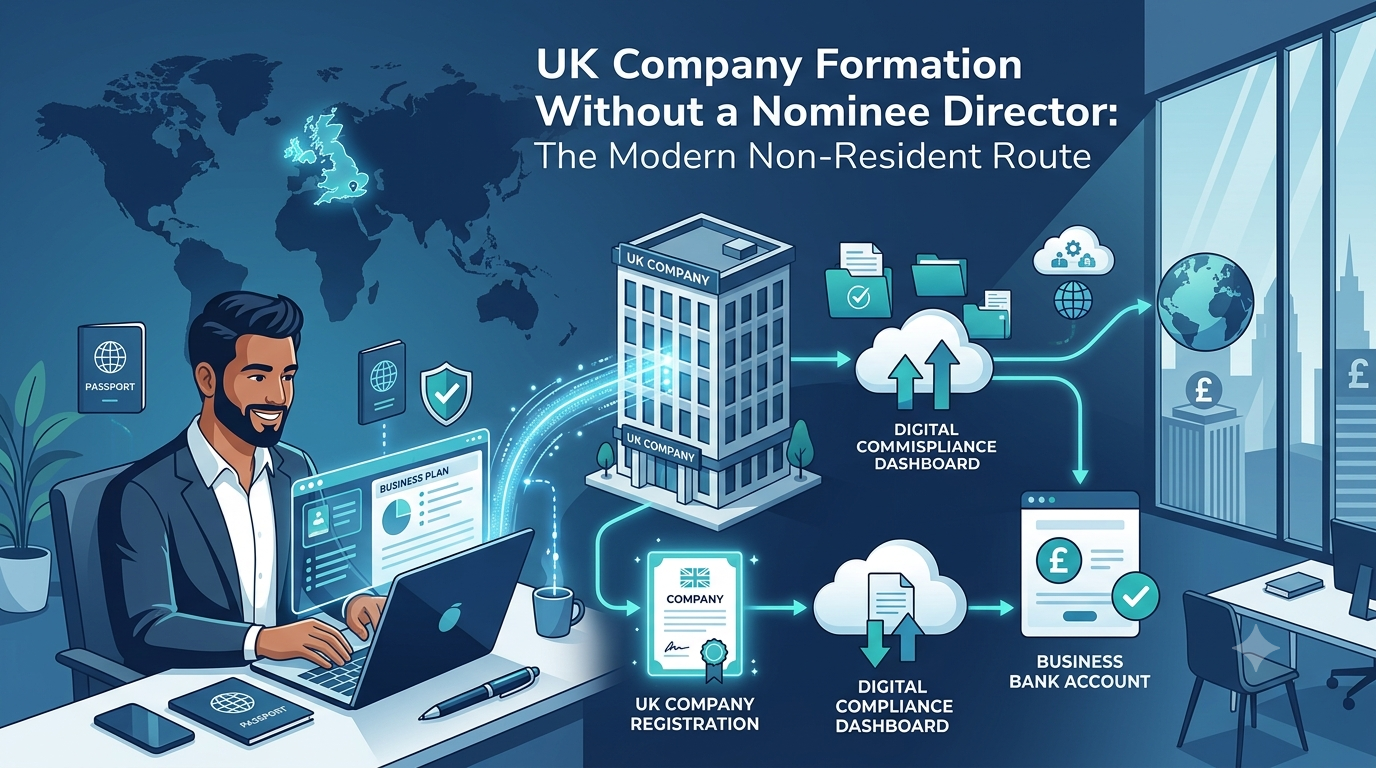
UK Company Formation
If you’re an overseas founder researching how to form a UK company, you may have come across nominee director services being marketed as a way to make it work. In 2026, that advice is largely out of date. UK law places no residency requirement on directors, so you don’t need a nominee. And under the Economic Crime and Corporate Transparency Act (ECCTA), traditional “private” nominee arrangements no longer deliver the privacy they used to. The honest, modern route is to form your UK company yourself, as your own director, with the right supporting services in place. At Form My Company, we help non-resident founders from over 150 countries do exactly that.
This guide explains why you don’t need a nominee director, how to form a UK company directly as a non-resident, and what services actually deliver the privacy and professionalism most founders are looking for.
Why You Don’t Need a Nominee Director as a Non-Resident
The idea that non-residents need a UK-based nominee director to run a UK company is a myth left over from an earlier era. UK law is clear: there is no nationality, residency, or visa requirement for directors of a UK limited company. As a non-resident, you can:
- Be the sole director of your UK company. From anywhere in the world, without a UK-based co-director or partner.
- Own 100% of the shares. No local shareholder is required.
- Run the company entirely remotely. All filings, banking, and operations can be handled online without ever visiting the UK.
The only genuine practical requirement is a UK registered office address (which you can’t provide from abroad yourself, so we include one). Beyond that, everything a nominee arrangement used to solve, non-residents can now handle directly.
What the ECCTA Changed
The Economic Crime and Corporate Transparency Act introduced sweeping reforms that make traditional nominee arrangements largely pointless for legitimate founders:
- Mandatory identity verification. Every director, PSC, and LLP member must verify their identity with Companies House. Nominees are not exempt, and neither are the beneficial owners behind them.
- Shadow director rules. If a beneficial owner directs a nominee from behind the scenes, they can be treated as a shadow director themselves, with the same duties, liabilities, and verification requirement.
- PSC transparency. Anyone owning or controlling 25% or more of a company must be transparently disclosed as a Person with Significant Control.
- Enhanced Companies House powers. Companies House can now query filings, investigate suspicious structures, share intelligence with enforcement, and strike off companies formed on a false basis.
The result is that the traditional privacy promise of a nominee arrangement, keeping the beneficial owner hidden, is effectively gone. What remains is the same full legal liability the nominee always had, plus new personal exposure and cost for both parties. For legitimate non-resident founders, there’s no upside left.
What Non-Residents Actually Want (and How to Get It Directly)
When we look at why non-residents historically considered nominee directors, the underlying needs are almost always one of these three:
- Keeping your home address off the public register. This is the most common concern, and it’s completely legitimate. The right solution is a professional director’s service address, which puts a UK correspondence address on the public register instead of your overseas home address.
- Presenting a professional UK business presence. A UK-based footprint that looks credible to clients, suppliers, and banks. The right solution is a UK registered office address and a UK director’s service address, which give your company a genuine UK presence without needing a nominee.
- Meeting practical requirements like banking or Companies House filings. These have never actually required a UK-resident director. What they need is a properly formed UK company with correct records, which any non-resident can have directly.
Notice the pattern: for every legitimate need a nominee arrangement was supposed to address, there’s a simpler, cheaper, and fully compliant alternative that doesn’t involve giving someone else your directorship.
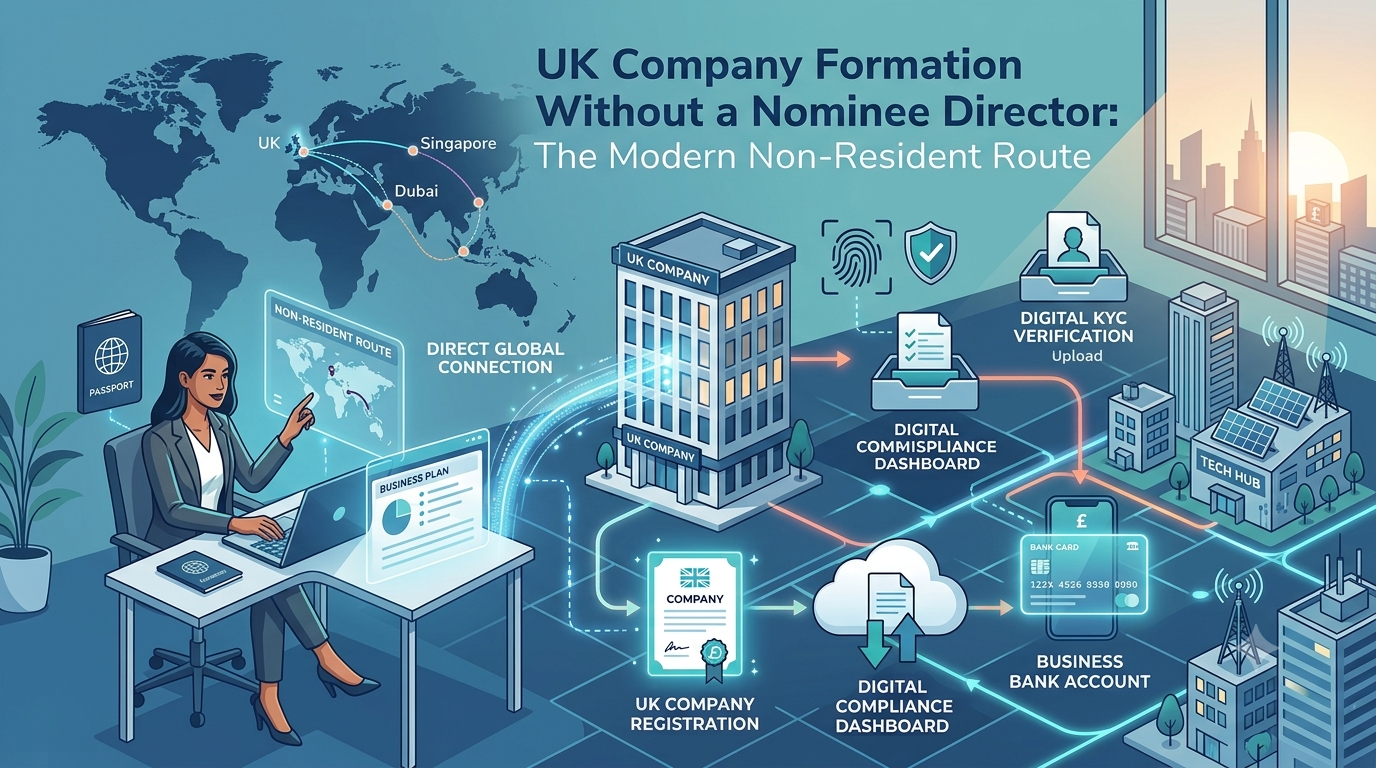
How Non-Residents Form a UK Company Directly in 2026
Forming a UK company as a non-resident, without a nominee, is straightforward when handled properly. With Form My Company, the process is:
Step 1: Choose Your Company Name
Pick a unique name for your business and we’ll instantly check its availability with Companies House.
Step 2: Pick the Non-Residents Package
Our Non-Residents package includes everything overseas founders need to form directly, without any nominee arrangement.
Step 3: Provide Your Details
Give us your details as sole director and shareholder, along with any other members. You act as the actual director on the public register, in your own name.
Step 4: Complete Identity Verification
As an Authorised Corporate Service Provider (ACSP), we handle your ECCTA-required identity verification remotely through our secure platform.
Step 5: We File Your Company
We submit your incorporation to Companies House using our UK registered office address in Bolton BL1 and your director’s service address at the same location. Your Certificate of Incorporation and digital documents are typically issued within hours.
You end up with a fully compliant UK limited company that you own and run entirely, without a nominee, without the risks, and without the ongoing complications.
What’s Included in Our Non-Residents Package
Our Non-Residents package gives you every element that a nominee arrangement was ever meant to solve, and more:
- A ready-to-trade UK limited company
- Companies House filing handled for you
- A compliant UK registered office address in Bolton BL1
- A UK director’s service address to keep your home address off the public register
- Digital Certificate of Incorporation and Memorandum and Articles of Association
- Digital share certificates and company register
- Identity verification (IDV) support as an ACSP
- VAT registration assistance with HMRC where needed
- Business bank account introductions to non-resident-friendly banking partners
- Ongoing compliance help including confirmation statement filing
Everything is delivered digitally, so you’re fully set up wherever you are in the world, and there’s no nominee anywhere in the structure.
The Practical Benefits of Skipping the Nominee Route
Choosing to form directly rather than through a nominee arrangement offers real advantages:
- Full control. You’re the actual director. No one else has legal authority over your company or filings.
- Simpler legal position. You’re the person the law expects to be in charge. No confusion about shadow director status, no complicated indemnity agreements, no third-party dependencies.
- Better banking outcomes. Business banking providers apply strict KYC checks and increasingly look through nominee structures. A clean, direct structure with you as the disclosed director and PSC tends to smooth banking applications rather than raise questions.
- Lower ongoing cost. No annual nominee director fees, no fresh verification each year for a third party, no dependency on someone else’s continued willingness to act.
- No hidden risks. Nominee arrangements can create disputes, unwanted disclosures, or complications if the nominee leaves or your relationship breaks down. Forming directly removes all of that.
- Full compliance under the ECCTA. No exposure to the specific scrutiny that arrangements designed to obscure ownership now attract.
The Privacy You Actually Get with a Direct Formation
Because this is often the main concern, it’s worth being explicit about the privacy you have when you form directly with our Non-Residents package:
- Your home address stays off the public register. Your Bolton BL1 director’s service address appears next to your name instead.
- Your company’s public address is a professional UK location. Your Bolton BL1 registered office, not your home abroad.
- Your name and identity are transparently on the register. This is required by law under the ECCTA in any case, and no nominee arrangement can change that.
- Your residential address is held privately by Companies House. Not publicly viewable unless you choose to use it as either your registered office or service address.
This delivers the privacy that most non-resident founders actually want, keeping their overseas home address off the UK public record, while remaining fully transparent and compliant with UK law.
When (If Ever) a Legitimate Nominee Arrangement Might Fit
To be fair, nominee director arrangements aren’t universally banned. They remain legal in the UK when set up transparently, with the nominee properly verified, the beneficial owner properly declared as a PSC, and a formal nominee agreement in place. For a small number of specific commercial structures (like certain trust arrangements or professional executor roles), they may still have a legitimate place.
But for the vast majority of non-resident founders looking to start and run a UK business, they don’t. What people usually want, privacy, professionalism, and a UK-based appearance, is now delivered better by a direct formation with a service address than by any nominee structure.
Form Your UK Company Directly Today
Non-resident founders no longer need a nominee director to form and run a UK company. UK law doesn’t require it, the ECCTA has removed the old privacy benefits, and the practical needs behind the search are better met by a professional director’s service address and a UK registered office. With Form My Company, forming your UK company directly is quick, transparent, and fully supported, with everything you need to launch and stay compliant in one place. Get started today and take direct ownership of your UK business.
Frequently Asked Questions
Do I need a nominee director to form a UK company as a non-resident?
No. UK law places no residency or nationality requirement on directors. Non-residents can be the sole director and shareholder of a UK limited company, running it entirely from abroad without any nominee arrangement.
Why do people still search for nominee director services?
Historically, nominee arrangements were used for privacy or to give a company a UK-based face. Under the ECCTA, mandatory identity verification and shadow director rules have removed the privacy benefits, so the practical case for a legitimate nominee is largely gone.
How do I get privacy without a nominee?
Use a professional UK director’s service address (which puts a UK correspondence address on the public register instead of your home address) and a UK registered office. Together, these keep your overseas home address off the public record while you remain the actual named director.
Is my UK company less credible without a nominee?
No. A properly formed UK limited company with a compliant UK registered office, a UK director’s service address, and full identity verification looks entirely professional. Banking providers, suppliers, and clients don’t require a UK-resident director to take you seriously.
Do I have to visit the UK to form a company directly?
No. The whole process is completed online. Identity verification, incorporation, and all filings can be handled remotely, with your Certificate of Incorporation issued digitally, often within hours.
Can I still use a nominee director if I want to?
Nominee arrangements remain legal under strict transparency conditions, including full identity verification of the nominee and PSC disclosure of the beneficial owner. For most non-resident founders, though, they no longer deliver a real benefit and add cost and risk.
What if my home country requires me to be a company director for tax reasons?
This is a genuinely individual question. UK company formation itself doesn’t force your directorship one way or the other, but your home country’s rules may. We recommend speaking with a qualified tax adviser in your country of residence before deciding on your structure.