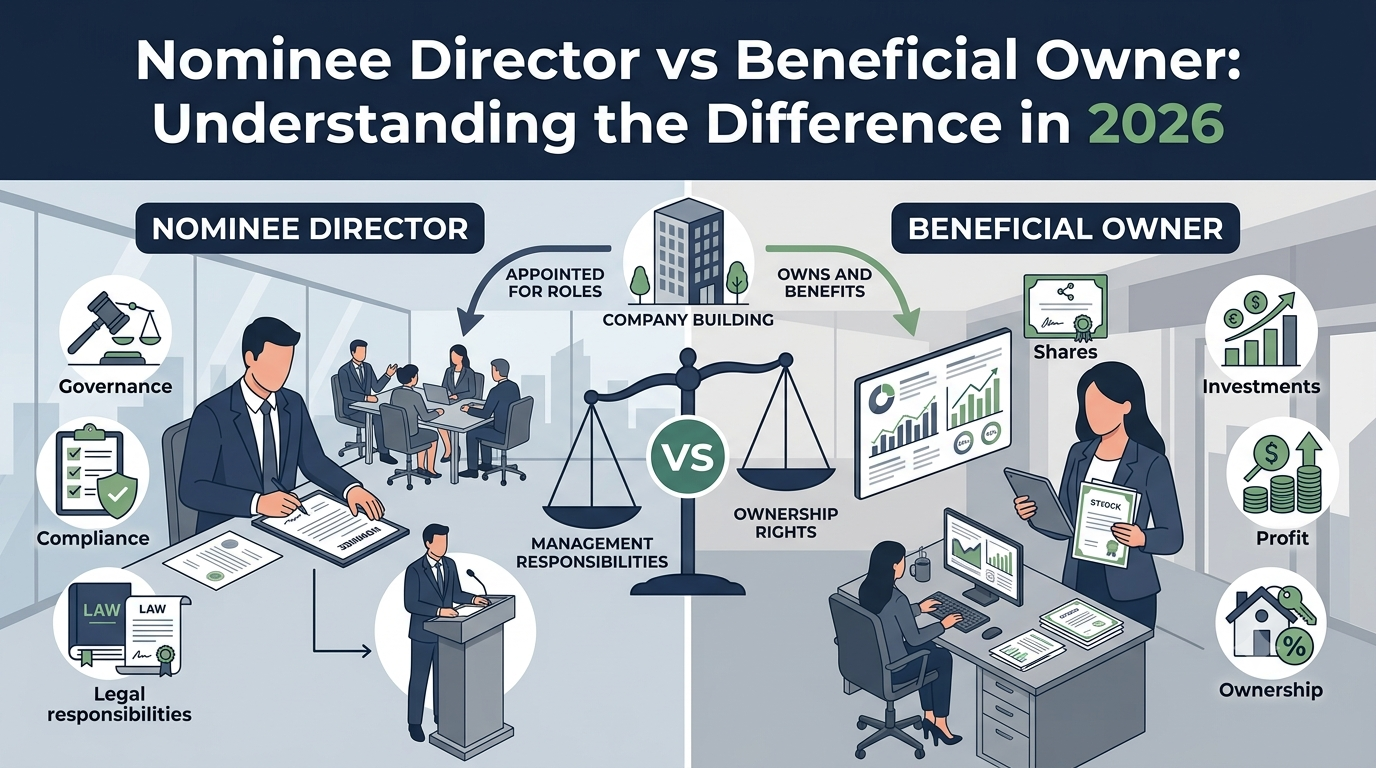
Nominee Director vs Beneficial Owner
The terms “nominee director” and “beneficial owner” often get confused, sometimes deliberately by promoters selling arrangements that don’t work under current UK law. But the distinction matters, both legally and practically, and getting it wrong can expose founders to serious risks. At Form My Company, we help founders understand exactly who’s who in a UK company structure, and we form companies transparently and compliantly under the Economic Crime and Corporate Transparency Act (ECCTA). This guide explains the difference between a nominee director and a beneficial owner, how each is treated under UK law, and what has changed in 2026.
What Is a Nominee Director?
A nominee director is a person who is formally appointed as a director of a company on behalf of someone else, usually the beneficial owner who wants their name kept off the public register. Historically, this was used for privacy or to give an overseas-owned company the appearance of a UK-based director.
Legally, a nominee director:
- Is named on the Companies House public register. Their name, service address, and other required details appear publicly.
- Has all the legal duties of a director. Every director owes duties to the company under the Companies Act 2006, including duties to promote its success, exercise reasonable care and skill, avoid conflicts of interest, and act within the company’s powers. A nominee director has these duties in full, no matter what any private agreement says.
- Is personally liable. If things go wrong (unpaid tax, unlawful trading, breach of duty), the nominee director can be held personally responsible.
- Must complete identity verification under the ECCTA. Just like any other director.
The key point is that in the eyes of the law, a nominee director is a director. The word “nominee” describes the informal relationship, not any reduced legal status.
What Is a Beneficial Owner?
A beneficial owner is the person who actually owns or controls a company, even if their name isn’t the one listed as the shareholder or director. In UK law, the concept is captured through the term Person with Significant Control (PSC).
You’re a PSC if you:
- Hold more than 25% of the company’s shares
- Hold more than 25% of the voting rights
- Have the right to appoint or remove the majority of directors
- Otherwise exercise significant influence or control over the company (or its trustees)
If you’re a PSC, UK law requires you to be declared on the Companies House public register, whether you’re formally named as a shareholder or not. That means even if shares are held through a nominee shareholder, or the company is technically owned by another entity, you must still be disclosed as the ultimate beneficial owner if you meet the PSC test.
The Core Difference
Put simply:
A nominee director is the named person doing the directorship on behalf of someone else. They’re publicly disclosed and legally responsible.
A beneficial owner is the real person who owns or controls the company, whether or not they’re named as director or shareholder. Under UK law, they must be disclosed as a PSC.
The two aren’t alternatives. They’re different roles. In a nominee arrangement, both roles exist: the nominee sits as director, while the beneficial owner sits behind them owning or controlling the shares. Under UK law, both must be declared, not just the visible one.
Why This Distinction Matters More in 2026
Under previous UK company law, nominee director arrangements sometimes did keep beneficial owners quietly out of view, particularly where PSC obligations were under-enforced. The ECCTA has changed this fundamentally:
- Mandatory identity verification. Every director and PSC must verify their identity with Companies House. Both the nominee director and the beneficial owner are covered.
- Shadow director rules. If a beneficial owner is directing the nominee behind the scenes, they may legally be a shadow director themselves, which brings the same duties, liabilities, and verification requirement as any named director.
- PSC transparency. Beneficial ownership disclosure is now actively enforced, with Companies House holding enhanced powers to query filings and investigate structures that appear designed to obscure ownership.
- Failure to prevent fraud offence. Corporate service providers, banks, and other regulated entities have new statutory duties to prevent misuse of corporate structures.
The practical effect is that the nominee director vs beneficial owner distinction is no longer a way to keep the beneficial owner hidden. Both are now disclosed, verified, and legally accountable. Any structure that pretends otherwise is misaligned with current UK law.
Legal Duties Side by Side
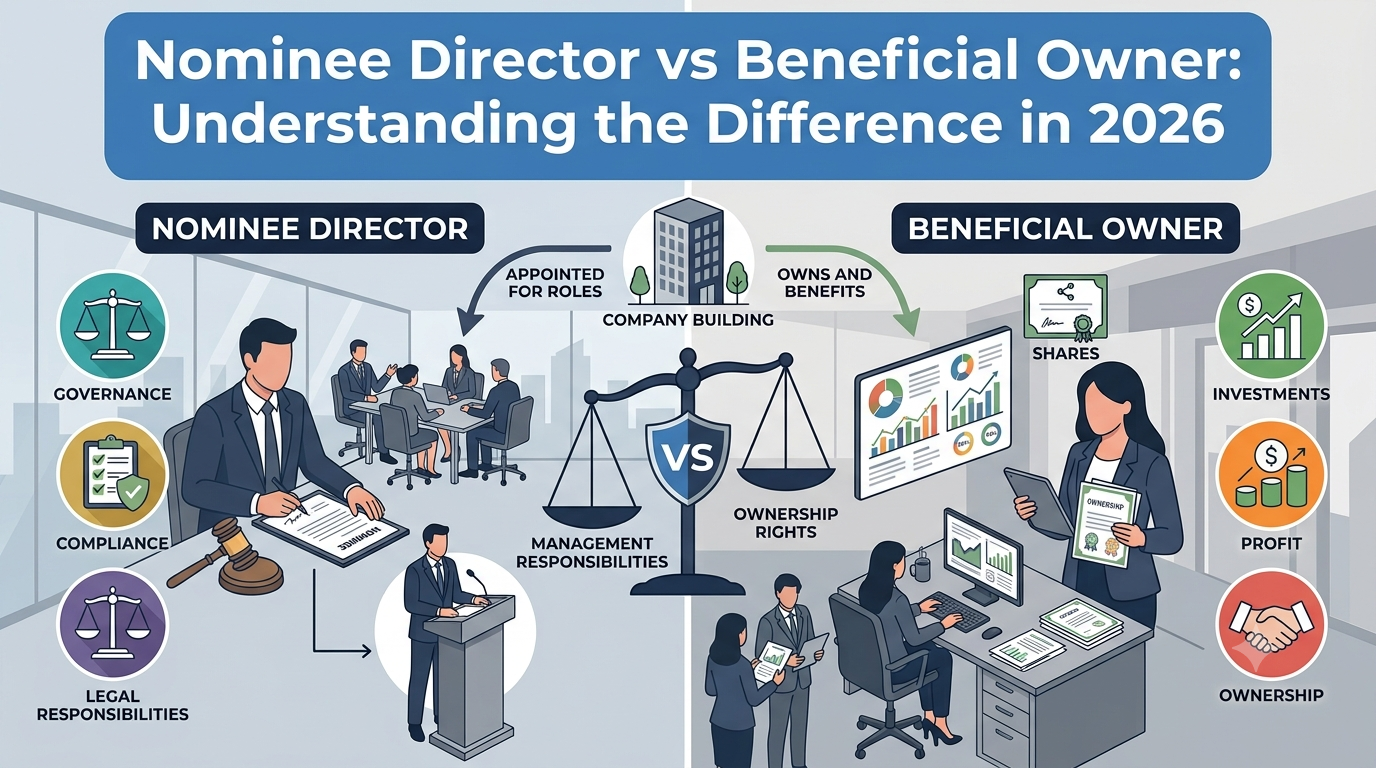
Here’s how the legal position of a nominee director and beneficial owner compare:
- Nominee director’s duties. Full director duties under the Companies Act 2006. Must act in the company’s best interests, not the beneficial owner’s, if they conflict. Personally liable for statutory breaches. Must complete identity verification. Publicly named on the register.
- Beneficial owner’s duties. Must be declared as a PSC if they meet the ownership or control test. Must complete identity verification. If they act as a shadow director, they take on director-level duties and liabilities. Publicly listed on the PSC register.
Notice that the beneficial owner doesn’t escape UK regulation just because they’re not formally named as a director. If they control the company, the law expects transparent disclosure.
What Happens If the Two Roles Conflict?
A common problem with nominee arrangements is that the nominee director and the beneficial owner sometimes have conflicting interests. The Companies Act 2006 is clear on where the nominee’s loyalty should lie: with the company itself, not the beneficial owner.
If a beneficial owner instructs a nominee director to do something that isn’t in the company’s best interests (like paying out funds inappropriately, avoiding compliance obligations, or acting against creditors’ interests), the nominee director is legally required to refuse. If they comply, they can face personal liability, including disqualification. If the beneficial owner effectively forces the decision from behind the scenes, they may be treated as a shadow director and share the liability.
This isn’t a theoretical risk. It’s exactly the kind of scenario Companies House and enforcement bodies now scrutinise.
When Non-Residents Really Don’t Need Either Arrangement
Overseas founders sometimes look at nominee director and beneficial owner questions when researching UK company formation. The good news is that in the vast majority of cases, they don’t need to worry about the split at all. UK law places no residency requirement on directors, so a non-resident can be:
- The sole director of their UK company. No nominee is needed.
- The sole shareholder and PSC. No hidden ownership structure is needed.
- Fully transparent and fully compliant. With their overseas home address kept off the public register via a professional UK director’s service address.
In other words, most non-residents get all the practical benefits (a UK company, professional appearance, privacy on their home address) without the two-role structure a nominee arrangement creates. That’s a cleaner, cheaper, and lower-risk position under the ECCTA.
Practical Privacy That Doesn’t Rely on Nominees
Because privacy is often the underlying reason people research the difference between nominee directors and beneficial owners, it’s worth being clear about what legitimately protects your privacy under current UK law:
- A director’s service address. Puts a UK correspondence address on the public register instead of your home address. Your name still appears (as it must), but your personal home stays off the record.
- A registered office address. Puts a professional UK address as your company’s official address instead of any residential location.
- Address suppression. In some cases, UK reforms let individuals apply to suppress certain personal information from the public register.
None of these involve pretending someone else is running your company. All of them are legitimate privacy tools that comply with the ECCTA in full.
How Form My Company Helps
We help non-resident founders form UK companies transparently and compliantly, without needing nominee arrangements. As an Authorised Corporate Service Provider (ACSP), we handle:
- Fast UK company formation with you as the actual named director
- Compliant UK registered office address in Bolton BL1
- UK director’s service address to keep your home address off the public register
- Identity verification (IDV) support for directors and PSCs under the ECCTA
- Ongoing compliance help including confirmation statements
- Banking partner introductions for non-resident-friendly providers
You end up with a UK company that’s genuinely yours, publicly transparent as the ECCTA requires, and privately protected in exactly the ways UK law allows.
Understand Your Structure and Form Your Company Today
Understanding the difference between a nominee director and a beneficial owner isn’t just legal theory. It shapes how your company is set up, who’s responsible for what, and how you comply with the UK’s transparency rules. In 2026, the honest answer for most non-resident founders is that neither a nominee director nor an obscured beneficial ownership structure is needed. A direct formation with the right privacy services delivers what you actually want, without the legal risk. With Form My Company, getting your UK company set up transparently and compliantly is quick and fully supported. Get started today.
Frequently Asked Questions
What’s the difference between a nominee director and a beneficial owner?
A nominee director is the person formally appointed as director on behalf of someone else, and is publicly named on the Companies House register. A beneficial owner is the person who actually owns or controls the company, and must be disclosed as a Person with Significant Control (PSC).
Can a nominee director hide the beneficial owner?
No, not under current UK law. The ECCTA requires both nominee directors and beneficial owners (PSCs) to be identified, verified, and disclosed on the public register. Attempting to obscure a beneficial owner risks criminal sanctions.
Do beneficial owners have legal duties?
Yes, in several ways. They must be transparently declared as PSCs if they meet the ownership or control test. They must complete identity verification. And if they effectively direct the company from behind the scenes, they can be treated as a shadow director with full director duties and liabilities.
Is a nominee director just a figurehead?
No. In UK law, a nominee director has all the same duties and personal liabilities as any other director under the Companies Act 2006. Private agreements between a nominee and beneficial owner don’t reduce those statutory duties.
Do non-resident founders need a nominee director?
No. UK law places no residency requirement on directors, so non-residents can be the sole director of their own UK company. A director’s service address and registered office solve the practical privacy concerns without a nominee arrangement.
What’s a shadow director and how does it affect beneficial owners?
A shadow director is someone whose instructions the actual directors habitually follow, even without formal appointment. Beneficial owners who direct their nominee from behind the scenes may be classified as shadow directors, with the same duties, liabilities, and identity verification requirements.
How do I set up a UK company transparently as a non-resident?
Form your company directly as the named sole director and shareholder, use a UK director’s service address and registered office address to protect your home address privacy, and complete identity verification through an ACSP like Form My Company. This gives you a fully compliant setup without any nominee arrangement.