Company Secretarial Service
Company secretarial services have evolved significantly over the past two decades. Since 2008, most private limited companies haven’t been required to have a named Company Secretary, but the underlying statutory compliance work company secretaries traditionally handled is more important than ever, particularly under the Economic Crime and Corporate Transparency Act (ECCTA). Modern company secretarial services focus on ongoing statutory compliance, Companies House filings, statutory registers, identity verification support, and coordination with wider legal and tax obligations. At Form My Company, we provide company secretarial support as an Authorised Corporate Service Provider (ACSP). This guide explains what UK company secretarial services actually involve in 2026 and how to choose the right support for your business.
What Is a Company Secretarial Service?
A company secretarial service handles the ongoing statutory compliance and administration for a UK company. Traditionally, this was done by a named Company Secretary appointed as an officer of the company, alongside directors. Today, for private limited companies, this role is optional, but the underlying work still needs to be done.
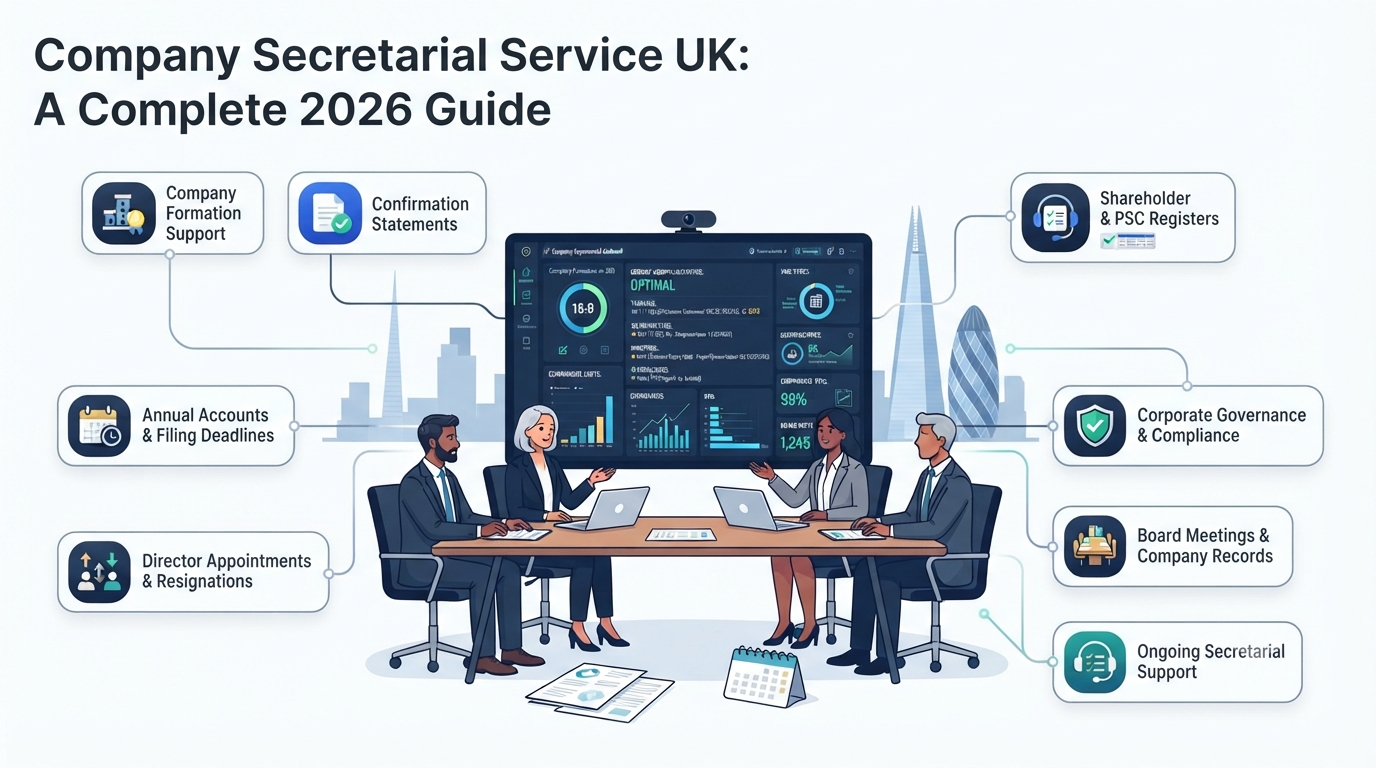
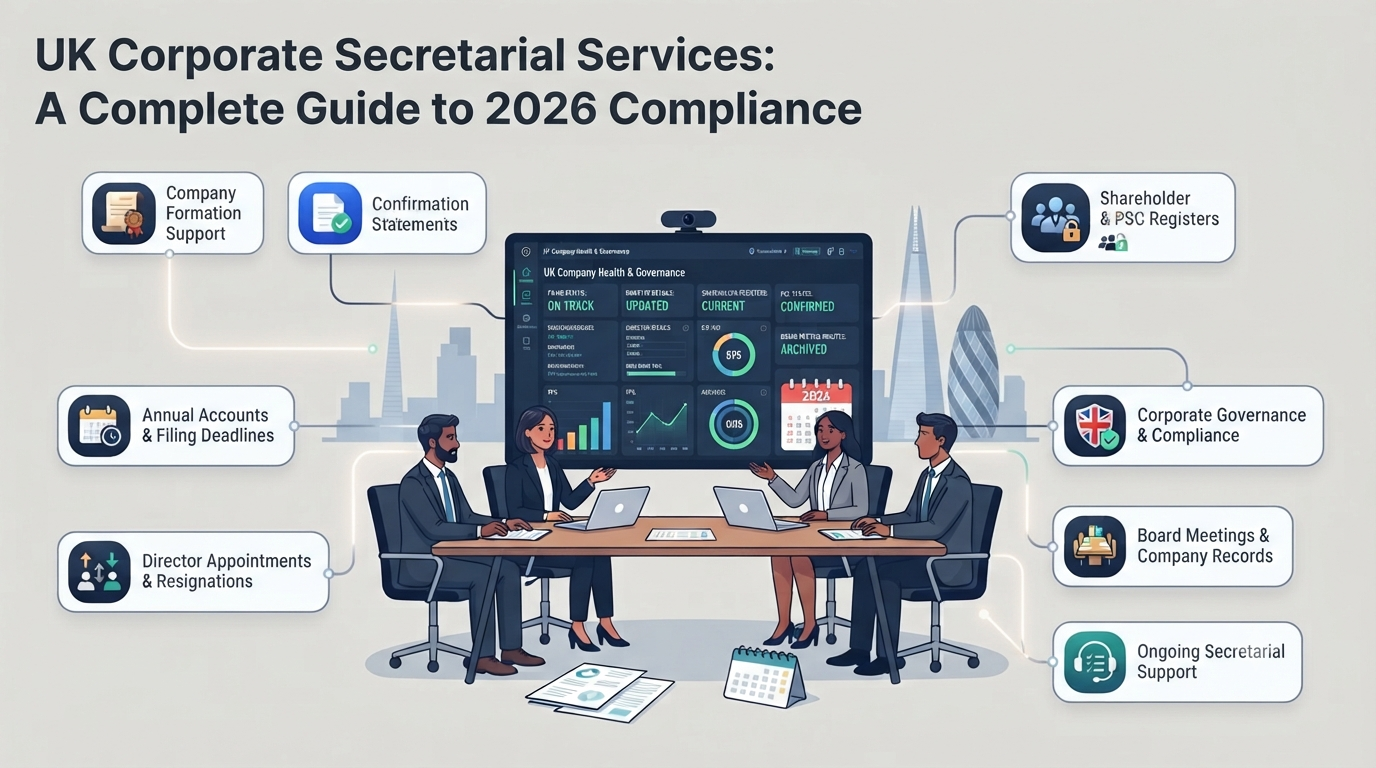
Modern company secretarial services typically cover:
- Companies House filings. Confirmation statements, director changes, PSC updates, registered office changes, and other statutory submissions.
- Statutory registers. Keeping the company’s internal registers of members, directors, PSCs, and other required records up to date.
- Identity verification support. Under the ECCTA, coordinating identity verification for directors, PSCs, and LLP members.
- Companies House correspondence. Handling routine correspondence and queries from Companies House.
- Meeting compliance calendars. Tracking deadlines and ensuring timely filings.
- Coordination with other advisers. Working alongside accountants, tax advisers, and solicitors on statutory matters.
- Ongoing corporate governance support. Board meeting documentation, resolutions, and internal processes.
- Registered office and service address. Often provided as part of the service.
- Ad hoc filings. For special resolutions, share transfers, name changes, and other events.
- AML compliance for regulated services. Where applicable to specific business types.
For most modern private limited companies, this is what a company secretarial service actually means. The named Company Secretary role is optional, but the compliance work is essential.
Who Legally Needs a Company Secretary?
The law distinguishes between different types of UK company:
- Private limited companies (Ltd). Since April 2008, private limited companies have NOT been required to appoint a Company Secretary. This applies to the vast majority of UK small and medium businesses.
- Public limited companies (PLC). Are required to appoint a Company Secretary, and there are specific qualification requirements for PLC Company Secretaries.
- Some regulated companies. Certain sectors (like insurance) may have specific requirements.
- LLPs and other structures. Have different rules that don’t typically require a Company Secretary.
For most modern UK small businesses, the choice is whether to voluntarily appoint a Company Secretary. Most don’t, instead using a company secretarial service to handle the compliance work.
What Modern Company Secretarial Services Actually Cover
Given most private limited companies don’t have a named Company Secretary, what does a modern service provide?
Annual Compliance
- Confirmation statement. Annual filing with Companies House confirming company details. Includes the £50 digital filing fee and coordination of any needed updates.
- Annual accounts filing. Coordinating with your accountant for annual accounts submission to Companies House. Not filed by company secretarial services themselves (that’s an accountant’s role), but coordinated for timing and consistency.
- Statutory register updates. Keeping the register of members, directors, PSCs, and other statutory records current.
- Corporation Tax coordination. Working alongside accountants for CT600 filing timing.
Event-Driven Filings
- Director changes. Appointments (AP01), resignations (TM01), and detail updates (CH01).
- PSC changes. Updates when Persons with Significant Control change.
- Registered office changes. Filing address changes with Companies House.
- Company name changes. Special resolutions, filings, and name change certificates.
- Share allotments and transfers. Coordinating share issuances, transfers, and related filings.
- Special resolutions. Filing special resolutions with Companies House.
ECCTA and Identity Verification
- Director identity verification. Coordinating IDV for new and existing directors.
- PSC identity verification. Including the birth-month deadline for existing PSCs.
- LLP member verification. For LLP structures.
- ACSP filing coordination. Under the ECCTA framework.
Corporate Governance Support
- Board meeting documentation. Minutes, agendas, and resolutions.
- Written resolutions. For decisions taken outside board meetings.
- Shareholder communications. Annual general meeting documentation and shareholder resolutions.
- Corporate seal. Where used, maintenance and use protocols.
- Company records. Ongoing maintenance of statutory records.
Address and Correspondence Services
- Registered office address. UK address for the company’s official register listing.
- Director’s service address. UK address for individual directors, keeping home addresses off the public register.
- Mail handling. Receiving and forwarding statutory correspondence.
- Companies House correspondence. Handling routine queries and correspondence.
Specialised Services
- Share certificate management. Issuing and maintaining share certificates.
- Register maintenance. For companies with more complex share structures.
- Overseas coordination. For non-resident directors and PSCs.
- Group company coordination. For businesses with multiple UK entities.
Modern company secretarial services often bundle these into packages or offer specific services on an ad hoc basis.
Company Secretarial Service vs Traditional Company Secretary
Understanding the difference matters:
Traditional Company Secretary. A named officer appointed to the company, with legal duties and often listed on Companies House. Required for PLCs, optional for private limited companies.
Modern company secretarial service. A service provider handling the same compliance work, but without necessarily being named as an officer. The company itself and its directors remain legally responsible for compliance, with the service provider handling the work.
The practical outcome is often the same (compliance handled correctly), but the legal structure differs. A service provider isn’t personally an officer of the company. Directors retain responsibility.
For most modern UK small businesses, the service provider approach offers:
- More flexibility. Change providers if needed without changing officers.
- Often lower cost. Compared to a named Company Secretary with formal appointment.
- Broader expertise. Service providers often have specialist knowledge across compliance areas.
- No personal appointment risk. Directors don’t need to worry about finding someone willing to be named as an officer.
The named Company Secretary approach can still make sense for PLCs, larger companies, and situations where a formal named role is preferred.
Company Secretarial Services for Non-Resident Owners
For non-resident owners of UK companies, company secretarial services are often essential:
- No UK presence to handle correspondence. Without a UK-based person, statutory correspondence goes unhandled without service provider support.
- Companies House deadlines are strict. Missing filings has real consequences (penalties, strike-off risk, criminal offences for directors).
- Time zones and language. Working directly with Companies House from abroad is often impractical.
- Multiple obligations to coordinate. Confirmation statements, PSC updates, identity verification, and other compliance need coordination.
- Higher stakes. Non-resident owners often can’t easily attend to compliance issues themselves.
- ECCTA identity verification. For directors and PSCs abroad, identity verification support from an ACSP is often essential.
For non-resident owners of UK companies, using a company secretarial service is more or less standard practice rather than optional.
What to Look For in a Company Secretarial Service
Not every provider is equal. Key factors:
- Range of services. Does the provider handle everything you need, or only some elements?
- ACSP status. Under the ECCTA, ACSP status matters for identity verification and Companies House filing efficiency.
- Experience with your situation. UK-based small businesses, non-resident owners, and specialist sectors have different needs.
- Fee structure. Clear pricing without surprise costs.
- Communication. Especially important for non-resident owners.
- Proactive deadline tracking. Good providers reach out ahead of deadlines rather than expecting you to remember.
- Coordination with your other advisers. Working alongside accountants and solicitors.
- Track record. Reviews, references, and reputation.
- Bundled services. Often better value than piecing services together.
- Ongoing multi-year support. For continuity rather than one-off filings.
- Sector expertise. Where your business is in a specific industry with specific compliance needs.
- Response times. Especially for non-resident owners across time zones.
The right provider depends on your specific situation. Match the provider’s strengths to your needs.
Costs of Company Secretarial Services
Costs vary significantly by provider and scope. Typical ranges:
- Basic annual compliance package. £150 to £500 per year, covering confirmation statement and basic filings.
- Comprehensive annual service. £300 to £1,000 per year, including confirmation statement, statutory register updates, ad hoc filings, and coordination.
- Registered office services. £50 to £200 per year, often included in packages.
- Director’s service address. £50 to £150 per year per director, often included in packages.
- Identity verification. Often included in ACSP services, or £30 to £100 per verification.
- Ad hoc filings. Individual filings (director changes, name changes) often £30 to £150 each.
- Larger companies or specialist sectors. Higher amounts, potentially retainer-based.
- Bundled with formation. New companies often get discounted first-year secretarial services.
The right price depends on the scope you need. Understand what’s included before signing up.
Common Mistakes to Avoid
A few issues come up regularly:
- Assuming you need a named Company Secretary. Most private limited companies don’t, but many people think they do.
- Choosing on price alone. Cheap providers may miss deadlines, provide poor communication, or leave gaps in coverage.
- Not checking ACSP status. Since November 2025, working with an ACSP matters for identity verification and Companies House efficiency.
- Piecing services together from multiple providers. Coordination burden and higher total cost.
- Missing deadlines. Companies House filing penalties compound.
- Not updating statutory registers. Internal registers matter alongside Companies House filings.
- Overlooking identity verification. For directors and PSCs, this is now a legal requirement.
- Not integrating with your accountant. Company secretarial work coordinates with tax filings.
- Choosing based on marketing rather than substance. Look at what’s actually included, not just promises.
- Underestimating ongoing compliance workload. Small companies often think secretarial services are simple. The workload adds up over time.
Getting professional advice before choosing a provider helps avoid these issues.
The ACSP Advantage
Since November 2025, working with an Authorised Corporate Service Provider (ACSP) matters more than it used to:
- Access to identity verification. ACSPs can complete Companies House identity verification. Non-ACSPs cannot.
- Direct filing authority. ACSPs have established Companies House filing relationships.
- Regulatory oversight. Operating under UK anti-money-laundering supervision.
- Failure to Prevent Fraud compliance. ACSPs operate within the ECCTA framework.
- Bundled services. ACSPs typically offer comprehensive packages combining formation, secretarial, address, and identity verification services.
- Audit trail. ACSP filings come with clear records useful for compliance.
For UK companies with ongoing compliance needs, working with an ACSP for company secretarial services is often more efficient and reliable than non-ACSP alternatives.
When You Might Not Need a Service
Company secretarial services aren’t universal. You might handle it yourself if:
- You’re the only director and shareholder. Simple company structure with minimal compliance.
- You’re confident with Companies House processes. WebFiling is manageable for straightforward filings.
- You have time to track deadlines. And a reliable system for reminders.
- You have wider tax and legal support already. An accountant or solicitor handling wider compliance may reduce the need for separate secretarial services.
- Your company is dormant. Less compliance workload means less need for professional support.
- Cost is a primary concern. For a truly simple company, DIY may be manageable.
For growing companies, non-resident owners, or businesses with more complex needs, professional secretarial services typically make sense.
How Form My Company Helps
We provide UK company secretarial services as an Authorised Corporate Service Provider (ACSP). We can:
- Handle ongoing annual compliance. Confirmation statements, statutory register maintenance, and Companies House coordination.
- Manage event-driven filings. Director changes, PSC updates, share issuances, and other statutory events.
- Support identity verification. For directors and PSCs under the ECCTA.
- Provide registered office and service addresses. UK addresses for compliance and privacy.
- Coordinate with your accountant. For consistency across statutory filings and tax compliance.
- Support non-resident owners. With remote coordination for UK companies run from abroad.
- Handle ad hoc filings. For special resolutions, name changes, and other events.
- Bundle services in packages. Our Non-Residents package brings together formation, secretarial support, registered office, service address, and identity verification.
- Provide multi-year support. For continuity rather than one-off filings.
For UK businesses that want compliance handled professionally, we provide the ongoing support that keeps companies running smoothly.
Get Professional Company Secretarial Support Today
UK company secretarial services have evolved from a required officer role to an ongoing compliance support service. For most modern private limited companies, this means finding a reliable ACSP that handles Companies House filings, statutory registers, identity verification, and ongoing compliance efficiently. With Form My Company, comprehensive company secretarial support is straightforward and fully supported. Get in touch today and let us keep your UK company compliant while you focus on your business.
Frequently Asked Questions
Do I need a Company Secretary for my UK limited company?
Not for private limited companies. Since April 2008, private limited companies have not been required to appoint a Company Secretary. Public limited companies (PLCs) still require one. Most modern small businesses use a company secretarial service instead of appointing a named Company Secretary.
What does a company secretarial service actually do?
Handles ongoing statutory compliance for your UK company, including Companies House filings (confirmation statement, director changes, PSC updates), statutory register maintenance, identity verification support, and coordination with wider advisers. Can include registered office and service address provision.
How much does a company secretarial service cost?
Typically £150 to £500 per year for basic annual compliance, £300 to £1,000 per year for comprehensive service, depending on the provider and scope. Bundled services often offer better value than piecing services together.
What’s the difference between a Company Secretary and a company secretarial service?
A Company Secretary is a named officer of the company with legal duties. A company secretarial service is a provider handling the same compliance work without necessarily being a named officer. The company and its directors retain legal responsibility.
Do I need company secretarial services if I’m a non-resident owner?
Almost always yes. Non-resident owners typically need professional secretarial support to handle Companies House correspondence, meet filing deadlines, and coordinate compliance from abroad. Working with an ACSP that provides comprehensive services is usually essential.
Why does ACSP status matter for company secretarial services?
Since November 2025, Authorised Corporate Service Providers (ACSPs) are the regulated route for Companies House identity verification and can efficiently handle filings. Using an ACSP for secretarial services ensures identity verification, filings, and compliance coordination all happen through one regulated provider.
Can Form My Company handle my company’s secretarial work?
Yes. As an ACSP, we handle comprehensive UK company secretarial services including confirmation statements, statutory register maintenance, director changes, PSC updates, identity verification, registered office, and coordination with your accountant. We support both UK-based and non-resident owners.