

Incomplete statutory documentation exposes UK firms to severe legal penalties, personal director liability, immediate financial fines from Companies House, and heightened exposure to corporate identity theft. Failing to maintain required registers and statutory filings invalidates corporate actions and severely undermines operational legitimacy.
What Is Statutory Documentation and Why Is It Mandatory?
Statutory documentation comprises the official registers, legal filings, and structural records that every UK company must maintain under the Companies Act 2006. These records prove legal ownership, corporate governance structure, regulatory compliance, and official operational status.
UK legal frameworks mandate that every registered entity maintains accurate, up-to-date records at its registered office address or a designated Single Alternative Inspection Location (SAIL). Statutory files include the Register of Members, Register of Directors, Register of People with Significant Control (PSC), and minutes of general and board meetings. The Companies Act 2006 imposes a strict legal duty on corporate officers to keep these registers accurate at all times.
Filing records with Companies House does not replace the legal requirement to maintain internal statutory registers. Public filings reflect public records, but internal statutory books act as the primary legal evidence of ownership and governance. When a conflict arises regarding shareholder status or directorship, legal authorities and UK courts rely on internal statutory registers over external public indexes. Maintaining these documents ensures operational transparency and validates all executive decision-making.
What Financial and Legal Penalties Arise from Missing Records?
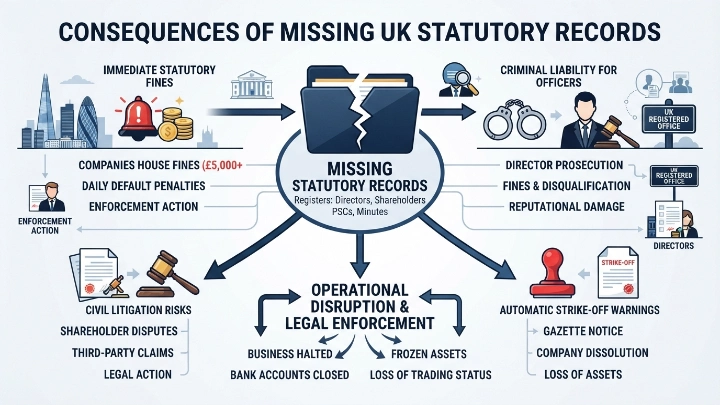
Missing statutory records trigger immediate statutory fines, criminal liability for company officers, civil litigation risks, and automatic strike-off warnings from Companies House. Statutory non-compliance results in persistent operational disruption and severe legal enforcement actions.
Under the Companies Act 2006, failing to maintain statutory registers constitutes a criminal offence committed by both the company and every officer in default. Financial penalties stack rapidly; basic failure to maintain accurate PSC registers results in unlimited fine structures for officers. Companies House issues fixed financial penalties for late annual confirmation statements and statutory account submissions, compounding daily until resolved.
Persistent statutory default leads directly to compulsory strike-off proceedings. The Registrar of Companies initiates strike-off action when statutory filings lapse, threatening full dissolution of the business entity. Dissolution automatically vests company assets in the Crown under bona vacantia rules, freezing corporate bank accounts instantly. Resolving a compulsory strike-off requires costly High Court restoration orders, triggering thousands of pounds in legal overheads.
How Does Incomplete Documentation Heighten Corporate Fraud Risks?
Incomplete statutory files leave administrative vulnerabilities that fraudsters exploit to execute unauthorized directorship changes, corporate identity theft, and fraudulent debt acquisition. Outdated documentation blocks rapid detection of malicious public register modifications.
Criminal syndicates frequently target UK entities displaying irregular filing histories or outdated statutory books. Fraudsters submit forged filing forms to Companies House, changing registered office addresses and replacing legitimate directors with fictional entities or stolen identities. If an entity fails to maintain internal statutory registers continuously, internal teams fail to notice unauthorized public register updates until significant damage occurs.
Corporate hijacking enables unauthorized parties to secure commercial loans, order high-value inventory, and drain corporate assets using the company’s established credit rating. When internal books are incomplete, proving legitimate directorship to banks and law enforcement requires lengthy legal proceedings. Securing proactive Fraud Protection monitors regulatory records continuously, mitigating unauthorized modifications before financial liabilities accumulate.
How Do Flawed Statutory Records Disrupt Mergers and Investments?
Flawed statutory records stall institutional investment, delay commercial due diligence, reduce company valuation, and abort corporate acquisitions entirely. Institutional investors reject transactions when legal ownership cannot be definitively verified through compliant books.
During corporate transactions, buyer legal teams conduct rigorous due diligence on statutory registers. If share transfer certificates, allotment documentation, or member registers display gaps, legal ownership of the target company remains uncertain. Investors cannot confirm whether current equity holders legally own their shares. Resolving missing historic share documentation requires executing expensive rectification applications under Section 125 of the Companies Act 2006.
When statutory records contradict public filings, acquiring entities halt negotiations or apply heavy valuation discounts to offset legal exposure. Missing board minutes or unrecorded share issuances invalidate past corporate actions, including dividend distributions and constitutional amendments. Companies aiming to scale must systematically audit and standardize their governance structures prior to entering capital raising rounds.
How Can UK Businesses Maintain Full Statutory Compliance?
UK businesses maintain statutory compliance by executing routine record audits, digitizing registers, automating annual return filings, and integrating active register monitoring tools. Systematic compliance routines eliminate human oversight and secure legal registers against regulatory enforcement.
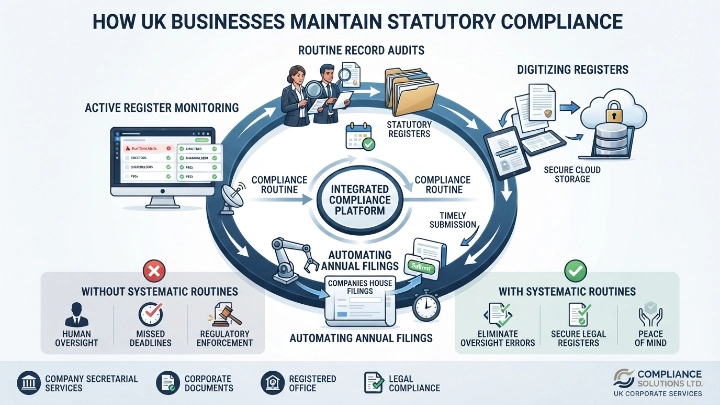
Establishing a robust governance protocol requires setting up specific registers immediately upon incorporation. Every UK corporate entity must keep and update six primary statutory records continuously:
Register of Members: Records exact equity allocations, share class details, and legal membership dates.
Register of Directors: Details full legal names, service addresses, business occupations, and appointment dates.
Register of Director Residential Addresses: Secures private residential data from public disclosure while fulfilling regulatory requirements.
Register of Secretaries: Documents appointed corporate secretaries and their official representation details.
Register of People with Significant Control (PSC): Tracks individuals exercising over 25% voting rights or ultimate operational control.
Register of Charges: Details corporate encumbrances, debentures, and legal mortgages secured against company assets.
Executing systematic quarterly compliance reviews prevents internal records from diverging from actual operational structures. When directors change residential addresses or shareholders transfer equity, administrators must update internal statutory registers before submitting mandatory regulatory filings. Reviewing Statutory Documentation: Essential Files Every UK Business Must Maintain provides clear operational guidelines for structuring compliant corporate governance frameworks across growing organizations.
Form My Company provides comprehensive secretarial infrastructure, registry auditing services, and legal compliance software designed to eliminate regulatory default risks. Implementing automated compliance tracking allows directors to focus on core operational growth while maintaining flawless statutory standing. Businesses looking to protect their brand and corporate standing can Standardise Your Company Records with Form My Company Solutions to secure structural integrity across all corporate entities.
Explore our Fraud Protection guide,
Transparency Rules: Managing Your PSC Register During Business Changes
How to Verify Your Company’s Standing with Official UK Records
Frequently Asked Questions
How does company fraud protection prevent corporate identity theft in the UK?
Company fraud protection safeguards UK businesses by continuously monitoring Companies House filings for unauthorized changes to director details or registered office addresses. Services provided by Form My Company instantly alert directors to suspicious activity, allowing rapid intervention before fraudulent loans or contracts are secured. This proactive oversight prevents corporate hijacking and preserves a business’s legal and financial standing.
What are the main signs that a company’s legal records have been compromised?
Unexplained modifications to registered office addresses, sudden appointments of unknown directors, or unexpected rejection of statutory filings often indicate compromised corporate records. Discrepancies between internal statutory books and public records on Companies House also point to potential administrative tampering. Enrolling in Form My Company’s corporate fraud protection ensures any unauthorized statutory alteration is flagged in real time.
Why is monitoring Companies House registers essential for UK business owners?
Because Companies House operates on a good-faith filing model, fraudulent submissions modifying company leadership or share structures can be registered without initial identity verification. Continuous register monitoring acts as a vital security layer, identifying unauthorized public updates immediately. Business owners rely on Form My Company fraud protection solutions to maintain control over their official corporate profile and prevent identity theft.
How do fraudulent directorship changes impact a business?
Unauthorized directorship changes allow bad actors to open fraudulent bank accounts, secure commercial credit lines, and order high-value goods using an established company’s credit rating. Resolving corporate identity fraud requires costly legal rectification and disrupts daily commercial operations. Deploying dedicated fraud protection through Form My Company mitigates these severe financial liabilities by stopping administrative hijacking at the filing stage.
Can registered UK companies lock their public records against unauthorized updates?
UK companies can protect their corporate filings by enrolling in electronic filing safeguards like the Companies House Protected Online Filing (PROOF) scheme alongside dedicated registry monitoring. These tools reject paper-based statutory updates, ensuring only authenticated electronic submissions from authorized corporate officers are accepted. Form My Company integrates robust fraud protection mechanisms to streamline register security and ensure comprehensive legal compliance for UK firms.