
Every UK business must maintain statutory registers, including directors, shareholders, and Persons with Significant Control (PSC). Companies must also keep accounting records, register of charges, meeting minutes, and incorporate documents at their registered office or Accessible Record Location to comply with the Companies Act 2006.
Which Statutory Registers Are Mandatory Under the UK Companies Act 2006?
UK companies must maintain registers of directors, director residential addresses, secretaries, shareholders, and Persons with Significant Control (PSC). The Companies Act 2006 mandates keeping these records updated and accessible for public inspection at the registered office or an official inspection location.
The Companies Act 2006 obliges every private limited company in the United Kingdom to create and maintain specific statutory books from the day of incorporation. These registers document the legal ownership, governance structure, and administrative officers of the corporate entity. Directors hold the legal responsibility for ensuring these files remain accurate and reflect all recent corporate changes. Failing to maintain accurate registers constitutes a criminal offence, exposing company officers to automatic fines and potential prosecution by regulatory bodies.
The register of directors records full legal names, service addresses, nationalities, dates of birth, and occupations of all appointed board members. A separate register of directors’ residential addresses must also exist, though this document remains protected from public disclosure to safeguard personal privacy. Companies that appoint a corporate secretary must maintain a register of secretaries detailing their official details. Each record must reflect appointments, resignations, or changes in particulars within 14 days of the event occurring.
The register of members details shareholder identities, the number and class of shares held, and the exact date each member entered or ceased membership. Share transfers or new issuances become legally binding only when entered into this register, making it the legal proof of ownership rather than share certificates. Additionally, companies must maintain a PSC register identifying individuals or entities holding more than 25% of voting rights or capital. Businesses can evaluate their wider corporate obligations by reviewing The Risks of Incomplete Statutory Documentation for UK Firms.
How Must UK Companies Store and Preserve Accounting Records?
Companies must retain all accounting records, invoices, receipts, and bank statements for a minimum of six years for private limited entities. Records must disclose the financial position accurately and show all daily receipts, expenditure transactions, and underlying tax calculation documentation.
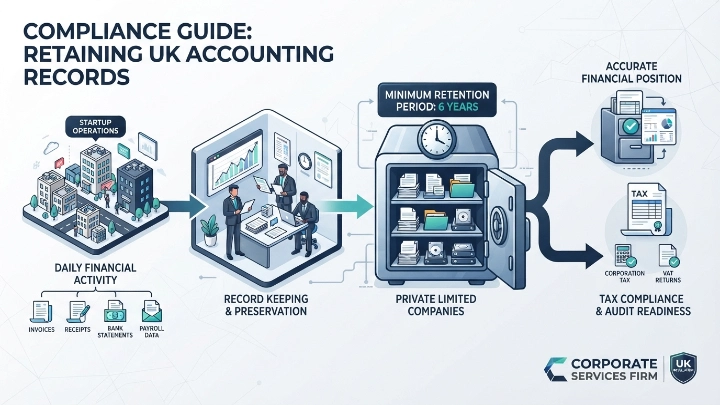
Financial compliance requires companies to preserve structured accounts detailing every financial transaction completed during each financial year. The law requires private entities to preserve these financial records for at least six years from the date of creation, while public limited companies must retain them for six years minimum. Directors must store these documents at the company registered office or at an alternative location designated for official inspection by HM Revenue and Customs (HMRC) inspectors.
Accounting documentation includes underlying financial assets such as sales invoices, supplier receipts, credit notes, wage records, and bank statements. The files must enable directors to prepare true and fair financial statements that comply with UK Generally Accepted Accounting Practice (UK GAAP) or International Financial Reporting Standards (IFRS). Failure to preserve adequate financial records leaves company officers liable to a monetary fine up to £3,000 or prosecution under tax evasion prevention frameworks.
Modern corporate governance permits businesses to store accounting records digitally provided the electronic system guarantees security, auditability, and immediate retrieval upon official request. Digital archives must prevent unauthorised modification and maintain backup redundancy across secure servers. When companies manage digital operational files, evaluating complete governance structures helps executives Standardise Your Company Records with Form My Company Solutions.
What Information Must Be Included in the PSC Register?
The Persons with Significant Control (PSC) register must detail individuals holding over 25% of shares or voting rights, control over board appointments, or significant influence. Entries require legal names, service addresses, birth dates, nationality, tax residency, and exact ownership percentages.
The PSC framework operates as a mandatory transparency protocol designed to expose beneficial ownership behind legal corporate structures operating within the UK. Companies must take proactive, reasonable steps to identify individuals who possess ultimate control over corporate decision-making or share capital distribution. Directors must issue official inquiry notices to suspected beneficial owners and record all dynamic changes promptly to keep corporate filings accurate.
Five specific criteria determine whether an individual or legal entity qualifies as a registrable Person with Significant Control:
Holding more than 25% of company shares directly or indirectly
Holding more than 25% of total voting rights within the business
Holding the right to appoint or remove the majority of board directors
Exercising the right to exert significant influence or operational control over company activities
Exercising significant influence over the activities of a trust or firm that controls the corporate entity
The register must include the individual’s full legal name, service address, country of residence, nationality, date of birth, and the specific date they acquired control status. The PSC register cannot remain blank; if a business completes steps and finds no registrable persons, it must record official statutory statements explaining that status.
How Do Board Minutes and General Meeting Resolutions Safeguard Compliance?
Companies must record and preserve written minutes of all board meetings, shareholder general meetings, and written resolutions for at least ten years. These documents prove legal corporate decision-making, director approval thresholds, shareholder voting outcomes, and structural changes.
Board meeting minutes serve as the formal legal record of corporate governance decisions made by appointed company directors. The Companies Act 2006 mandates that businesses retain these written records for a minimum duration of ten years from the meeting date. Properly executed minutes record the date, time, physical or digital location, attendees present, and specific board resolutions passed during executive deliberations.
General meeting minutes document shareholder decisions, including annual general meetings and extraordinary general meetings. They capture formal resolutions that dictate major structural decisions, such as altering articles of association, approving director contracts, or authorizing new share allotments. Maintaining clear resolution archives protects companies during corporate audits, contract disputes, investor due diligence procedures, and regulatory checks by statutory authorities.
Corporate governance frameworks require distinct categories of resolutions depending on the business action:
| Resolution Type | Voting Threshold Required | Purpose & Statutory Requirement |
| Ordinary Resolution | Simple Majority (>50%) | Routine business decisions, appointing directors, approving dividend payments. |
| Special Resolution | Qualified Majority (≥75%) | Structural modifications, changing company name, amending Articles of Association. |
| Written Resolution | Majority or 75% | Decisions passed by eligible members without holding a physical general meeting. |
Why Is Maintaining a Register of Charges Critical for Corporate Security?
Companies must record all fixed and floating charges, mortgages, debentures, and financial encumbrances created against corporate assets. Maintaining an internal register of charges protects creditor priorities, prevents asset duplication, and ensures accurate financial reporting during audits.
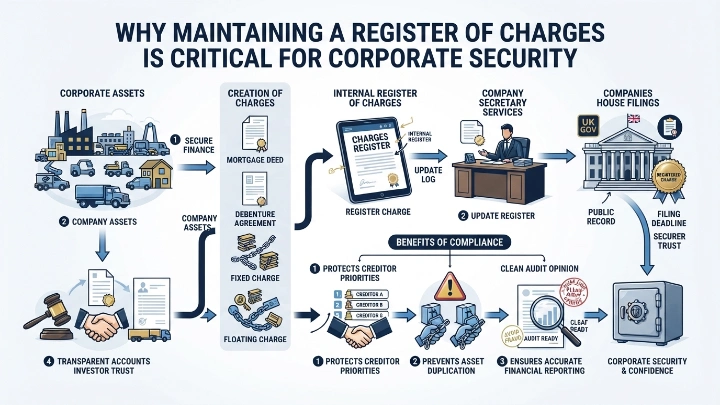
A charge represents a legal security interest granted by a company to a lender or creditor over company assets, securing loans or financial obligations. When a business creates a charge, it must register the instrument with Companies House within 21 days of creation. Maintaining an accurate internal register of charges ensures that prospective lenders and commercial partners possess full visibility regarding encumbered company assets.
Failing to register a security charge within the mandatory 21-day statutory window renders the charge void against liquidators, administrators, and competing creditors. This failure makes the underlying debt immediately payable upon demand, creating severe liquidity challenges for company operations. Furthermore, corporate officers face financial penalties for failing to keep internal records aligned with public registry filings.
Maintaining a comprehensive charge register also protects companies against fraudulent encumbrance attempts. Unauthorized third parties may attempt to register fraudulent charges against company assets to extract capital or compromise corporate credit ratings. Implementing proactive corporate surveillance through Fraud Protection services enables directors to detect unverified registration filings immediately and protect corporate solvency.
How Should Companies Handle Corporate Changes and Statutory Filings?
Companies must notify Companies House of operational modifications using specific statutory forms within statutory timeframes ranging from 14 to 28 days. Mandatory notifications include director appointments, registered office address moves, share allotments, and articles amendments.
Corporate maintenance requires ongoing communication with the UK central registrar to maintain public record accuracy. When structural alterations occur within a business, directors must submit designated statutory notices to Companies House alongside updated internal registers. Missing statutory filing deadlines triggers automatic financial penalties, public compliance warnings, or strike-off proceedings against the business entity.
Key compliance filings demand strict adherence to legal notice periods:
Submit Form AP01 within 14 days of appointing a new company director
Submit Form TM01 within 14 days of terminating a director appointment
Submit Form AD01 within 14 days of changing the registered office address
Submit Form PSC01 within 14 days of updating Person with Significant Control details
Submit Form SH01 within 28 days of allotting new share capital to members
Alongside event-driven notifications, every company must submit an annual Confirmation Statement (Form CS01) to verify that recorded public information remains accurate. The Confirmation Statement must be filed at least once every 12 months, even if no corporate changes occurred during the operational reporting period.
What Are the Legal Penalties for Failing to Maintain Statutory Records?
Failing to maintain required statutory records results in criminal liability for company officers, civil fines up to £5,000, and potential director disqualification. Regulatory non-compliance can also cause compulsory strike-off action by Companies House and reputational damage.
The UK legal framework treats failure to maintain statutory books as an offence committed by both the company and its individual officers. Section 113 of the Companies Act 2006 establishes that directors who default on record-keeping duties face daily criminal fines for ongoing non-compliance. Regulatory authorities view persistent failure as proof of corporate negligence, exposing directors to personal civil and criminal liabilities.
Beyond monetary fines, Companies House possesses statutory powers to initiate compulsory strike-off proceedings against non-compliant entities. If a company fails to file annual confirmation statements or financial accounts, the registrar publishes notice of intent to dissolve the business and seize assets as bona vacantia. Dissolution revokes the legal trading status of the business and terminates corporate limited liability protections for owners.
Commercial consequences often exceed formal regulatory fines when statutory documentation falls out of compliance. Financial institutions routine conduct compliance audits before approving business bank accounts, commercial credit lines, or corporate loans. Missing statutory registers, outdated share records, or unrecorded PSC details interrupt commercial transactions, halt corporate sales acquisitions, and destroy institutional investor confidence. Form My Company assists UK firms by auditing corporate documentation structures and implementing standardized compliance solutions.
Explore our Fraud Protection guide,
Business Continuity: How Secure Documentation Prevents Corporate Fraud
PSC Reporting: Common Mistakes and How to Avoid Them
Frequently Asked Questions
What Is Corporate Identity Theft in the UK Business Sector?
Corporate identity theft occurs when unauthorized individuals manipulate official filings at Companies House to change director details, registered addresses, or business credentials. Fraudsters use falsified public register information to secure unauthorized loans, open fraudulent bank accounts, and order goods on corporate credit lines. Form My Company provides proactive identity protection tools that continuously monitor public database entries to block fraudulent register modifications.
How Does Form My Company Protect Businesses From Fraudulent Record Alterations?
Form My Company links directly to the Companies House database to deliver automated real-time alerts whenever a filing is submitted against your company number. The system tracks pending statutory alterations, including director appointments, share transfers, and address updates, allowing directors to spot unauthorized changes instantly. This instant detection allows business owners to stop corporate hijacking and alert regulatory authorities before financial damage occurs.
Why Is Real-Time Companies House Monitoring Necessary for UK Firms?
Companies House operates on a good-faith processing model that often accepts and publishes digital filings before verifying the submitting party’s authorization. Unmonitored businesses may go months without realizing bad actors have changed their registered office address or management details. Activating real-time monitoring via Form My Company fills this security gap by providing 24/7 digital surveillance over public corporate registers.
Can Existing Companies Register for Form My Company Fraud Protection?
Yes, any active UK Limited Company or Limited Liability Partnership (LLP) can enroll in Form My Company fraud protection regardless of where or when it was formed. The onboarding process syncs your existing Company Registration Number with secure tracking software and verifies director identities. Once configured, the platform maintains continuous record surveillance without requiring changes to your current registered office.
What Actions Should Directors Take If Unauthorized Company Alterations Occur?
Directors must immediately report unauthorized corporate filings to Companies House and Action Fraud to initiate legal rectification proceedings. Form My Company fraud protection alerts provide instant evidentiary records of fraudulent submissions to accelerate dispute resolution. Prompt detection prevents fraudulent actors from using compromised company credentials to contract debt or divert official mail.